

Joseph Hurard (1887-1956) Landscape Of The Alpilles
Artist: Joseph Hurard (1887-1956)
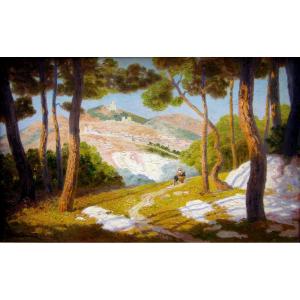
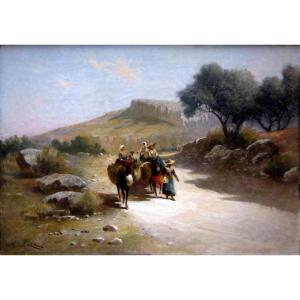
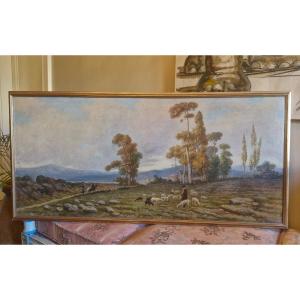
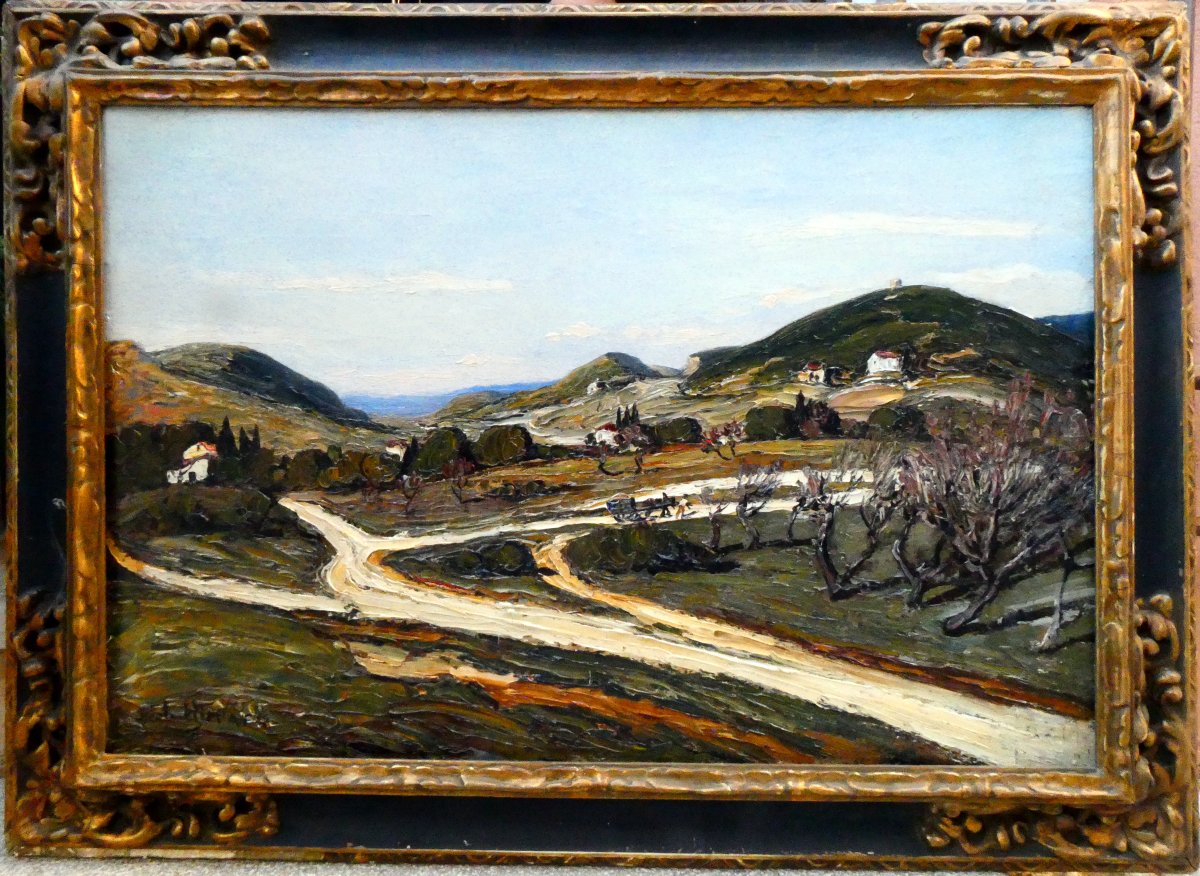
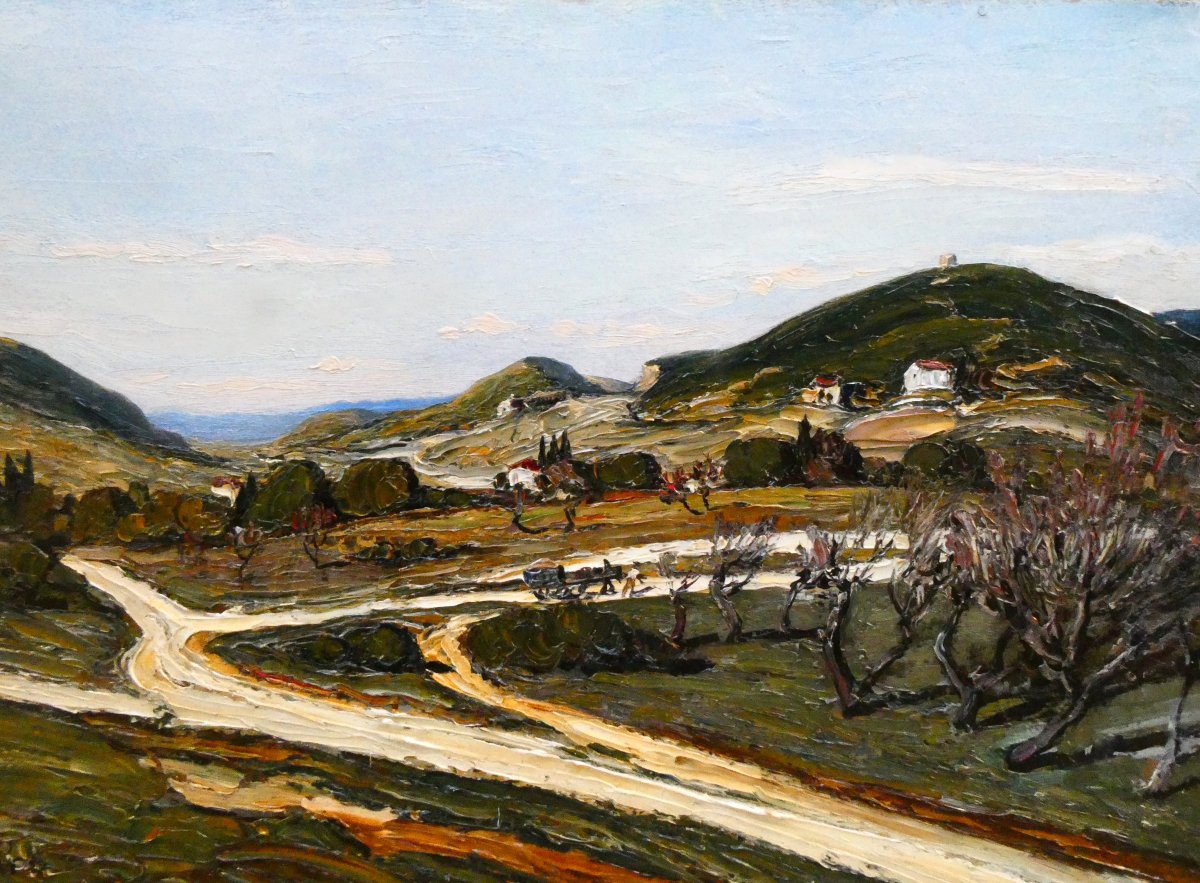
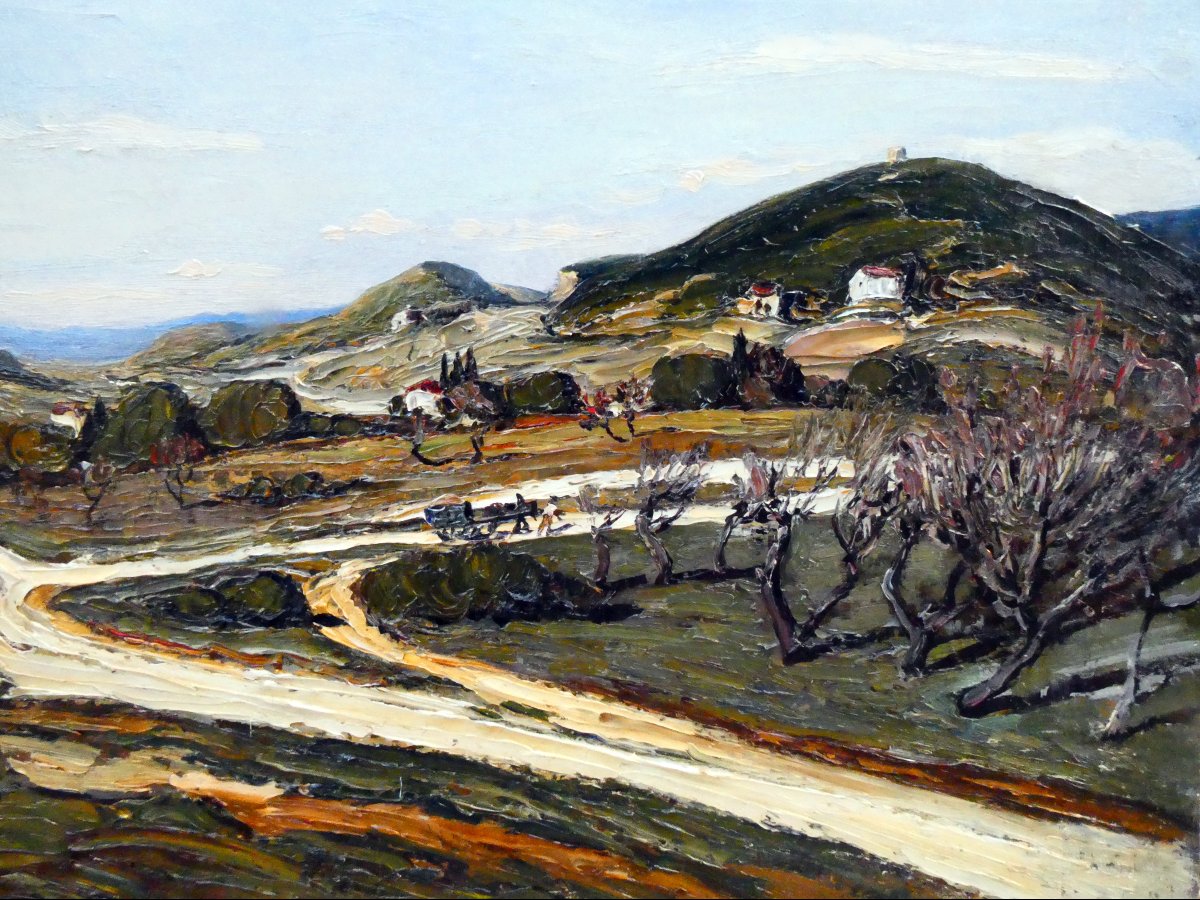
A generous material applied by broad brushstrokes and spatulas for this work which represents a hilly landscape animated by a character walking on a path, his cart and his horse at his side.
Warm and intense colors add depth to this rural scene and give this work the somewhat dramatic dimension of the peasant condition at the beginning of the 20th century that we find in the films of Marcel Pagnol and the novels of Jean Giono.
The work is an oil on cardboard presented in a beautiful Empire frame which measures 72 cm by 98 cm, and 54 cm by 81 cm for the painting alone.
In good condition, it is signed lower left.
A painting certainly produced in the Alpilles where the artist, a member of the Group of 13 (the School of Avignon), had his habits.
Born in Avignon in 1887, he first worked in a drugstore.
Selling canvases and colors to Avignon artists, he met them on Sundays to paint with them.
His talent noted, he was part of the "Group of Thirteen" created in 1912 by Clément Brun, of which he was the youngest.
He became friends with Joseph Meissonnier and participated with the group in a first exhibition on December 21, 1912, which was a great success, followed by a second exhibition on December 18, 1913, which was also the last of the Group.
In this melting pot, he frequented elders already touched by fame like Lina Bill or Auguste Chabaud. Among the most gifted draftsmen of his generation, painting with disconcerting ease, he quickly made a name for himself.
Unfortunately, Hurard did not go to study at the Beaux-Arts, which we can regret because he would likely have been one of the greatest painters of his time.
He died in Martigues in 1956.
Exhibition at the Société Nationale des Beaux-Arts,
Paris Exhibition at the Salon des Indépendants, Paris Retrospective in Martigues in 1956
Works in the Public Collections
Calvet Museum in Avignon
Ziem Museum in Martigues
Regards de Provence Foundation in Marseille
Warm and intense colors add depth to this rural scene and give this work the somewhat dramatic dimension of the peasant condition at the beginning of the 20th century that we find in the films of Marcel Pagnol and the novels of Jean Giono.
The work is an oil on cardboard presented in a beautiful Empire frame which measures 72 cm by 98 cm, and 54 cm by 81 cm for the painting alone.
In good condition, it is signed lower left.
A painting certainly produced in the Alpilles where the artist, a member of the Group of 13 (the School of Avignon), had his habits.
Born in Avignon in 1887, he first worked in a drugstore.
Selling canvases and colors to Avignon artists, he met them on Sundays to paint with them.
His talent noted, he was part of the "Group of Thirteen" created in 1912 by Clément Brun, of which he was the youngest.
He became friends with Joseph Meissonnier and participated with the group in a first exhibition on December 21, 1912, which was a great success, followed by a second exhibition on December 18, 1913, which was also the last of the Group.
In this melting pot, he frequented elders already touched by fame like Lina Bill or Auguste Chabaud. Among the most gifted draftsmen of his generation, painting with disconcerting ease, he quickly made a name for himself.
Unfortunately, Hurard did not go to study at the Beaux-Arts, which we can regret because he would likely have been one of the greatest painters of his time.
He died in Martigues in 1956.
Exhibition at the Société Nationale des Beaux-Arts,
Paris Exhibition at the Salon des Indépendants, Paris Retrospective in Martigues in 1956
Works in the Public Collections
Calvet Museum in Avignon
Ziem Museum in Martigues
Regards de Provence Foundation in Marseille
2 000 €
Period: 20th century
Style: Other Style
Condition: Good condition
Material: Oil painting on cardboard
Length: 81 cm
Height: 54 cm
Reference (ID): 1636239
Availability: In stock
Print