


Still Life With A Garland Of Flowers And Fruit, Aniello Ascione (naples, Documented From 1680 To 1708)
Artist: Aniello Ascione (naples, C. 1680 - 1708) Avec Expertise Professeur Stefano Causa (université De Naples)
Aniello Ascione (Naples, documented from 1680 to 1708)
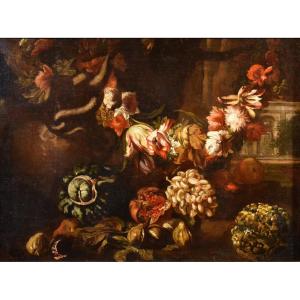
Still Life with a Garland of Flowers and Fruit
Oil on canvas,
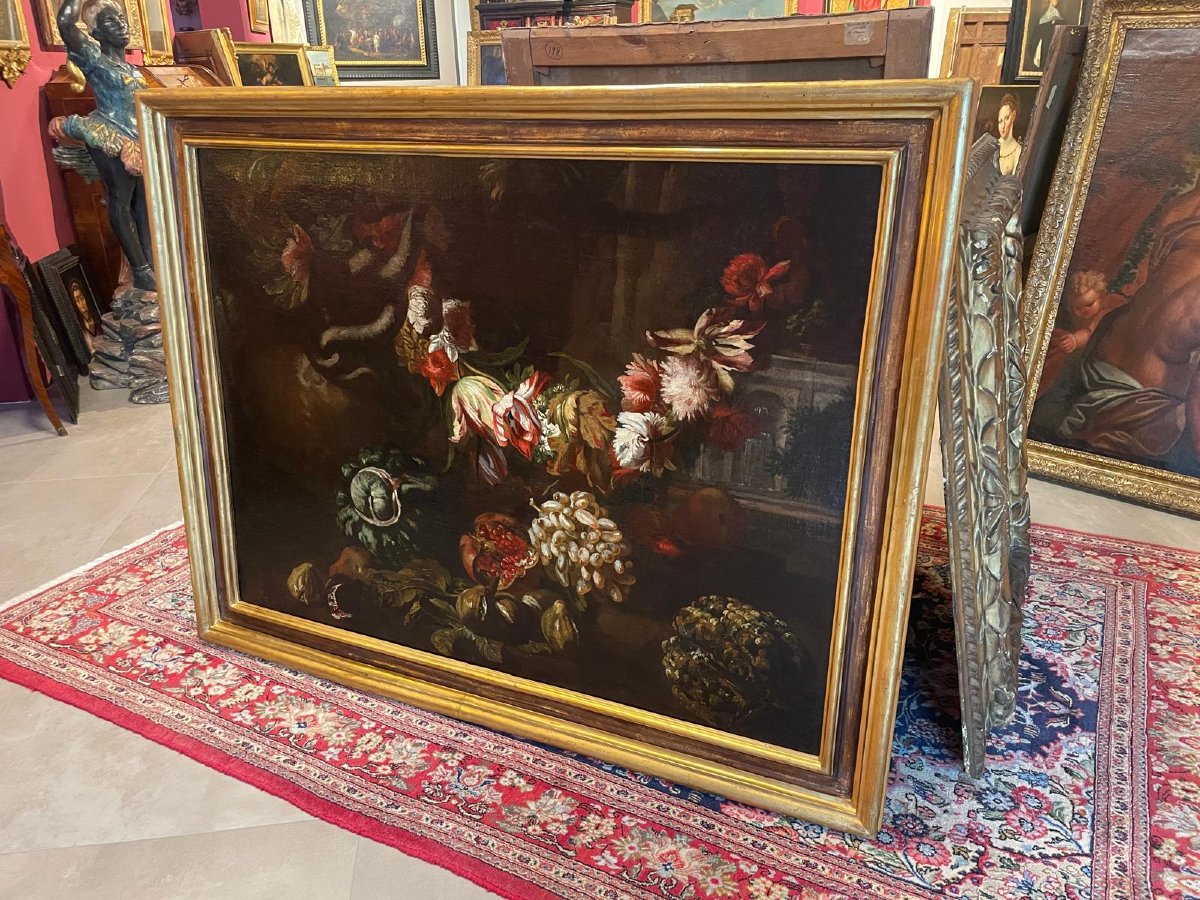
89 x 117 cm – framed 104 x 132 cm.
With an expert appraisal and attribution study by Prof. Stefano Causa (University of Naples)
For full details, click HERE
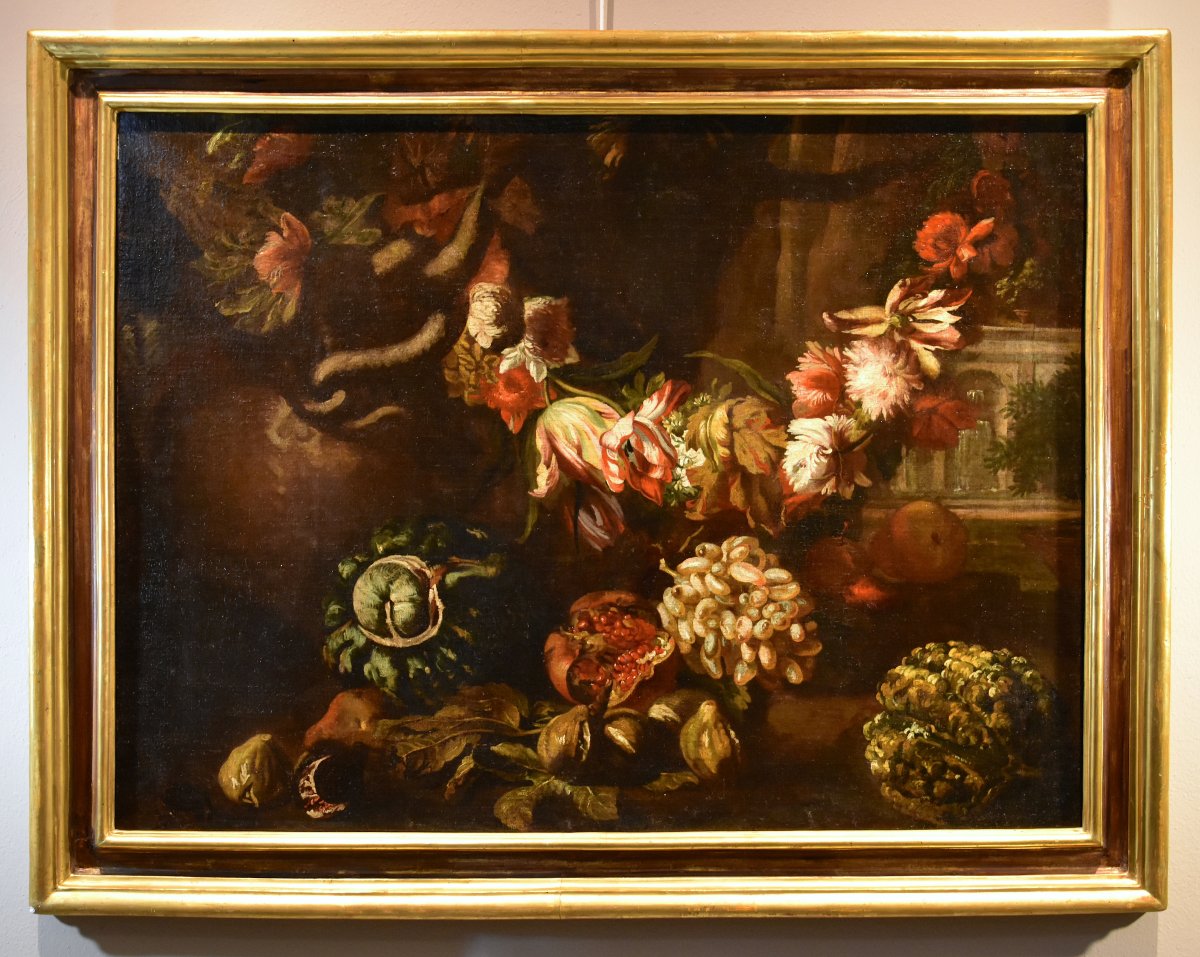
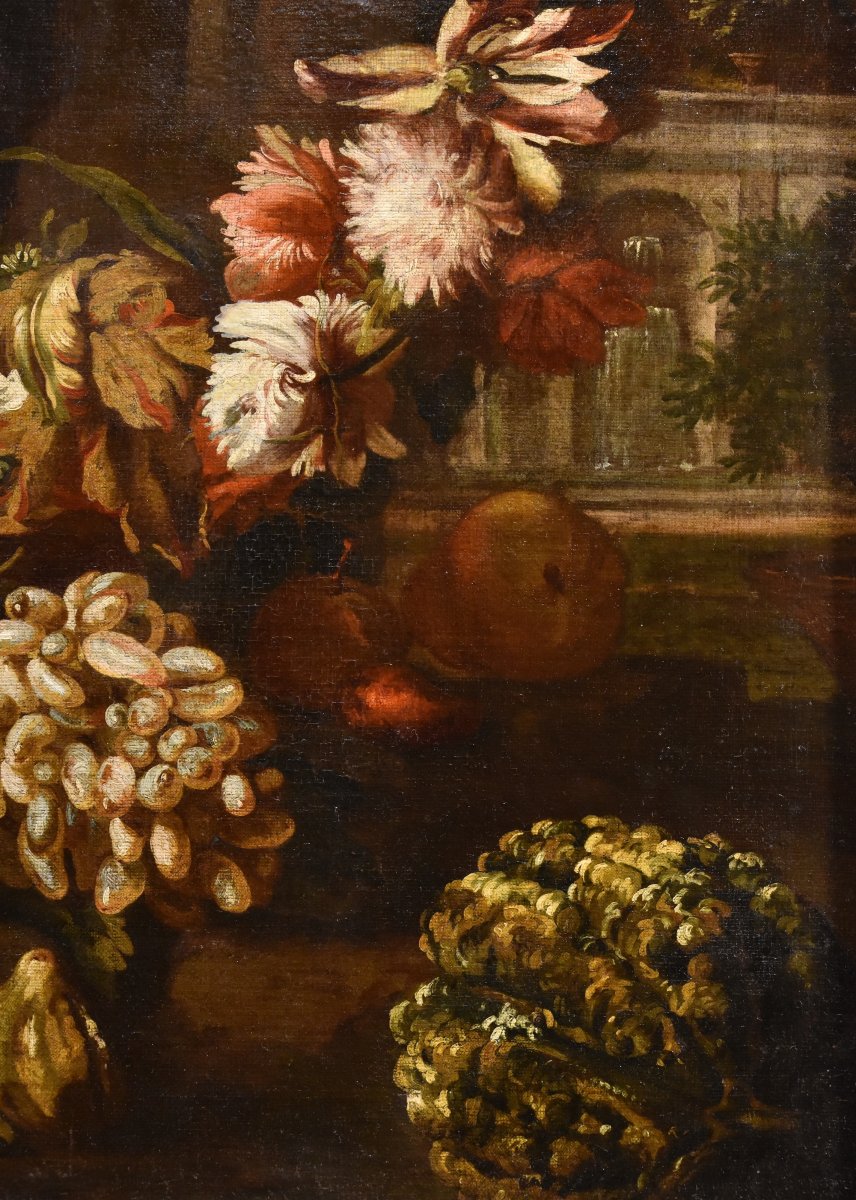
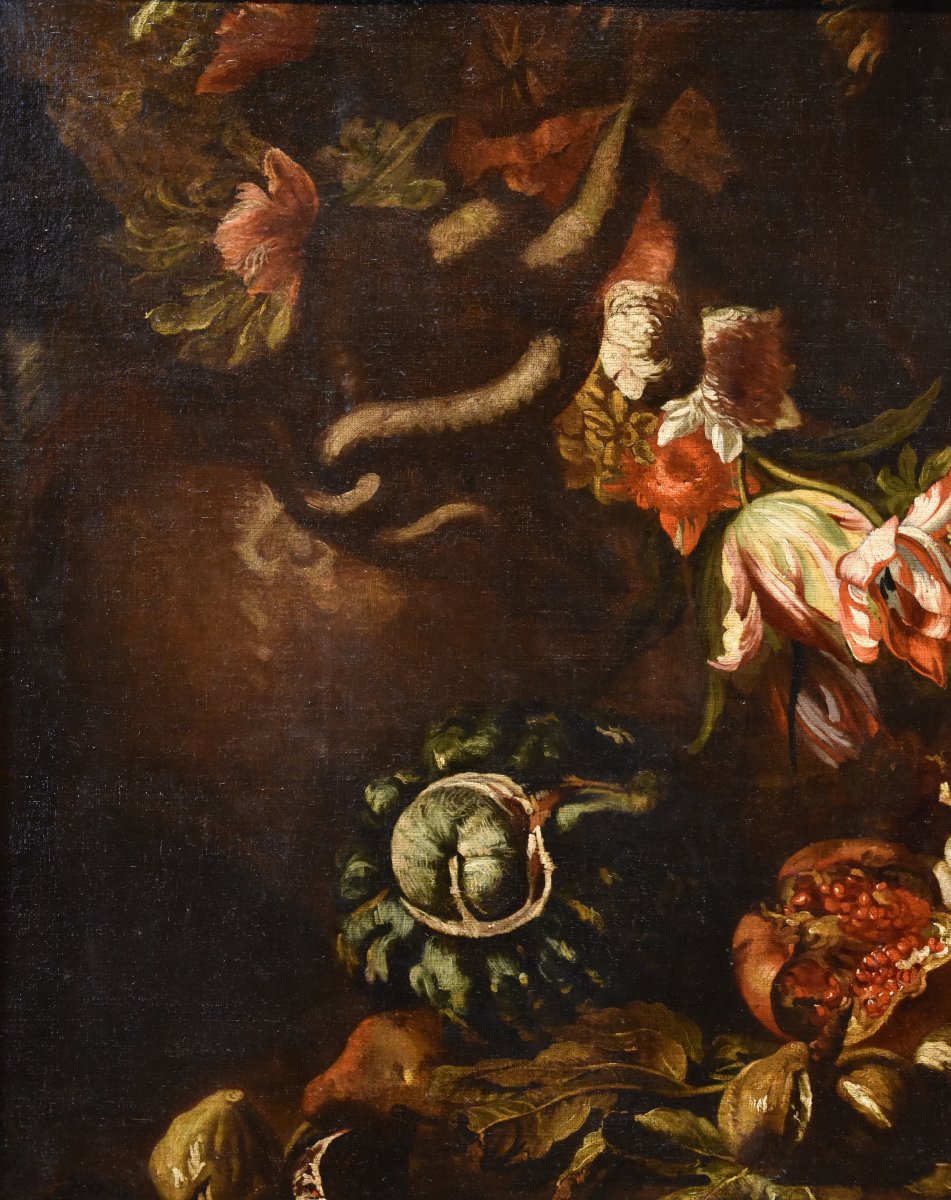
'' This fruit composition with a garland of flowers is the work of Aniello Ascione and represents a significant addition to the final chapter of Neapolitan still life—the most Baroque and decorative one imaginable. The naturalistic fervor—still in the Caravaggesque vein—of the early 17th-century masters, from Luca Forte to Porpora, now seems like a distant memory.
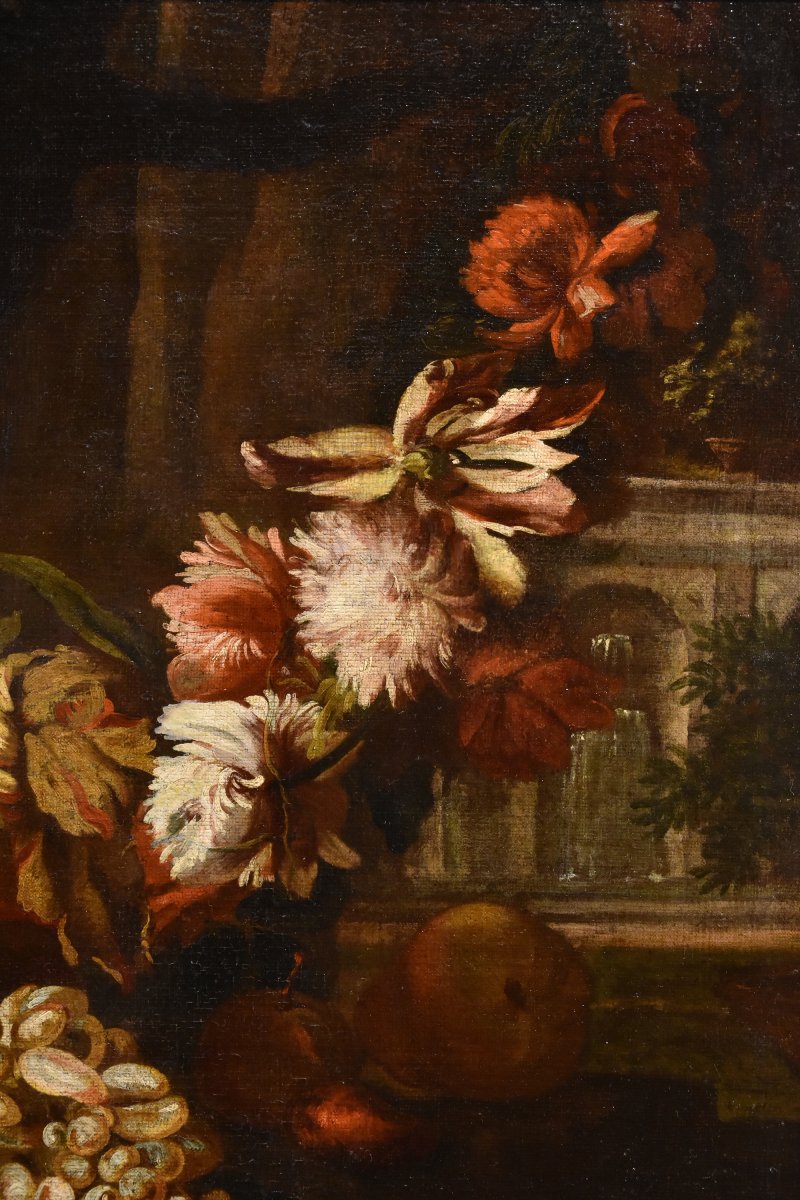
Ascione’s name is also confirmed by a comparison with the signed still life at the Civic Museum of Castello Ursini in Catania; compared to that work, the painting under consideration is a one-sixteenth-scale version. It is not uncommon, after all, for still-life painters’ workshops to rely on easily replicable compositions. The melon on the right, the arrangement of flowers, and, in the background, the outline of a column or a fountain. We could compare them to the standardized formal types used by great southern composers such as Alessandro or Domenico Scarlatti (who, incidentally, were active around the same time as our painting).
Composed with a diagonal framing, our painting connects to the Neapolitan artistic climate straddling the eras of Giordano and Francesco Solimena (including its links to the contemporary Roman scene of a Michelangelo da Campidoglio and a Spadino). These were the years when still life, so to speak, reached its peak of prominence. But let’s not get ahead of ourselves—let’s take a closer look.
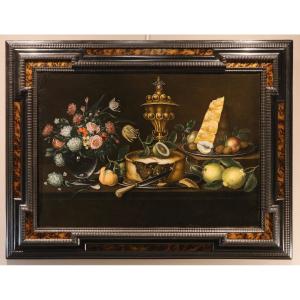
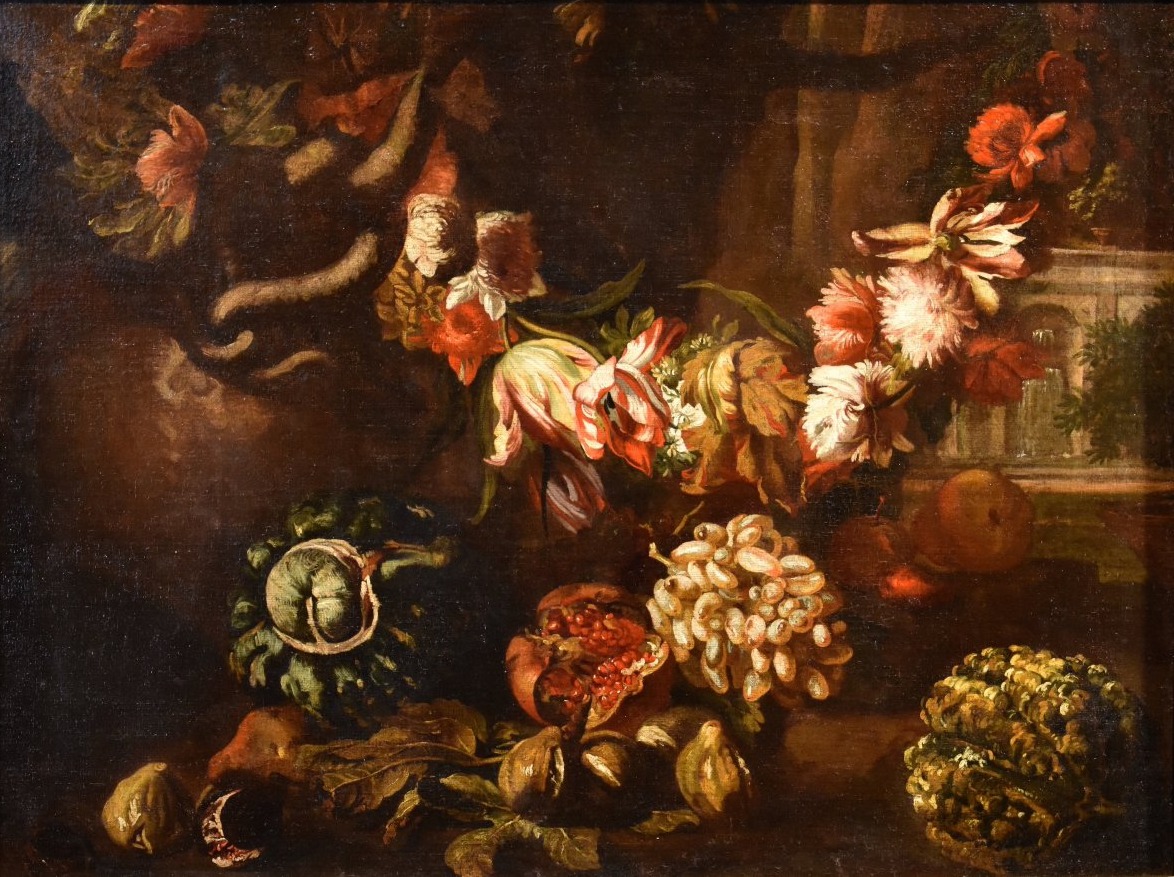
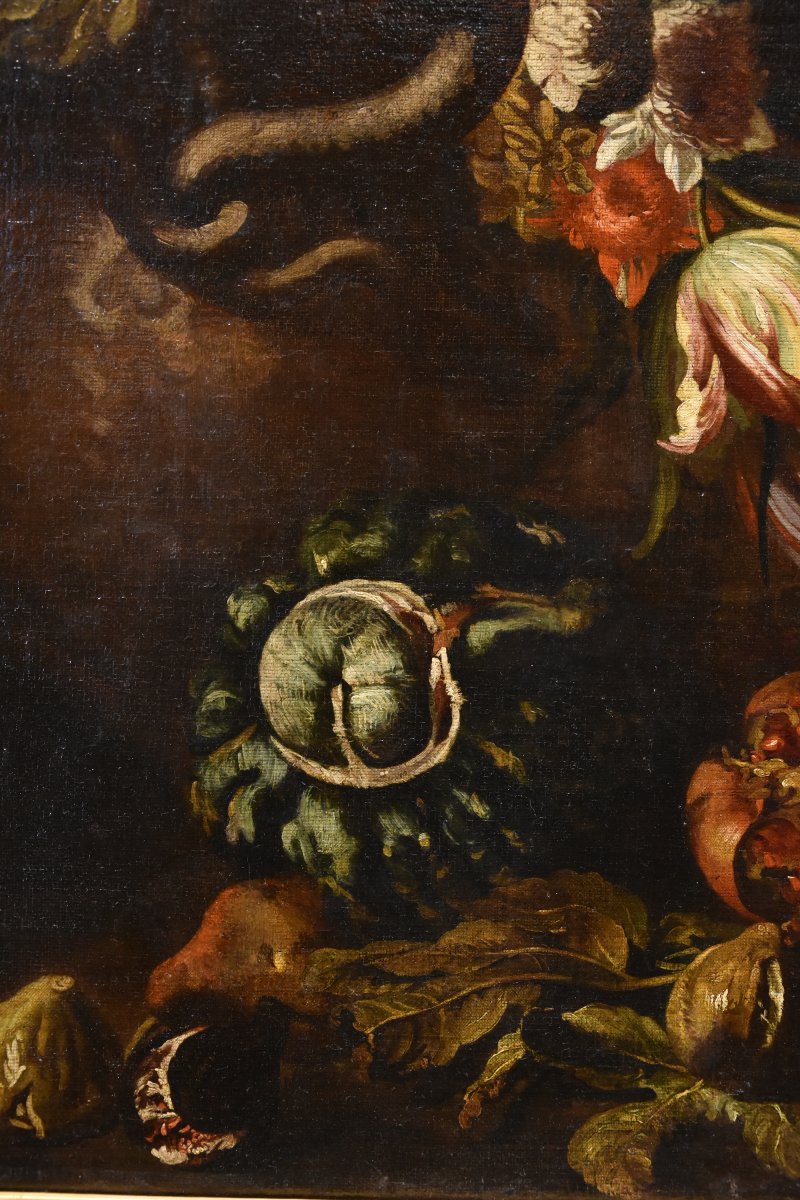
We are faced with a complex work conceived for connoisseurs willing to slowly make their way—with their eyes (and their sense of smell)—through the fruit and flowers. Every single element of the composition is weighed in its individuality and conceived in relation to a broader whole. The interpretation of the painting is triggered by the melon on the right with its jagged rind (a hallmark of the Ruoppolo family and a distinctive mark of belonging).
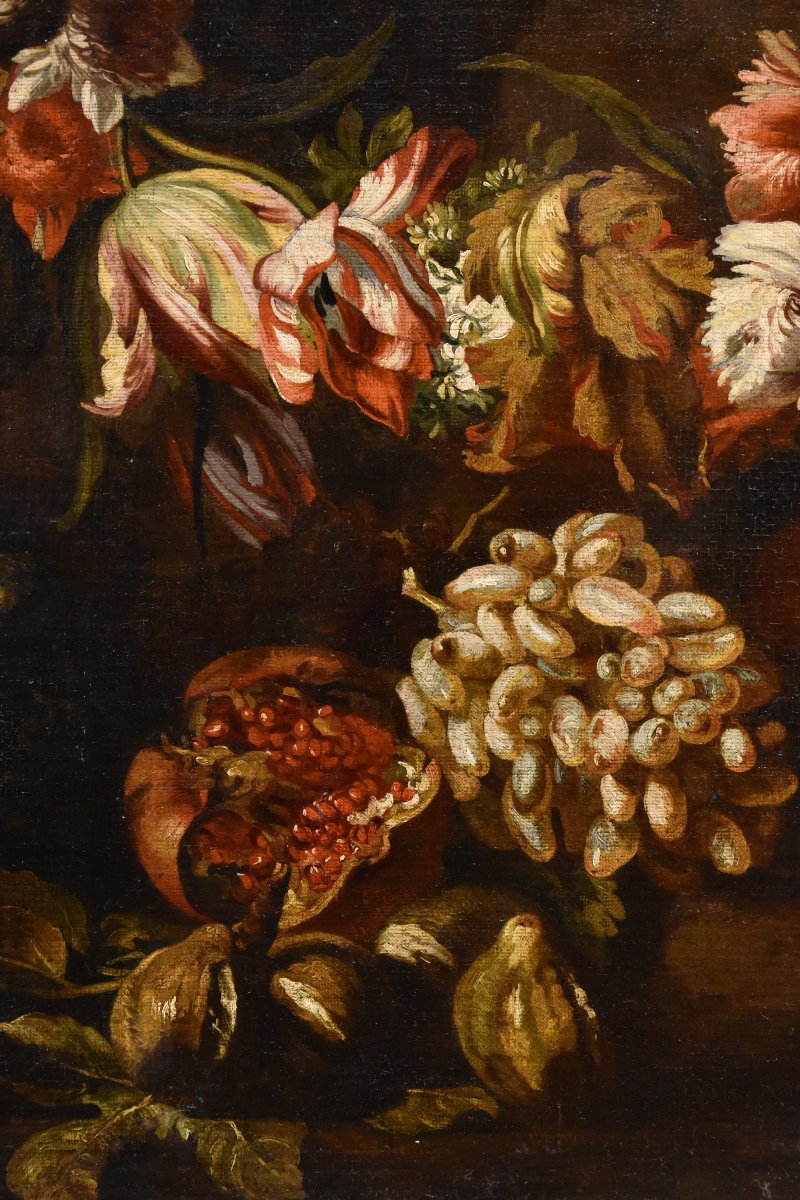
Immediately to the side, a carpet of half-open figs and leaves occupies the foreground of the canvas.
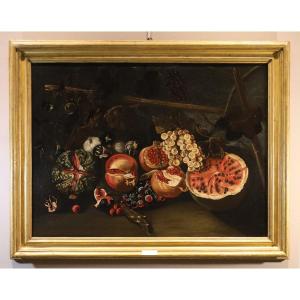
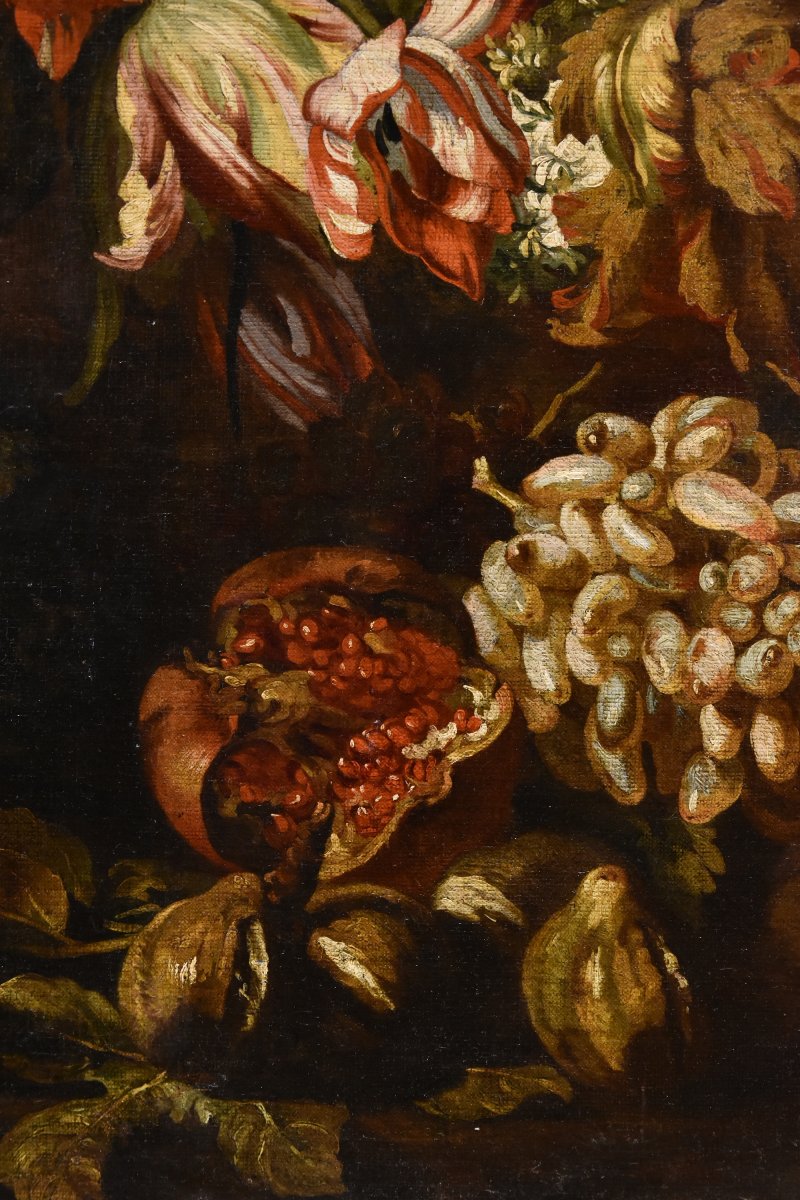
The decision to arrange the fruits diagonally enlivens the composition by adding depth. The shadowy, almost earthy quality of the surface culminates in the pomegranate, opened almost obscenely, with its seeds speckled with light; moving further to the right, the fireworks of the grape cluster burst forth (of that particular variety known in the South as “uva cornicella”).
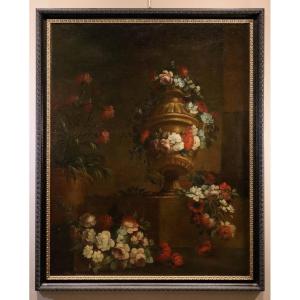
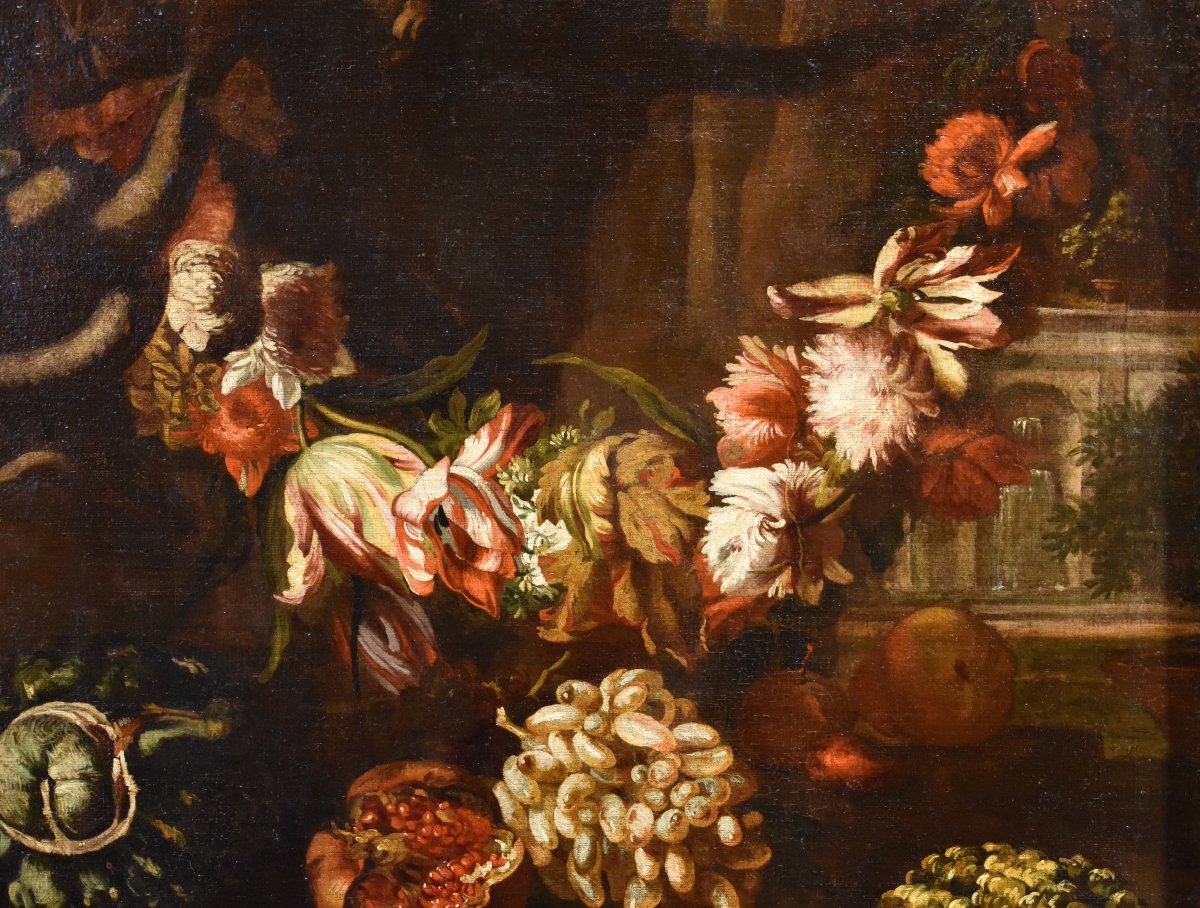
The spectacle of the painting might even end here if, in the center of the page—like a multicolored hammock—the garland did not impose itself as a dramatic flourish and as one of the finest touches of the still life’s final season. To use a much-overused metaphor, these paintings are a feast for the eyes. On the right, in the background, a fragment of architecture peeks out as a sort of homage, featuring a fountain that Giordano himself would not have rendered with any less passion.
[...] ''
ADDITIONAL INFORMATION:
The sold artwork is complemented by a lovely gilded frame and comes with a certificate of authenticity and warranty.
We handle and arrange the shipping of purchased works, both within Italy and internationally, through professional and insured carriers. It is also possible to view the painting at our gallery in Riva del Garda; we would be delighted to welcome you and show you our collection of works.
Please feel free to contact us, with no obligation, for any additional information.
Follow us on:
INSTAGRAM https://www.instagram.com/galleriacastelbarco/?hl=it
FACEBOOK https://www.facebook.com/galleriacastelbarco
Still Life with a Garland of Flowers and Fruit
Oil on canvas,
89 x 117 cm – framed 104 x 132 cm.
With an expert appraisal and attribution study by Prof. Stefano Causa (University of Naples)
For full details, click HERE
'' This fruit composition with a garland of flowers is the work of Aniello Ascione and represents a significant addition to the final chapter of Neapolitan still life—the most Baroque and decorative one imaginable. The naturalistic fervor—still in the Caravaggesque vein—of the early 17th-century masters, from Luca Forte to Porpora, now seems like a distant memory.
Ascione’s name is also confirmed by a comparison with the signed still life at the Civic Museum of Castello Ursini in Catania; compared to that work, the painting under consideration is a one-sixteenth-scale version. It is not uncommon, after all, for still-life painters’ workshops to rely on easily replicable compositions. The melon on the right, the arrangement of flowers, and, in the background, the outline of a column or a fountain. We could compare them to the standardized formal types used by great southern composers such as Alessandro or Domenico Scarlatti (who, incidentally, were active around the same time as our painting).
Composed with a diagonal framing, our painting connects to the Neapolitan artistic climate straddling the eras of Giordano and Francesco Solimena (including its links to the contemporary Roman scene of a Michelangelo da Campidoglio and a Spadino). These were the years when still life, so to speak, reached its peak of prominence. But let’s not get ahead of ourselves—let’s take a closer look.
We are faced with a complex work conceived for connoisseurs willing to slowly make their way—with their eyes (and their sense of smell)—through the fruit and flowers. Every single element of the composition is weighed in its individuality and conceived in relation to a broader whole. The interpretation of the painting is triggered by the melon on the right with its jagged rind (a hallmark of the Ruoppolo family and a distinctive mark of belonging).
Immediately to the side, a carpet of half-open figs and leaves occupies the foreground of the canvas.
The decision to arrange the fruits diagonally enlivens the composition by adding depth. The shadowy, almost earthy quality of the surface culminates in the pomegranate, opened almost obscenely, with its seeds speckled with light; moving further to the right, the fireworks of the grape cluster burst forth (of that particular variety known in the South as “uva cornicella”).
The spectacle of the painting might even end here if, in the center of the page—like a multicolored hammock—the garland did not impose itself as a dramatic flourish and as one of the finest touches of the still life’s final season. To use a much-overused metaphor, these paintings are a feast for the eyes. On the right, in the background, a fragment of architecture peeks out as a sort of homage, featuring a fountain that Giordano himself would not have rendered with any less passion.
[...] ''
ADDITIONAL INFORMATION:
The sold artwork is complemented by a lovely gilded frame and comes with a certificate of authenticity and warranty.
We handle and arrange the shipping of purchased works, both within Italy and internationally, through professional and insured carriers. It is also possible to view the painting at our gallery in Riva del Garda; we would be delighted to welcome you and show you our collection of works.
Please feel free to contact us, with no obligation, for any additional information.
Follow us on:
INSTAGRAM https://www.instagram.com/galleriacastelbarco/?hl=it
FACEBOOK https://www.facebook.com/galleriacastelbarco
14 900 €
Period: 17th century
Style: Louis 15th - Transition
Condition: Good condition
Material: Oil painting
Width: encadré 132 cm.
Height: encadré 104 cm.
Reference (ID): 1801870
Availability: In stock
Print