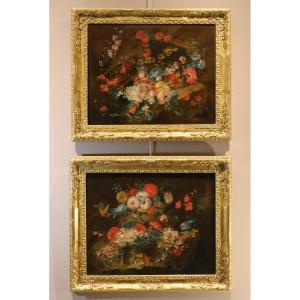


Pair Of Floral Still Lifes, Attributed To Antoine Monnoyer (1671–1747)
Artist: Antoine Monnoyer Le Jeune (paris 1671 - Paris Saint-germain-en-laye 1747) Attribué
Antoine Monnoyer the Younger (Paris 1671 – Paris Saint-Germain-en-Laye 1747) attributed
Pair of floral still lifes
Early 18th century
Oil on canvas
52 x 65 cm. - With carved and gilded wooden frames. 66 x 79 cm.
FULL DETAILS OF THE PAIR OF PAINTINGS (CLICK HERE)
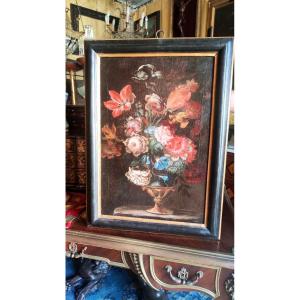
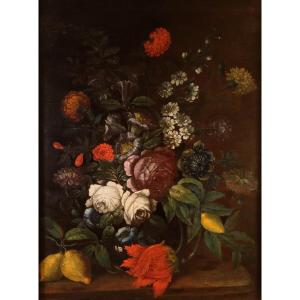
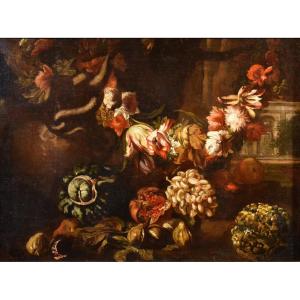
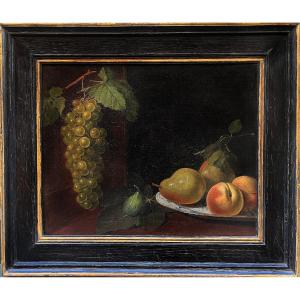
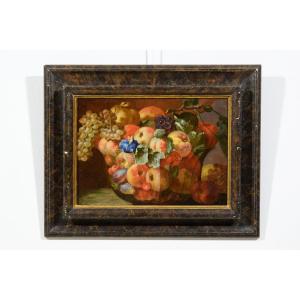
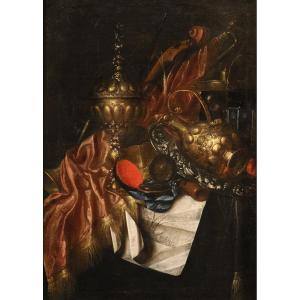
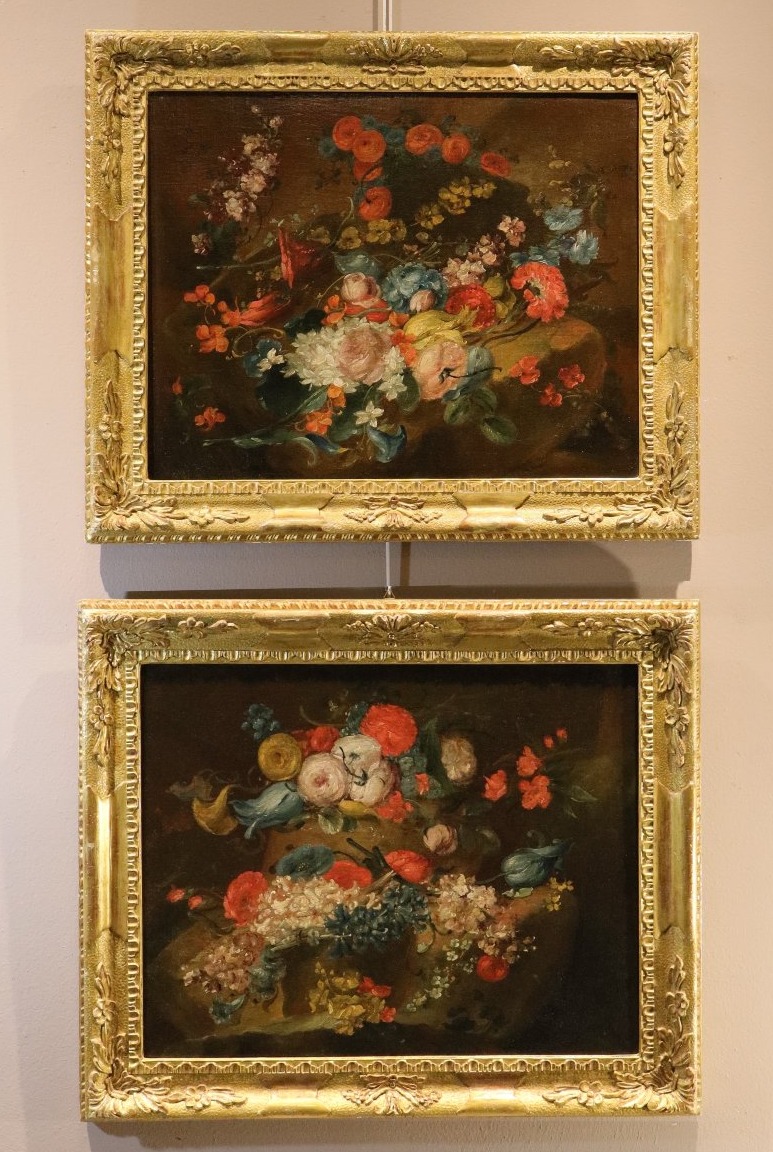
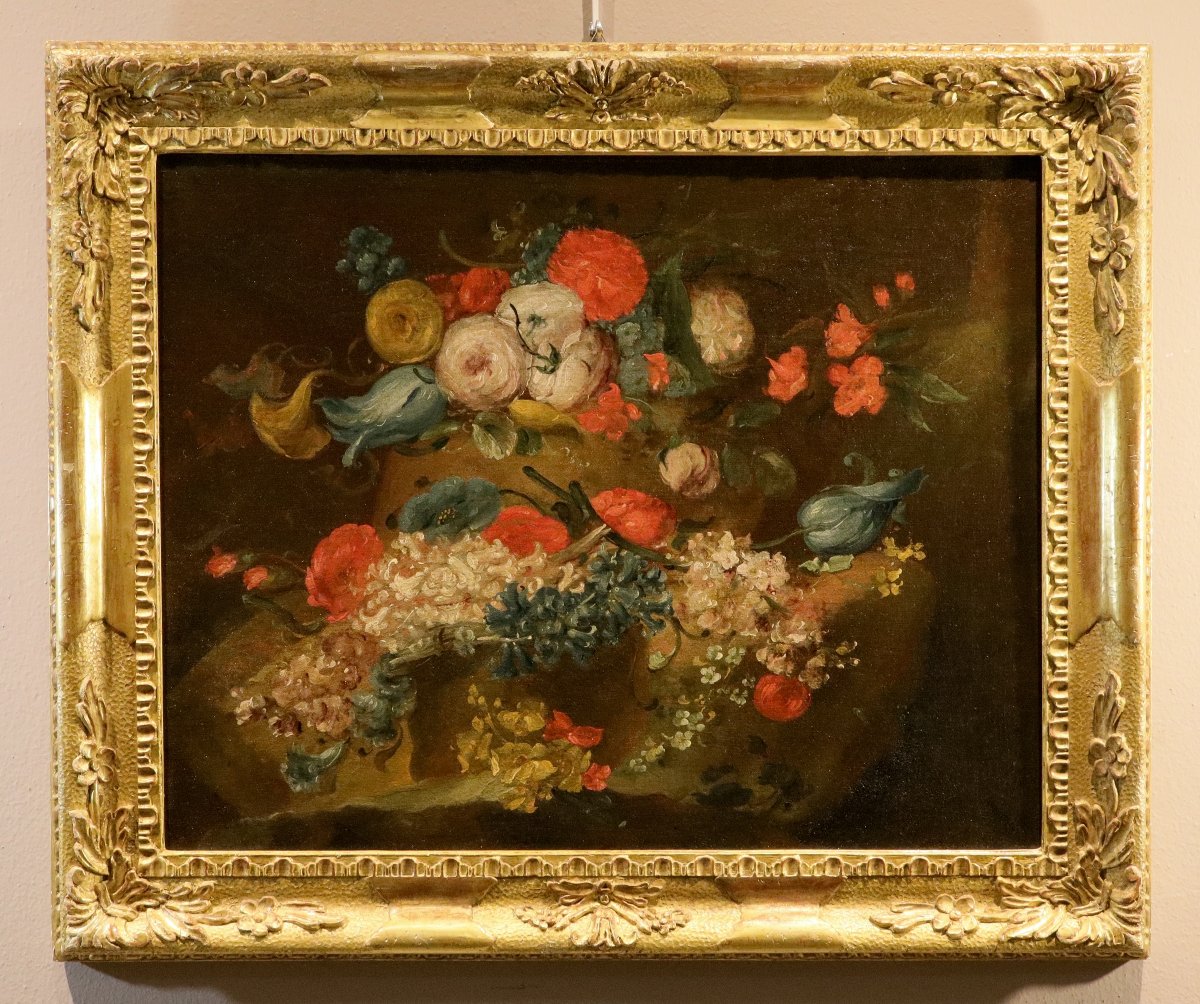
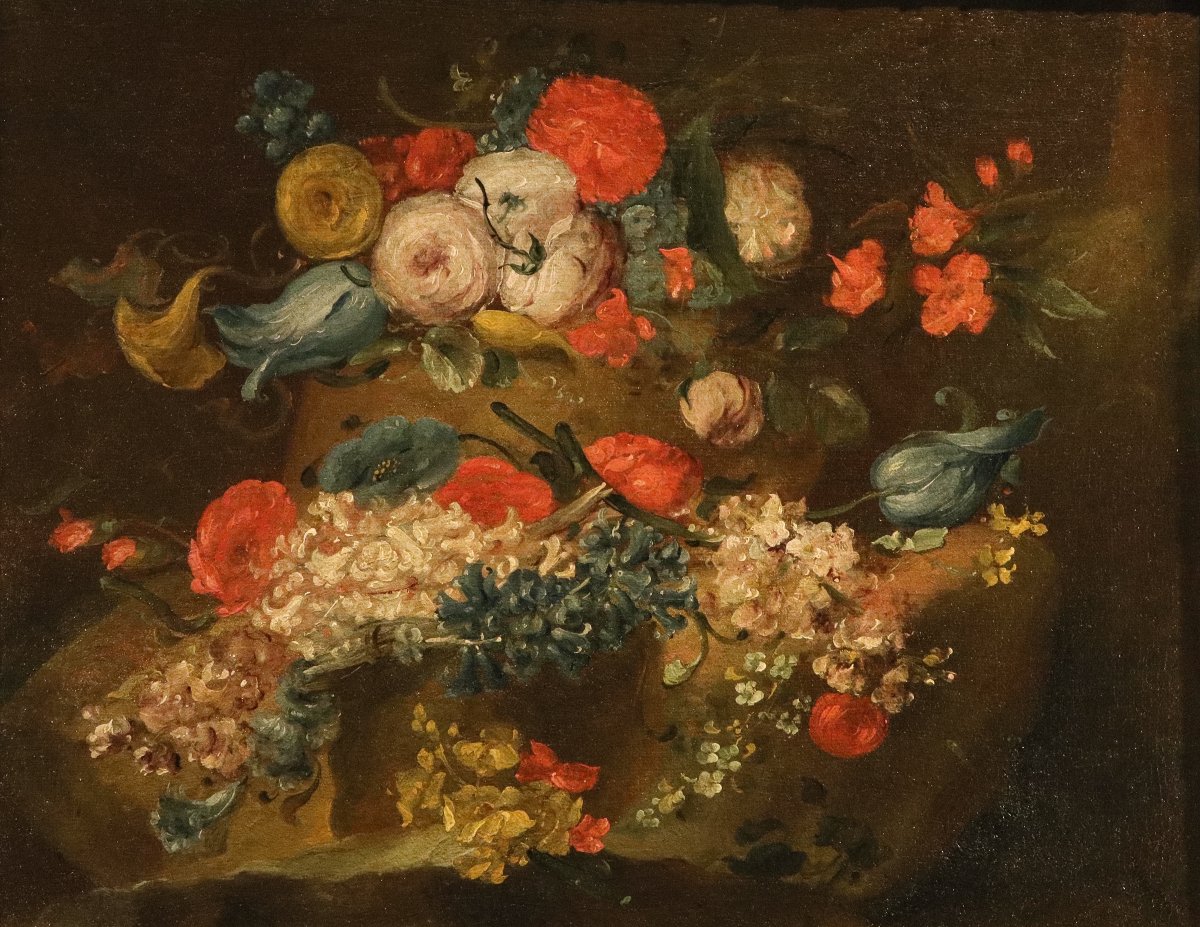
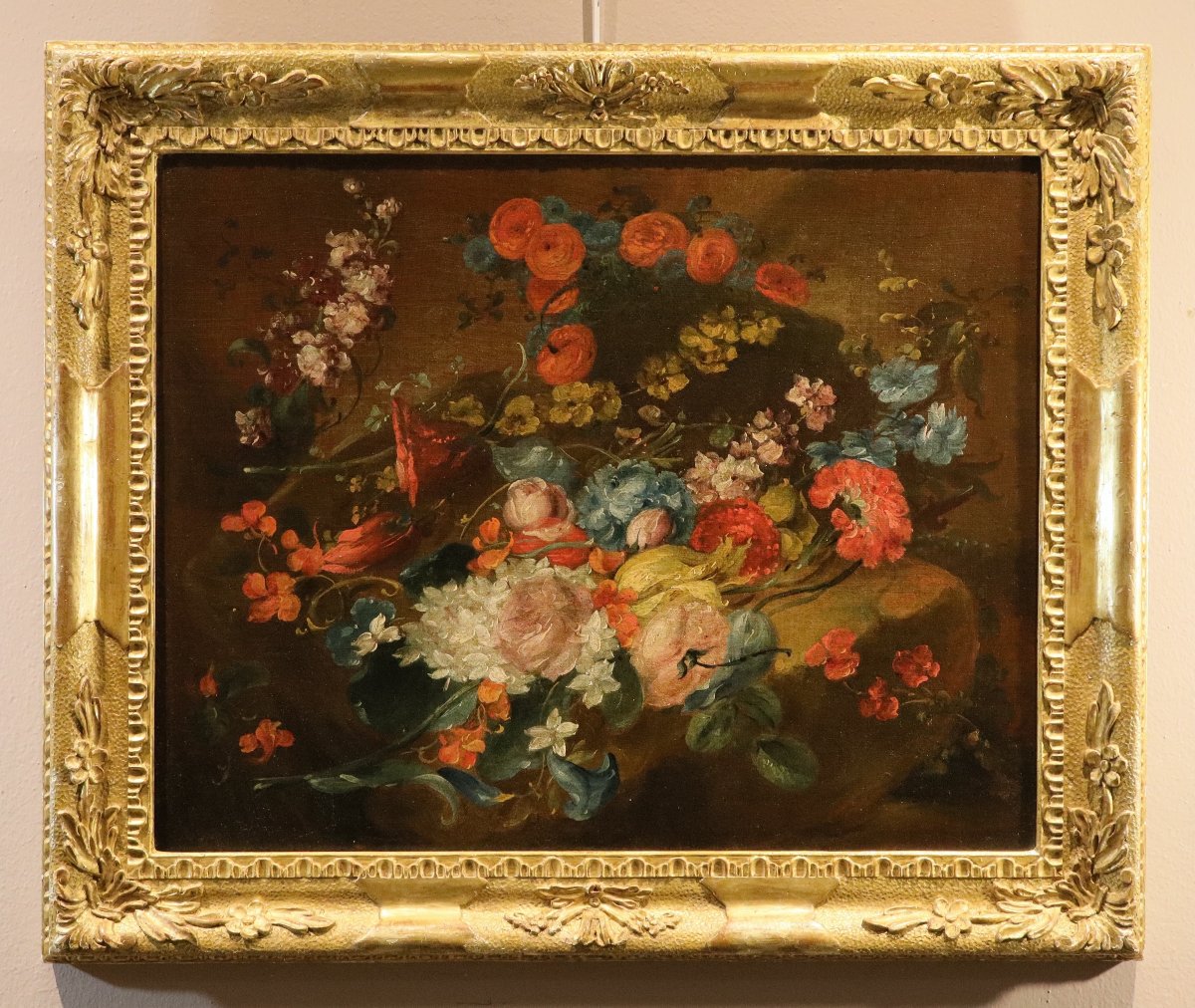
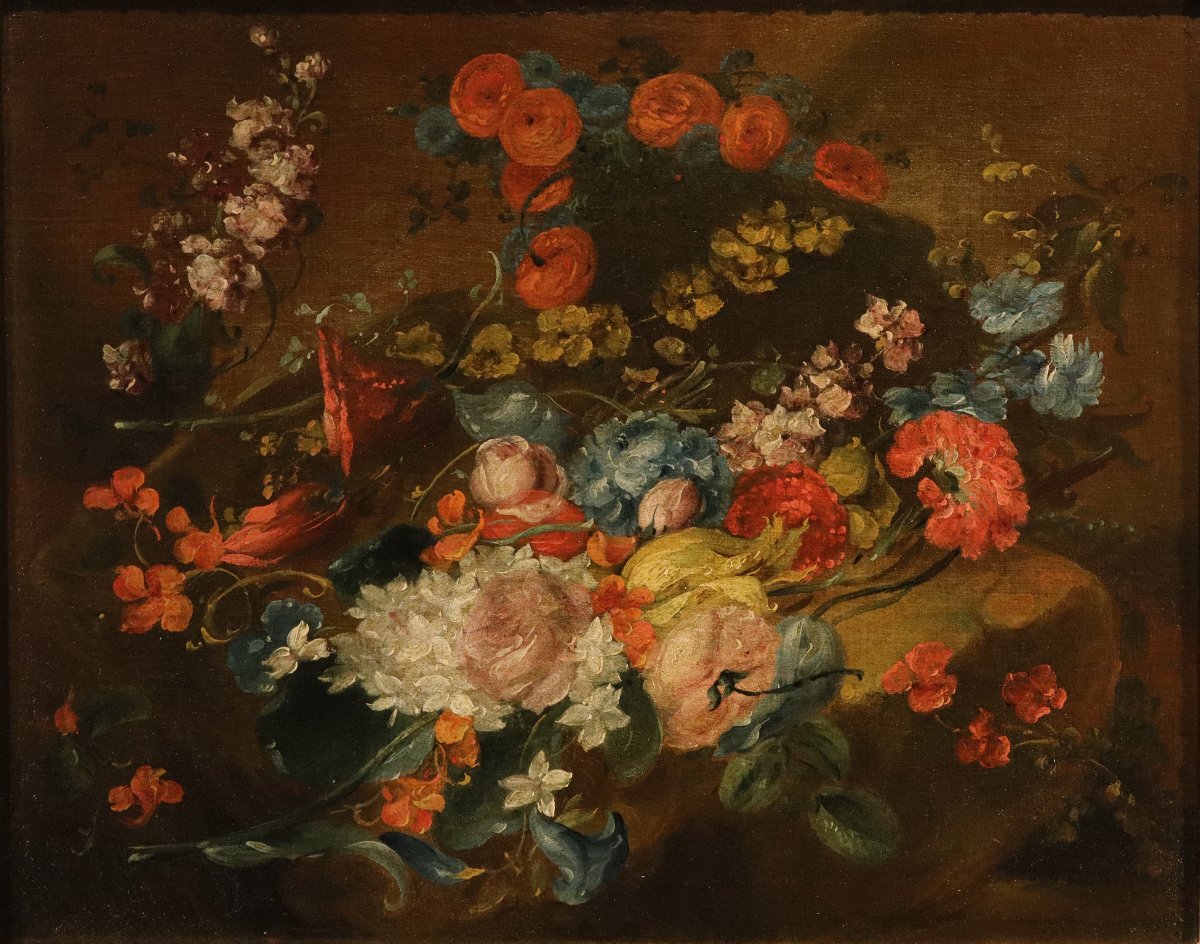
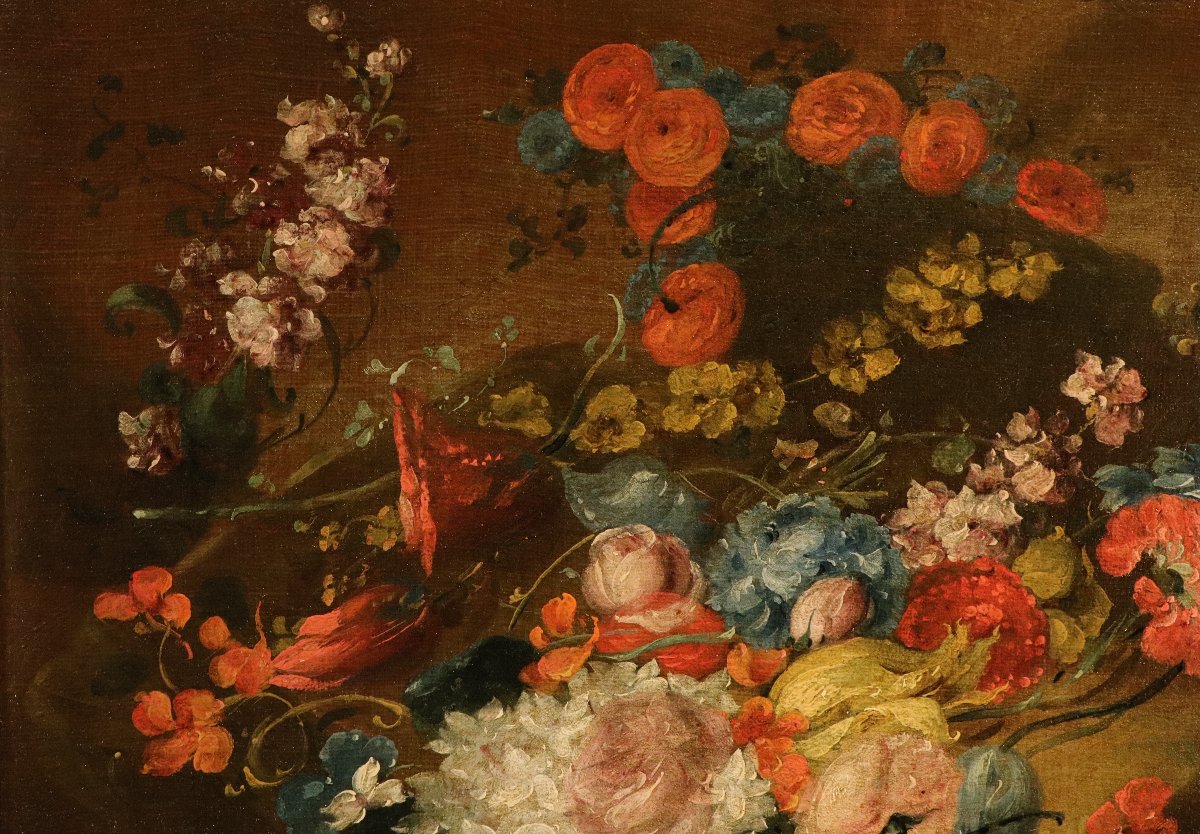
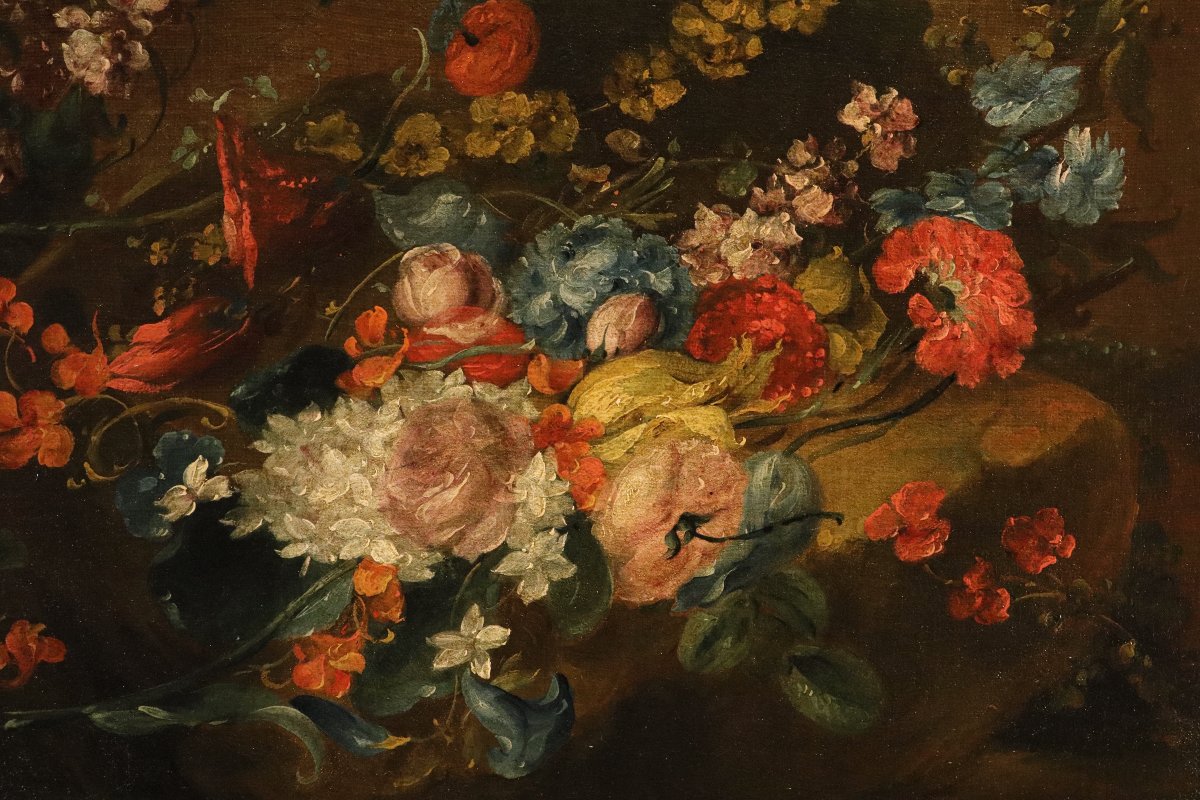
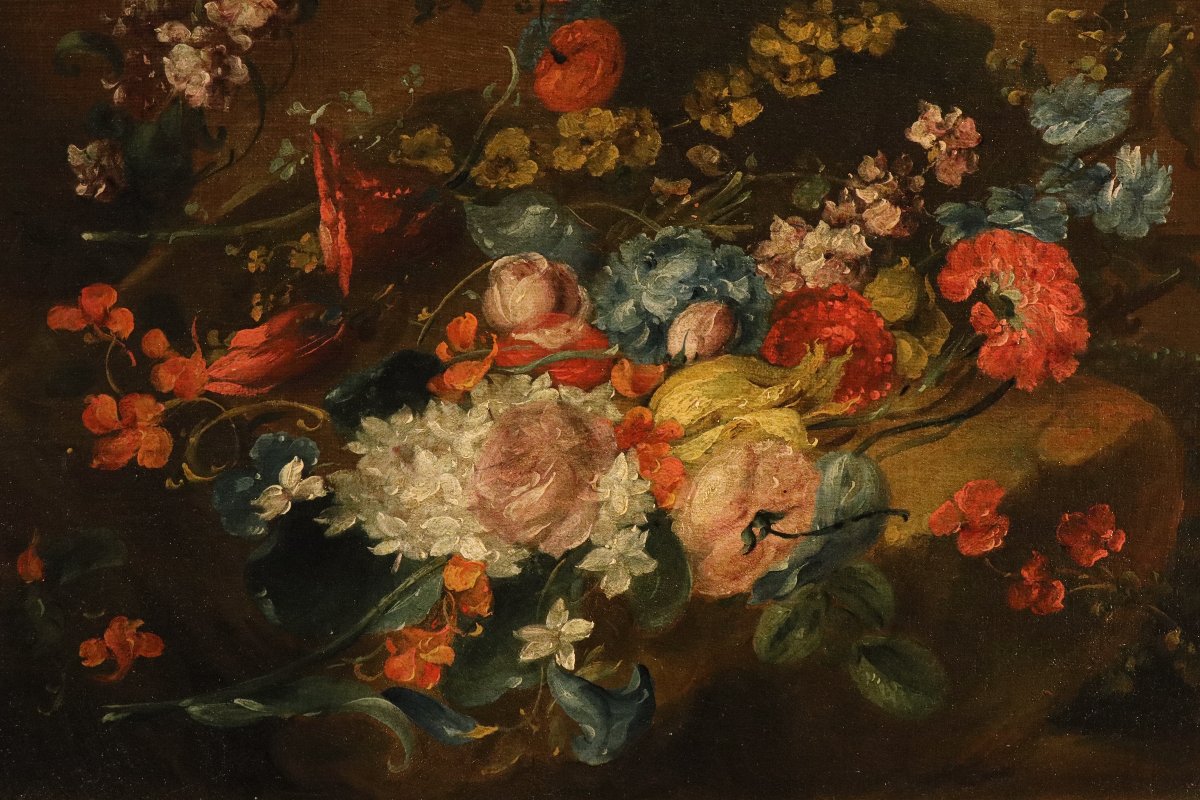
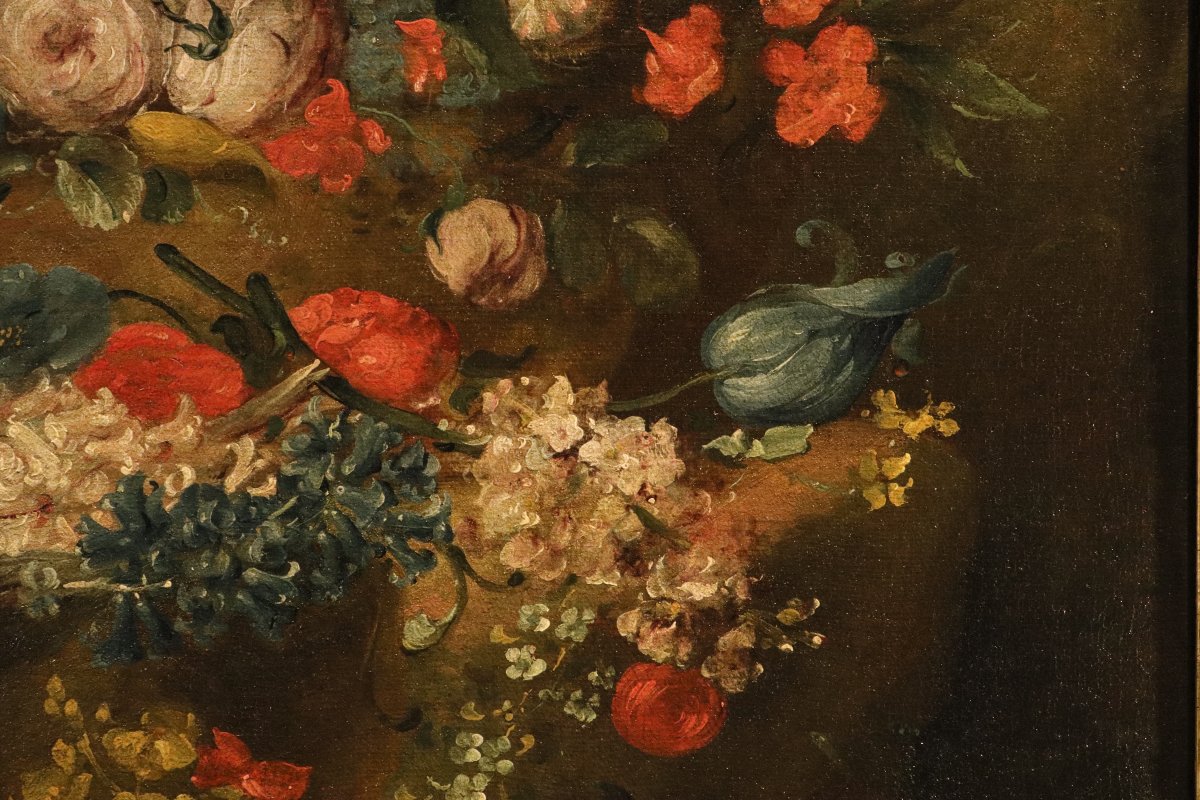
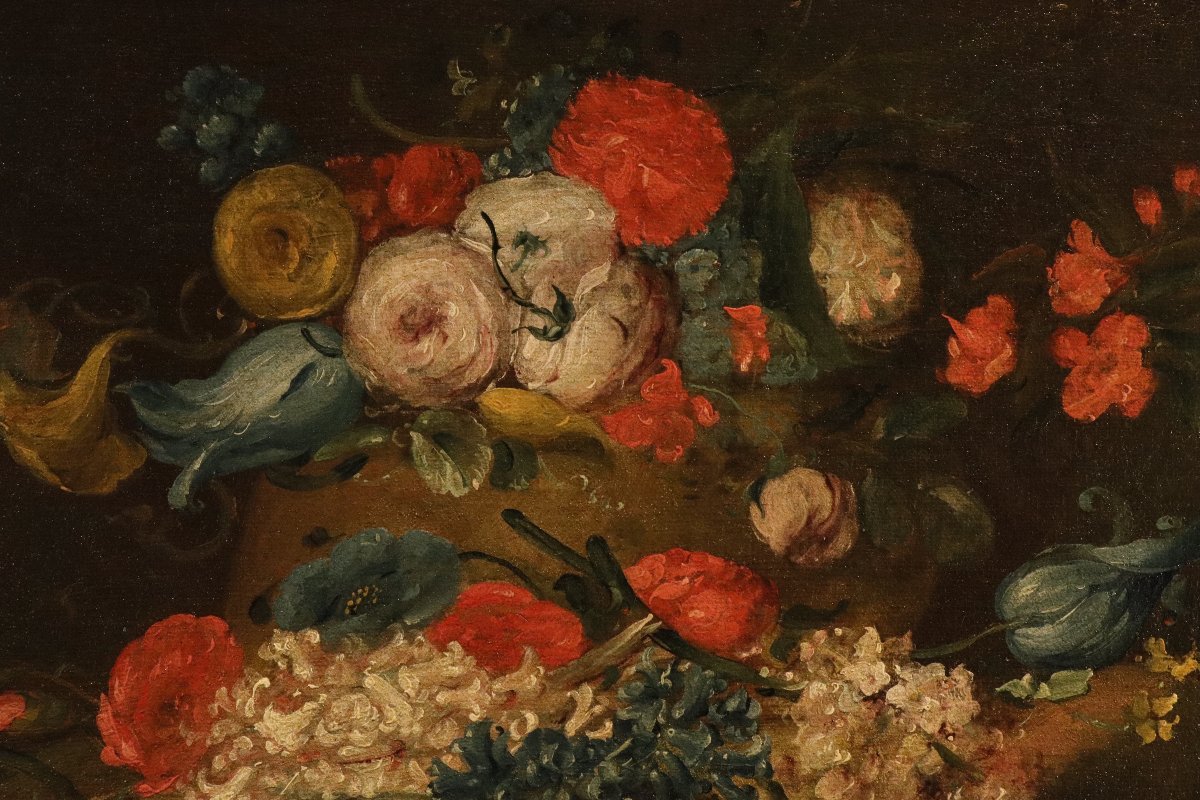
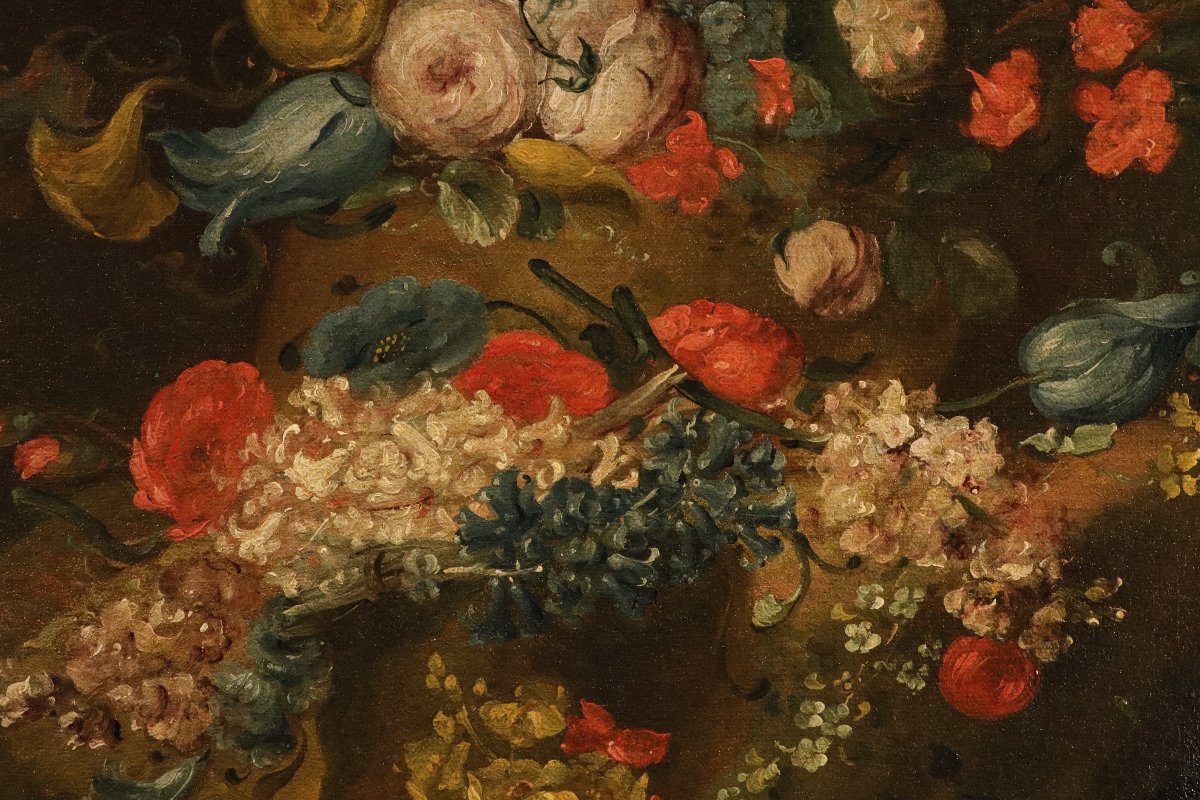
This splendid pair of paintings depicts a set of still lifes featuring floral arrangements: both canvases display rich bouquets of colorful flowers (including roses, carnations, daffodils, tulips, and anemones), with iridescent hues and elegantly arranged together.
The flowers, arranged with a deliberate asymmetry, are set in an outdoor setting and seem almost to overflow from the natural rock formations typical of Baroque garden settings. The canvases feature a dark, almost uniform background that serves to make the brilliance and chromatic vibrancy of the petals stand out with absolute prominence, a refined technique that lends a strong sense of three-dimensionality.
From an attributional standpoint, it is easy to identify the elements and stylistic canons typical of the floral compositions of the Monnoyer family, the undisputed masters of Franco-Flemish still life at the turn of the 17th and 18th centuries, a tradition led by the famous Jean-Baptiste and his son Antoine Monnoyer, whose artistic style is distinguished precisely by this type of sumptuous, dense, and highly decorative composition.
Upon closer examination of the works, we are inclined to attribute them, in particular, to Antoine Monnoyer (Paris 1671 – Paris Saint-Germain-en-Laye 1747), recognizable by the elegant structure of the composition combined with the characteristic freshness and brilliance of the colors.
After likely training in London at his father Jean Baptiste’s studio, Antoine moved to Paris, a city that became one of the main hubs of his artistic career, quickly establishing himself in the prestigious artistic circles of the French capital. At the height of his success, he left France for a study trip to Rome and then embarked on a career that would take him to various European courts, in Sweden, where he decorated the Royal Palace in Stockholm, with extended stays in England, particularly in London, where the family enjoyed the patronage of important clients and royalty.
The paintings of the French artist —nicknamed “Young Baptist” for having perpetuated and evolved his father’s great pictorial tradition—are imbued with a soft sensuality derived from the sinuous movement of the flowers, intertwined in a sort of melody that unites them within a broader Baroque aesthetic. Finally, the interplay of the color palette is beautiful, especially between the deep red and the blue, which lends the composition a masterful and final lyrical touch.
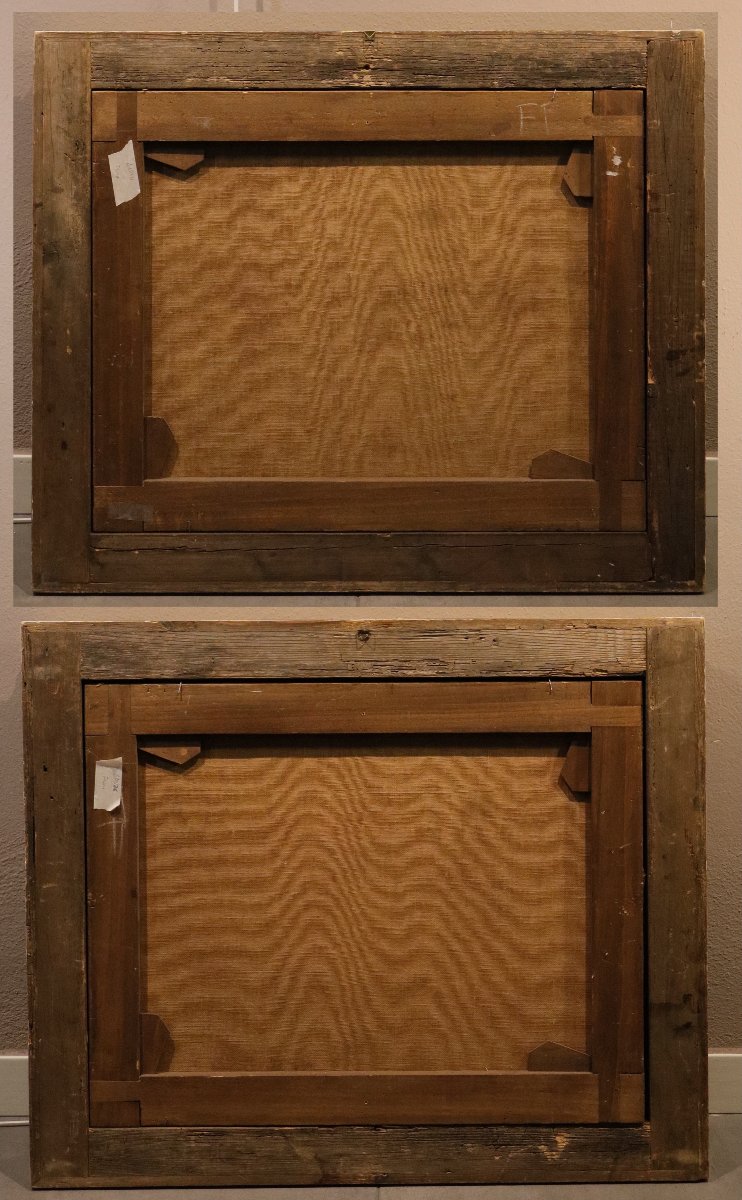
The paintings are in excellent condition and are enhanced by beautiful carved and gilded period wooden frames, whose geometric motifs and acanthus leaf details at the corners amplify their dramatic character, evoking their original destination in the salons of the 18th-century aristocracy.
ADDITIONAL INFORMATION:
The sold work comes with a certificate of authenticity and warranty.
We handle and arrange the transport of purchased works, both within Italy and internationally, using professional and insured carriers. It is also possible to view the painting at our gallery in Riva del Garda; we would be delighted to welcome you to show you our collection of works.
Please feel free to contact us for any additional information.
Follow us on:
INSTAGRAM https://www.instagram.com/galleriacastelbarco/?hl=it
FACEBOOK https://www.facebook.com/galleriacastelbarco/
Pair of floral still lifes
Early 18th century
Oil on canvas
52 x 65 cm. - With carved and gilded wooden frames. 66 x 79 cm.
FULL DETAILS OF THE PAIR OF PAINTINGS (CLICK HERE)
This splendid pair of paintings depicts a set of still lifes featuring floral arrangements: both canvases display rich bouquets of colorful flowers (including roses, carnations, daffodils, tulips, and anemones), with iridescent hues and elegantly arranged together.
The flowers, arranged with a deliberate asymmetry, are set in an outdoor setting and seem almost to overflow from the natural rock formations typical of Baroque garden settings. The canvases feature a dark, almost uniform background that serves to make the brilliance and chromatic vibrancy of the petals stand out with absolute prominence, a refined technique that lends a strong sense of three-dimensionality.
From an attributional standpoint, it is easy to identify the elements and stylistic canons typical of the floral compositions of the Monnoyer family, the undisputed masters of Franco-Flemish still life at the turn of the 17th and 18th centuries, a tradition led by the famous Jean-Baptiste and his son Antoine Monnoyer, whose artistic style is distinguished precisely by this type of sumptuous, dense, and highly decorative composition.
Upon closer examination of the works, we are inclined to attribute them, in particular, to Antoine Monnoyer (Paris 1671 – Paris Saint-Germain-en-Laye 1747), recognizable by the elegant structure of the composition combined with the characteristic freshness and brilliance of the colors.
After likely training in London at his father Jean Baptiste’s studio, Antoine moved to Paris, a city that became one of the main hubs of his artistic career, quickly establishing himself in the prestigious artistic circles of the French capital. At the height of his success, he left France for a study trip to Rome and then embarked on a career that would take him to various European courts, in Sweden, where he decorated the Royal Palace in Stockholm, with extended stays in England, particularly in London, where the family enjoyed the patronage of important clients and royalty.
The paintings of the French artist —nicknamed “Young Baptist” for having perpetuated and evolved his father’s great pictorial tradition—are imbued with a soft sensuality derived from the sinuous movement of the flowers, intertwined in a sort of melody that unites them within a broader Baroque aesthetic. Finally, the interplay of the color palette is beautiful, especially between the deep red and the blue, which lends the composition a masterful and final lyrical touch.
The paintings are in excellent condition and are enhanced by beautiful carved and gilded period wooden frames, whose geometric motifs and acanthus leaf details at the corners amplify their dramatic character, evoking their original destination in the salons of the 18th-century aristocracy.
ADDITIONAL INFORMATION:
The sold work comes with a certificate of authenticity and warranty.
We handle and arrange the transport of purchased works, both within Italy and internationally, using professional and insured carriers. It is also possible to view the painting at our gallery in Riva del Garda; we would be delighted to welcome you to show you our collection of works.
Please feel free to contact us for any additional information.
Follow us on:
INSTAGRAM https://www.instagram.com/galleriacastelbarco/?hl=it
FACEBOOK https://www.facebook.com/galleriacastelbarco/
14 500 €
Period: 18th century
Style: Louis 15th - Transition
Condition: Excellent condition
Material: Oil painting
Width: encadré 79 cm.
Height: encadré 66 cm.
Reference (ID): 1777070
Availability: In stock
Print