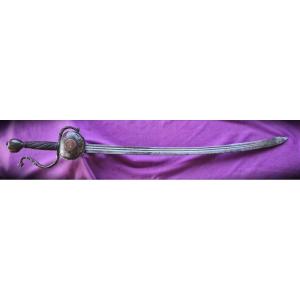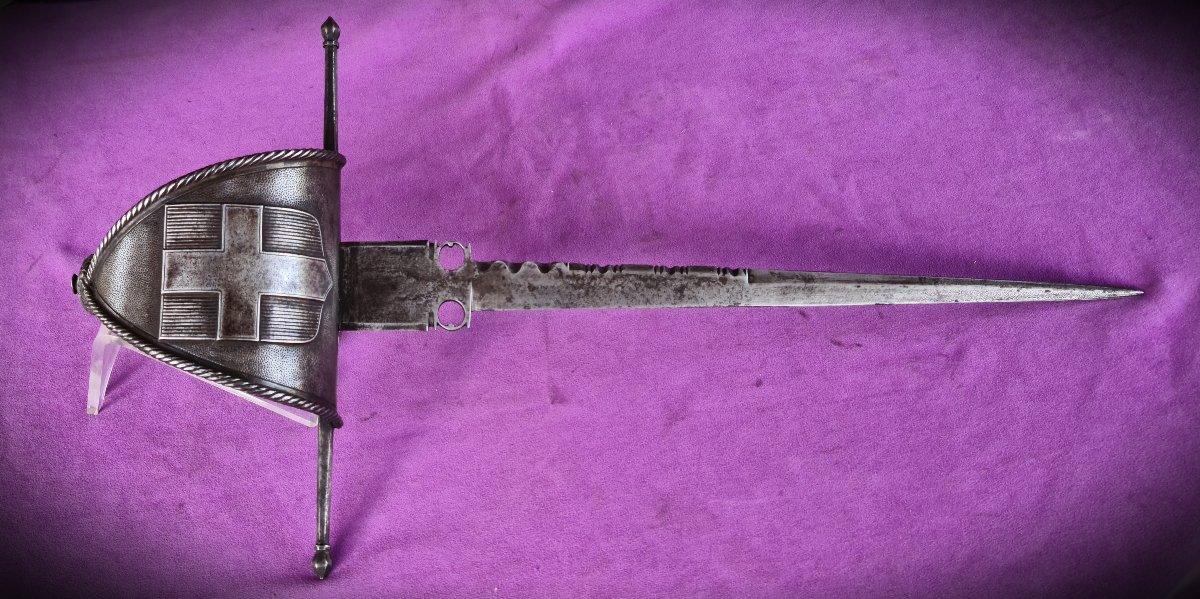



Spanish Left-handed Dagger With A Sail-shaped Hilt, Featuring A Coat Of Arms.
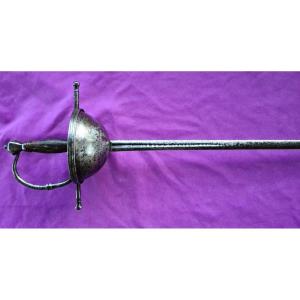
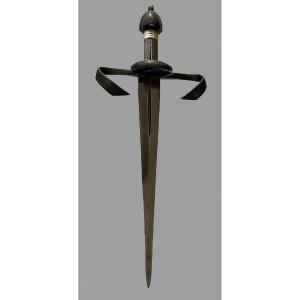
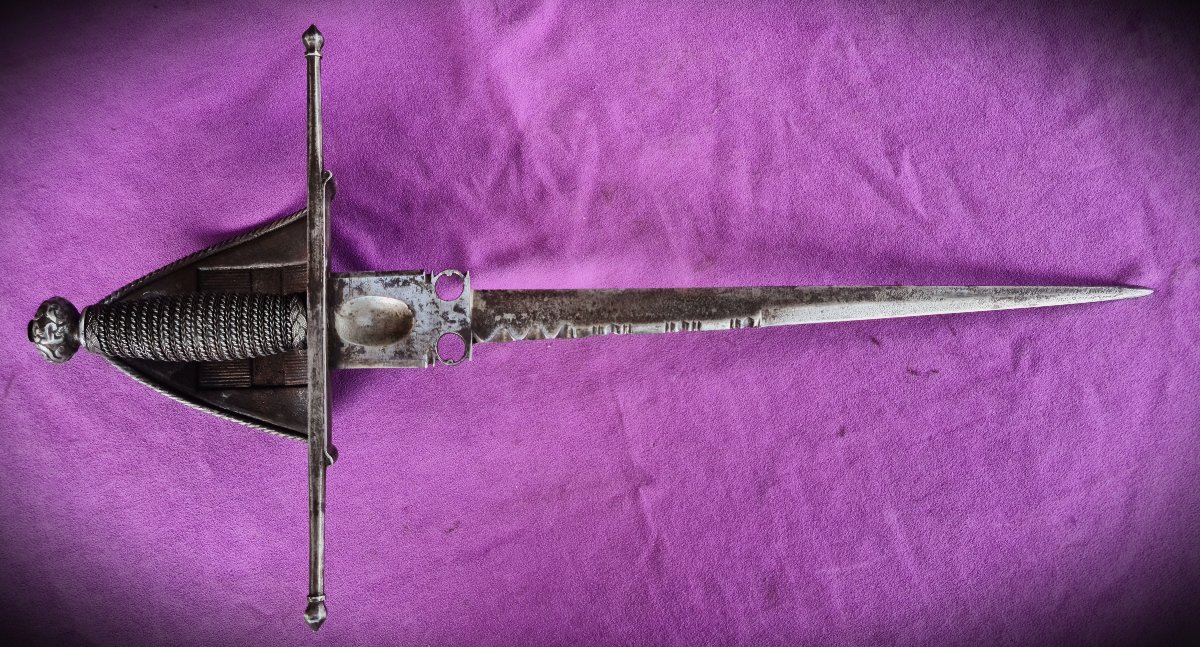
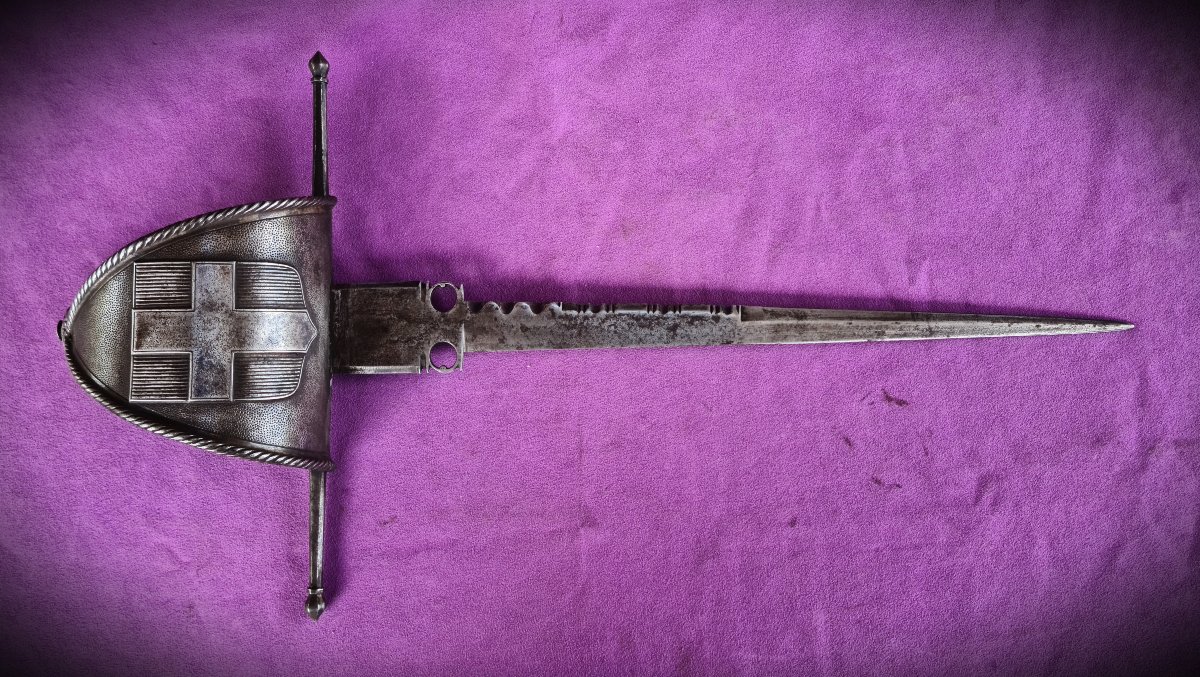
This left-handed dagger is known as a “sail dagger”because of the triangular guard that protects the hand, which resembles thes ail of a ship. The style is unmistakably 17th-century Spanish, and following a thorough analysis, it likely dates from the last quarter of the 17th century.
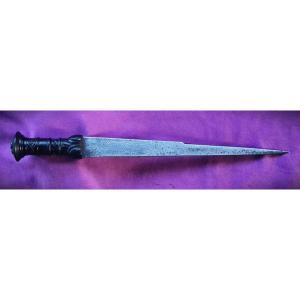
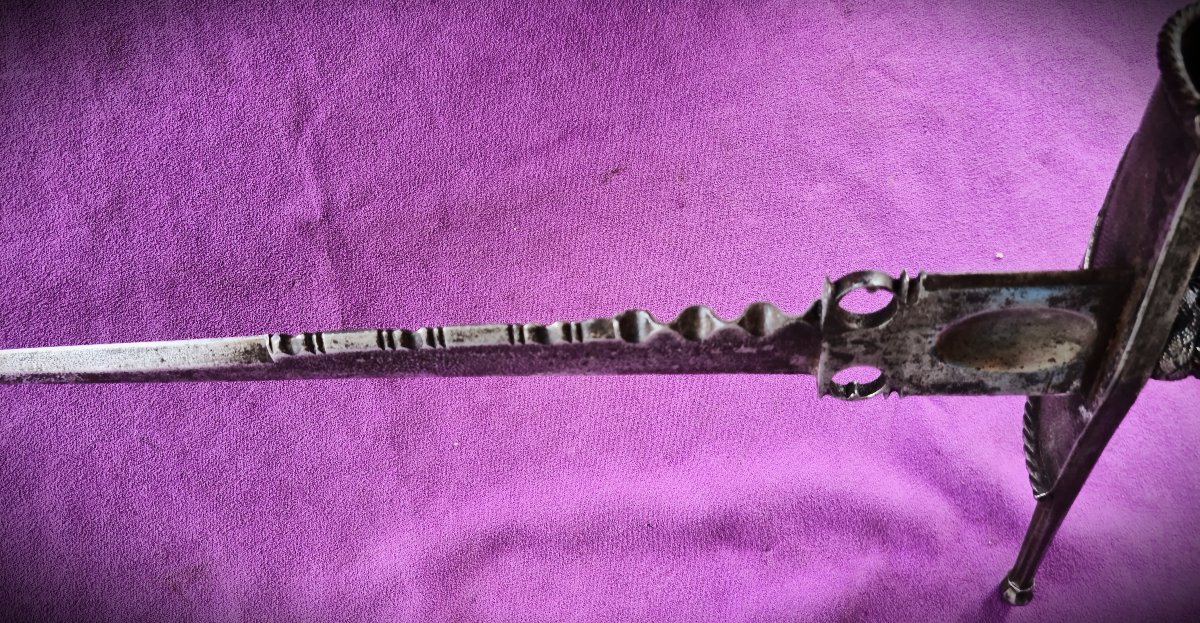
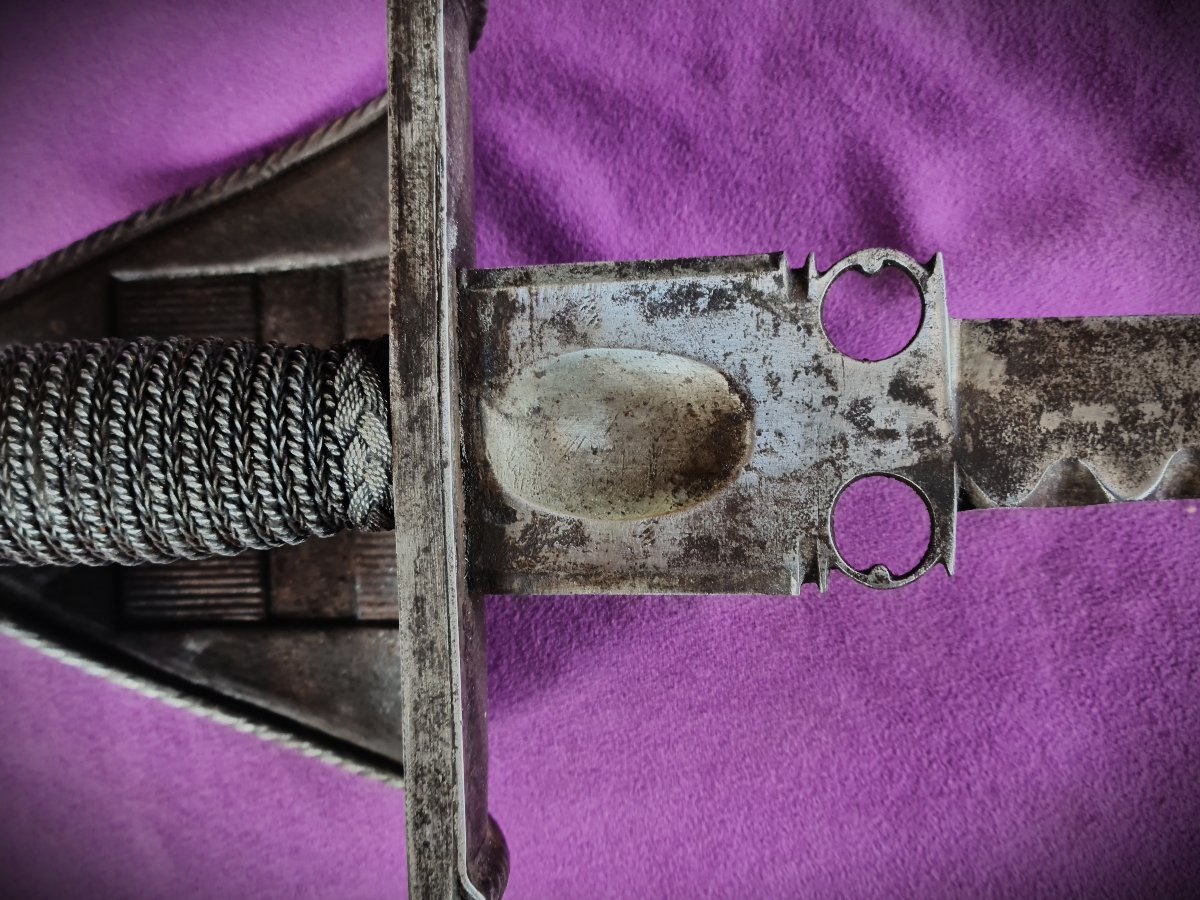
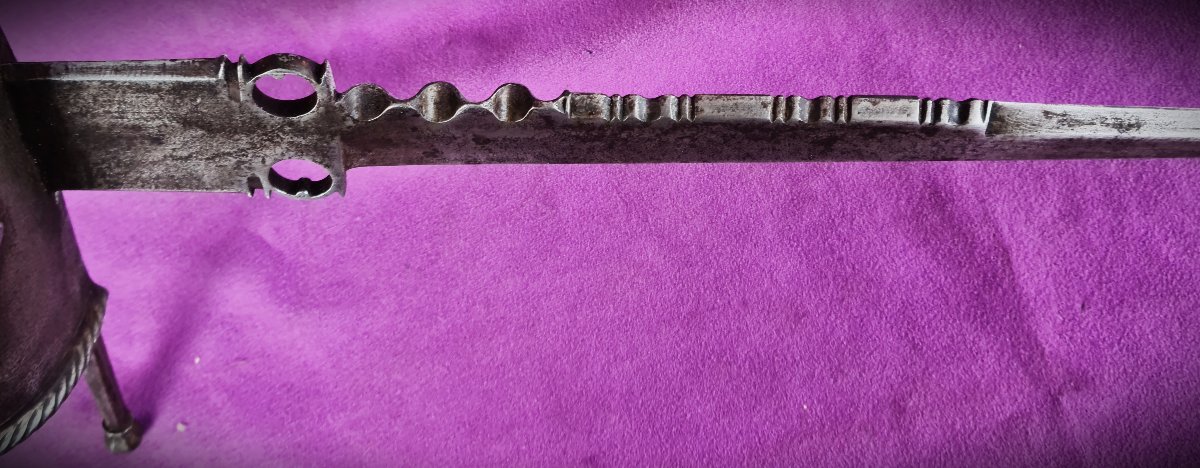
BLADE: Following a ricasso on the inner side of which there is a recess designed to support the thumb, there are two holes known as “point breakers” (rompe puntas) The blade then features, on one side, a long cutting edge that extends to the point, and on the other, a thick sback, decorated with intricate scalloped guilloché, designed to prevent an opponent’s blade from slipping. The back then takes the form of a second cutting edge that extends to the tip.
Blade length = 39.4 cm, width at the ricasso 4.5 cm, thickness at the ricasso 4.3 mm
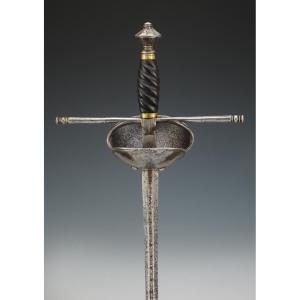
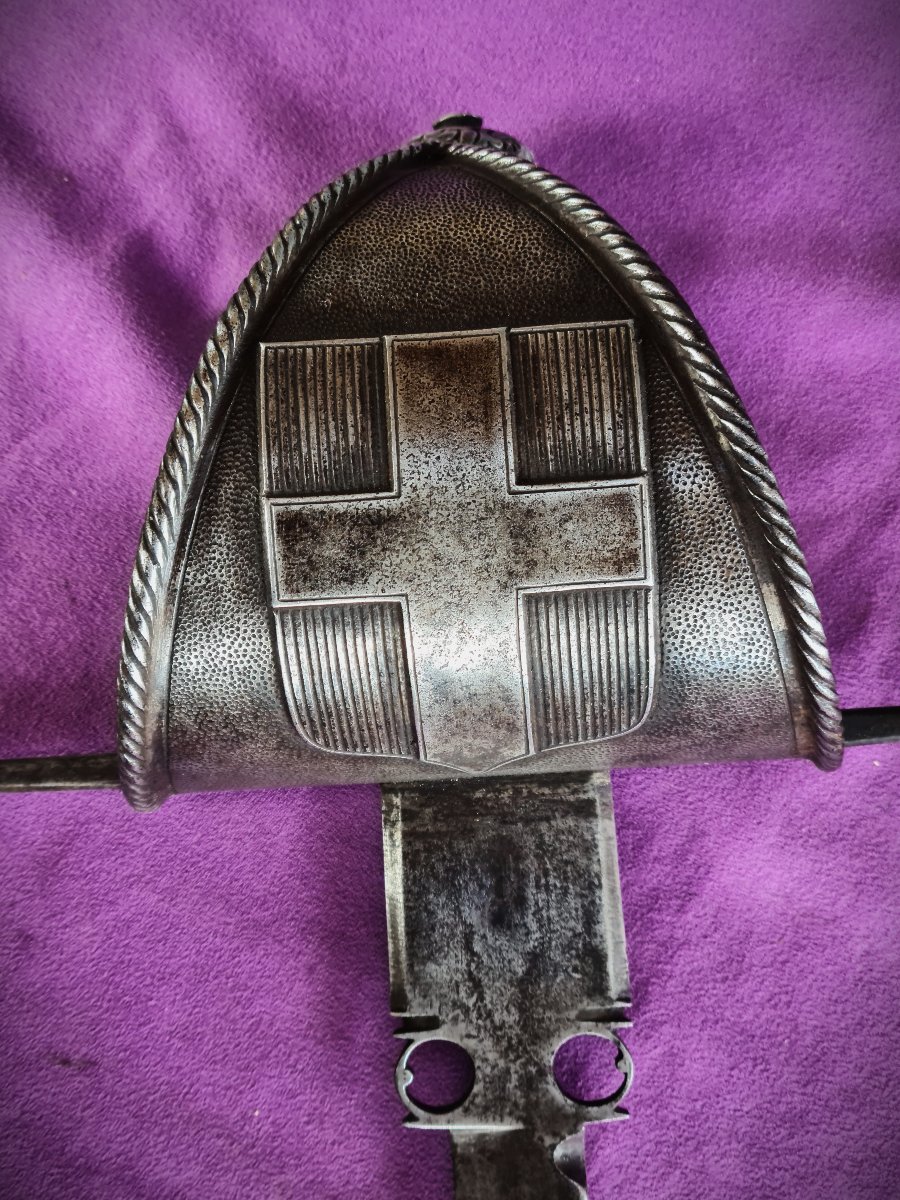
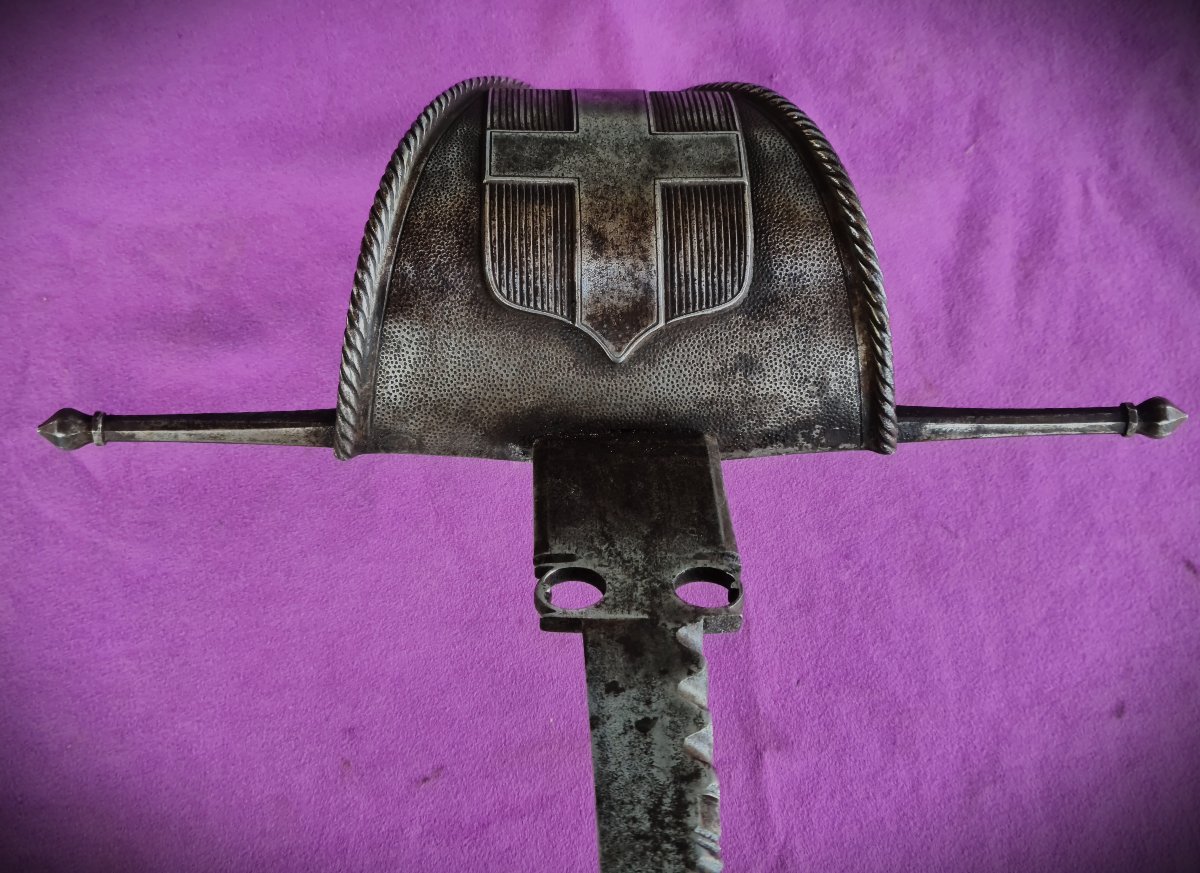
GUARD: It consist son one hand, a central section or “cross” with an octagonal cross-section terminating in two acorn-shaped, faceted quillons. And on the other hand, the guard it self, which is riveted to the quillons of the cross guard, using 17th-century techniques. The edges of this guard are twisted into a cord known as a “brise pointes” and wound around a steel rod, following a classical technique of the period.
The central motif of this veil is a prominent coat of arms, “gules with a cross of argent,” which immediately evokes the coat of arms of Savoy, and which, after research, corresponds here to the coat of arms of the very ancient house Aspremont . The background of thev eil outside the shield is decorated with a very fine dotted pattern, which in heraldry would represent gold This coat of arms on a dagger with a Spanish sail would historically correspond to the arms of Marie-Louise, Countess of Aspremont, wife of Heinrich-Franz von Mansfeld, Prince of Fondi, who from 1683 to 1690 served as ambassador of the Imperial Court of Vienna to the Spanish court. In 1690, this diplomat was invited to a wedding in Valladolid, on the occasion of which he was bestowed numerous gifts and honors. It was therefore likely on this occasion that this dagger was crafted, evoking the coat of arms of his wife, who herself came from a very ancient line of nobility.
The purely honorary purpose of the weapon explains the thinness of the guard, whose defensive role was no longer the primary concern.
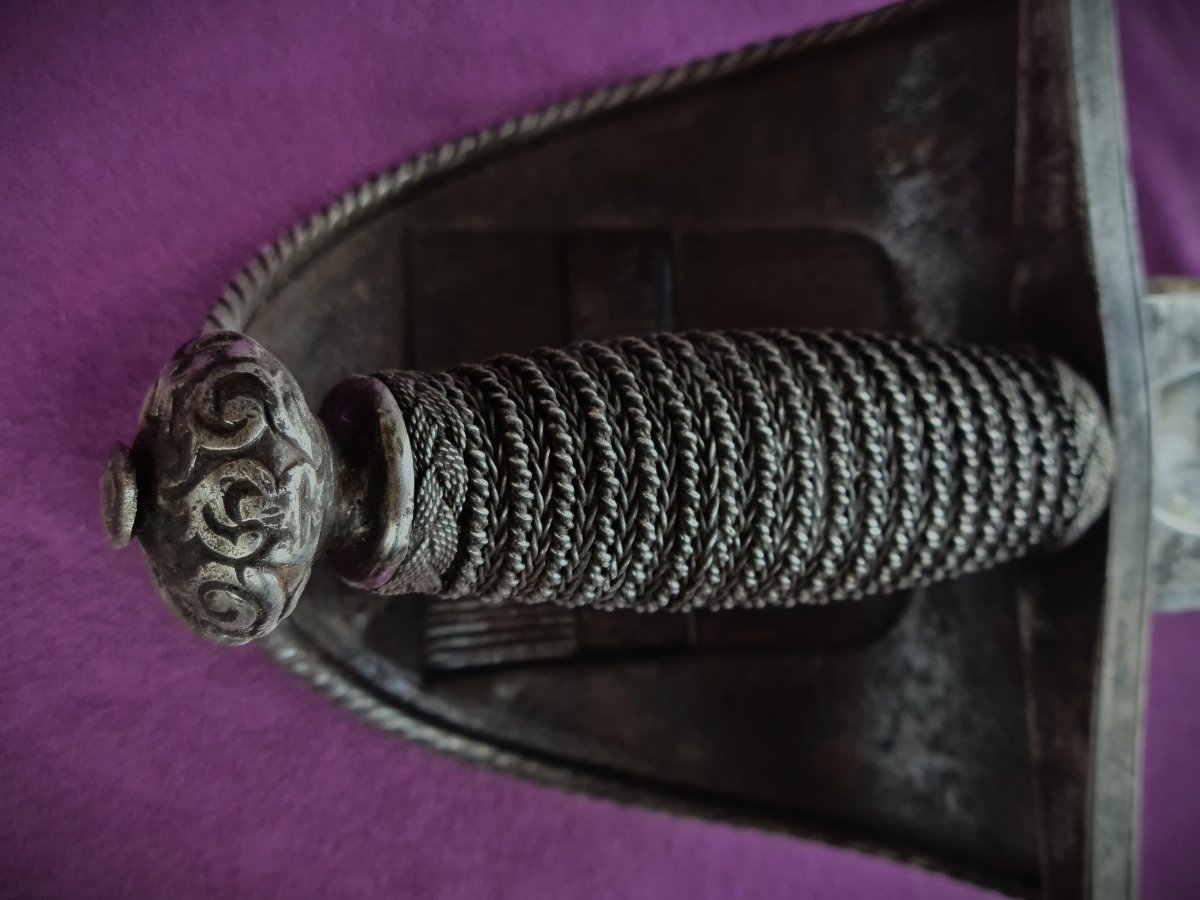
POMMEL: It is shaped like a flattened bulb, chiseled with plant motifs and topped by a small, flattened knob to which the blade tang is riveted.
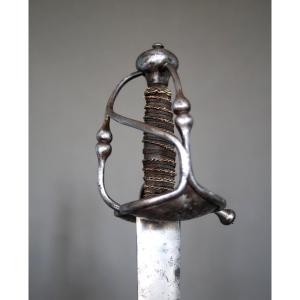
GRIP : It iscovered with intricate wire bindinf, indicative of meticulous craftsmanship. The braided crown-shaped ferrules, known as “Turk's heads,” are present and in perfect condition.
In conclusion, this is a beautiful dagger. My interpretation based ont he coat of arms cannot, of course, be guaranteed 100%, but everything seems to fit, however…
I acquired this dagger in Alsace, in the Vosges region, which is further evidence, since Marie Louise d’Aspremont’s two daughters had connections to this region: Marie-Anne de Mansfeld married, in 1699, the Count Guillaume Florentin of the House of Salm, in the Vosges. The other daughter married her cousin Charles-François de Mansfeld, which brings us back to the same geographical area, on one side or the other of the Rhine. In any case, I can only guarantee with certainty that this dagger is antique, probably from the late17th century, based on the evidence cited. In the worst-case scenario, it ma ybe an unlikely 19th-century fabrication. I therefore guarantee that this dagger is, at a minimum, from the 19th century, with a goodchance that it dates from the very last years of the 17thcentury. The asking price takes this possibility into account
Ref DX-2454
Shipping costs: France €30, Europe €40
BLADE: Following a ricasso on the inner side of which there is a recess designed to support the thumb, there are two holes known as “point breakers” (rompe puntas) The blade then features, on one side, a long cutting edge that extends to the point, and on the other, a thick sback, decorated with intricate scalloped guilloché, designed to prevent an opponent’s blade from slipping. The back then takes the form of a second cutting edge that extends to the tip.
Blade length = 39.4 cm, width at the ricasso 4.5 cm, thickness at the ricasso 4.3 mm
GUARD: It consist son one hand, a central section or “cross” with an octagonal cross-section terminating in two acorn-shaped, faceted quillons. And on the other hand, the guard it self, which is riveted to the quillons of the cross guard, using 17th-century techniques. The edges of this guard are twisted into a cord known as a “brise pointes” and wound around a steel rod, following a classical technique of the period.
The central motif of this veil is a prominent coat of arms, “gules with a cross of argent,” which immediately evokes the coat of arms of Savoy, and which, after research, corresponds here to the coat of arms of the very ancient house Aspremont . The background of thev eil outside the shield is decorated with a very fine dotted pattern, which in heraldry would represent gold This coat of arms on a dagger with a Spanish sail would historically correspond to the arms of Marie-Louise, Countess of Aspremont, wife of Heinrich-Franz von Mansfeld, Prince of Fondi, who from 1683 to 1690 served as ambassador of the Imperial Court of Vienna to the Spanish court. In 1690, this diplomat was invited to a wedding in Valladolid, on the occasion of which he was bestowed numerous gifts and honors. It was therefore likely on this occasion that this dagger was crafted, evoking the coat of arms of his wife, who herself came from a very ancient line of nobility.
The purely honorary purpose of the weapon explains the thinness of the guard, whose defensive role was no longer the primary concern.
POMMEL: It is shaped like a flattened bulb, chiseled with plant motifs and topped by a small, flattened knob to which the blade tang is riveted.
GRIP : It iscovered with intricate wire bindinf, indicative of meticulous craftsmanship. The braided crown-shaped ferrules, known as “Turk's heads,” are present and in perfect condition.
In conclusion, this is a beautiful dagger. My interpretation based ont he coat of arms cannot, of course, be guaranteed 100%, but everything seems to fit, however…
I acquired this dagger in Alsace, in the Vosges region, which is further evidence, since Marie Louise d’Aspremont’s two daughters had connections to this region: Marie-Anne de Mansfeld married, in 1699, the Count Guillaume Florentin of the House of Salm, in the Vosges. The other daughter married her cousin Charles-François de Mansfeld, which brings us back to the same geographical area, on one side or the other of the Rhine. In any case, I can only guarantee with certainty that this dagger is antique, probably from the late17th century, based on the evidence cited. In the worst-case scenario, it ma ybe an unlikely 19th-century fabrication. I therefore guarantee that this dagger is, at a minimum, from the 19th century, with a goodchance that it dates from the very last years of the 17thcentury. The asking price takes this possibility into account
Ref DX-2454
Shipping costs: France €30, Europe €40
980 €
Period: 17th century
Style: Renaissance, Louis 13th
Condition: Excellent condition
Length: 52.3 cm
Width: aux quillons 27.6 cm
Reference (ID): 1793831
Availability: In stock
Print