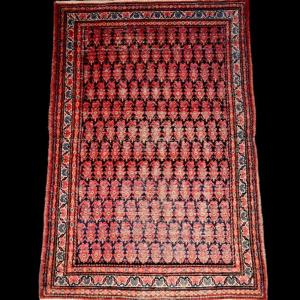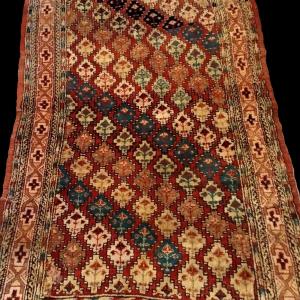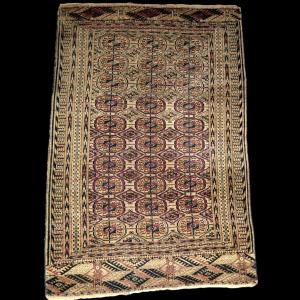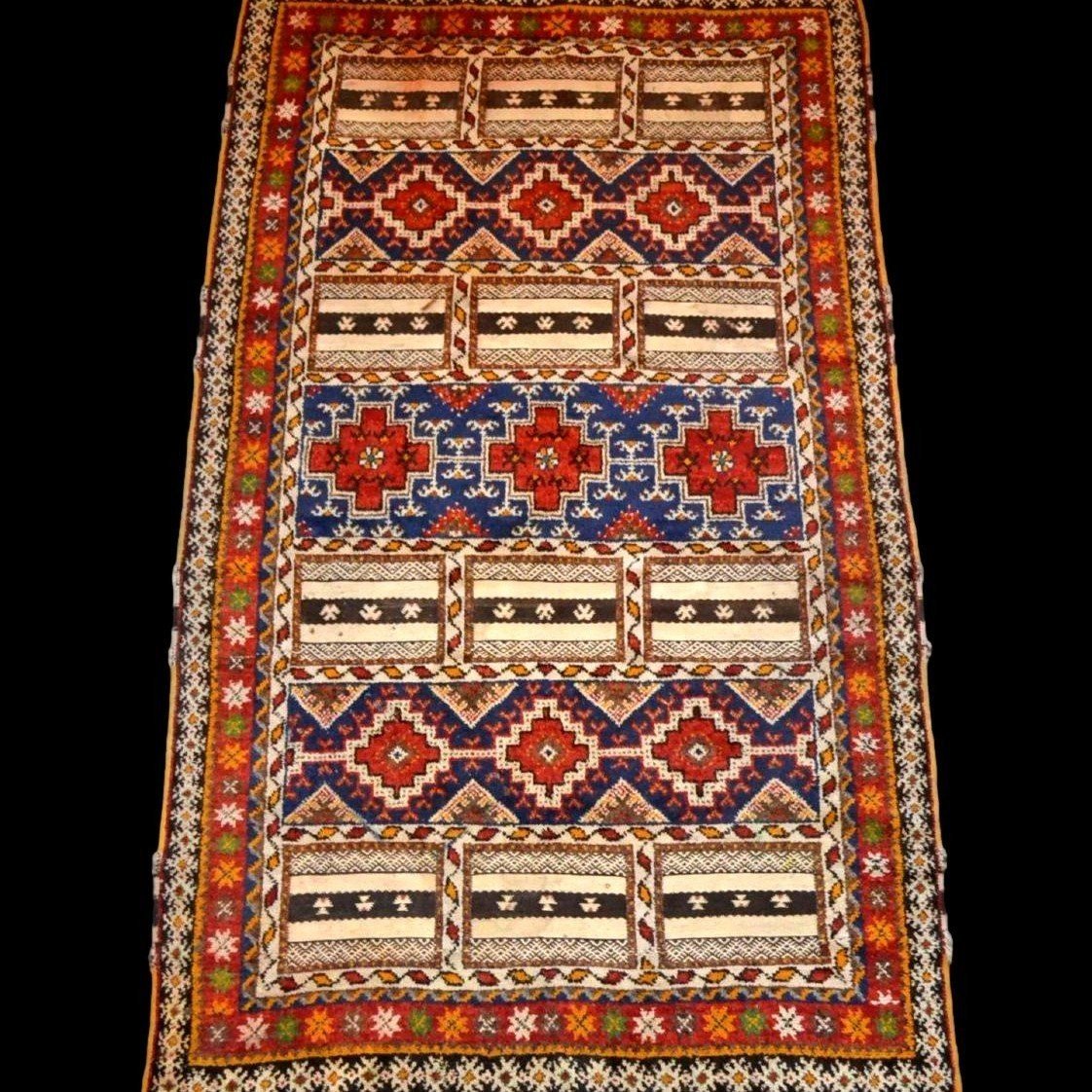
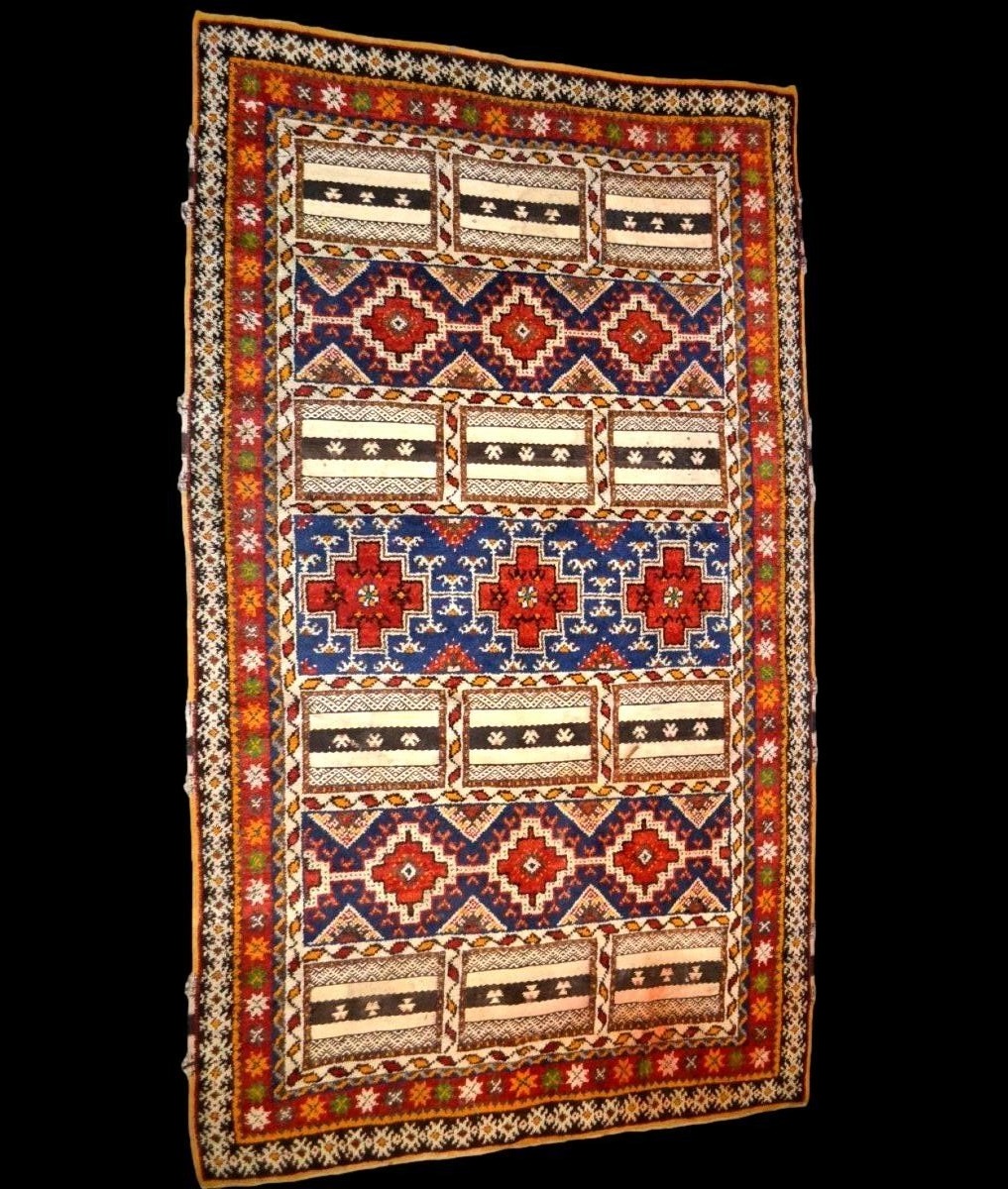
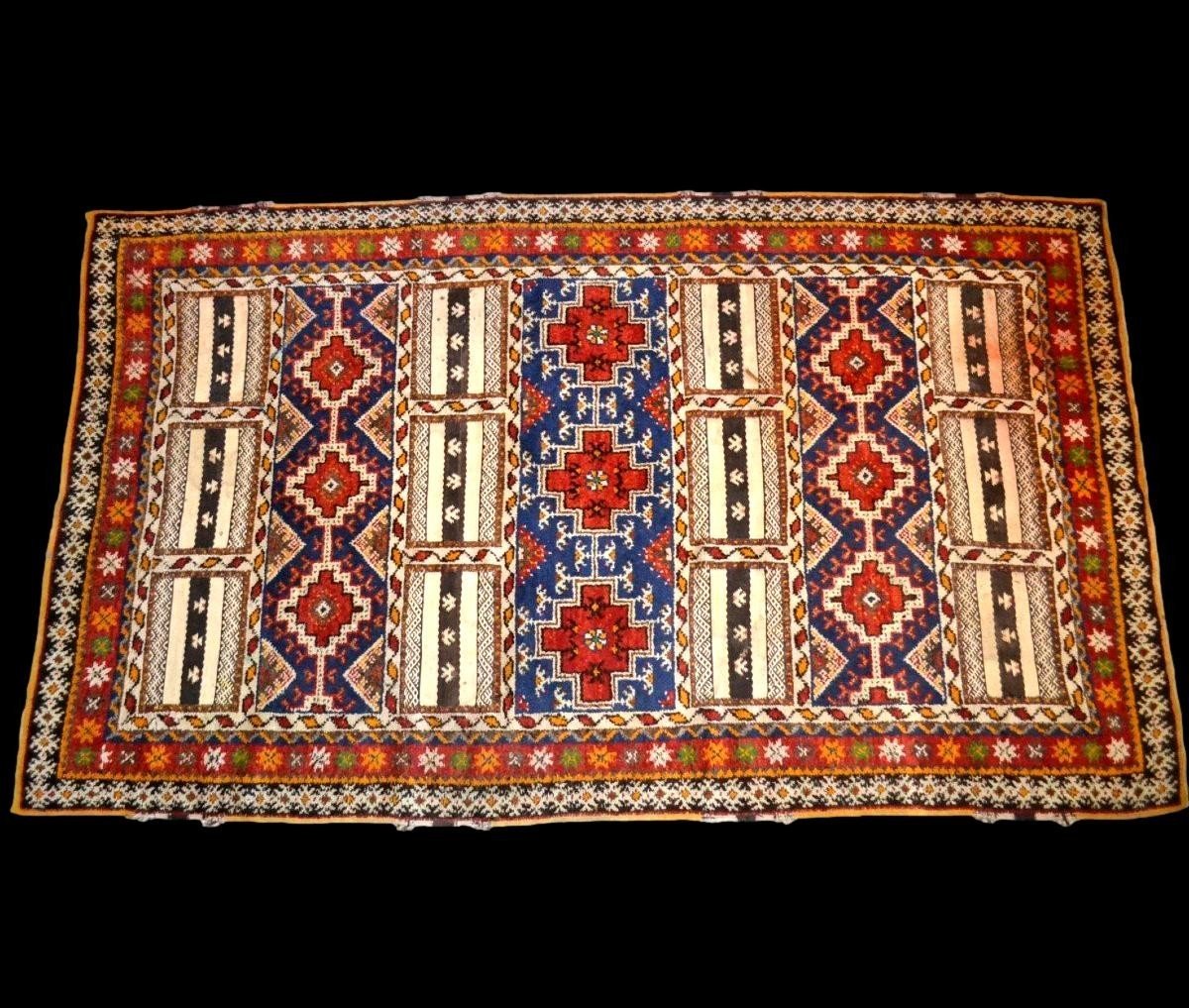
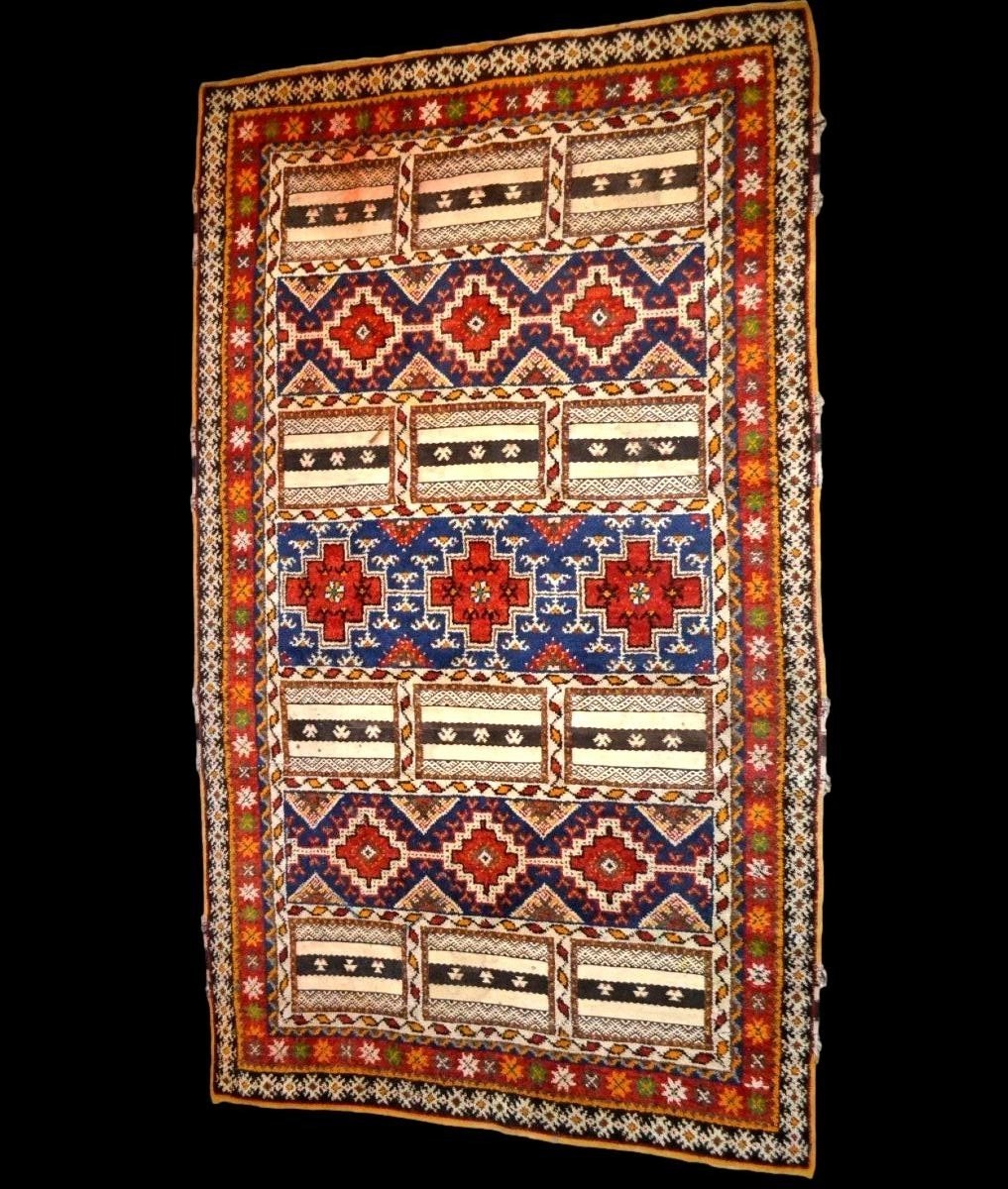
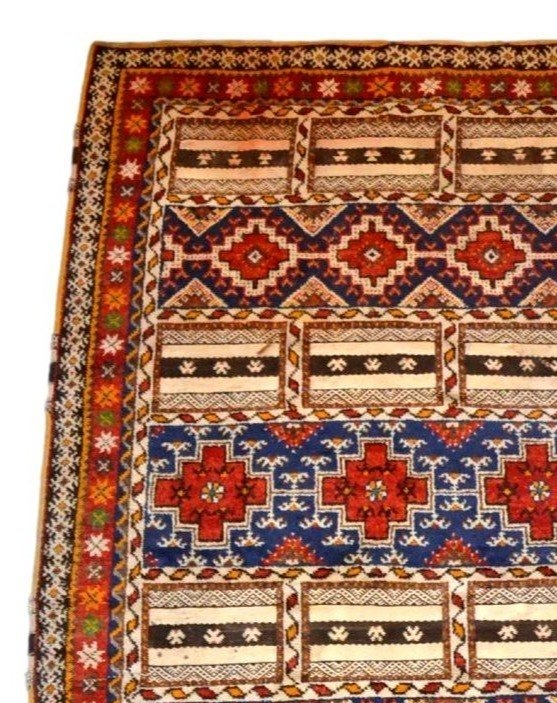
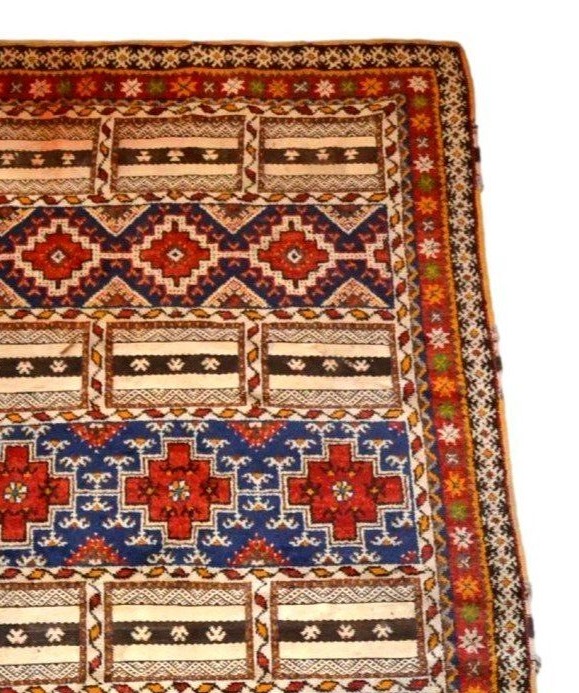
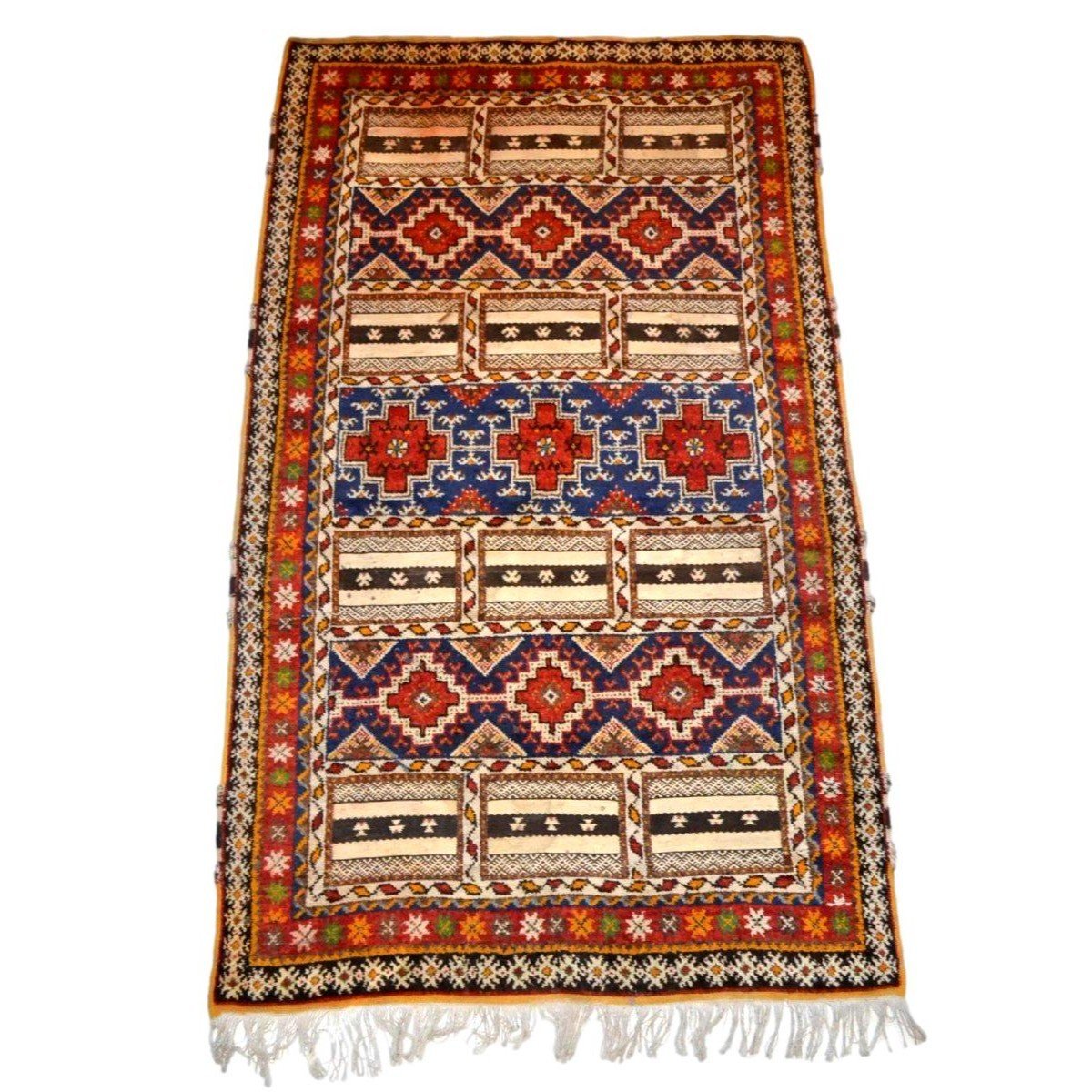
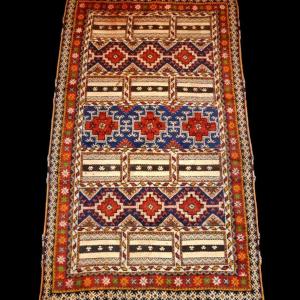


Glaoua Rug, 150 X 260 Cm, Hand-knotted Wool, 1950, Aït Ouaouzguite Berber Women, High Atlas,
Artist: Femmes Berbères Aït Ouaouzguite
Artist : Aït Ouaouzguite Berbers
Hanbel from the High Atlas and Jebel Siroua, made of wool.
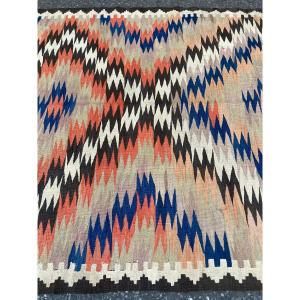
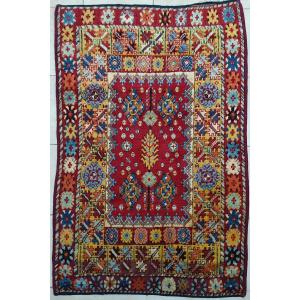
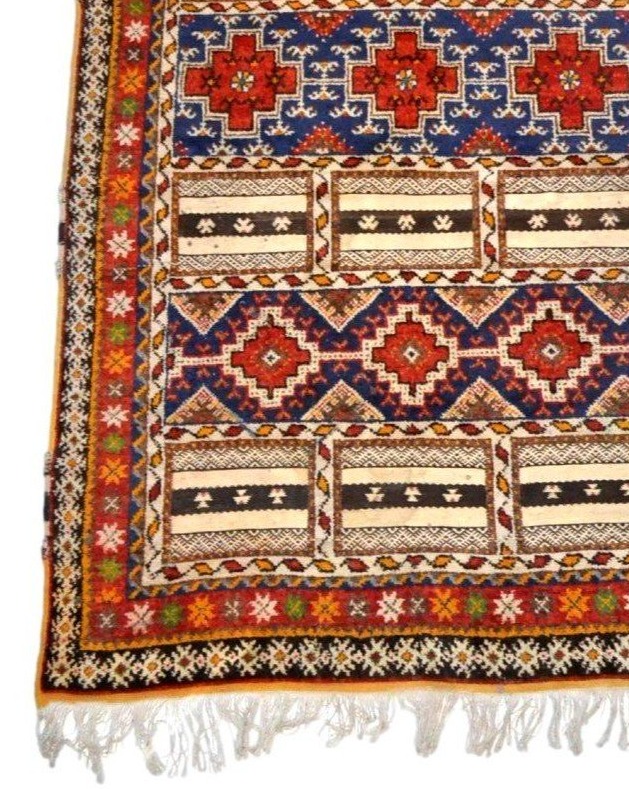
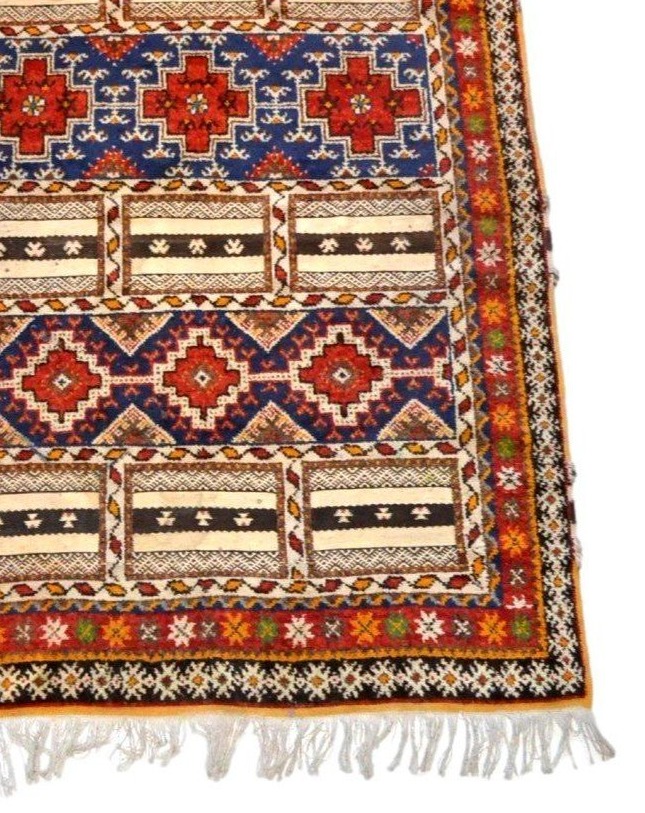
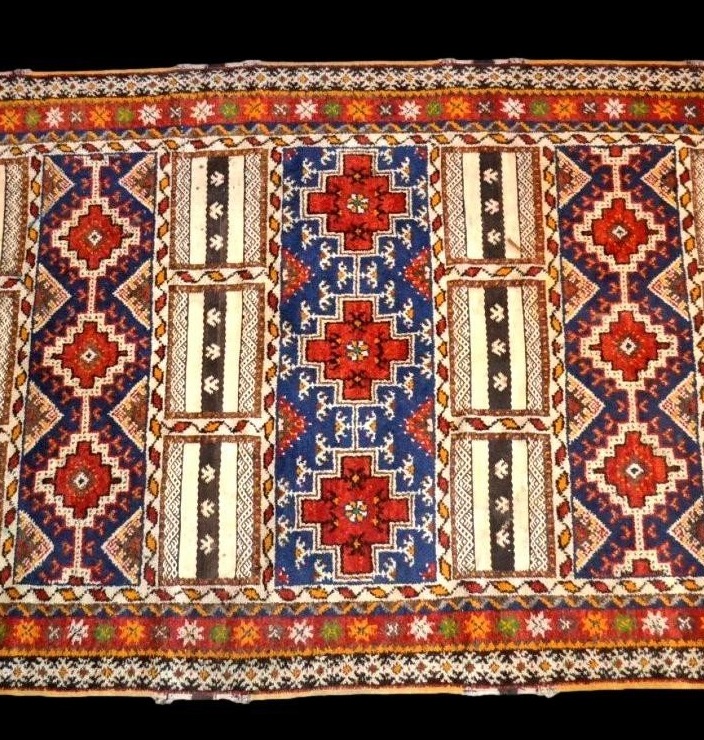
Moroccan rug hand-knotted by Berber women of the Aït Ouaouzguite tribe before 1950.
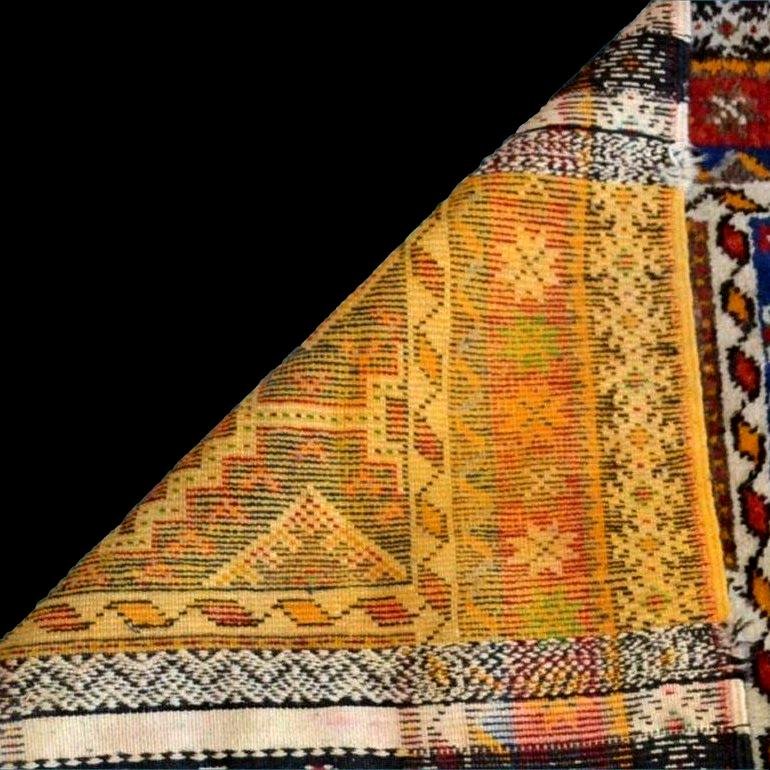
This specific type of rug is unique in that it is produced by combining three different weaving techniques.
The glaoua rug belongs to the Amazigh rug group.
To the best of my knowledge, the technique of flat knotting or weaving combined with cord work is unique to this ethnic group.
This piece is in very good condition, though it shows slight signs of wear due to its age.
One end is finished in the kilim style, the other in fringes; the rug has a curry-yellow weft background.
The colors are entirely natural, derived from plants and minerals.
During the French Protectorate (beginning in 1912), an ambitious policy was implemented to preserve and promote the art of Berber carpet weaving in Morocco.
A Department of Moroccan Crafts and Arts was established to preserve textile techniques and dyes.
This project was carried out by Prosper Ricard, with the support of Marshal Lyautey, who undertook a considerable effort to catalog and preserve Moroccan rugs.
## Lyautey set out to restore the honor and rituals of the Moroccan monarchy, which, though ancient, had been severely undermined by decades of strife and dissent.
A staunch royalist, Lyautey thus restored the trappings of power to the Alawite monarchy.
He was convinced that only a sultan recognized for the prestige of his ancestral traditions could unite the Moroccan people, who until then had been torn apart by incessant tribal separatism.
As a result, the Marshal organized efforts to promote respect for the country’s arts and customs.
A label for artisanal and commercial products was created, and cooperatives were established.
This is why it is possible today to find Moroccan rugs of very high quality.
Amazigh carpets vary depending on the tribes that produce them:
The carpets of the Ait Ouaouzguite tribal confederation, in the Taznakhte region near Ouarzazate, are the best known.
There are Glaoua rugs from the High Atlas region; rugs from the Middle Atlas, known as Achdif, found around Meknes and Rabat among the Zemmour or Zayane tribes; and finally, rural rugs from the Haouz region of Marrakech.
Our rug features the colors typical of this style: white, red, black, golden yellow, orange, and various shades of blue.
This rug is in very good condition and has been professionally cleaned using eco-friendly methods.
Dimensions: Width: 150 cm (59") x Length: 260 cm (102")
FREE SHIPPING TO FRANCE, just like all our rugs!
FRANCE €0 / EUROPE €25 / WORLD 50€
For more information or additional photos, please call me at:
06 13 36 09 30 or email winsteinprovence@gmail.com
.www.winsteinprovence.com
Please note: Text and photos by WINSTEIN, all rights reserved
Hanbel from the High Atlas and Jebel Siroua, made of wool.
Moroccan rug hand-knotted by Berber women of the Aït Ouaouzguite tribe before 1950.
This specific type of rug is unique in that it is produced by combining three different weaving techniques.
The glaoua rug belongs to the Amazigh rug group.
To the best of my knowledge, the technique of flat knotting or weaving combined with cord work is unique to this ethnic group.
This piece is in very good condition, though it shows slight signs of wear due to its age.
One end is finished in the kilim style, the other in fringes; the rug has a curry-yellow weft background.
The colors are entirely natural, derived from plants and minerals.
During the French Protectorate (beginning in 1912), an ambitious policy was implemented to preserve and promote the art of Berber carpet weaving in Morocco.
A Department of Moroccan Crafts and Arts was established to preserve textile techniques and dyes.
This project was carried out by Prosper Ricard, with the support of Marshal Lyautey, who undertook a considerable effort to catalog and preserve Moroccan rugs.
## Lyautey set out to restore the honor and rituals of the Moroccan monarchy, which, though ancient, had been severely undermined by decades of strife and dissent.
A staunch royalist, Lyautey thus restored the trappings of power to the Alawite monarchy.
He was convinced that only a sultan recognized for the prestige of his ancestral traditions could unite the Moroccan people, who until then had been torn apart by incessant tribal separatism.
As a result, the Marshal organized efforts to promote respect for the country’s arts and customs.
A label for artisanal and commercial products was created, and cooperatives were established.
This is why it is possible today to find Moroccan rugs of very high quality.
Amazigh carpets vary depending on the tribes that produce them:
The carpets of the Ait Ouaouzguite tribal confederation, in the Taznakhte region near Ouarzazate, are the best known.
There are Glaoua rugs from the High Atlas region; rugs from the Middle Atlas, known as Achdif, found around Meknes and Rabat among the Zemmour or Zayane tribes; and finally, rural rugs from the Haouz region of Marrakech.
Our rug features the colors typical of this style: white, red, black, golden yellow, orange, and various shades of blue.
This rug is in very good condition and has been professionally cleaned using eco-friendly methods.
Dimensions: Width: 150 cm (59") x Length: 260 cm (102")
FREE SHIPPING TO FRANCE, just like all our rugs!
FRANCE €0 / EUROPE €25 / WORLD 50€
For more information or additional photos, please call me at:
06 13 36 09 30 or email winsteinprovence@gmail.com
.www.winsteinprovence.com
Please note: Text and photos by WINSTEIN, all rights reserved
1 480 €
Period: 20th century
Style: Orientalism
Condition: Excellent condition
Material: Wool
Length: 260 cm - 102"
Width: 150 cm - 59"
Reference (ID): 1792417
Availability: In stock
Print