THIS OBJECT WAS SOLD
Set Of Three Delft Plates, Delft, Netherlands (1764–1778)

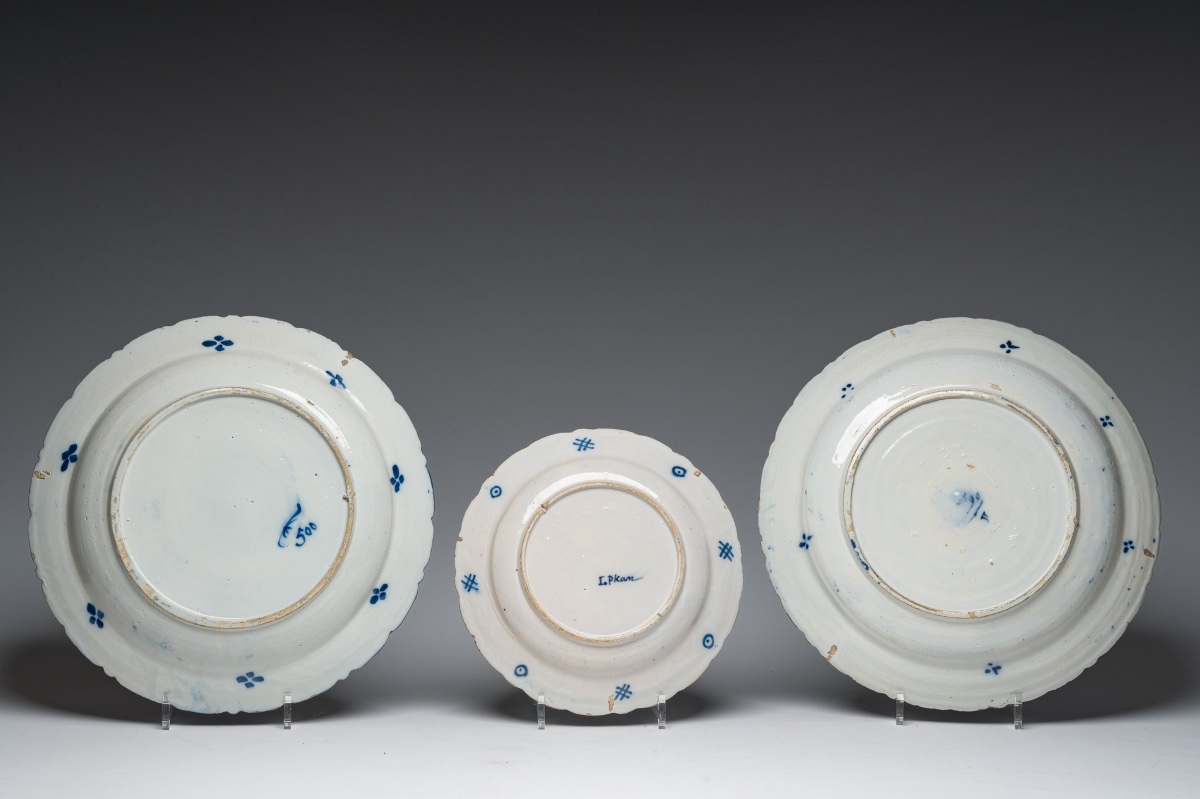


This rare 18th-century set brings together the exceptional craftsmanship of two of Delft’s greatest earthenware manufacturers.
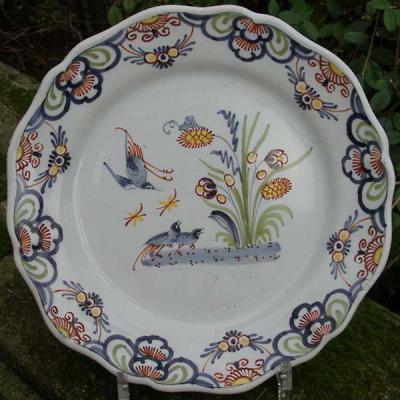
The smallest plate was produced between 1764 and 1778 by the De Lampetkan earthenware factory in Delft and features, in its center, a bird motif depicting a standing heron with both legs submerged in a pond. It is surrounded by a design of peonies and other native plant species. The rising side and scalloped rim are adorned with small floral cartouches separated from one another by a palm leaf. The reverse side of the plate bears the maker’s mark “L.P. Kan,” which refers to the De Lampetkan factory.
The plate on the left features a monumental basket of flowers in the center, filled with peonies, carnations, and stylized leaves. The basket rests on a centered pedestal. The main motif is surrounded by a wide, continuous border composed of large, linked cartouches, rhythmically filled with stylized floral motifs and geometric ornaments. On the back is the De Porceleyne Claeuw mark. The number “500” was applied to the glaze and likely refers to a collection or catalog number that was added only in the 19th century.The saucer on the right is a blue-and-white tea plate typical of the period from 1765 to 1785. The central panel depicts a detailed tree with stylized fan-shaped leaves, among which subtle bird motifs are interwoven. This tree is set against a typical fence adorned with flowers reaching toward the sky. The rising sidewall and scalloped rim are richly adorned with a wide border composed of linked cartouches, filled with floral motifs and geometric cross-hatching, intended to give the piece an Asian character. This saucer was also manufactured by De Porceleyne Claeuw.
About the factories:
The “De Lampetkan” factory was founded in 1609 at the corner of the Nieuwe Langendijk and the Oosteinde in Delft and remained in operation until 1811. The artistic and commercial heyday of this factory occurred during the third quarter of the 18th century. This period coincided with the visionary leadership of the widow Brouwer-van der Hagen, who held the reins from 1756 to 1778. Under her leadership, the factory devoted itself to reproducing exquisite imported Chinese porcelain on refined Dutch earthenware. When the city of Delft enacted a strict trademark law in 1764 to protect the local market, the widow officially registered the “L.P. kan” trademark. The small painters’ crosses on the backs of the plates, as seen on this plate, are also a distinctive feature.
The De Porceleyne Claeuw factory was founded in 1661 and remained in operation until 1840. It gained international renown thanks to its exceptional specialization in imitating precious Asian porcelain. The artistic heyday of this factory coincided with the reign of Lambertus Sanderus, who served as its director from 1763 to 1806. It was also Sanderus who, in 1764, registered the stylized bird emblem as the official trademark.
The smallest plate was produced between 1764 and 1778 by the De Lampetkan earthenware factory in Delft and features, in its center, a bird motif depicting a standing heron with both legs submerged in a pond. It is surrounded by a design of peonies and other native plant species. The rising side and scalloped rim are adorned with small floral cartouches separated from one another by a palm leaf. The reverse side of the plate bears the maker’s mark “L.P. Kan,” which refers to the De Lampetkan factory.
The plate on the left features a monumental basket of flowers in the center, filled with peonies, carnations, and stylized leaves. The basket rests on a centered pedestal. The main motif is surrounded by a wide, continuous border composed of large, linked cartouches, rhythmically filled with stylized floral motifs and geometric ornaments. On the back is the De Porceleyne Claeuw mark. The number “500” was applied to the glaze and likely refers to a collection or catalog number that was added only in the 19th century.The saucer on the right is a blue-and-white tea plate typical of the period from 1765 to 1785. The central panel depicts a detailed tree with stylized fan-shaped leaves, among which subtle bird motifs are interwoven. This tree is set against a typical fence adorned with flowers reaching toward the sky. The rising sidewall and scalloped rim are richly adorned with a wide border composed of linked cartouches, filled with floral motifs and geometric cross-hatching, intended to give the piece an Asian character. This saucer was also manufactured by De Porceleyne Claeuw.
About the factories:
The “De Lampetkan” factory was founded in 1609 at the corner of the Nieuwe Langendijk and the Oosteinde in Delft and remained in operation until 1811. The artistic and commercial heyday of this factory occurred during the third quarter of the 18th century. This period coincided with the visionary leadership of the widow Brouwer-van der Hagen, who held the reins from 1756 to 1778. Under her leadership, the factory devoted itself to reproducing exquisite imported Chinese porcelain on refined Dutch earthenware. When the city of Delft enacted a strict trademark law in 1764 to protect the local market, the widow officially registered the “L.P. kan” trademark. The small painters’ crosses on the backs of the plates, as seen on this plate, are also a distinctive feature.
The De Porceleyne Claeuw factory was founded in 1661 and remained in operation until 1840. It gained international renown thanks to its exceptional specialization in imitating precious Asian porcelain. The artistic heyday of this factory coincided with the reign of Lambertus Sanderus, who served as its director from 1763 to 1806. It was also Sanderus who, in 1764, registered the stylized bird emblem as the official trademark.
Explore similar pieces and discover your ideal find:
Faience Plates & Dinnerware