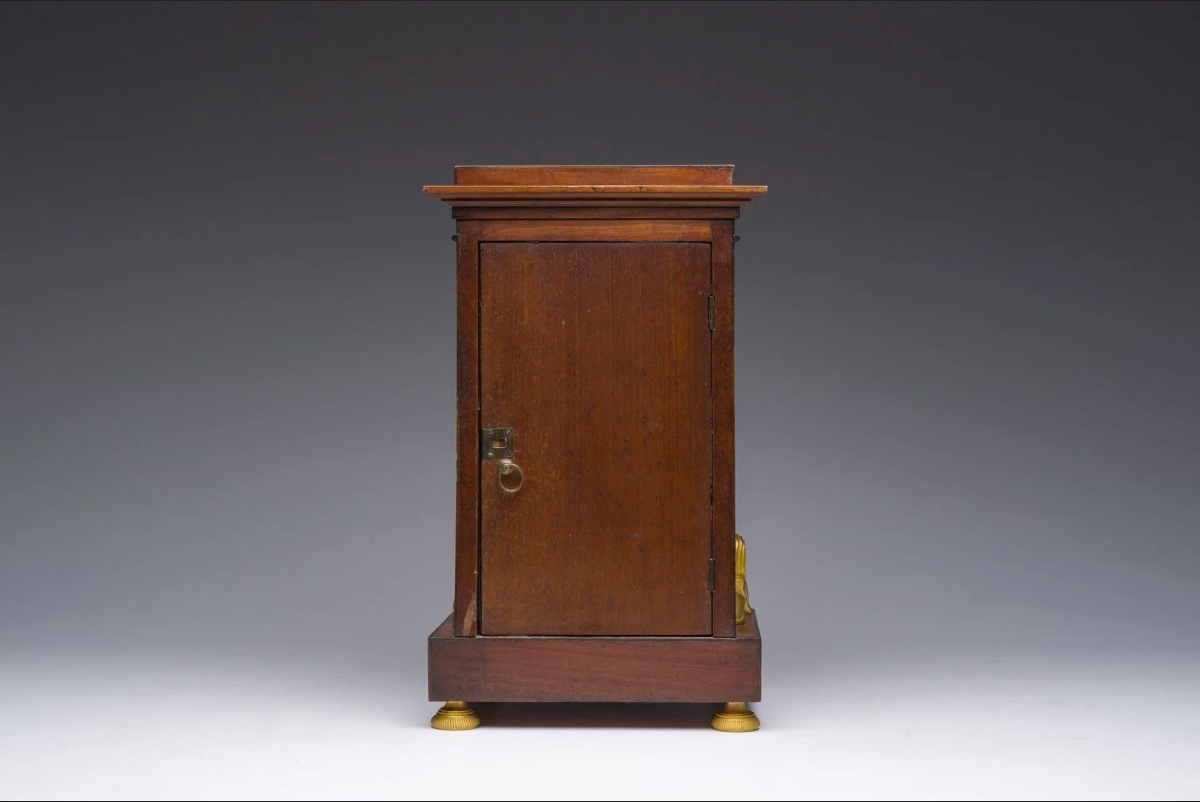


Mahogany Clock, Empire Style, Colin, Paris (1804-1810)
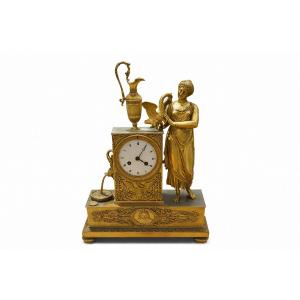
This magnificent clock is a refined example of French craftsmanship, combining functionality and artistic expression. It was made during the French Empire, in the first quarter of the 19th century.
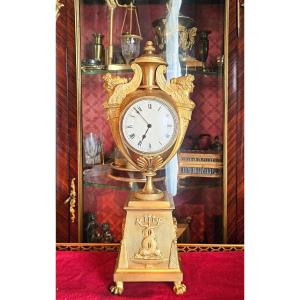
Napoleon's Egyptian campaign sparked a renewed interest in classical antiquity. This is reflected in the two high-quality gilt-bronze sphinxes set in niches at the base of the case. Above the sphinxes, beneath the dial, is a gilt-bronze ornament with swans and floral motifs. The understated mahogany case has a door at the back providing access to the movement and pendulum. The case rests on four gilt-brass spherical feet. The round enamel dial features a slim aperture with Roman numerals for the hours and Arabic numerals for the quarter-hours. The whole is protected by a domed glass set within a guilloché gilt-brass ring.
The dial is signed Colin à Paris. In the archives of Parisian watchmaking, such as Tardy's reference work, Dictionnaire des Horlogers Français (Dictionary of French Watchmakers), the independent watchmaker Colin is mentioned as an active craftsman during the Directory (1795-1799), the Consulate (1799-1804), and the Empire period (1804-1815). His workshop was probably located on the rue du Bac, on the banks of the Seine. As Colin was an independent master who did not produce on a large scale, his authentic pieces are relatively rare and highly prized by collectors of early 19th-century French watchmaking.
Napoleon's Egyptian campaign sparked a renewed interest in classical antiquity. This is reflected in the two high-quality gilt-bronze sphinxes set in niches at the base of the case. Above the sphinxes, beneath the dial, is a gilt-bronze ornament with swans and floral motifs. The understated mahogany case has a door at the back providing access to the movement and pendulum. The case rests on four gilt-brass spherical feet. The round enamel dial features a slim aperture with Roman numerals for the hours and Arabic numerals for the quarter-hours. The whole is protected by a domed glass set within a guilloché gilt-brass ring.
The dial is signed Colin à Paris. In the archives of Parisian watchmaking, such as Tardy's reference work, Dictionnaire des Horlogers Français (Dictionary of French Watchmakers), the independent watchmaker Colin is mentioned as an active craftsman during the Directory (1795-1799), the Consulate (1799-1804), and the Empire period (1804-1815). His workshop was probably located on the rue du Bac, on the banks of the Seine. As Colin was an independent master who did not produce on a large scale, his authentic pieces are relatively rare and highly prized by collectors of early 19th-century French watchmaking.
1 100 €
Period: 19th century
Style: Consulat, Empire
Condition: Good condition
Material: Solid wood
Height: 35,00cm
Reference (ID): 1699277
Availability: In stock
Print