

Meissen Porcelain, Second Half Of The 18th Century, Bolognese Puppy On A Cushion
Meissen porcelain, second half of the 18th century
Bolognese puppy on a cushion
Decorated porcelain, 24 x 22.5 x 14 cm
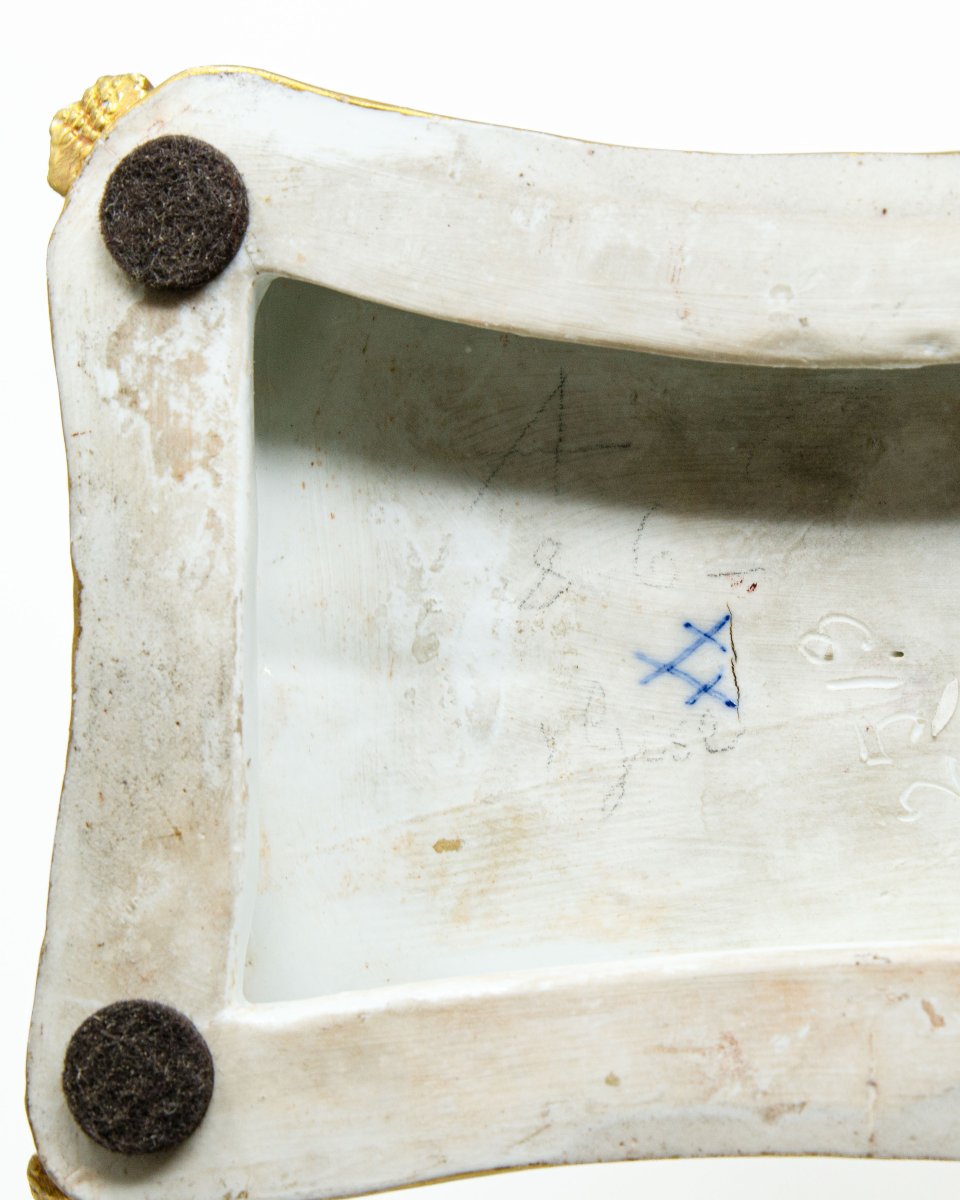
Blue mark in the shape of a pseudo-sword and engraving of model number 2513 on the unglazed underside
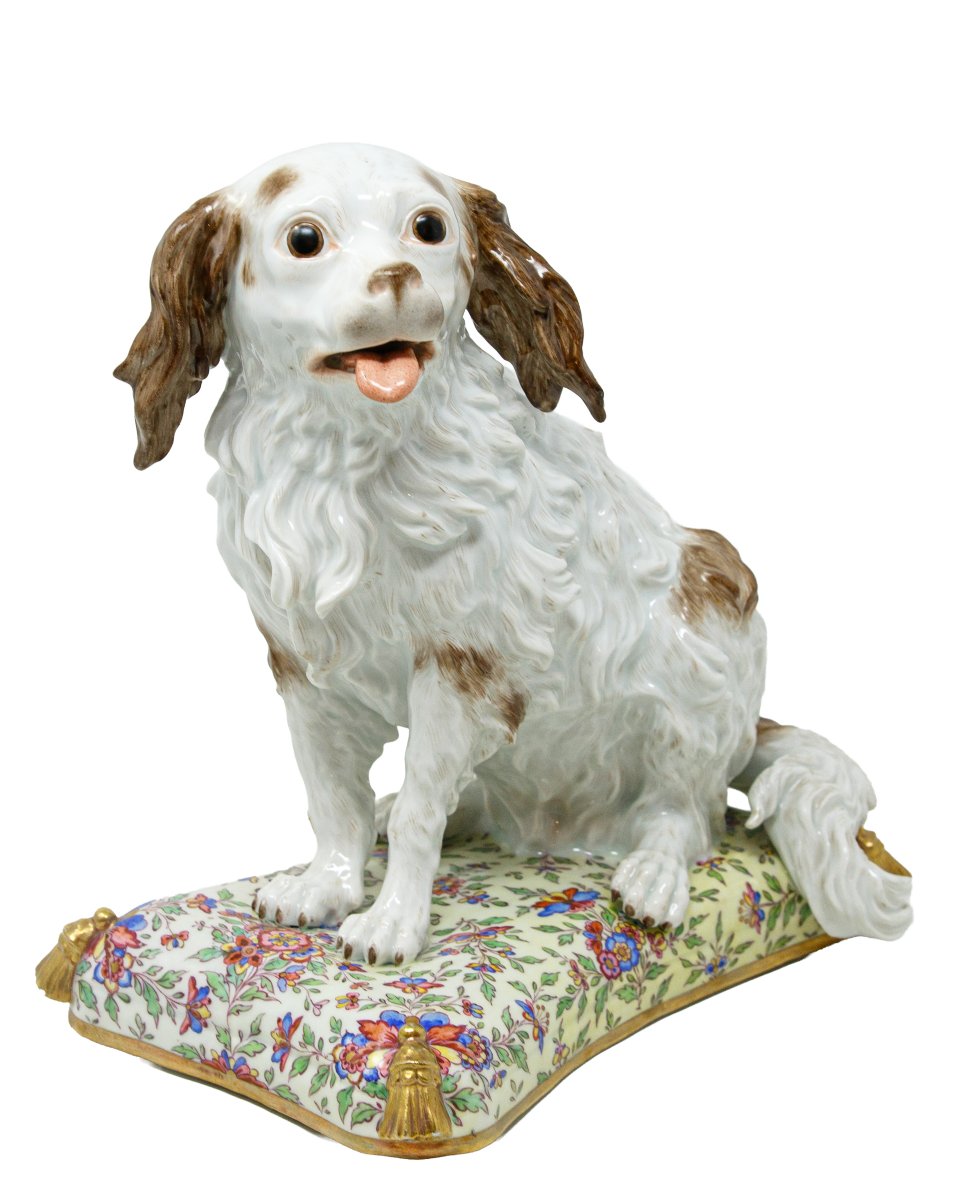
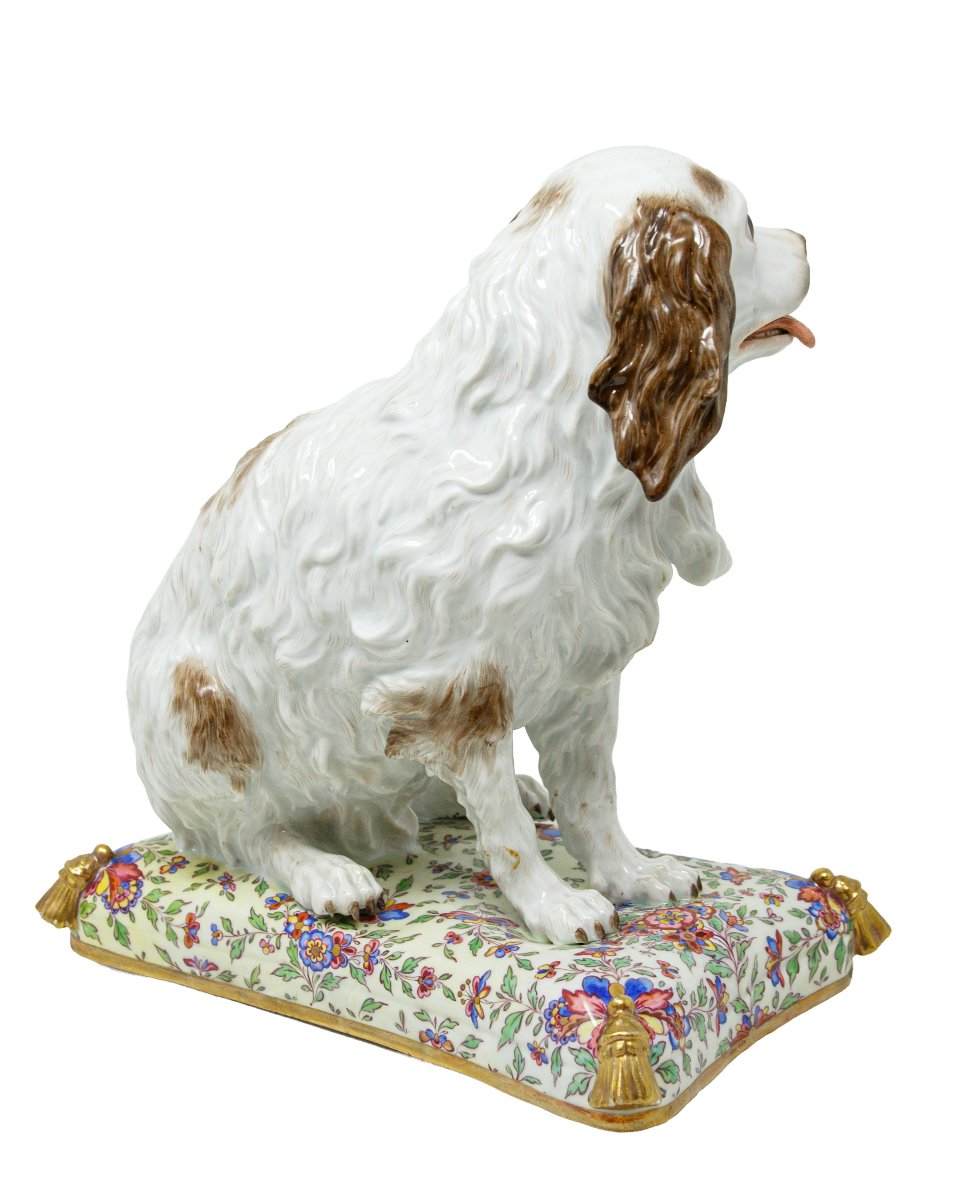
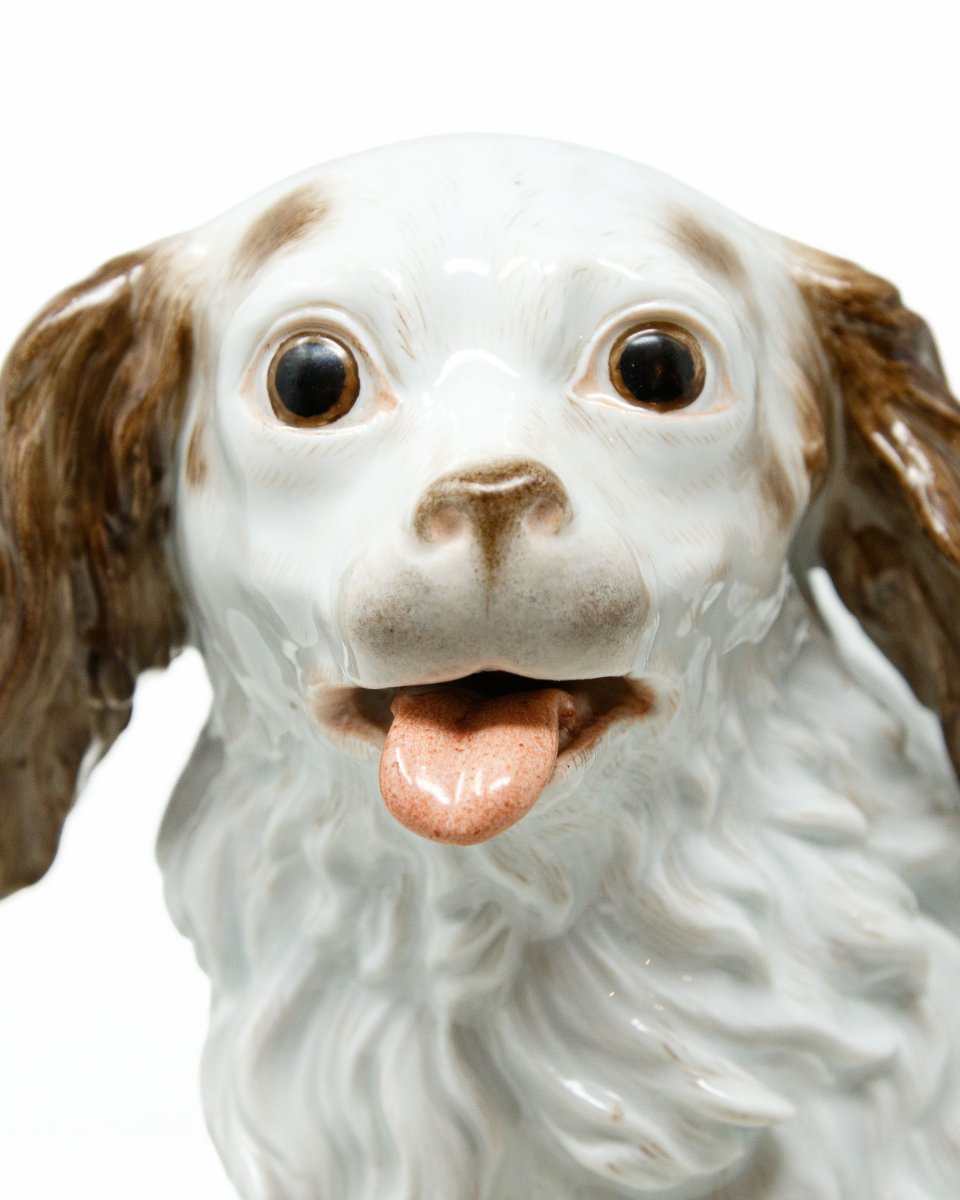
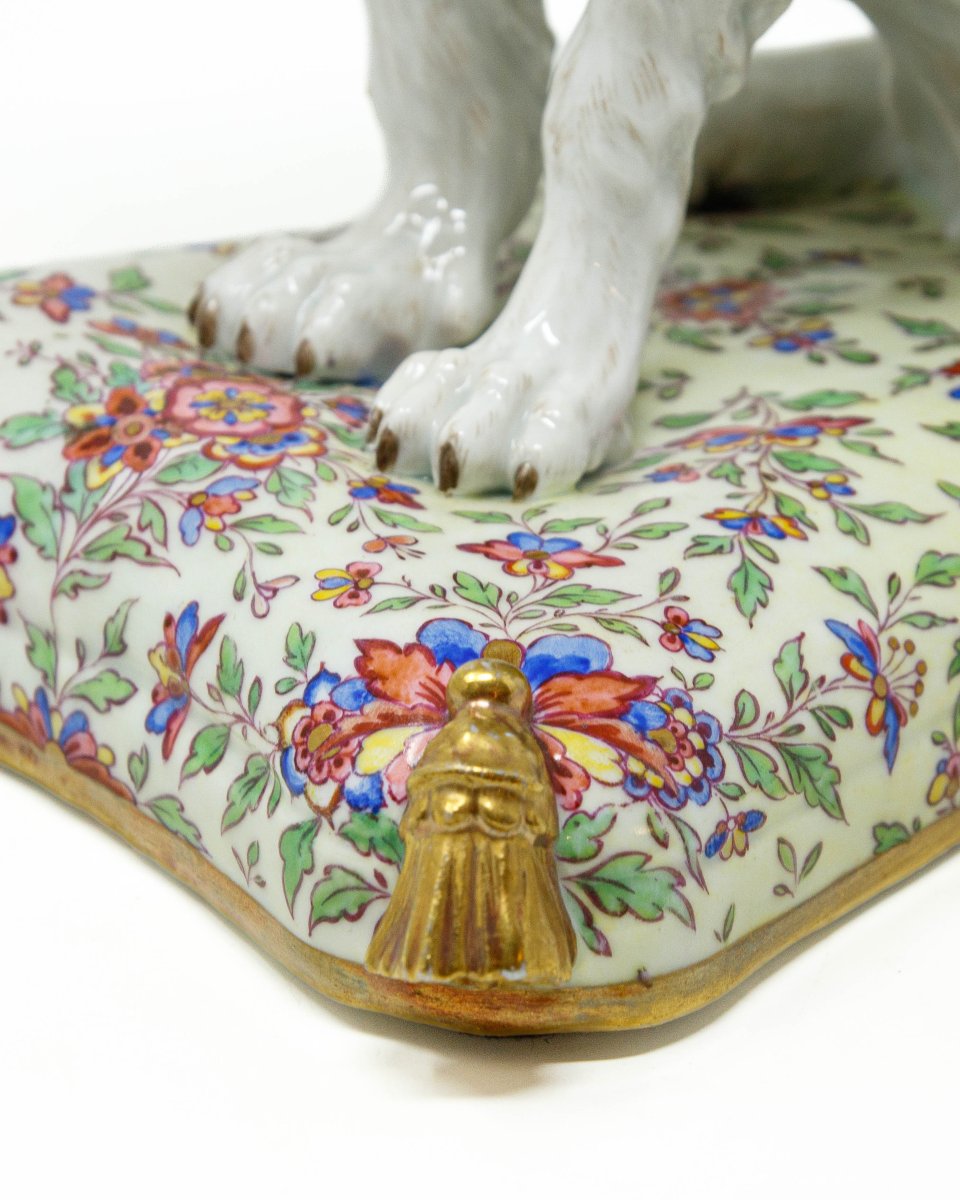
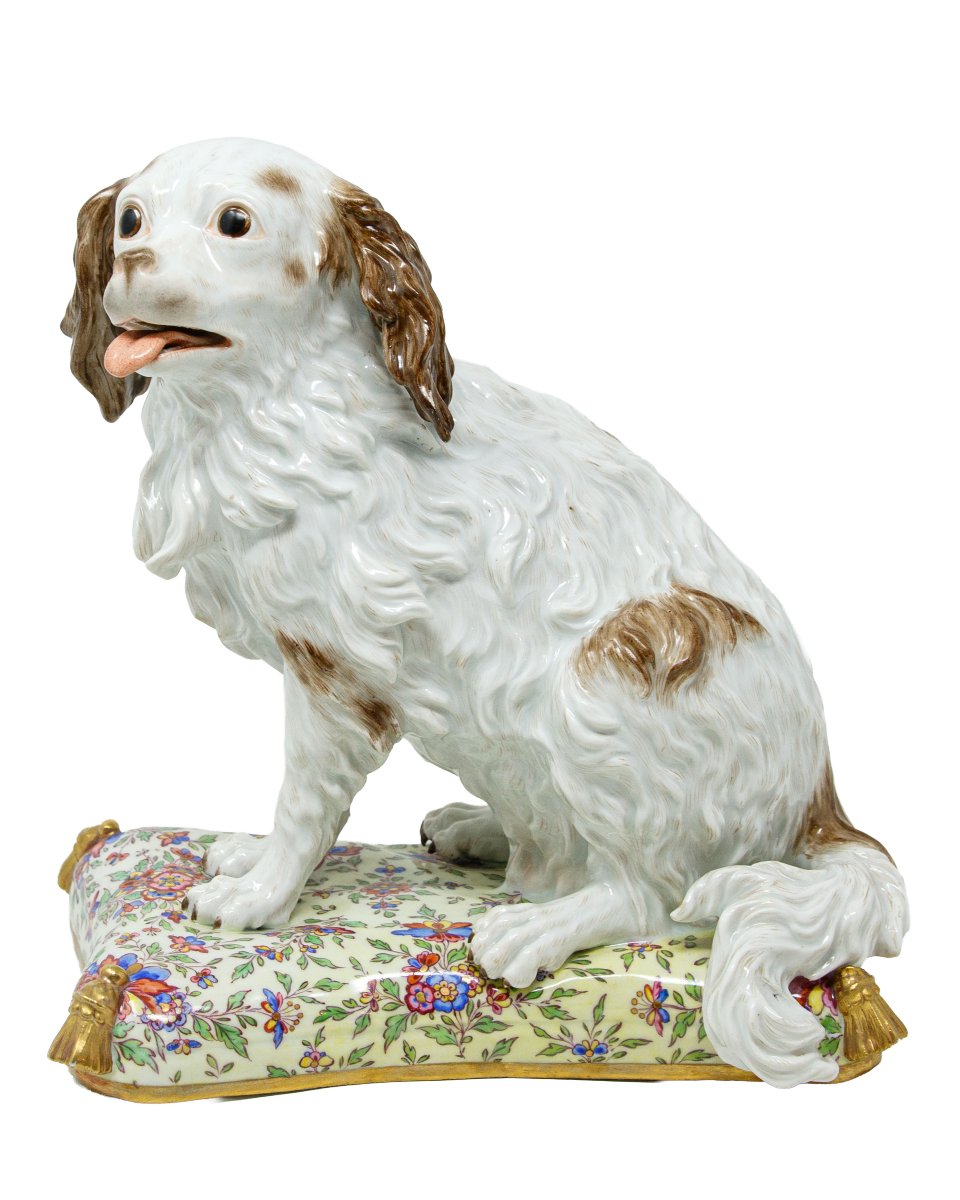
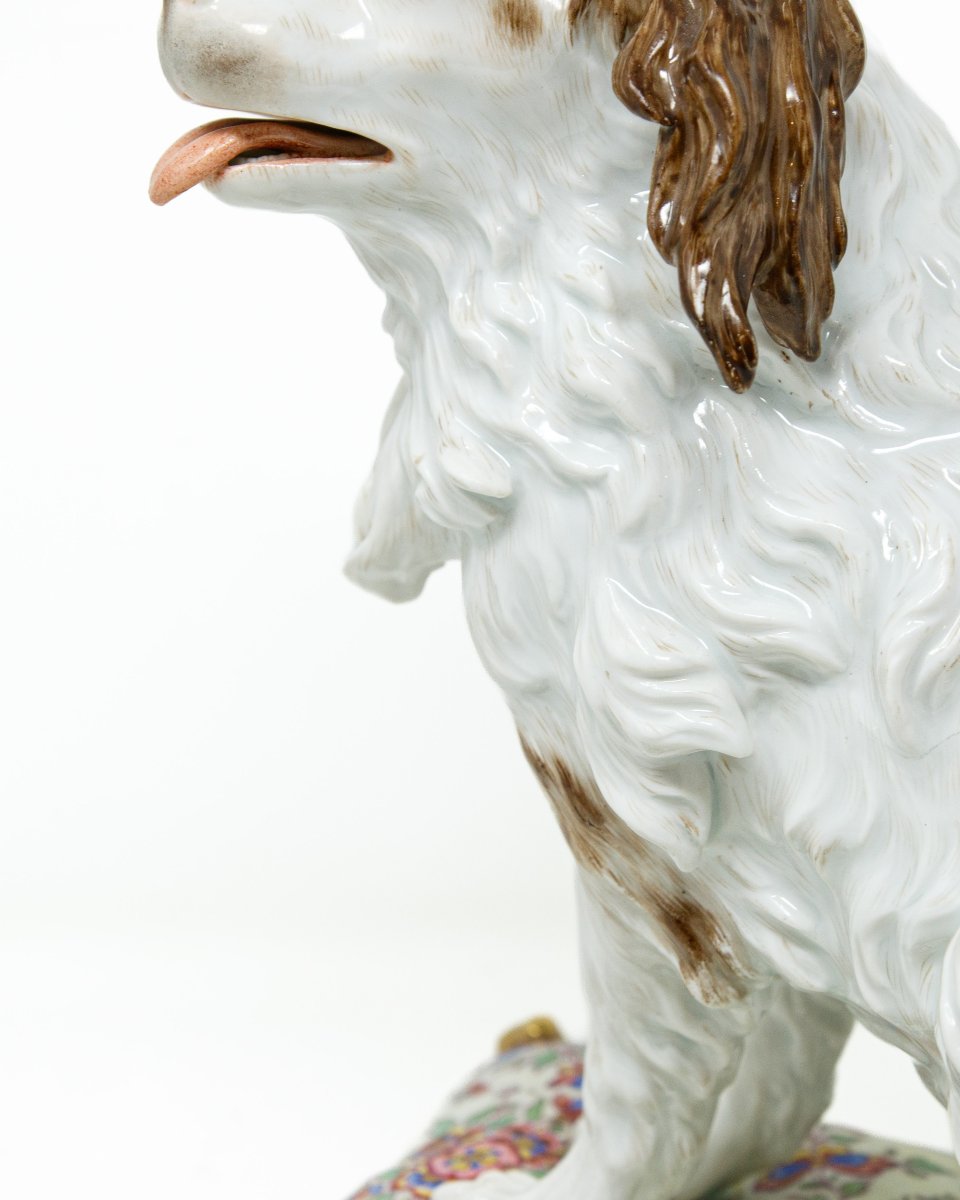
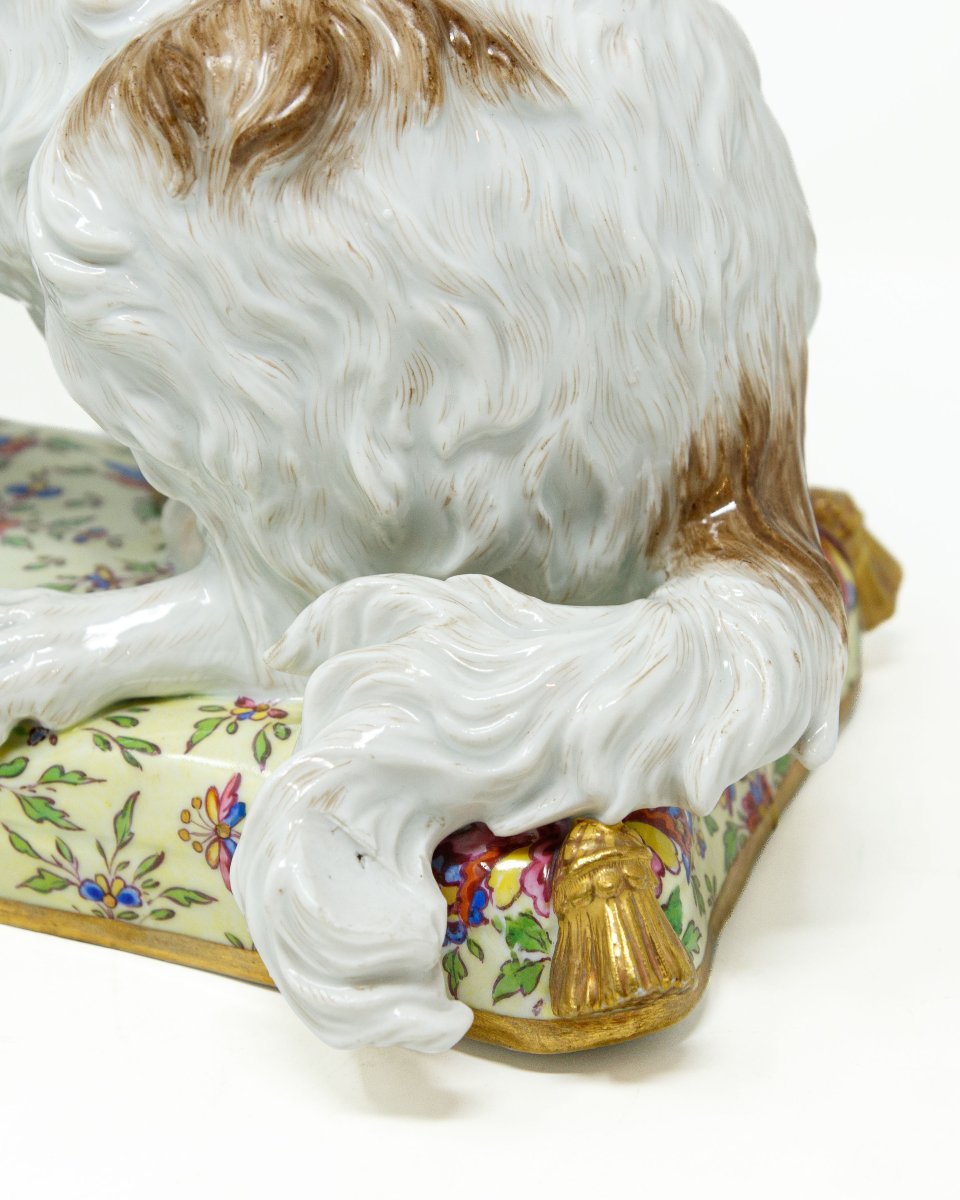
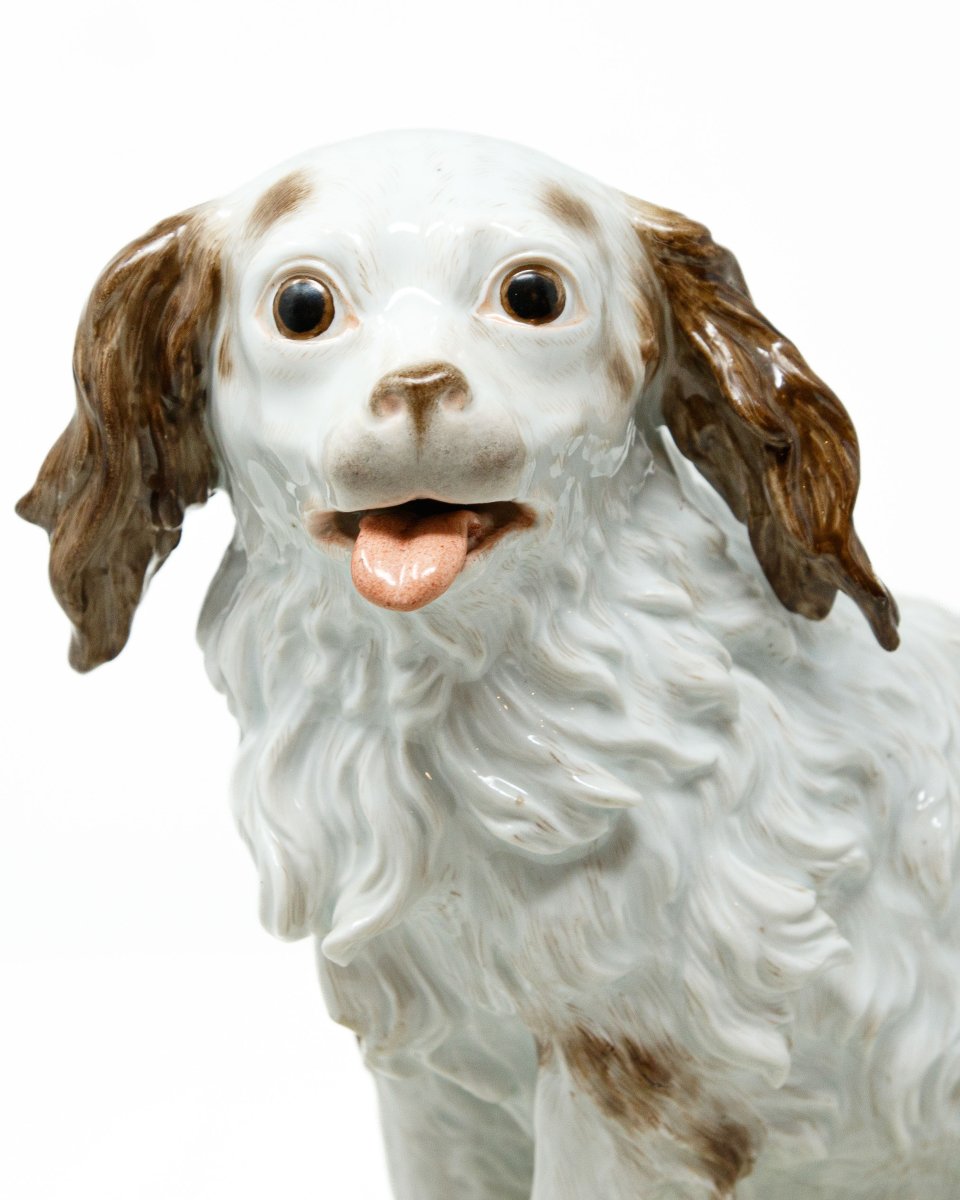
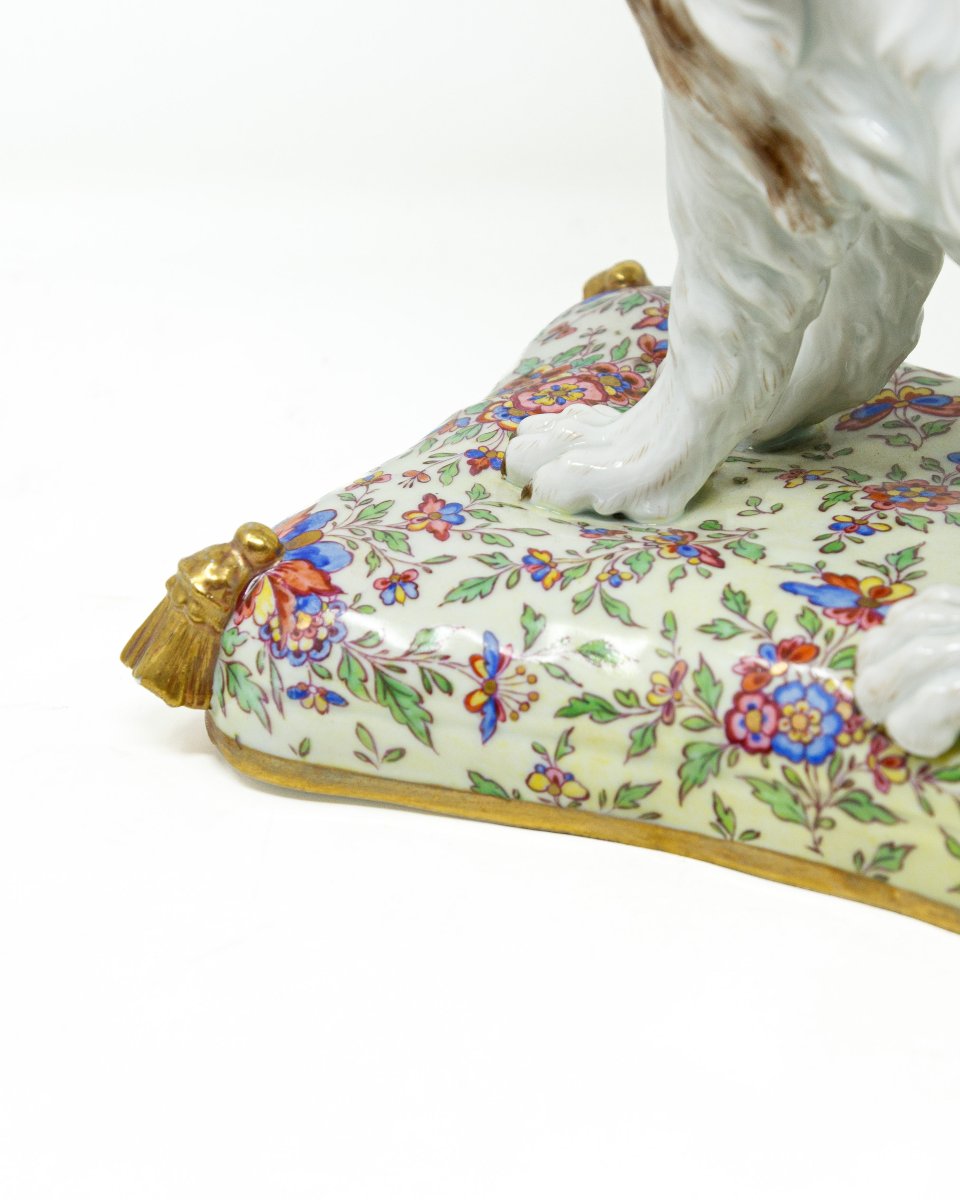
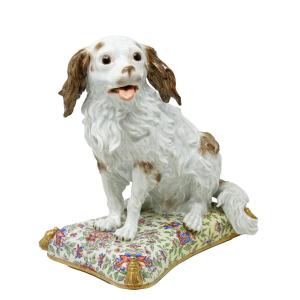
A Bolognese dog in hard-paste Meissen porcelain sits composed on a rectangular cushion, with its pink tongue protruding and its shiny black eyes turned toward the viewer in a lively, almost surprised expression. The animal’s coat is rendered with extraordinary skill: a white background interspersed with wavy locks, speckled with dark brown on the long, drooping ears and along the back, with shading that mimics the softness of the breed’s natural fur. The cushion on which the dog sits is decorated with a dense tapestry of polychrome floral motifs—roses, bluebells, green leaves—on a light yellow background, enlivened at the corners by golden tassels that highlight its precious character and the typically 18th-century taste for meticulous ornamentation. The base is edged in gold, in keeping with a well-established decorative tradition at the famous Saxon manufactory.
The history of Meissen porcelain has its roots in the early 18th century, when the Elector of Saxony, Augustus the Strong, driven by a veritable obsession with Oriental ceramics, funded the research of Ehrenfried Walther von Tschirnhaus and Johann Friedrich Böttger. The latter, who originally presented himself as an alchemist capable of turning metals into gold, found in his collaboration with Tschirnhaus the path to a far more lasting achievement: the creation of European hard-paste porcelain. The Royal Porcelain Manufactory officially opened in 1710 at Albrechtsburg Castle in Meissen, not far from Dresden. The first designs were inspired by Chinese and Japanese porcelain from Arita, but by the 1730s, the manufactory had already developed a completely independent artistic style, thanks above all to the genius of Johann Joachim Kändler, who joined the factory in 1731 and became its chief modeler. Kändler received commissions for numerous dog figurines, and his workbooks attest to an extensive zoomorphic output, revealing his meticulous attention to anatomical accuracy and the psychological characterization of the animals. From 1774 to 1814, artistic direction passed to Camillo Marcolini-Ferretti, who introduced a star into the crossed-swords logo, ushering in the so-called Marcolini period, characterized by an increasingly neoclassical style without compromising the quality of craftsmanship. In 1861, the manufactory was relocated to the Triebisch Valley, where it remains to this day.
The figure of the dog on a flowered cushion with tassels belongs to a series of Kändler-style models that were widely popular in European courts during the second half of the 18th century. A direct comparison can be made with the so-called “Bolognese” dog from Meissen, which appears in various color variations in major museum collections: The Metropolitan Museum of Art in New York holds an example of this type, dating from the first half of the 18th century, which had belonged to a private French collection prior to 1743, attesting to how early these sculptures began circulating among major European collectors. The Louvre in Paris also possesses versions of this model, which differ from the specimen under consideration here in terms of the breed depicted and the decorative details of the cushion. At the Pitti Palace in Florence, there is a Meissen porcelain pug that shares the same compositional approach as our spaniel, though it differs in subject and color palette. Meissen’s Bolognese dogs enjoyed enormous popularity in the 18th century, ranking among the most prized gifts exchanged by the powerful figures of the time. The Bolognese Dog presented here stands out from these comparisons due to the vibrant colors of the floral cushion—which echoes the “Indianischen Blumen” motifs so popular in Meissen production during the second half of the century—and the extraordinary quality of the modeling of the coat. Exemplars identical in design appear very rarely on the antiques market, which confirms its value both historically and as a collector’s item.
Period: 18th century
Style: Other Style
Condition: Good condition
Material: Porcelain
Width: 22,5
Height: 24
Depth: 14
Reference (ID): 1786257
Availability: In stock