

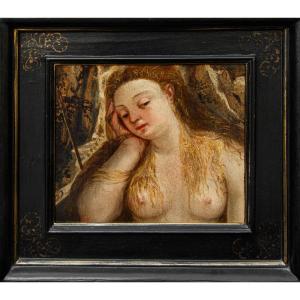


Venetian School Of The 16th Century, Magdalene In The Desert
Venetian School of the 16th century
Magdalene in the desert
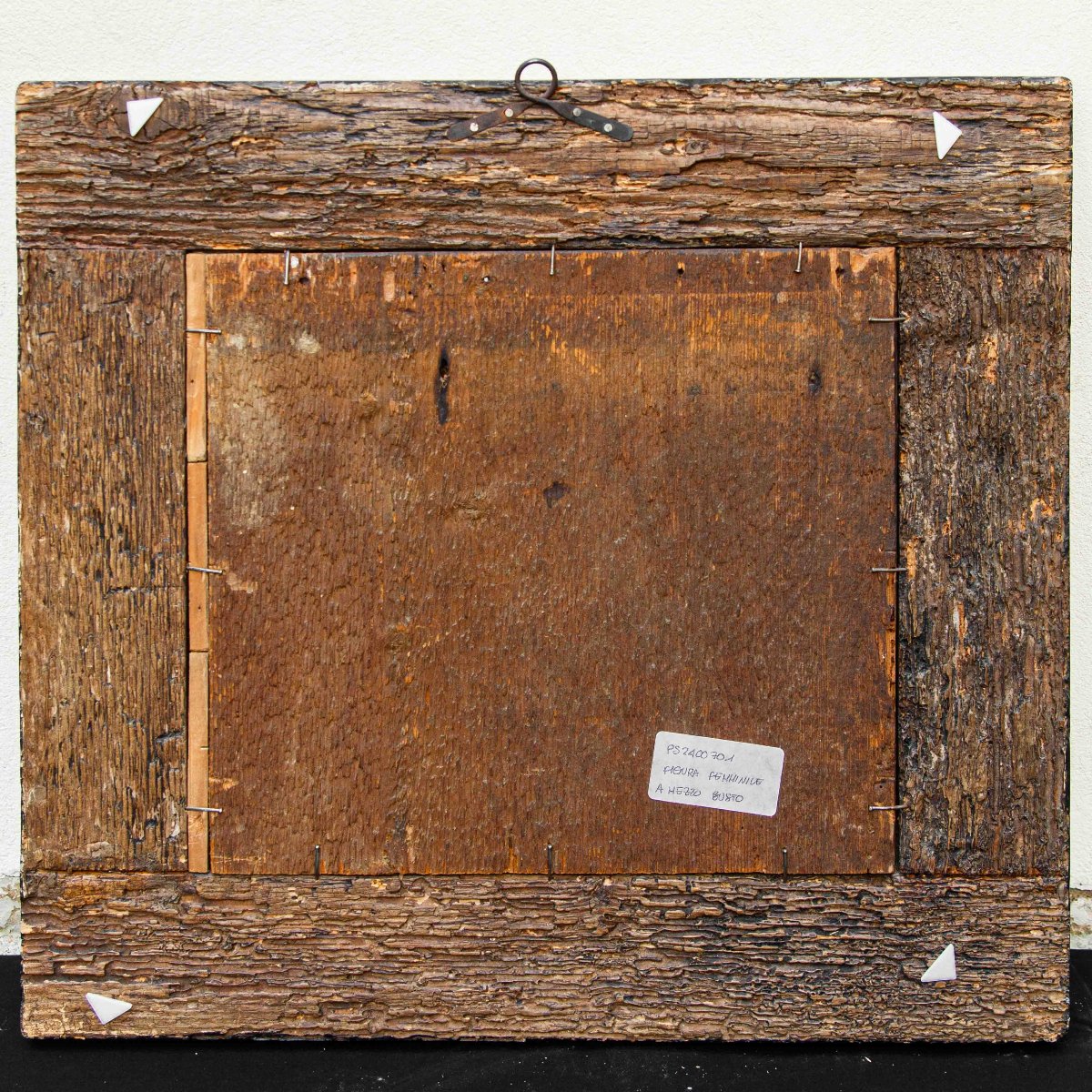
Oil on panel, 30 x 35 cm
With frame, cm 48 x 53
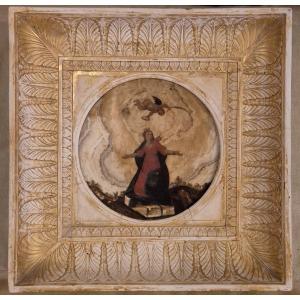
The roots of the legend of the Magdalene in the desert lie in Jacobus de Voragine's Golden Legend, a 13th-century work that collects the lives of the saints. In this narrative, the Magdalene, after the resurrection of Christ, retreats to the desert of Provence, where she leads a life of penance, fasting and prayer. The image of the woman isolating herself from the world to purify the soul captures the collective imagination and becomes a powerful religious archetype. The present depiction, probably originally part of a larger composition, depicts a moment of deep reflection and prayer of the saint. With her head abandoned on one hand she seems lost in her thoughts and reflections often linked to death and resurrection, the transience of life and the uselessness of earthly goods. Next to it, in a landscape that already has few connotations can be recognized as desert, which becomes the symbolic place of solitude, trial and purification, we see the cross, the first testimony of his Christian devotion.
Sixteenth-century Venetian art, with its masters such as Titian, Tintoretto, and Veronese, offered a particularly rich and complex reinterpretation of the iconography of the Penitent Magdalene in the Desert. In this context, the figure of the Magdalene transforms from a simple allegory of repentance to a subject of great charm and complexity, reflecting the cultural and artistic transformations of the period.
Titian is one of the major interpreters of the figure of the Magdalene. In her works, the saint is no longer just a symbol of penance, but becomes a sensual and fascinating figure.
Tintoretto, with his dynamic and dramatic style, offers a more restless and tormented representation of the Magdalene. His figures are often bathed in a bright, contrasting light, which emphasizes their interiority and emotions
The present, clearly influenced by the examples of his greatest masters of sixteenth-century Venice, also seems to look to the art of Francesco Montemezzano (Verona, 1555 – 1600), and to his most incisive and tormented language.
Magdalene in the desert
Oil on panel, 30 x 35 cm
With frame, cm 48 x 53
The roots of the legend of the Magdalene in the desert lie in Jacobus de Voragine's Golden Legend, a 13th-century work that collects the lives of the saints. In this narrative, the Magdalene, after the resurrection of Christ, retreats to the desert of Provence, where she leads a life of penance, fasting and prayer. The image of the woman isolating herself from the world to purify the soul captures the collective imagination and becomes a powerful religious archetype. The present depiction, probably originally part of a larger composition, depicts a moment of deep reflection and prayer of the saint. With her head abandoned on one hand she seems lost in her thoughts and reflections often linked to death and resurrection, the transience of life and the uselessness of earthly goods. Next to it, in a landscape that already has few connotations can be recognized as desert, which becomes the symbolic place of solitude, trial and purification, we see the cross, the first testimony of his Christian devotion.
Sixteenth-century Venetian art, with its masters such as Titian, Tintoretto, and Veronese, offered a particularly rich and complex reinterpretation of the iconography of the Penitent Magdalene in the Desert. In this context, the figure of the Magdalene transforms from a simple allegory of repentance to a subject of great charm and complexity, reflecting the cultural and artistic transformations of the period.
Titian is one of the major interpreters of the figure of the Magdalene. In her works, the saint is no longer just a symbol of penance, but becomes a sensual and fascinating figure.
Tintoretto, with his dynamic and dramatic style, offers a more restless and tormented representation of the Magdalene. His figures are often bathed in a bright, contrasting light, which emphasizes their interiority and emotions
The present, clearly influenced by the examples of his greatest masters of sixteenth-century Venice, also seems to look to the art of Francesco Montemezzano (Verona, 1555 – 1600), and to his most incisive and tormented language.
2 900 €
Period: 16th century
Style: Other Style
Condition: Good condition
Material: Oil painting on wood
Width: 35
Height: 30
Reference (ID): 1668412
Availability: In stock
Print