
Retour De Chasse By René Louis Chrétien (1867-1945)
Artist: René Louis Chrétien (1867-1945)
Retour de chasse
Huile/Toile 61 x46
Very good condition
Signed lower left
Sold with original frame
The work:
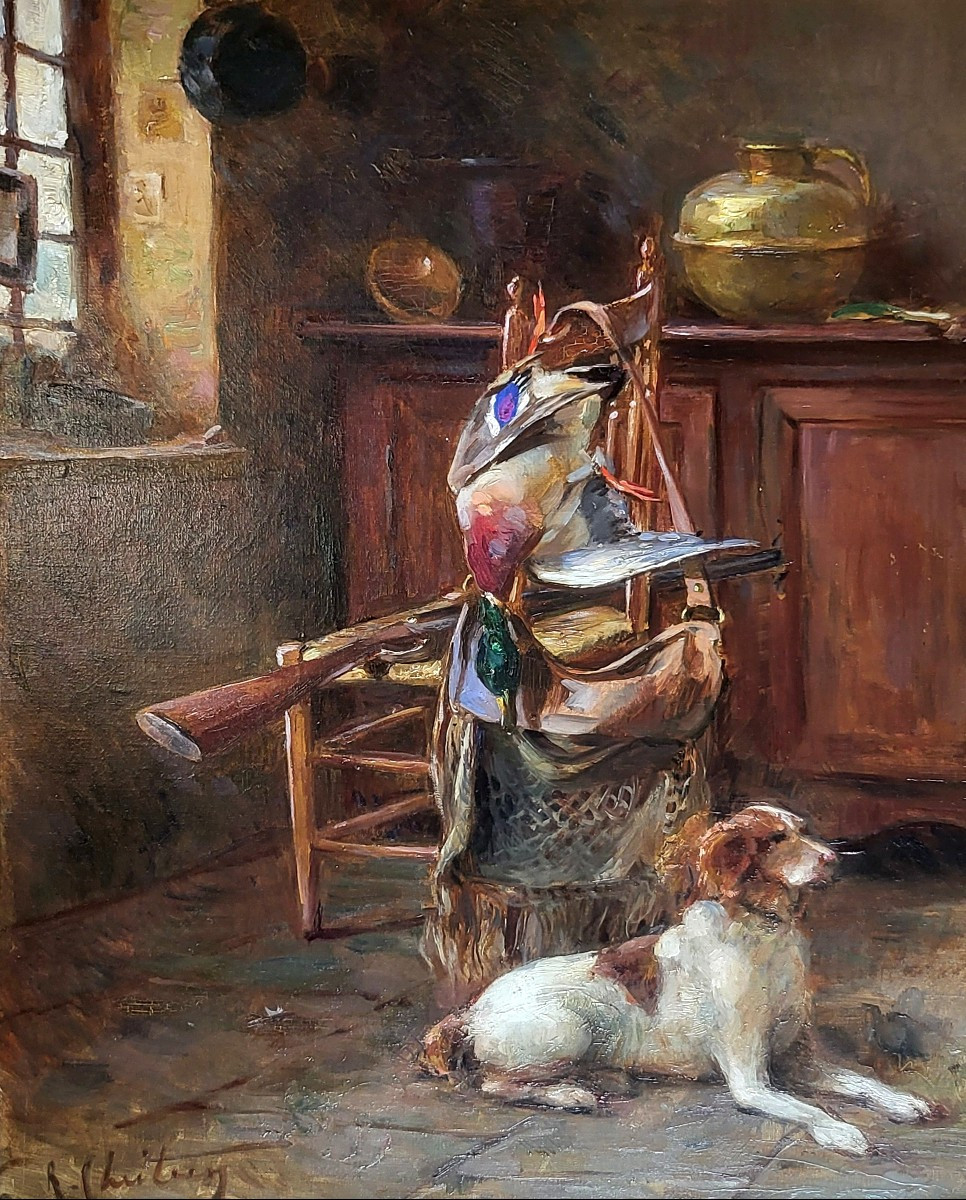
This oil on canvas by René-Louis Chrétien is a virtuoso example of his mastery of genre scenes and still lifes.
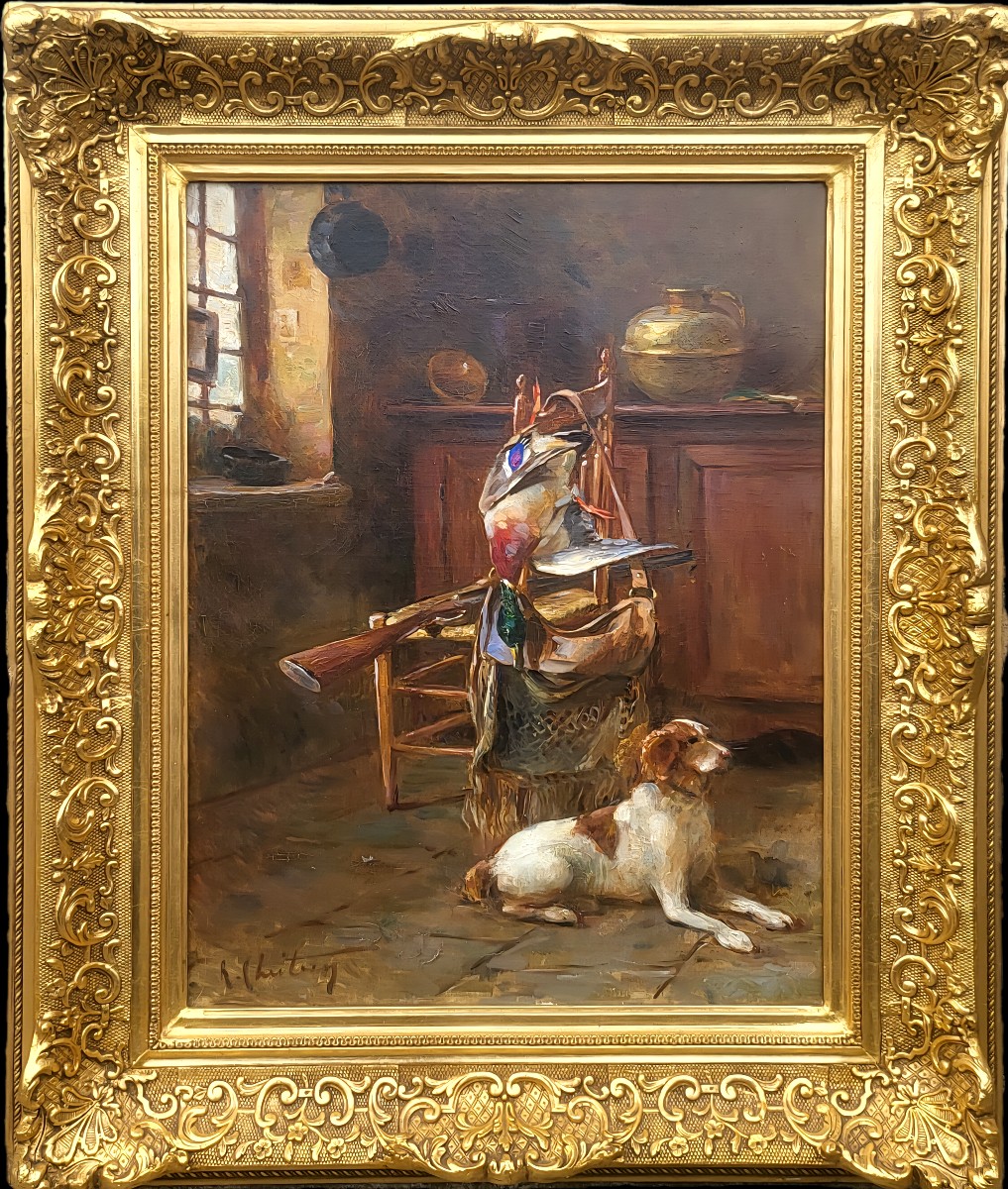
It captures the atmosphere of an interior returning from a hunt, centered on a side chair from which hang, like a deliberate trophy, a mallard and a wood duck (WoodDuck) in brilliant plumage.
A wood-and-metal shotgun rests stably against the ensemble, above a canvas hunting bag and woven basket. The stone floor is partially visible, where a hunting dog, a white and orange spotted pagneul, lies at rest, head attentive, completing the hunting theme.
The background, lit by a mullioned window on the left,reveals other elements: a polished metal ewer and ceramic jug on a rustic wooden cabinet, and a cast-iron frying pan hanging on the wall.
The painting is beautifully framed in its original frame.
The Artist:
René-Louis Chrétien (full name Marie LouisRené Chrétien) was a French painter and pastellist, born on October 2, 1867 inChoisy-le-Roi and died on December 28, 1945 in Rochefort-en-Yvelines.
He is particularly renowned for the excellence of his still lifes, although he also excelled in genre scenes, portraits and landscapes. Trained by the great masters, the son of painter Auguste Clément Chrétien, the young René-Louis was immersed in the artistic milieu from an early age, receiving his first lessons from his father.
Proving his precocious talent, he went on to join prestigious Parisian institutions, the Académie Julian and the École nationale supérieure desbeaux-arts.There, he perfected his technique under the guidance of renowned masters of the time, the pillars of academic art Léon Bonnat, Gustave Boulanger and Jules-Élie Delaunay. He began exhibiting in 1887 at the Salon des Artistes Français, becoming a member the following year.
His technical virtuosity and realistic style quickly won over the public and juries alike. Over the years, he accumulated official distinctions. A prolific artist, he continued to exhibit regularly throughout his life, taking part in the Brussels Exhibition in 1910 and maintaining his presence at the Salon right up to the height of the Second World War (in 1940).
While René-Louis Chrétien painted scenes of daily life (such as shrimp fisherwomen or craftsmen at work) and portraits, his true artistic signature lay in his still lifes. He had a particular gift for depicting everyday objects, food and table settings with almost tactile precision.
The theme of the pantry and table: dusty old wine bottles, glasses, oysters, fruit (strawberries, apples, plums), onions and game.
His works are distinguished by a remarkable mastery of light reflections on glass or pewter, and by a meticulous realism inherited from the Dutch tradition and Chardin.
Parallel to his own production, he played a mentoring role for the younger generation. In particular, he trained the famous Brazilian painter Pedro Alexandrino Borges, a major figure in Brazilian still-life painting.
His works are on display in numerous museums, including the Musée d'Orsay (Paris), as well as the Beaux-Arts museums of Amiens, Caen, Dijon, Reims, Grenoble, La Rochelle, Mulhouse and Saint-Étienne. Abroad: at the Pinacothèque de l'État de São Paulo (Brazil) and the Auckland Art Gallery (New Zealand).
Huile/Toile 61 x46
Very good condition
Signed lower left
Sold with original frame
The work:
This oil on canvas by René-Louis Chrétien is a virtuoso example of his mastery of genre scenes and still lifes.
It captures the atmosphere of an interior returning from a hunt, centered on a side chair from which hang, like a deliberate trophy, a mallard and a wood duck (WoodDuck) in brilliant plumage.
A wood-and-metal shotgun rests stably against the ensemble, above a canvas hunting bag and woven basket. The stone floor is partially visible, where a hunting dog, a white and orange spotted pagneul, lies at rest, head attentive, completing the hunting theme.
The background, lit by a mullioned window on the left,reveals other elements: a polished metal ewer and ceramic jug on a rustic wooden cabinet, and a cast-iron frying pan hanging on the wall.
The painting is beautifully framed in its original frame.
The Artist:
René-Louis Chrétien (full name Marie LouisRené Chrétien) was a French painter and pastellist, born on October 2, 1867 inChoisy-le-Roi and died on December 28, 1945 in Rochefort-en-Yvelines.
He is particularly renowned for the excellence of his still lifes, although he also excelled in genre scenes, portraits and landscapes. Trained by the great masters, the son of painter Auguste Clément Chrétien, the young René-Louis was immersed in the artistic milieu from an early age, receiving his first lessons from his father.
Proving his precocious talent, he went on to join prestigious Parisian institutions, the Académie Julian and the École nationale supérieure desbeaux-arts.There, he perfected his technique under the guidance of renowned masters of the time, the pillars of academic art Léon Bonnat, Gustave Boulanger and Jules-Élie Delaunay. He began exhibiting in 1887 at the Salon des Artistes Français, becoming a member the following year.
His technical virtuosity and realistic style quickly won over the public and juries alike. Over the years, he accumulated official distinctions. A prolific artist, he continued to exhibit regularly throughout his life, taking part in the Brussels Exhibition in 1910 and maintaining his presence at the Salon right up to the height of the Second World War (in 1940).
While René-Louis Chrétien painted scenes of daily life (such as shrimp fisherwomen or craftsmen at work) and portraits, his true artistic signature lay in his still lifes. He had a particular gift for depicting everyday objects, food and table settings with almost tactile precision.
The theme of the pantry and table: dusty old wine bottles, glasses, oysters, fruit (strawberries, apples, plums), onions and game.
His works are distinguished by a remarkable mastery of light reflections on glass or pewter, and by a meticulous realism inherited from the Dutch tradition and Chardin.
Parallel to his own production, he played a mentoring role for the younger generation. In particular, he trained the famous Brazilian painter Pedro Alexandrino Borges, a major figure in Brazilian still-life painting.
His works are on display in numerous museums, including the Musée d'Orsay (Paris), as well as the Beaux-Arts museums of Amiens, Caen, Dijon, Reims, Grenoble, La Rochelle, Mulhouse and Saint-Étienne. Abroad: at the Pinacothèque de l'État de São Paulo (Brazil) and the Auckland Art Gallery (New Zealand).
2 600 €
Period: 20th century
Style: Other Style
Condition: Excellent condition
Material: Oil painting
Length: 61
Width: 46
Reference (ID): 1761494
Availability: In stock
Print