



Caravaca Cross - Chased Bronze - Spain, 17th/18th Century
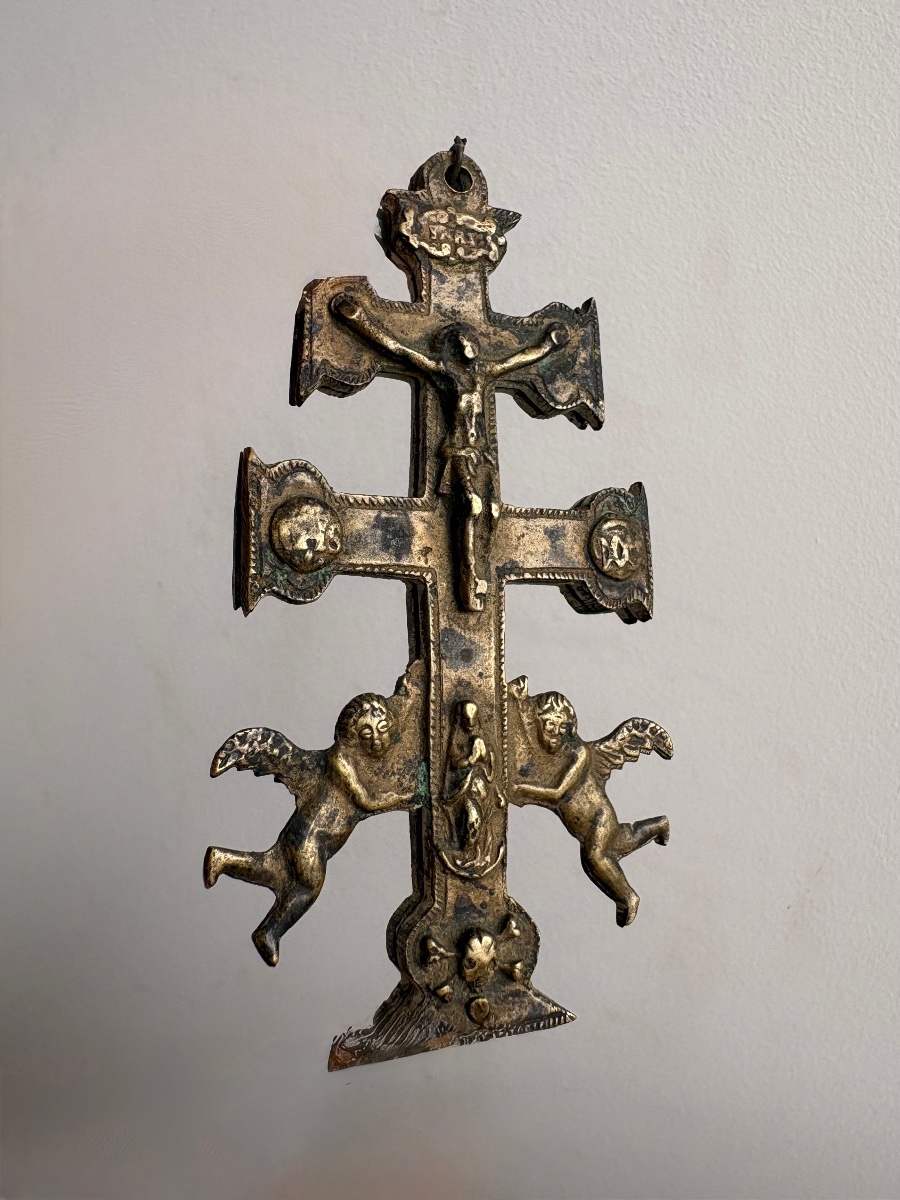
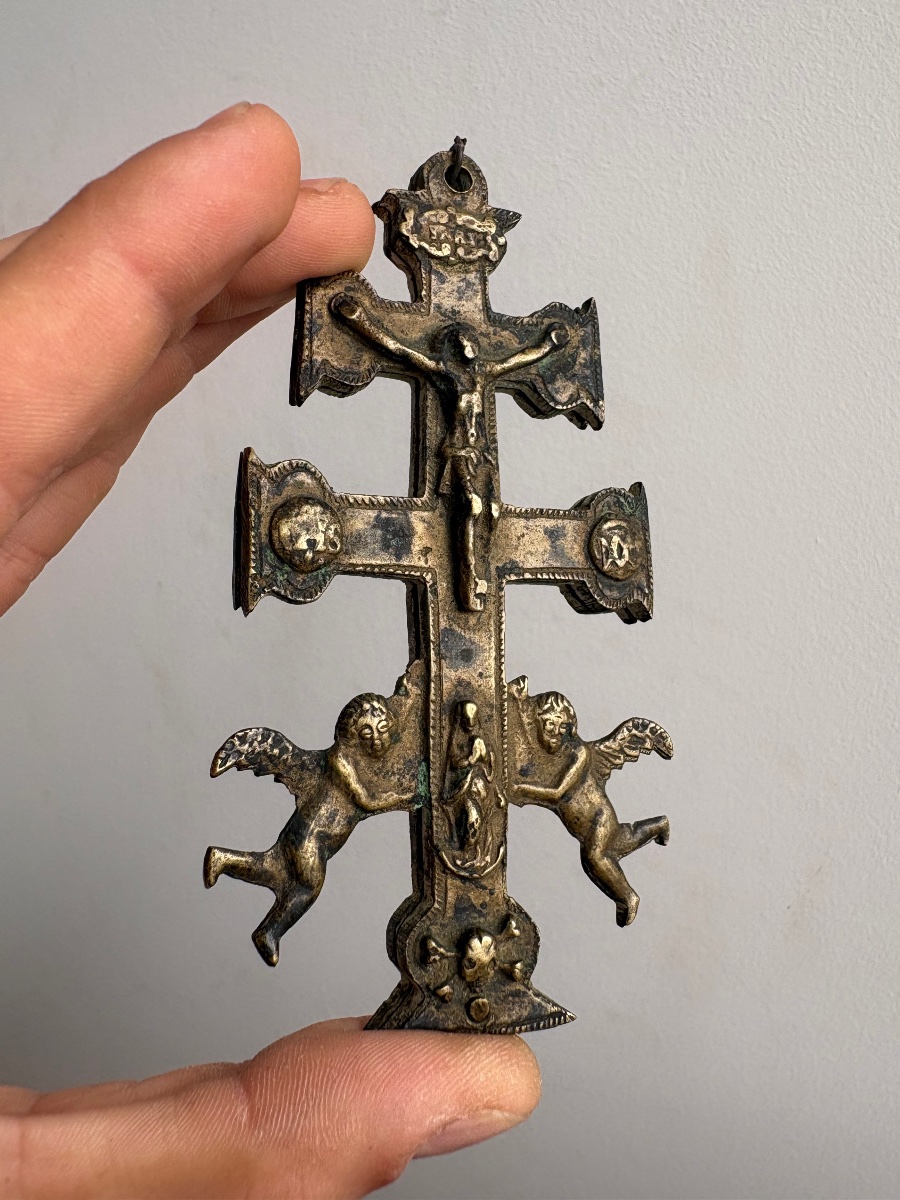
A Caravaca Cross (a patriarchal cross with two crossbars), crafted from cast and chased bronze—a piece typical of Spanish devotional objects from the 17th and 18th centuries.
The iconography of this piece is rich in both theological and artistic depth. It is structured vertically:
- At the top, the titulus bears the inscription "INRI," positioned above the crucified Christ, who wears a perizonium (loincloth) knotted on the right side.
- On the middle crossbar, two raised cartouches flank the central axis, each displaying the monogram "IHS."
- In the lower section, two cherubim with outstretched wings frame a depiction of the Virgin Mary in prayer.
- Finally, the base of the cross is adorned with a Memento Mori motif.
The reverse side features a hollowed-out structure with nine compartments, characteristic of pieces designed to house and carry relics (a reliquary cross). Subtle chased details decorate this side as well.
The original suspension ring at the top has been replaced by an antique wire attachment.
In excellent state of preservation, with a beautiful, aged bronze patina developed through centuries of handling.
Caravaca de la Cruz is a municipality in the autonomous community of the Region of Murcia, Spain. It is considered the fifth "holy city" in the world, following Jerusalem, Rome, Santo Toribio de Liébana, and Santiago de Compostela.
The *Cruz de Caravaca* is a cross-shaped reliquary with two crossbars, said to contain a fragment of the True Cross of Christ. According to tradition, it once belonged to Patriarch Robert, the first bishop of Jerusalem following its conquest from the Muslims during the First Crusade (1099). According to tradition, the cross appeared miraculously in Caravaca on May 3, 1232. At that time, Caravaca was ruled by a Moorish king who held many Christians—including a priest—in his prisons. The priest explained that his role was to celebrate Mass, "during which God Himself offers Himself as a victim for mankind, descending upon the altar at the prayer of His minister." Intrigued, the king ordered him to celebrate Mass in his presence at the palace. The priest replied that certain items were required for the celebration, so the king dispatched a messenger to Cuenca with instructions to retrieve everything that was needed. The priest began the service before the king and his court, but upon approaching the altar, he realized that a cross was missing—and that it was impossible to celebrate Mass without one. Suddenly, amidst a dazzling light, a double-barred cross appeared, carried by two angels. It was later revealed that this was the cross of the Patriarch of Jerusalem. Each year, from May 1st to 5th, Caravaca hosts festivities to commemorate this miraculous event. Since the miracle, the town has become a significant pilgrimage site in Europe; it is likely that pilgrims who visited would bring back such crosses as a memento of their journey.
Free shipping within metropolitan France. Please contact me preferably via email. I remain at your disposal should you require any further information.
Period: 18th century
Style: Other Style
Condition: Excellent condition
Material: Bronze
Length: 11.5cm
Width: 6cm
Reference (ID): 1742692
Availability: In stock