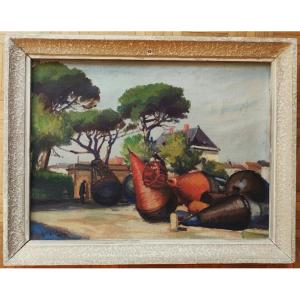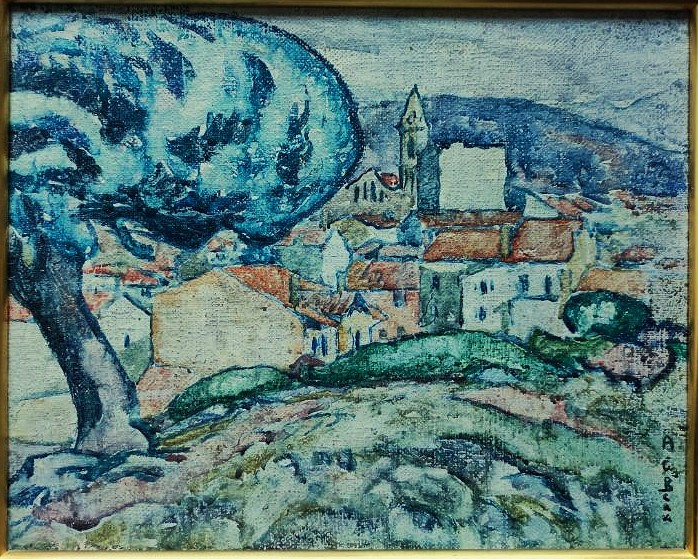
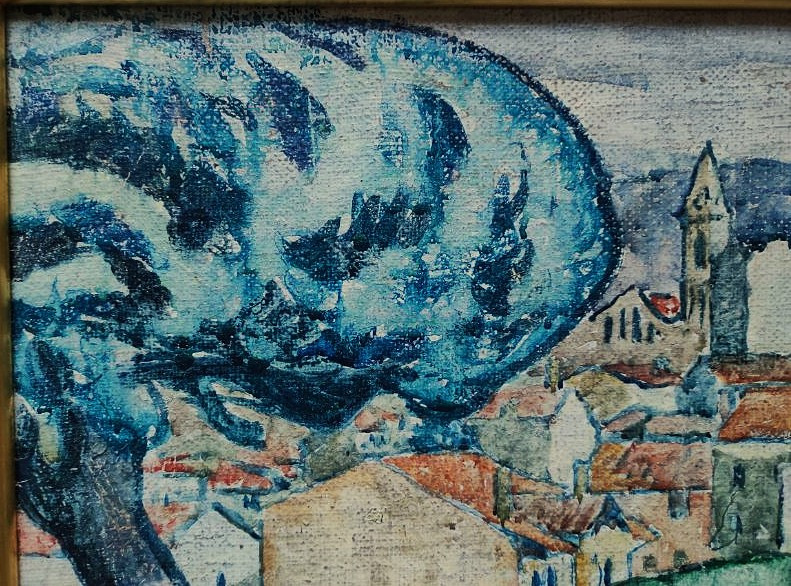
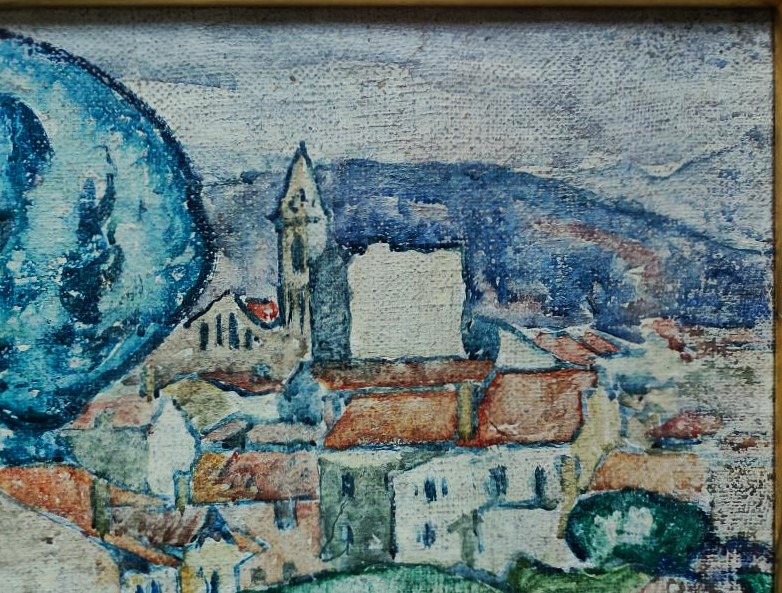
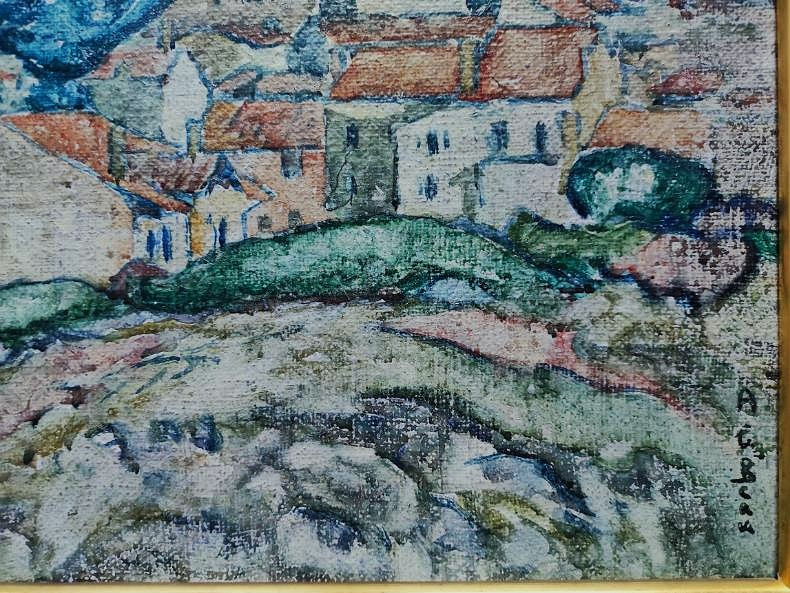
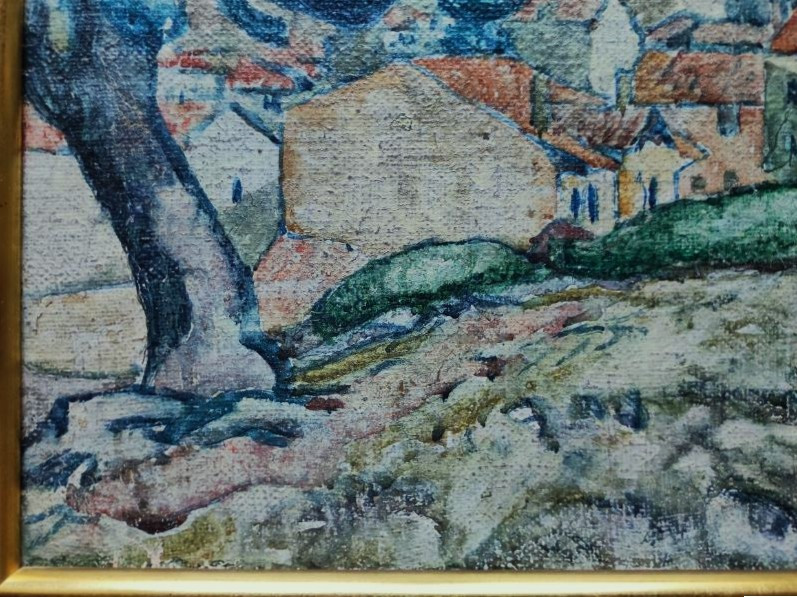
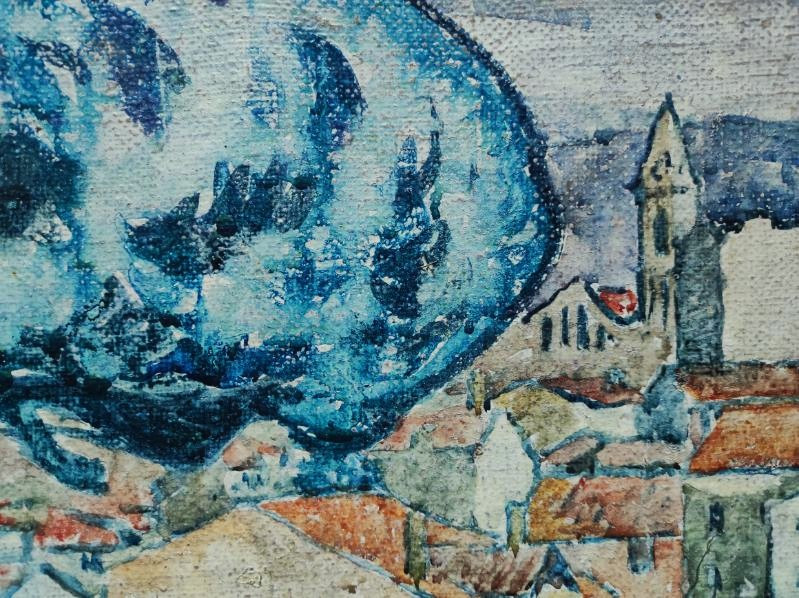
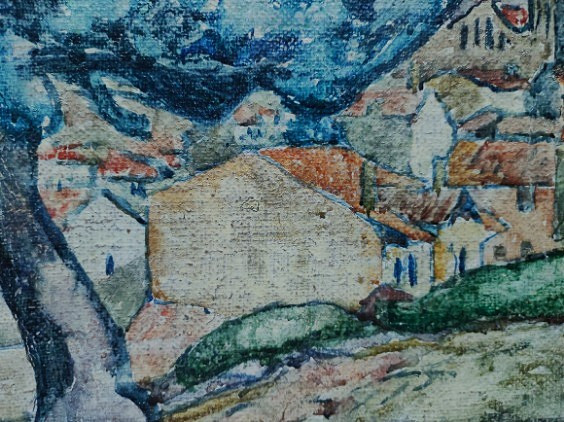
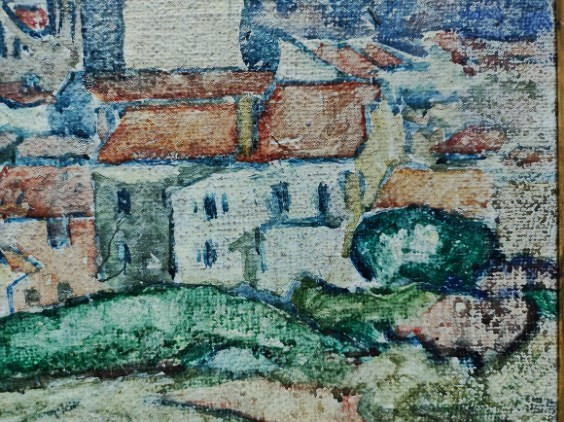


Alcide Le Beau (1873-1943) The Village C. 1912. Pont-aven School, Fauve, Gauguin, Sérusier....
Artist: Alcide Le Beau (1873-1943)
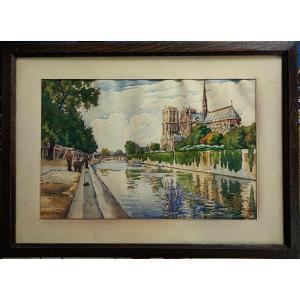
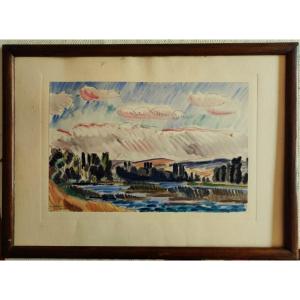
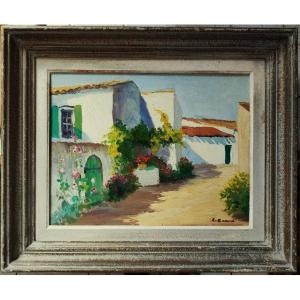
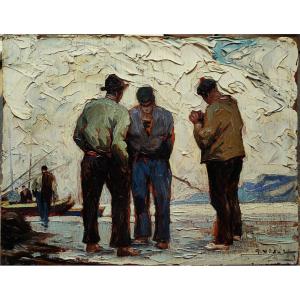
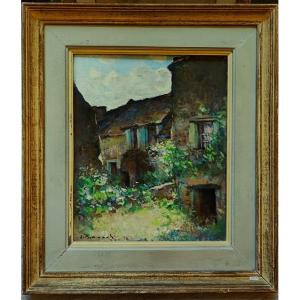
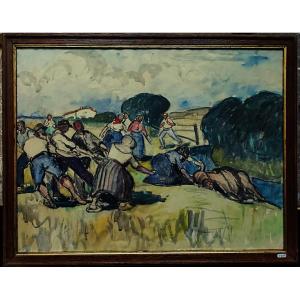
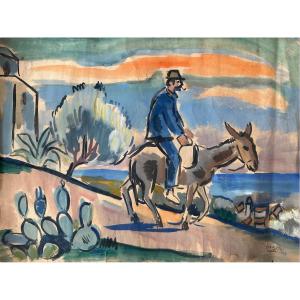
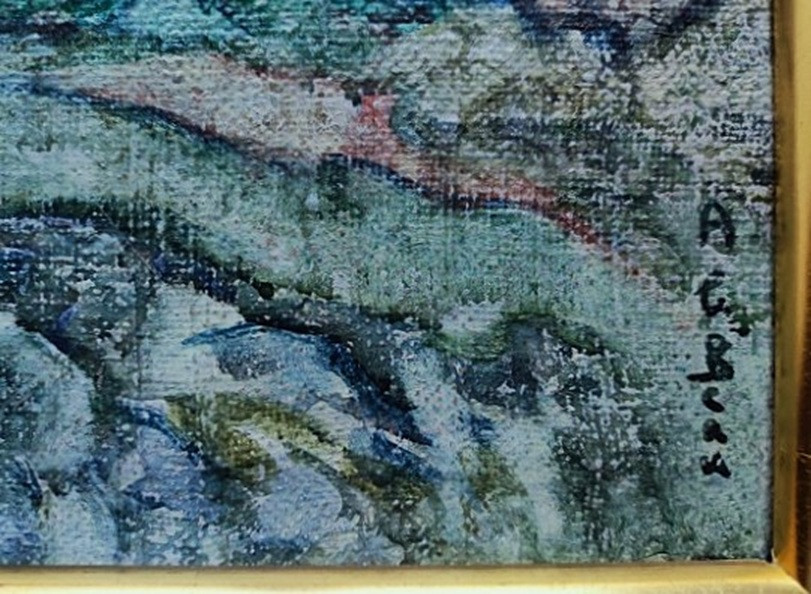
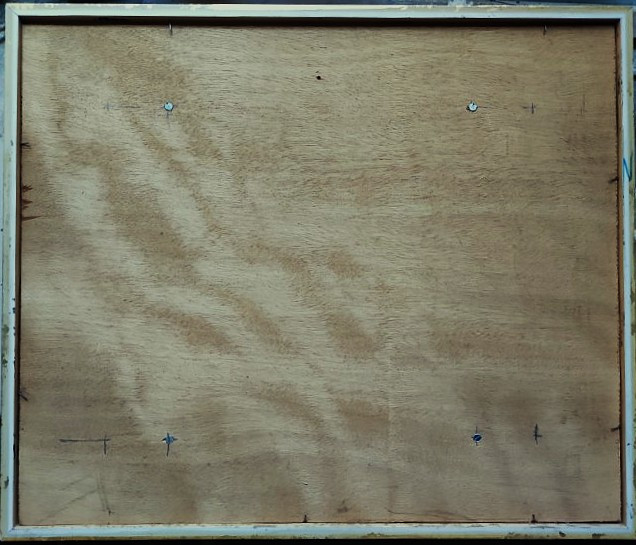
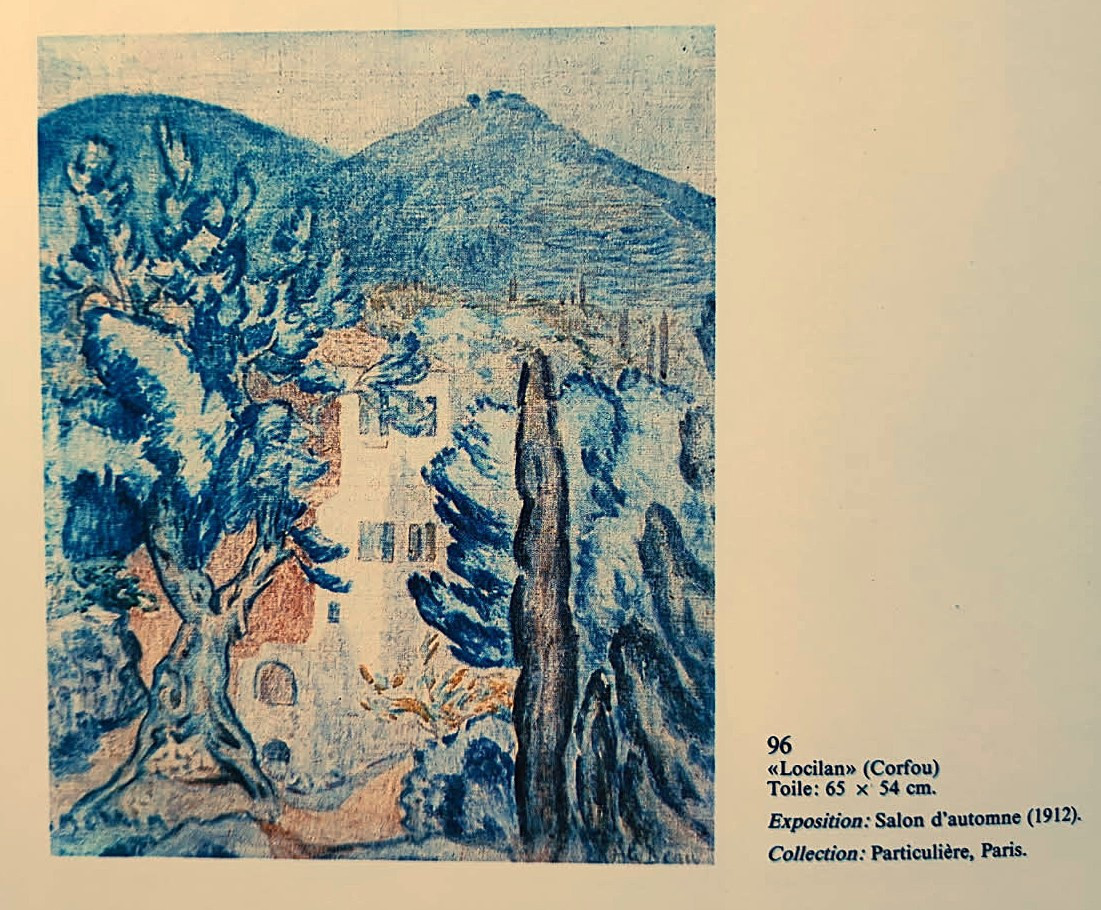
The second work by Alcide Le Beau, this time a tempera on canvas depicting a village, circa 1912, signed lower right. Canvas dimensions: 33 x 41 cm, 43 x 51 cm including the frame. It is part of a set of six works (two paintings and four washes and watercolors) from a collection acquired in Sanary shortly after Le Beau's death and the dispersal of several of his works, making it entirely new to the market. This is a charming tempera on canvas in which the artist depicts a village, most likely Mediterranean, Provence or Corfu, I believe, created around 1912. Tempera was a technique Le Beau frequently employed, both during his time in Brittany and when he painted in Provence, Corfu, and Corsica. However, the palette of his tempera paintings is very often the same, with shades of green, blue, brown, and gray, and a few highlights of vermilion red. Obviously, one always senses the painter's synthetic style, less so his Fauvist leanings here, but these paintings are very personal and so typical of Le Beau. Le Beau is certainly, along with Léon Detroy, Charles Bichet, and Gaston Thiesson, one of my favorite painters. I have offered a few rare works in the past, but their rarity means that I only have them very seldom—about ten in some 25 years. Unfortunately, Le Beau has not been helped by certain self-proclaimed experts who regularly reject works on the market that are absolutely authentic, often sublime and major works. So why? Is it self-interest or incompetence? In any case, this is very detrimental to the painter...so, fellow collectors and owners, just because you own a work by Le Beau that was rejected doesn't mean it's a fake...I know of many examples, feel free to share them with me... Alcide Marie Le Beau was born on July 30, 1873, in Lorient; some sources indicate a birth year of 1872, but apparently it was 1873. He died on August 12, 1943. He studied at the Jesuit college in Lorient. In 1890, he moved to Paris with his mother. He was the partner of the painter Irène Reno (née Rena Hassenberg). With his partner, he participated in the Section d'Or exhibition at the Galerie La Boétie in October 1912. A painter of the Pont-Aven school, he had been exhibiting at the Salon des Indépendants since 1902. A self-taught painter of landscapes and genre scenes, Alcide Le Beau was equally adept at oil painting and watercolor. He was a rare artist whose rapid, tormented brushstrokes and vibrant forms conveyed a unique lyricism. His intimacy with nature is expressed sometimes in thick impasto with brilliant colors, sometimes in smooth impasto with muted hues and simplified forms. Alcide Le Beau was particularly drawn to the intellectualized vision of the Pont-Aven Masters, who had influenced his youth. He was part of the avant-garde alongside the leading figures of the Fauvist movement. A brilliant artist, he was recognized by critics and the most discerning art dealers. In 1902, he exhibited at the Salon des Indépendants, then at Berthe Weill's gallery from 1903. He was part of the "Cage aux Fauves" (Cage of Wild Beasts) at the 1905 Salon d'Automne, alongside Albert Marquet, Henri Matisse, Maurice Vlaminck, and André Derain. The artist also participated in group exhibitions at Berthe Weill's gallery in Paris in 1903-1904, with Raoul Dufy and Henri Matisse, and then at the Durand-Ruel gallery in 1911. His reputation grew considerably, and numerous exhibitions were dedicated to him in France as well as in Saint Petersburg. In 1906, an exhibition at Vollard's gallery definitively established him and propelled him to the forefront of the art world. In 1907, the Druel gallery organized a retrospective of his Fauvist period, featuring some forty of his paintings. Alcide Le Beau managed to capture atmospheres through a chromatic palette similar to that of Gauguin and Van Gogh. For him, color served only as a support for a gradual and subtle transcription of the primary effect observed in the Fauves. He sought a spiritual and expressive dimension in his works from 1906 to 1908, which corresponds to the apogee of his art. It was during this period that he painted his Corsican landscapes, as well as his vases; subjects drawn from Wagner's operas. Bibliography: Robert Hellebranth, Anne Burdin, Alcide Le Beau 1873-1943, Matute editions, 1988, Paris; Alcide Le Beau, 1873-1943, Musée de Pont-Aven, October 2, 1992 - January 3, 1993; E. Bénézit, volume 8, pages 374-375. This tempera painting on canvas is in good condition for its age of approximately 110 years. Delivered in a contemporary American-style frame, a panel conceals the canvas on the reverse. Guaranteed authentic.
1 480 €
Period: 20th century
Style: Modern Art
Condition: Good condition
Material: Oil painting
Length: 41
Height: 33
Reference (ID): 1727440
Availability: In stock
Print