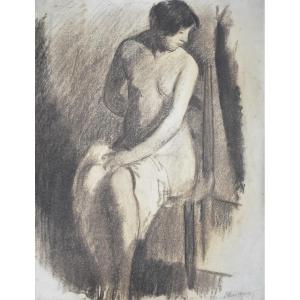
Eugène Le Poittevin - Portrait Of David Teniers
Artist: Eugène Le Poittevin (1806-1870)
Drawing by Eugène Le Poittevin (1806-1870) depicting a portrait of David Teniers.
Titled and signed with the monogram, this drawing is a preparatory study for the painting Le Poittevin exhibited at the 1848 Salon (David Teniers Leading Juan d'Autriche, His Pupil, to a Fair, no. 2923).
Dimensions: 24.7 x 20 cm.
A marine painter, "the inventor of Étretat," in the words of Alexandre Dumas, Le Poittevin foreshadowed Impressionism. After an established official career and numerous paintings exhibited at the Salon, he devoted a significant portion of his work to Normandy. This was particularly true of Étretat, then a small fishing village, which he helped to introduce to his friends in the Parisian artistic elite. Although Baudelaire mocked this painter for "painting too well," the bold choice of his compositions, reminiscent of Japanese prints, the rejection of Romanticism, and the primary importance given to human activity and the human figure, make him a figure of modernity.
In 1872, shortly after his death, his friend, the painter Eugène Bellangé, wrote about his drawings: "Most of these sketches, full of energy, elegance, and charm, are in no way inferior to the painted studies. Many are executed with a master's hand and with the rarest of ease."
Titled and signed with the monogram, this drawing is a preparatory study for the painting Le Poittevin exhibited at the 1848 Salon (David Teniers Leading Juan d'Autriche, His Pupil, to a Fair, no. 2923).
Dimensions: 24.7 x 20 cm.
A marine painter, "the inventor of Étretat," in the words of Alexandre Dumas, Le Poittevin foreshadowed Impressionism. After an established official career and numerous paintings exhibited at the Salon, he devoted a significant portion of his work to Normandy. This was particularly true of Étretat, then a small fishing village, which he helped to introduce to his friends in the Parisian artistic elite. Although Baudelaire mocked this painter for "painting too well," the bold choice of his compositions, reminiscent of Japanese prints, the rejection of Romanticism, and the primary importance given to human activity and the human figure, make him a figure of modernity.
In 1872, shortly after his death, his friend, the painter Eugène Bellangé, wrote about his drawings: "Most of these sketches, full of energy, elegance, and charm, are in no way inferior to the painted studies. Many are executed with a master's hand and with the rarest of ease."
100 €
Period: 19th century
Style: Modern Art
Condition: Excellent condition
Length: 20
Height: 24,7
Reference (ID): 1726117
Availability: In stock
Print