




Kitchen Scene – Oil On Canvas By Joseph-denis Odevaere (1775-1830)
Kitchen Scene – Oil on Canvas by Joseph-Denis Odevaere (1775–1830)
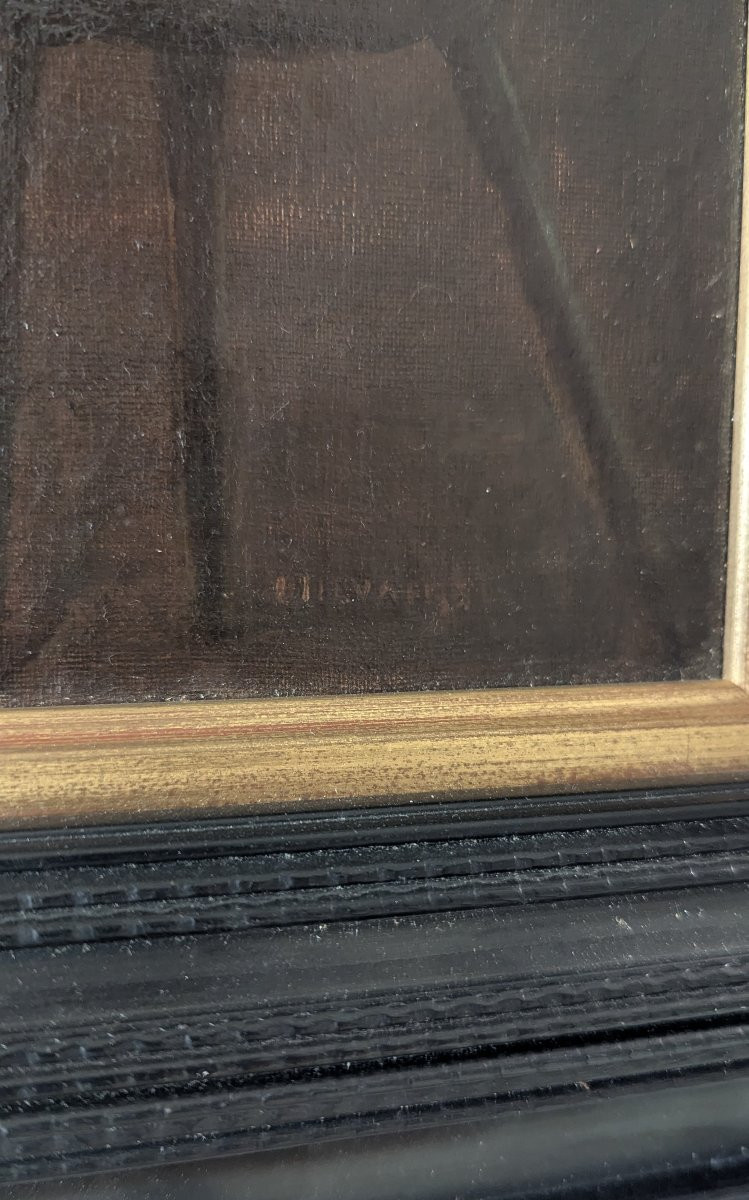
A charming and luminous genre scene depicting the interior of a kitchen, signed lower right by Joseph-Denis Odevaere, the Flemish Neoclassical painter who was a pupil of Jacques-Louis David and later became First Painter to King William I of the Netherlands.
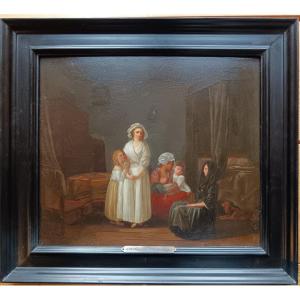
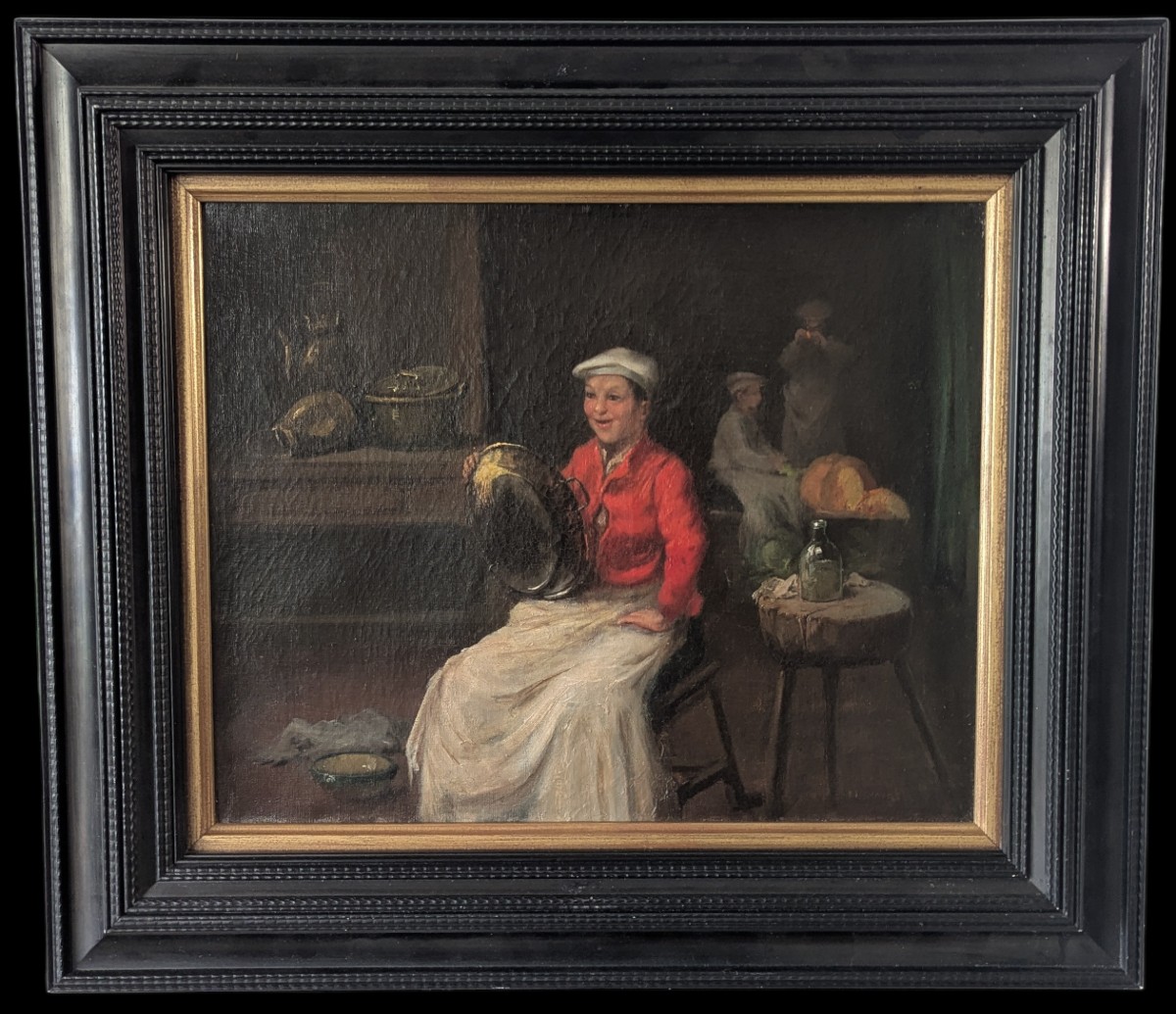
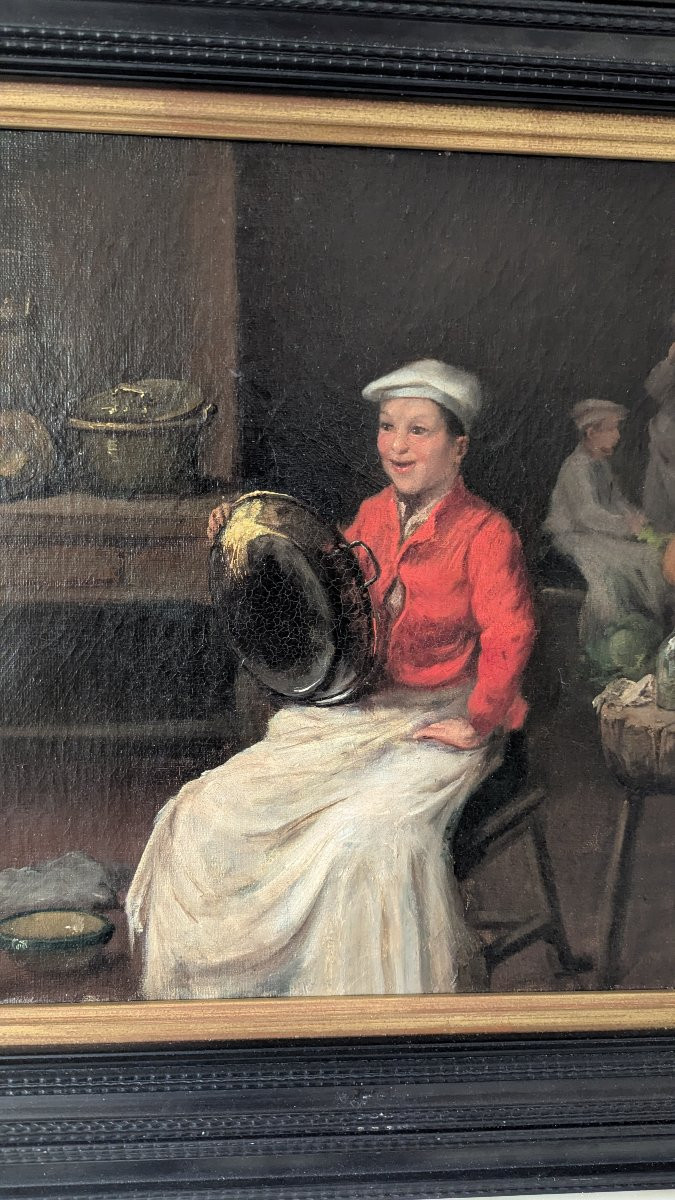
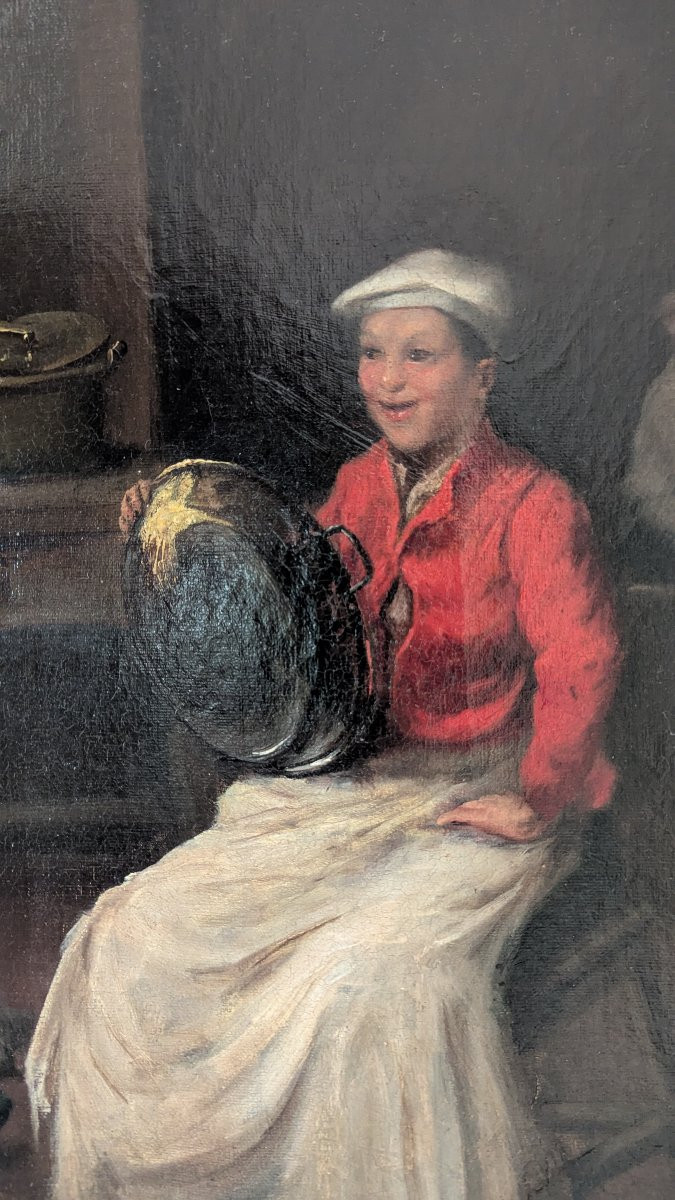
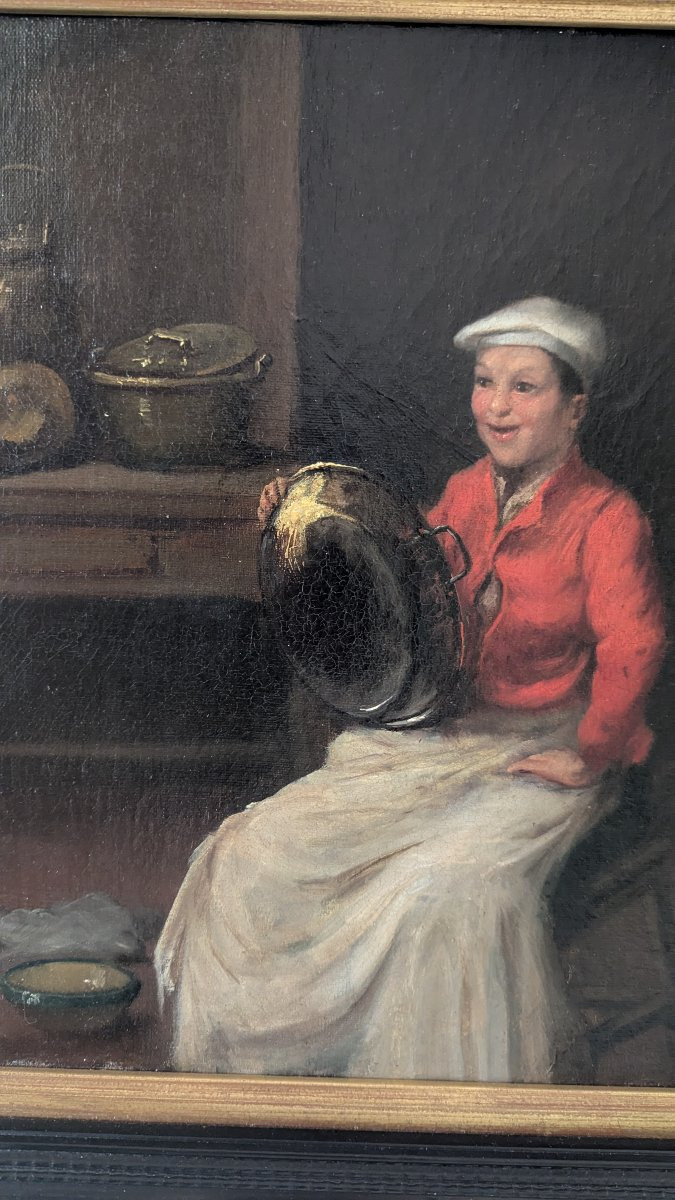
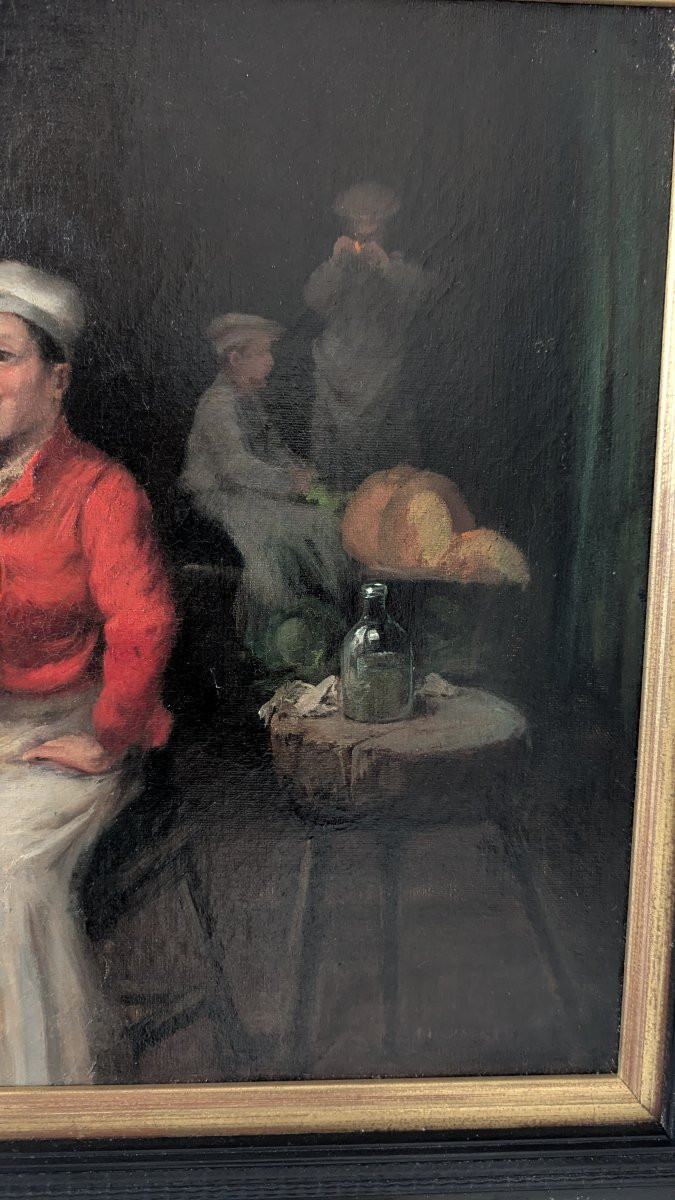
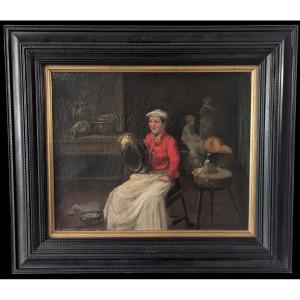
At the center of the composition, a maid or cook sits on a chair, dressed in a vivid red jacket and a pristine white apron, her head covered with a white cap. In her hands she holds a dish which she appears to be polishing or drying, turning toward the viewer with a warm and lively smile, full of spirit and animation. The brushwork is confident and fluid, revealing great mastery in the rendering of textures: the sheen of the red satin jacket, the linen of the white apron, and the reflective surface of the metal plate.
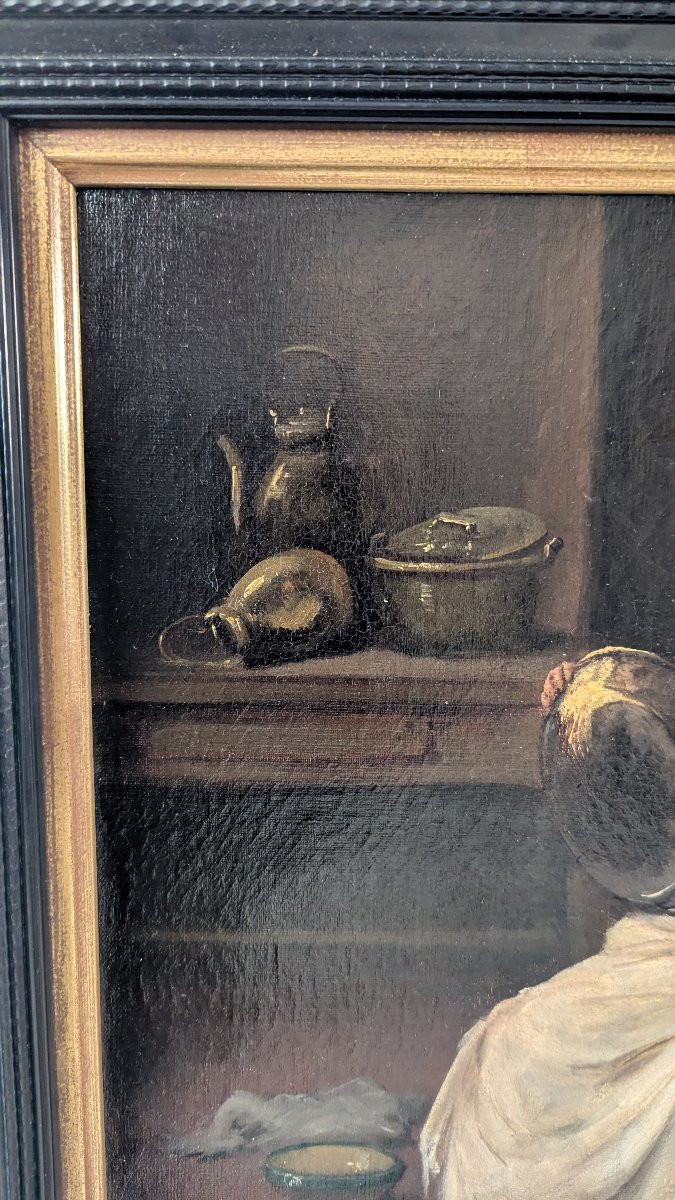
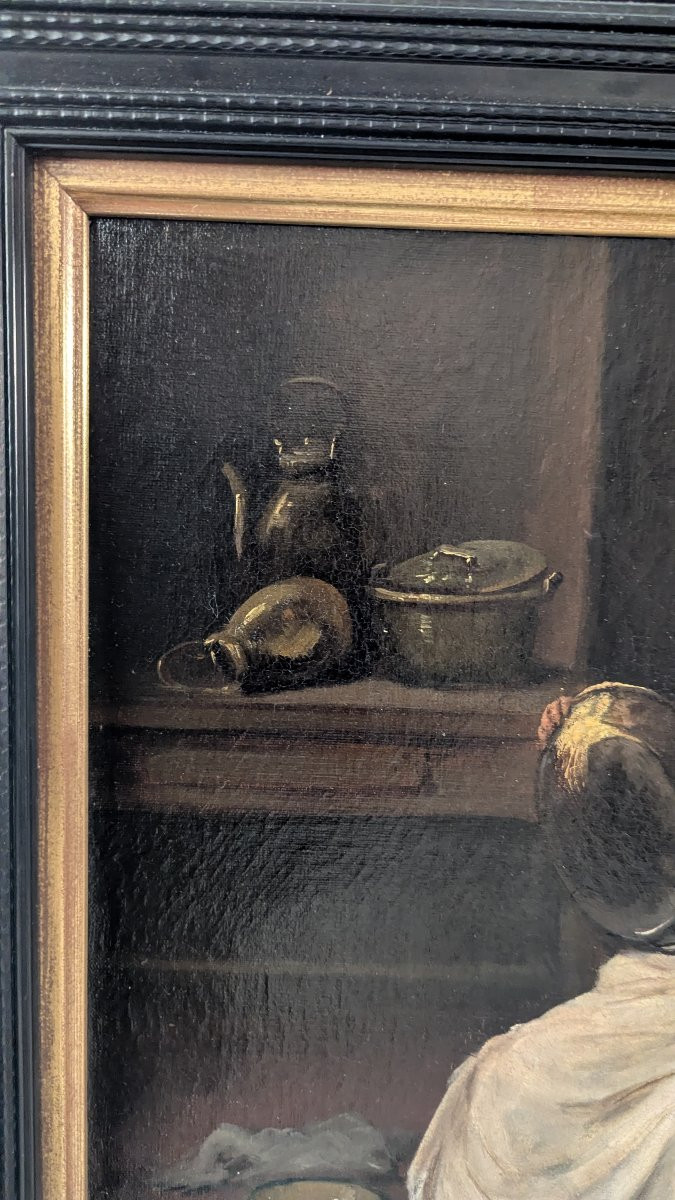
In the background, within the dim recesses of the kitchen, two additional figures are discreetly sketched. On a three-legged chopping block to the right, a bottle can be seen. On the table in the rear left, several kitchen utensils are arranged.
The whole composition is immersed in a carefully controlled chiaroscuro, typical of the painter’s Davidian training, with striking contrasts between the red jacket and the white apron on the one hand, and the dark depth of the interior space on the other. The treatment of light recalls the great tradition of Dutch and Flemish interior scenes, here renewed through the neoclassical sensibility of the early nineteenth century, in the lineage of Chardin, Greuze, and Martin Drölling.
The work is signed in the lower right corner, making it a documented and significant piece within the painter’s oeuvre. Genre scenes by Odevaere are rare on the art market, as the artist is primarily known for his large historical compositions and official portraits. This intimate painting reveals a lesser-known yet particularly appealing aspect of his talent.
Good overall condition. Modern blackened frame with a discreet gilt fillet, sober and well suited to the horizontal format of the work.
33 × 51 cm.
Joseph-Denis Odevaere (also known as Joseph-Désiré Odevaere or Joseph Dionysius Odevaere) was born in Bruges in 1775 and died in Brussels on 26 February 1830. He stands among the most significant representatives of Flemish Neoclassicism, at the crossroads between the pictorial traditions of the former Low Countries and the broader European Neoclassical movement that emerged from the French Revolution.
Odevaere received his first artistic training at the Academy of Painting in Bruges under François Wynckelman. He subsequently moved to Paris, where he worked first in the studio of his compatriot Joseph-Benoît Suvée and later under the leading master of Neoclassicism, Jacques-Louis David, with whom he studied from 1796 to 1802. This dual lineage—both Flemish and Davidian—would leave a lasting imprint on his style.
In 1804 he won the Grand Prix de peinture with his painting The Death of Phocion (now preserved at the École nationale supérieure des Beaux-Arts in Paris). The prize enabled him to travel to Rome, where he remained for eight years, copying the Old Masters and immersing himself particularly in the work of Raphael, for whom he held a profound admiration. He was among the artists summoned to decorate the Quirinal Palace for Napoleon’s visit, producing preparatory sketches for the occasion. Upon his return to Paris, Napoleon received him and awarded him the grand medal commemorating his coronation.
Following the events of 1814, Odevaere returned to his homeland and in 1815 was appointed First Painter to King William I of the Netherlands—the highest official distinction accessible to an artist in the Southern Netherlands at that time. During this period he produced large historical compositions, including The Union of Utrecht in 1579, The Battle of Nieuwpoort, The Martyrdom of Saint Lawrence, and Raphael Presented to Pope Julius II by Bramante.
Between 1825 and 1829, influenced by the liberal ideals of his time, Odevaere created several works in support of the Greek War of Independence, notably the celebrated painting The Last Defenders of Missolonghi Preferring Death to Slavery, exhibited at the Salon of 1827. During this period he signed his works “Joseph Dionysius Odevaere,” a deliberate gesture of Hellenization.
A committed theorist, Odevaere was also a writer and art critic. He authored a treatise on the arts in Italy from their origins to Raphael and produced a translation of the life of the master of Urbino. He was also a founding member of the first Société des Douze.
His works are preserved notably at the Groeninge Museum in Bruges, the Royal Museums of Fine Arts of Belgium in Brussels, the École nationale supérieure des Beaux-Arts in Paris, and the Musée Magnin in Dijon.
Period: 19th century
Style: Consulat, Empire
Condition: Good condition
Material: Oil painting
Width: 51
Height: 33
Reference (ID): 1720275
Availability: In stock