

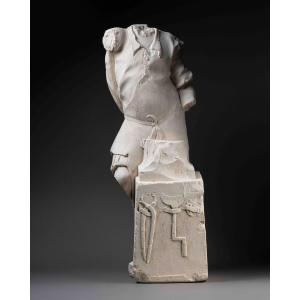


Saint Crispin - Loire Valley, 16th Century
Saint Crispin
Loire Valley, 16th century
tuffeau stone
H: 67 cm
Provenance: Private French collection since the 1960s
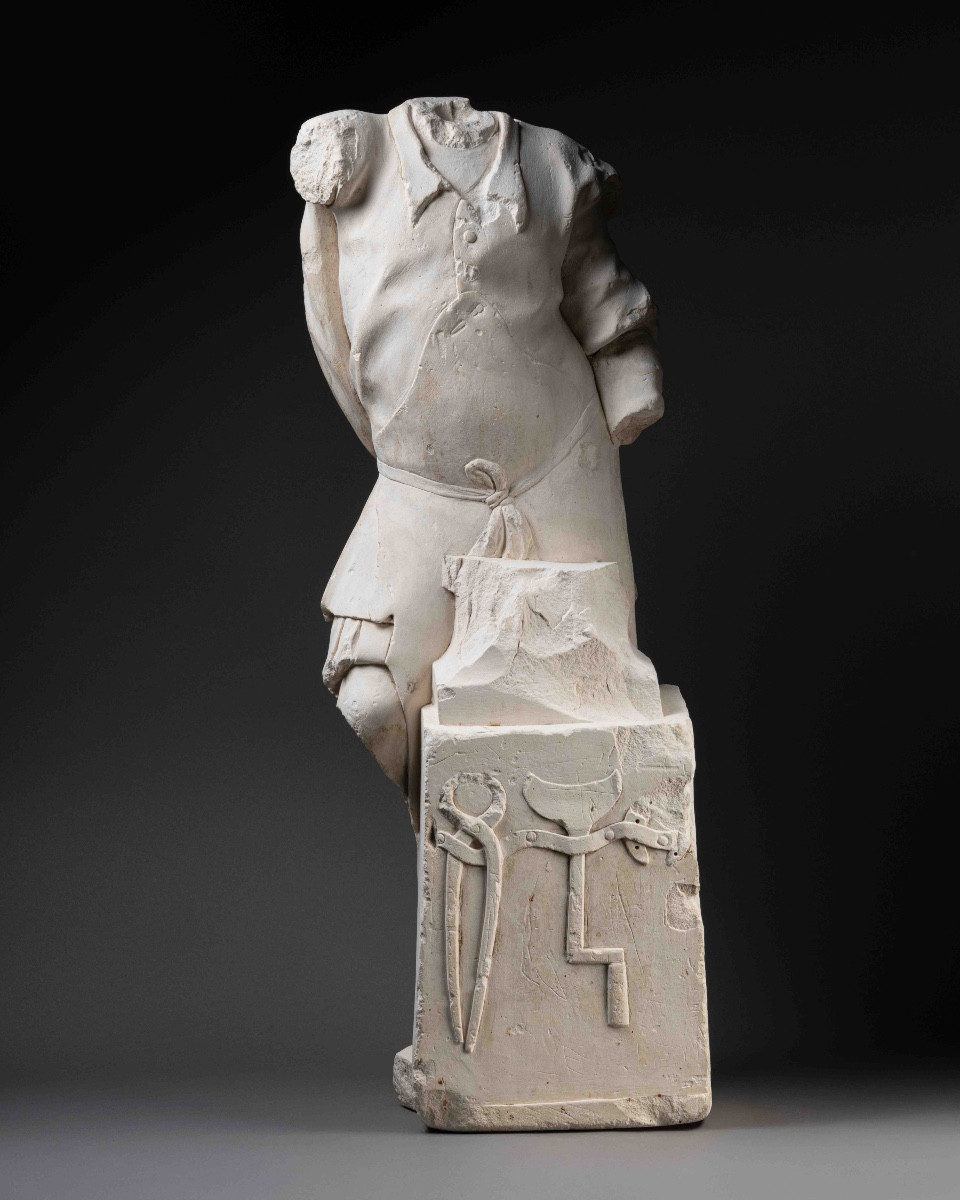
This fragmentary limestone sculpture represents Saint Crispin, the patron saint of shoemakers and the leather trades. The saint is depicted standing before his workbench, the front of which is carved in relief with tools associated with his craft — including a pair of pincers, a curved implement, and a metal rod — attributes traditionally connected with shoemaking.
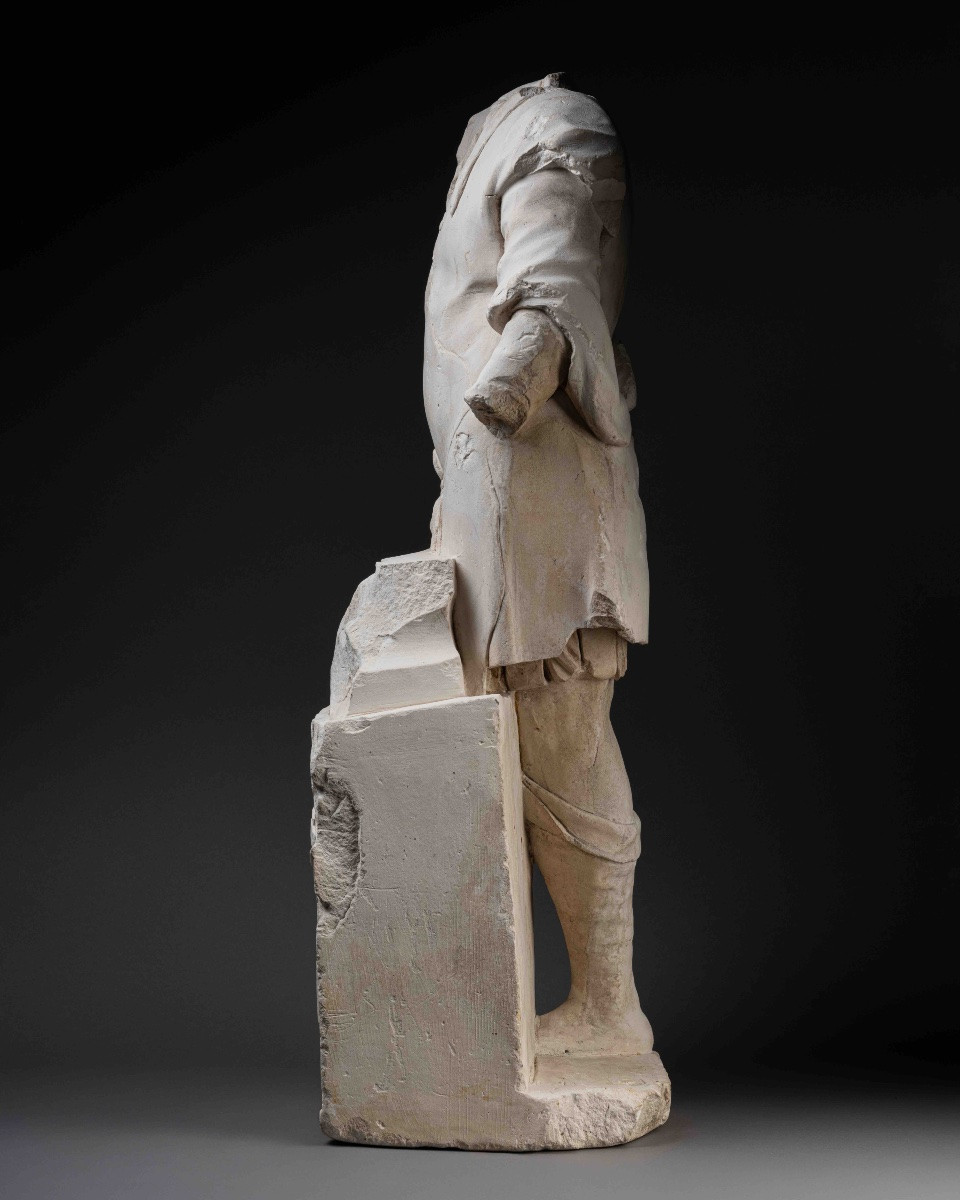
The figure is distinguished by a dynamic and slightly contrapposto stance. The body inclines forward and to one side, creating a gentle torsion through the torso that conveys both movement and the physical engagement of the artisan at work. This rhythmic shift of weight is particularly expressive: the left shoulder dips as if caught mid-gesture, while the drapery drawn diagonally across the chest reinforces the impression of an action momentarily suspended.
The treatment of the garments reveals close observation of both form and material. The saint wears a fitted doublet with a crisply articulated collar, seams, and buttoning; its soft folds suggest the weight of a practical working garment shaped by daily use. A tied apron, knotted at the waist, falls in controlled angular folds that demonstrate the sculptor’s sensitivity to texture and to the structural articulation of the figure. The modelling of the torso beneath the garment remains supple and carefully defined, indicating a confident understanding of anatomy and a desire to situate the figure convincingly within three-dimensional space.
These stylistic characteristics correspond closely to sculptural production in the Loire Valley during the sixteenth century, when regional workshops developed a distinctive idiom combining elements inherited from the late Gothic tradition with emerging Renaissance influences. The lively sense of movement, the attentive rendering of costume, and the expressive presence of the figure reveal an artistic sensibility equally attentive to the reality of artisanal labor and to the spiritual dignity of the saint.
According to hagiographic tradition, Saint Crispin and his brother Crispinian were Roman nobles who travelled to Gaul in the third century to preach Christianity. Settling in Soissons, they supported themselves by working as shoemakers while evangelizing the local population. Martyred during the persecutions of Diocletian, they were soon venerated as the patron saints of shoemakers and workers in the leather trades. Their cult spread widely throughout France and the Low Countries, where numerous guilds placed their workshops and chapels under their protection.
A sculpture such as the present example likely adorned a guild chapel or devotional setting associated with the leather trades, where it would have invoked the saint’s protection over craftsmen and their work. Through the refinement of its modelling, the carefully observed details of costume, and the subtle sense of movement, the figure conveys the dignity of a craftsman-saint rendered with both naturalism and restrained elegance.
Period: 16th century
Style: Renaissance, Louis 13th
Condition: Good condition
Material: Stone
Height: 67
Reference (ID): 1720005
Availability: In stock