



Large Triptych, 1900, By Marie Marlier - Art Nouveau Nancy -
Artist: Marie Marlier (1862-1917)
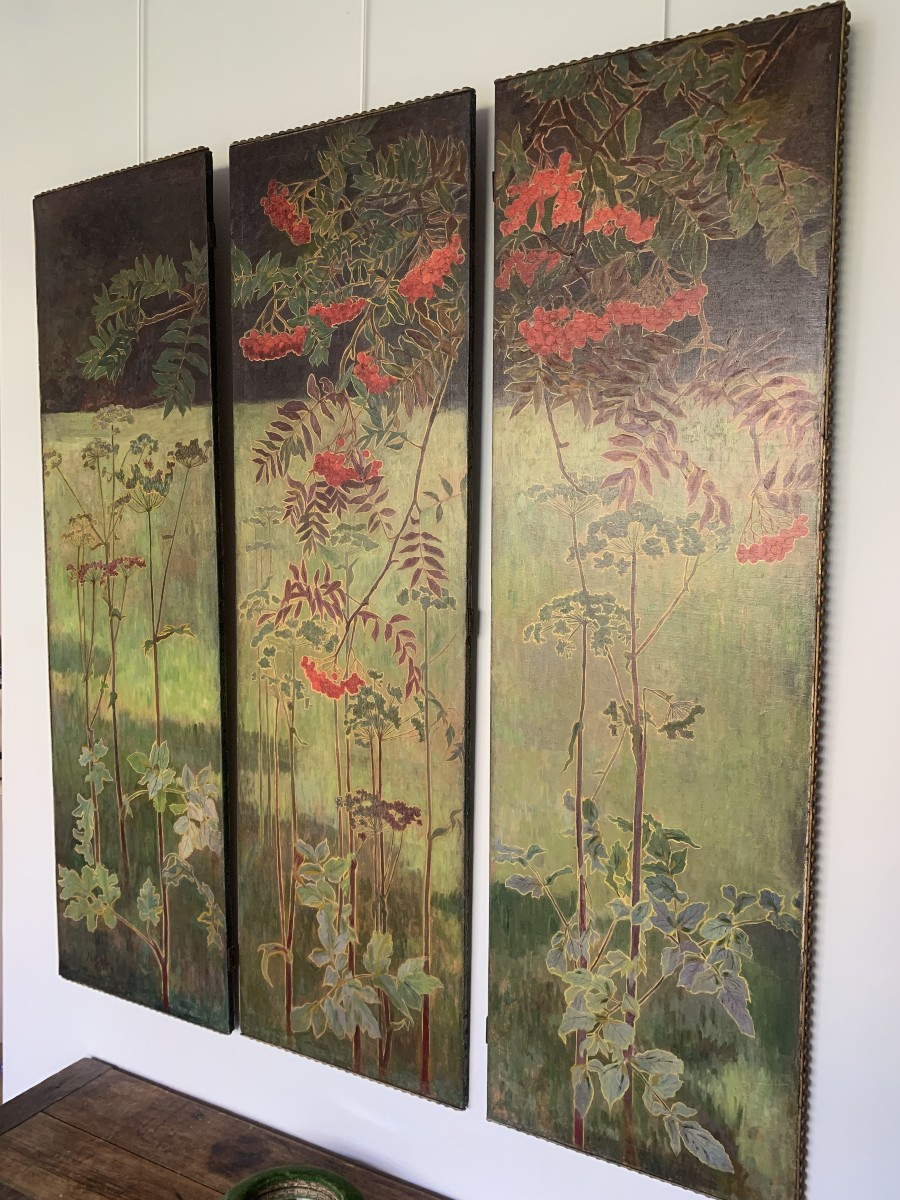
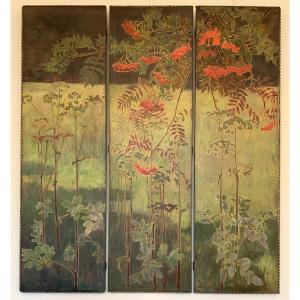
A jewel of Nancy Art Nouveau! An exceptional triptych formerly mounted as a screen.
Marie MARLIER (1862-1917)
Rowan Tree and Wild Angelica, circa 1900.
Three oil paintings on canvas forming a screen, signed lower left M. Marlier.
Height 150 cm, width 45 cm x 3.
Restorations.
Original frame and hinges.
Marie MARLIER (1862-1917) was born on June 7, 1862, in Remiremont, Vosges, near Epinal, and is one of those forgotten women artists who belonged fully to the Nancy School. A flower and landscape painter, she was a student of Pierre Waidmann (1860-1937) and Jules Adler (1865-1952). She exhibited her works at the Nancy Salon from 1892 to 1905, and also in Paris at the Salon des Artistes Français in 1895, 1896, 1898, 1899, and 1908. Her flower paintings depict not bouquets but wild plants in their natural state: "Hollyhocks," "Honeysuckle," "Yellow Dog Rose," and her landscapes of "rustic gardens" or "Morning Studies." She thus fully embraced the naturalist movement of the turn of the century. She died on November 3, 1917, in Bouxurulles, in her native Vosges region.
The Charles Friry Museum in Remiremont houses several works by this artist, as well as a reconstructed studio of her teacher, Pierre Waidmann.
We know of another screen by her in the same style, with 4 leaves, exhibited twice in 1901, first at the Maison d'Art Lorraine (see reproduction) then at the Salon de Langres.
This triptych forming a screen is a wonderful example of the refinement of the Nancy School, which reflects both the aesthetics of Art Nouveau and the regional identity of Lorraine.
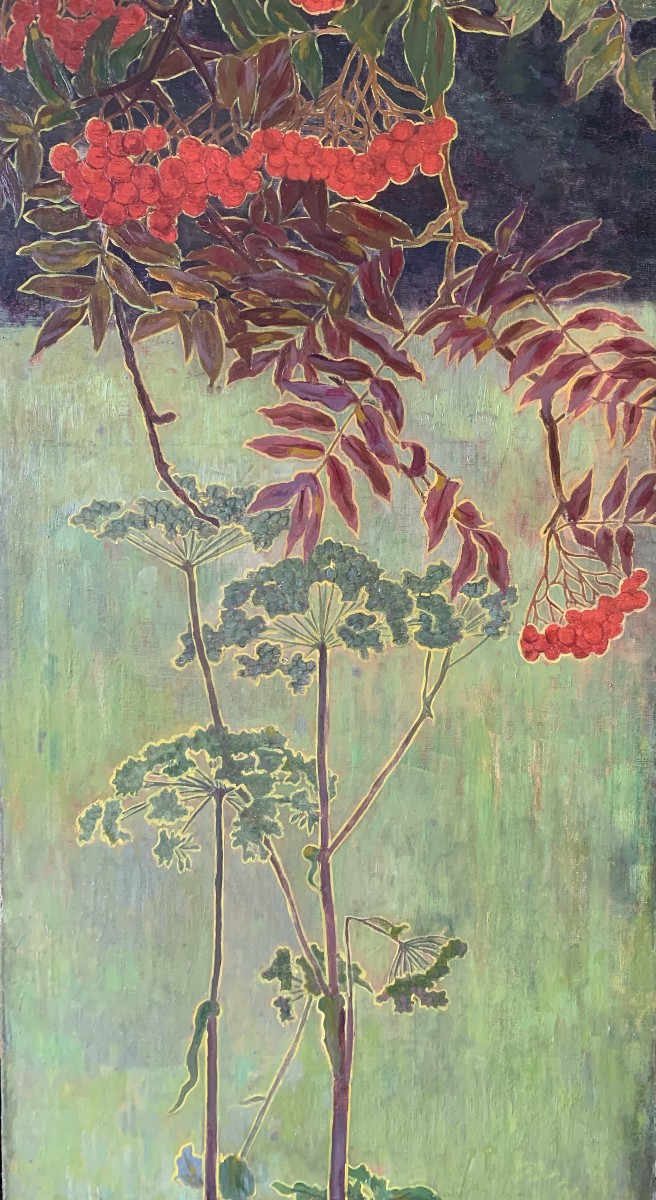
The artist here uses two plants very common in the Vosges Mountains: the Rowan tree in the upper part and the Wild Angelica in the lower part of the composition. On a purely aesthetic level, the angelica provides slender, vertical lines, while the Rowan, placed at the top, offers arabesques and touches of vibrant color thanks to its red berries.
But the combination of these two plants does not stem solely from a purely formal approach; it is also a typically Art Nouveau expression of Nature as a vital force, and this screen offers a particularly rich symbolism. The Rowan tree has been considered since the Middle Ages as a protective tree, warding off misfortune and evil spirits. Its bright red berries, particularly vibrant in autumn, symbolize energy, perseverance, vitality, and robustness. The Wild Angelica evokes more of an inner protection, health, and healing. Together, they form a protective duo. The stems of Angelica, with its large, delicate, and airy umbels, also symbolize spiritual elevation and growth.
Placed one beneath the other, delicately intertwined, this duo embodies an ideal: that of inner elevation under vigorous protective forces. It invites meditation on the coexistence of the fragile and the robust, the feminine and the masculine.
Marie MARLIER (1862-1917)
Rowan Tree and Wild Angelica, circa 1900.
Three oil paintings on canvas forming a screen, signed lower left M. Marlier.
Height 150 cm, width 45 cm x 3.
Restorations.
Original frame and hinges.
Marie MARLIER (1862-1917) was born on June 7, 1862, in Remiremont, Vosges, near Epinal, and is one of those forgotten women artists who belonged fully to the Nancy School. A flower and landscape painter, she was a student of Pierre Waidmann (1860-1937) and Jules Adler (1865-1952). She exhibited her works at the Nancy Salon from 1892 to 1905, and also in Paris at the Salon des Artistes Français in 1895, 1896, 1898, 1899, and 1908. Her flower paintings depict not bouquets but wild plants in their natural state: "Hollyhocks," "Honeysuckle," "Yellow Dog Rose," and her landscapes of "rustic gardens" or "Morning Studies." She thus fully embraced the naturalist movement of the turn of the century. She died on November 3, 1917, in Bouxurulles, in her native Vosges region.
The Charles Friry Museum in Remiremont houses several works by this artist, as well as a reconstructed studio of her teacher, Pierre Waidmann.
We know of another screen by her in the same style, with 4 leaves, exhibited twice in 1901, first at the Maison d'Art Lorraine (see reproduction) then at the Salon de Langres.
This triptych forming a screen is a wonderful example of the refinement of the Nancy School, which reflects both the aesthetics of Art Nouveau and the regional identity of Lorraine.
The artist here uses two plants very common in the Vosges Mountains: the Rowan tree in the upper part and the Wild Angelica in the lower part of the composition. On a purely aesthetic level, the angelica provides slender, vertical lines, while the Rowan, placed at the top, offers arabesques and touches of vibrant color thanks to its red berries.
But the combination of these two plants does not stem solely from a purely formal approach; it is also a typically Art Nouveau expression of Nature as a vital force, and this screen offers a particularly rich symbolism. The Rowan tree has been considered since the Middle Ages as a protective tree, warding off misfortune and evil spirits. Its bright red berries, particularly vibrant in autumn, symbolize energy, perseverance, vitality, and robustness. The Wild Angelica evokes more of an inner protection, health, and healing. Together, they form a protective duo. The stems of Angelica, with its large, delicate, and airy umbels, also symbolize spiritual elevation and growth.
Placed one beneath the other, delicately intertwined, this duo embodies an ideal: that of inner elevation under vigorous protective forces. It invites meditation on the coexistence of the fragile and the robust, the feminine and the masculine.
9 500 €
Period: 20th century
Style: Art Nouveau
Condition: Excellent condition
Material: Oil painting
Width: 45 cm x 3
Height: 150
Reference (ID): 1718866
Availability: In stock
Print