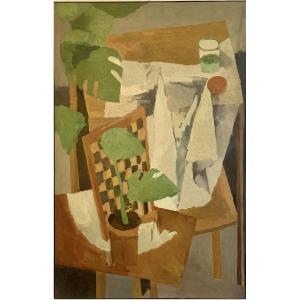
Marc Sterling - Chess - 1950 - Ukraine - Paris School
Artist: Marc Sterling (1895-1976)
Marc Sterling (1895-1976)
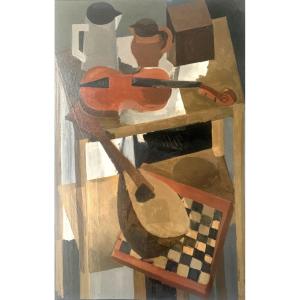
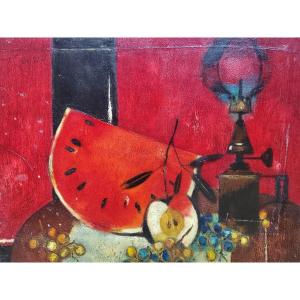
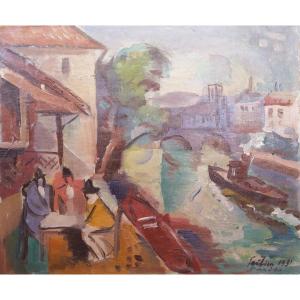
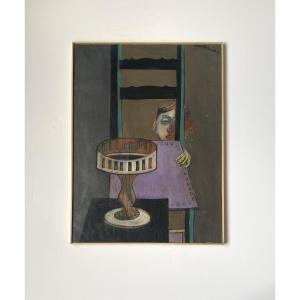
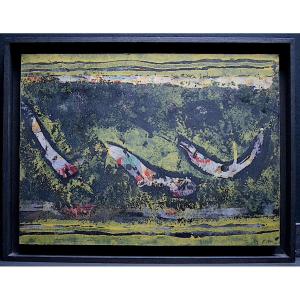
Chess, circa 1950
Oil on canvas, signed with initials lower right,
re-signed "M Sterling, Paris" on the reverse
19 x 24 cm
Marc Sterling, born Mordkha Sterling, (Minsk 1895 - Neuilly-sur-Seine 1976) was a French painter of Russian origin.
Born into a Jewish family from Ukraine, Marc Sterling studied painting in Odessa, then at the Vhutemas in Moscow in the early 1920s. In 1921-1922, he was in Berlin where he met his future wife and where his first exhibition took place. In 1923, he settled in Paris and joined the international circle of artists of the School of Paris. He frequented the cafés and studios of Montparnasse, as well as the artists' colony of La Ruche; There he met, among others, Jacques Chapiro, Ossip Lubitch, Lazare Volovick, Michel Kikoïne, and Pinchus Krémegne. During the Second World War, Sterling and his family (he had two daughters) took refuge with friends. In September 1941, he was interned in a camp.[4] After the war, he returned to Paris. He remarried in 1953 to a young student of Ossip Zadkine. He lived between Paris and Switzerland, traveled extensively, and exhibited regularly in galleries and salons. He continued to work until his death in 1976.
Sterling's work is very varied and constantly renewed, never settling into a single style, maintaining great vitality. He practiced various techniques: oil, gouache, drawing, wash, and engraving. Several periods can be distinguished in his work. A student of Vladimir Tatlin at the Vkhutemas, Sterling was a constructivist in his early career. Then, in Paris, through contact with artists like Pablo Picasso, Georges Braque, Juan Gris, and Jean Metzinger, Sterling gravitated towards Synthetic Cubism. During the 1930s, Sterling developed a more fluid and lyrical style—bouquets of flowers, birdcages, portraits of his daughters—treated in a kind of dreamlike realism. After the war, dark and nightmarish visions bore the mark of tragedy. From the early 1950s onward, more varied colors and subjects imbued with calm and delicacy appeared—nudes and portraits. His later period, the 1960s and 70s, is characterized by increasing freedom in both color and subject matter: fabulous animals, fantastical beings, and imaginary landscapes are bathed in a highly personal, poetic atmosphere.
Works in Paris at the Musée National d'Art Moderne and the Tel Aviv Museum of Art.
Bibliography: Nieszawer and Princ, Histoires des artistes Juifs de l'École de Paris, 1905-1939, (Denoël, 2000 - Somogy, 2015) Les étoiles éditions, 2020, pp. 385-387.
Chess, circa 1950
Oil on canvas, signed with initials lower right,
re-signed "M Sterling, Paris" on the reverse
19 x 24 cm
Marc Sterling, born Mordkha Sterling, (Minsk 1895 - Neuilly-sur-Seine 1976) was a French painter of Russian origin.
Born into a Jewish family from Ukraine, Marc Sterling studied painting in Odessa, then at the Vhutemas in Moscow in the early 1920s. In 1921-1922, he was in Berlin where he met his future wife and where his first exhibition took place. In 1923, he settled in Paris and joined the international circle of artists of the School of Paris. He frequented the cafés and studios of Montparnasse, as well as the artists' colony of La Ruche; There he met, among others, Jacques Chapiro, Ossip Lubitch, Lazare Volovick, Michel Kikoïne, and Pinchus Krémegne. During the Second World War, Sterling and his family (he had two daughters) took refuge with friends. In September 1941, he was interned in a camp.[4] After the war, he returned to Paris. He remarried in 1953 to a young student of Ossip Zadkine. He lived between Paris and Switzerland, traveled extensively, and exhibited regularly in galleries and salons. He continued to work until his death in 1976.
Sterling's work is very varied and constantly renewed, never settling into a single style, maintaining great vitality. He practiced various techniques: oil, gouache, drawing, wash, and engraving. Several periods can be distinguished in his work. A student of Vladimir Tatlin at the Vkhutemas, Sterling was a constructivist in his early career. Then, in Paris, through contact with artists like Pablo Picasso, Georges Braque, Juan Gris, and Jean Metzinger, Sterling gravitated towards Synthetic Cubism. During the 1930s, Sterling developed a more fluid and lyrical style—bouquets of flowers, birdcages, portraits of his daughters—treated in a kind of dreamlike realism. After the war, dark and nightmarish visions bore the mark of tragedy. From the early 1950s onward, more varied colors and subjects imbued with calm and delicacy appeared—nudes and portraits. His later period, the 1960s and 70s, is characterized by increasing freedom in both color and subject matter: fabulous animals, fantastical beings, and imaginary landscapes are bathed in a highly personal, poetic atmosphere.
Works in Paris at the Musée National d'Art Moderne and the Tel Aviv Museum of Art.
Bibliography: Nieszawer and Princ, Histoires des artistes Juifs de l'École de Paris, 1905-1939, (Denoël, 2000 - Somogy, 2015) Les étoiles éditions, 2020, pp. 385-387.
900 €
Period: 20th century
Style: Modern Art
Condition: Excellent condition
Material: Oil painting
Width: 24
Height: 19
Reference (ID): 1674939
Availability: In stock
Print