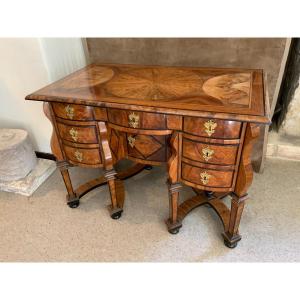



Mazarin Desk, Broken Top. Work In The 17th-century Style, Louis XIV Style, Late 19th Century
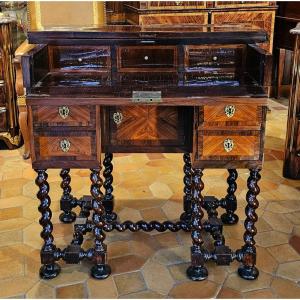
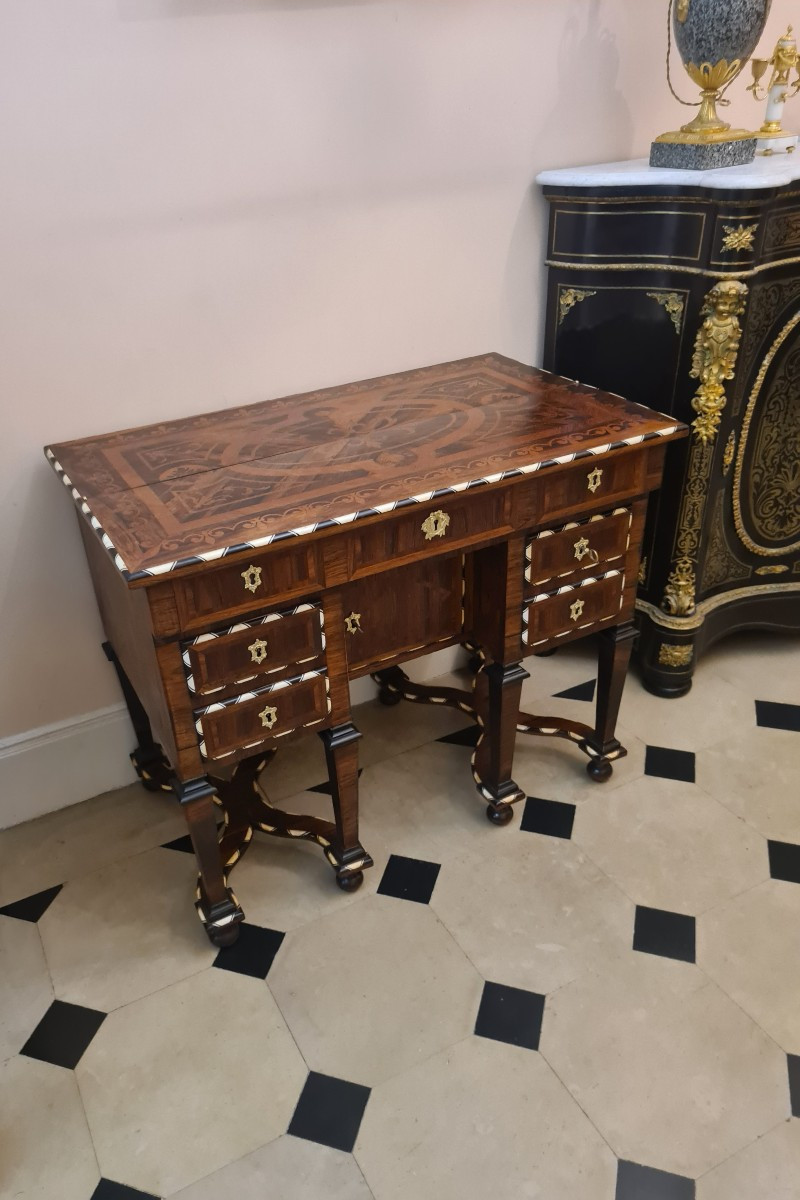
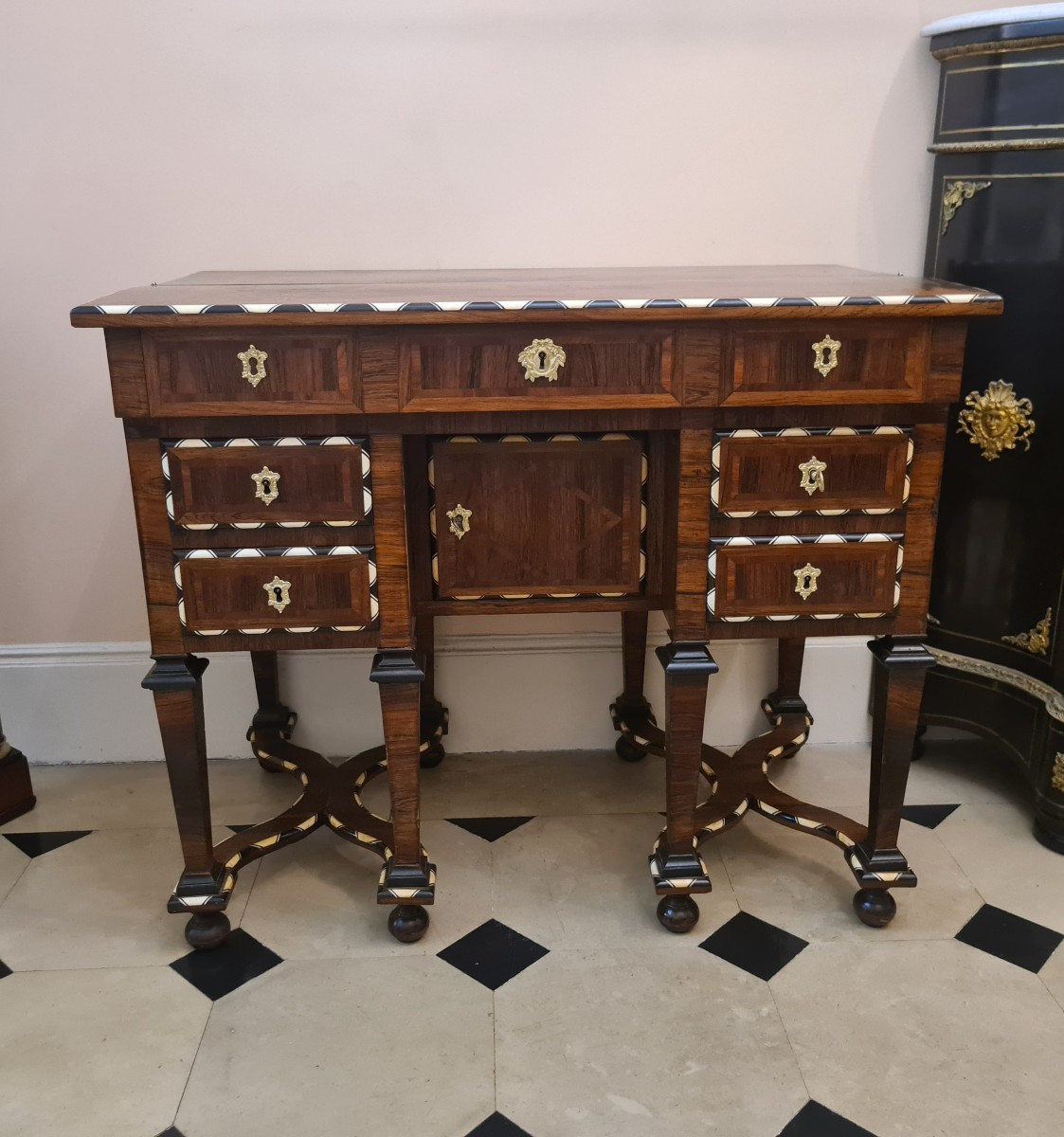
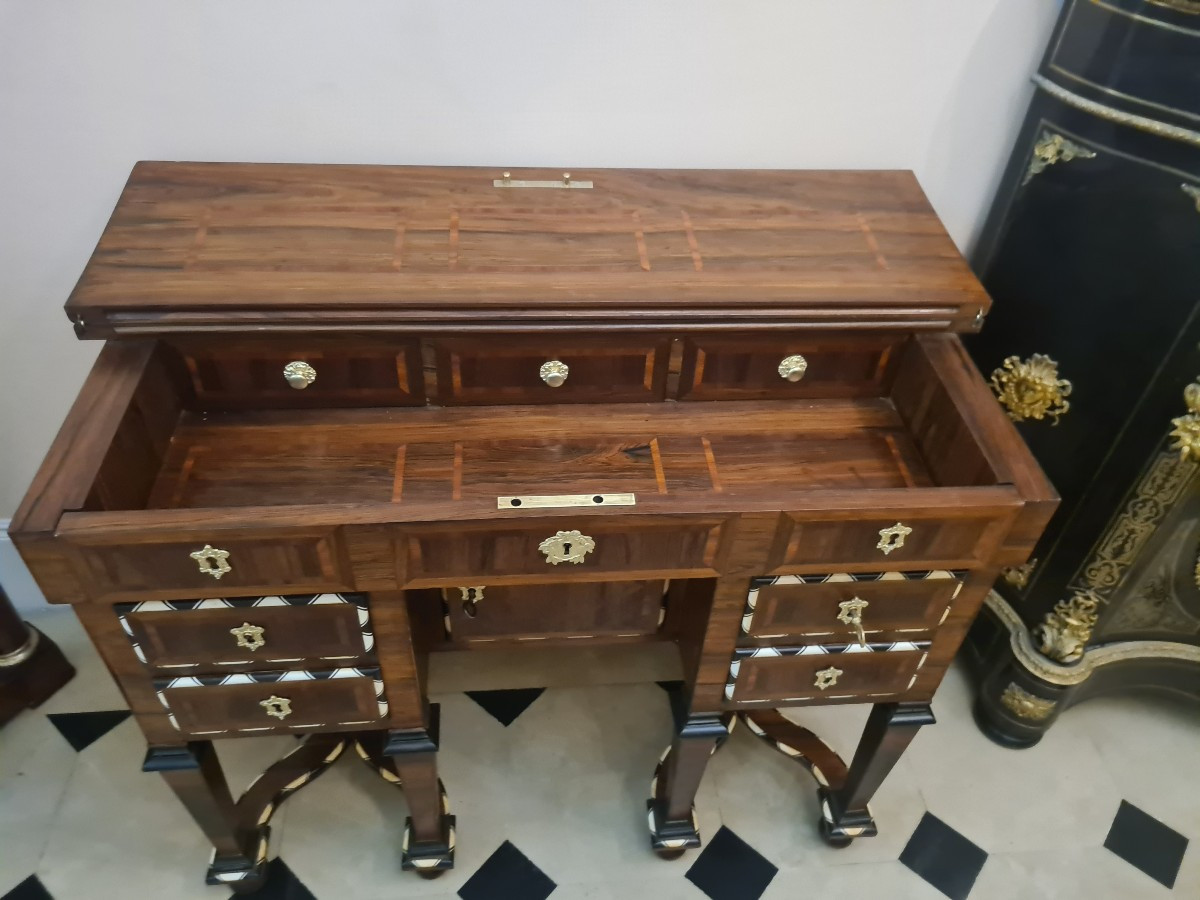
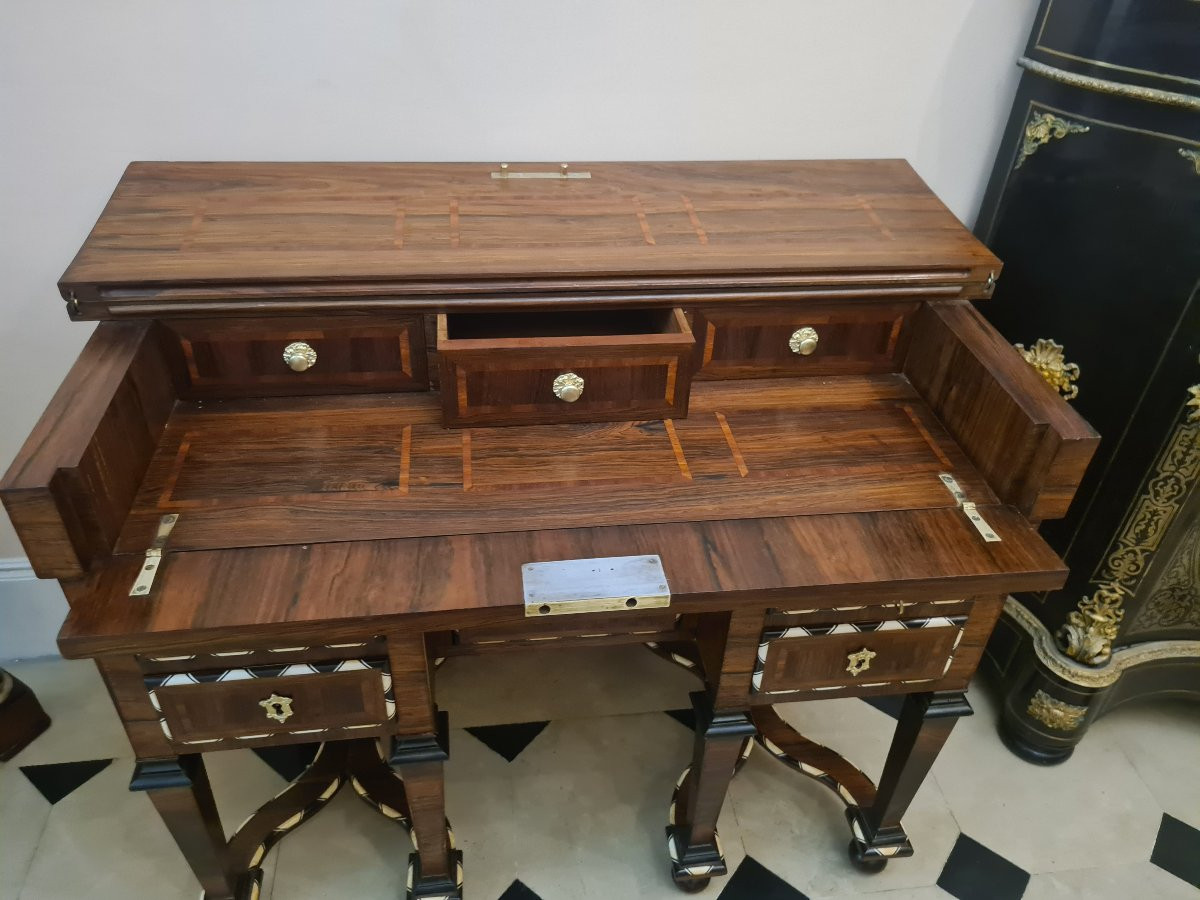
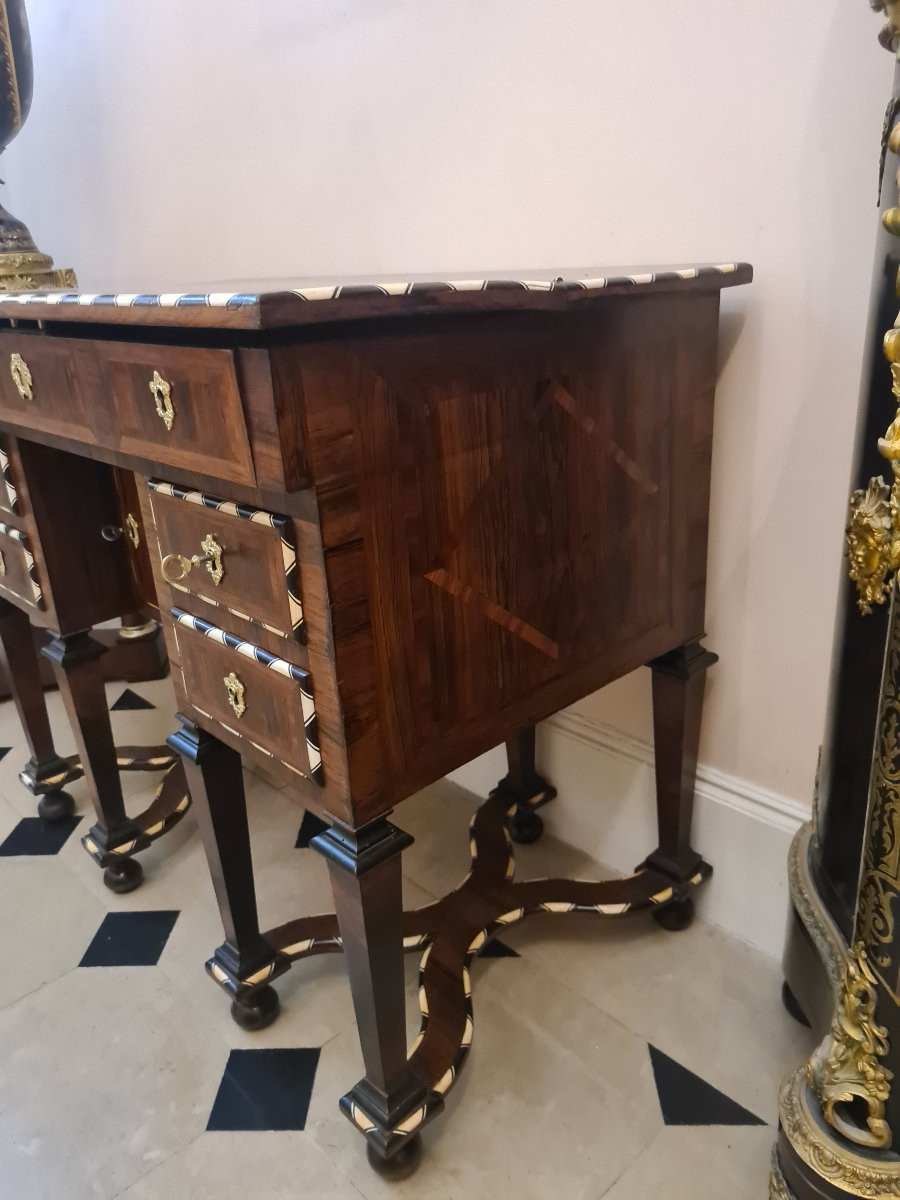
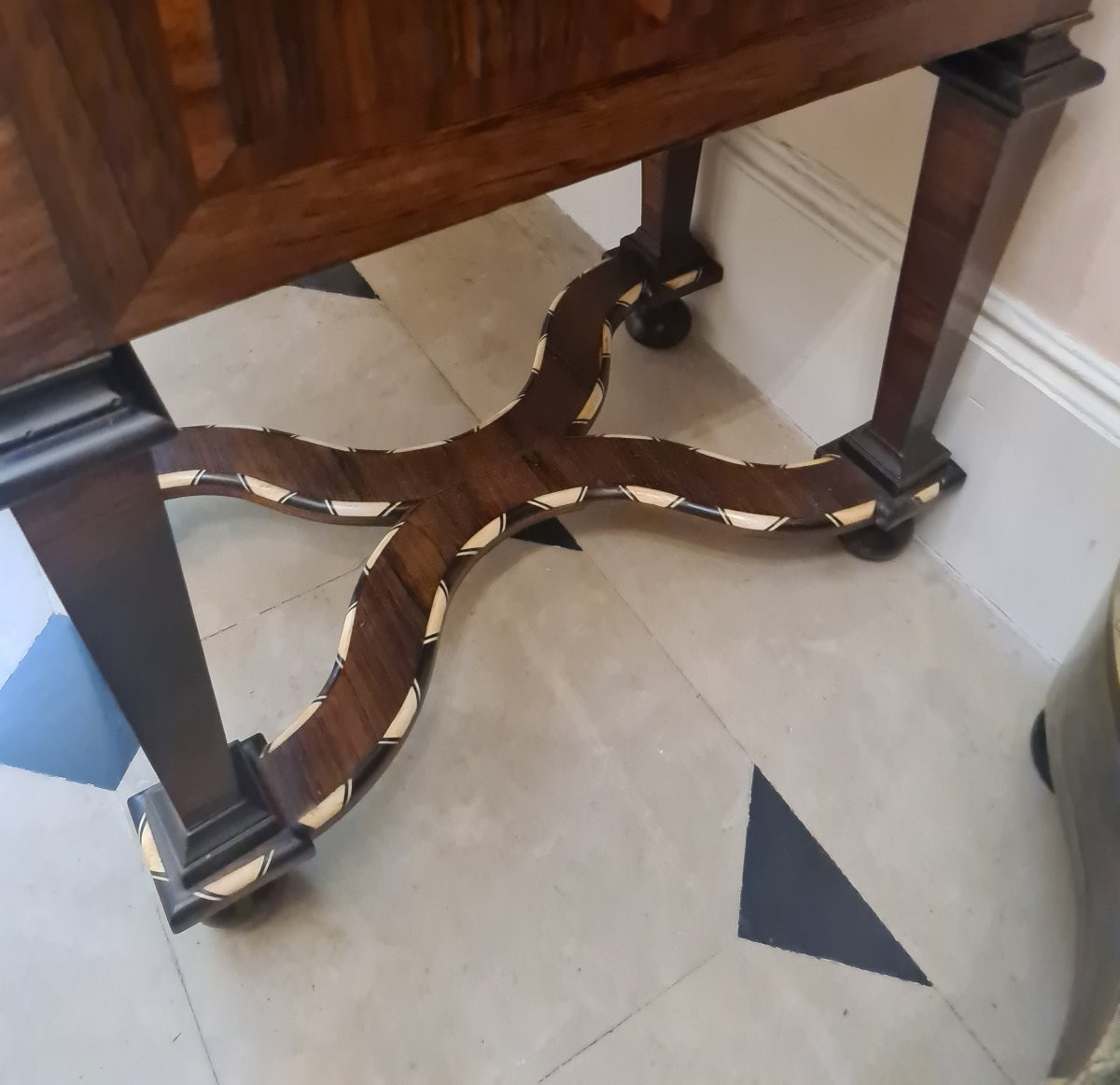
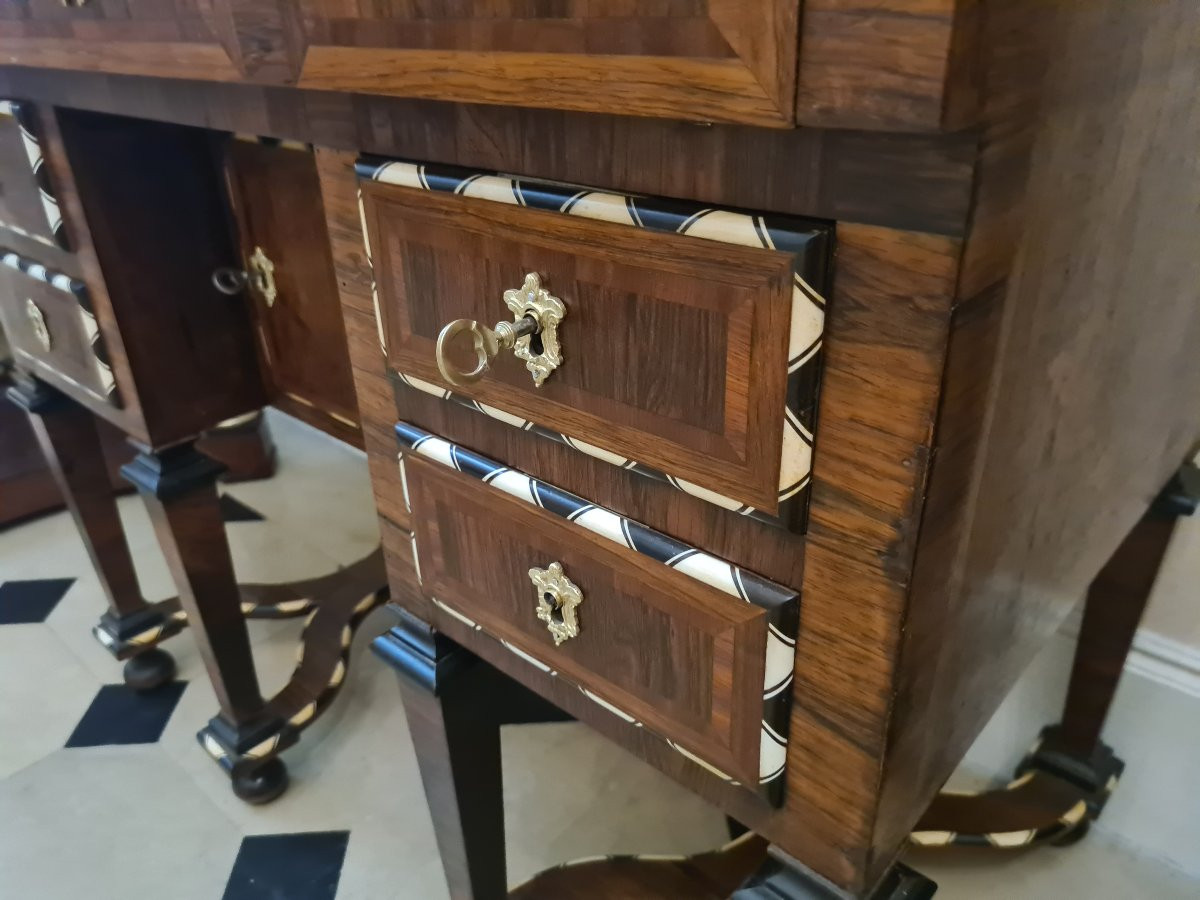
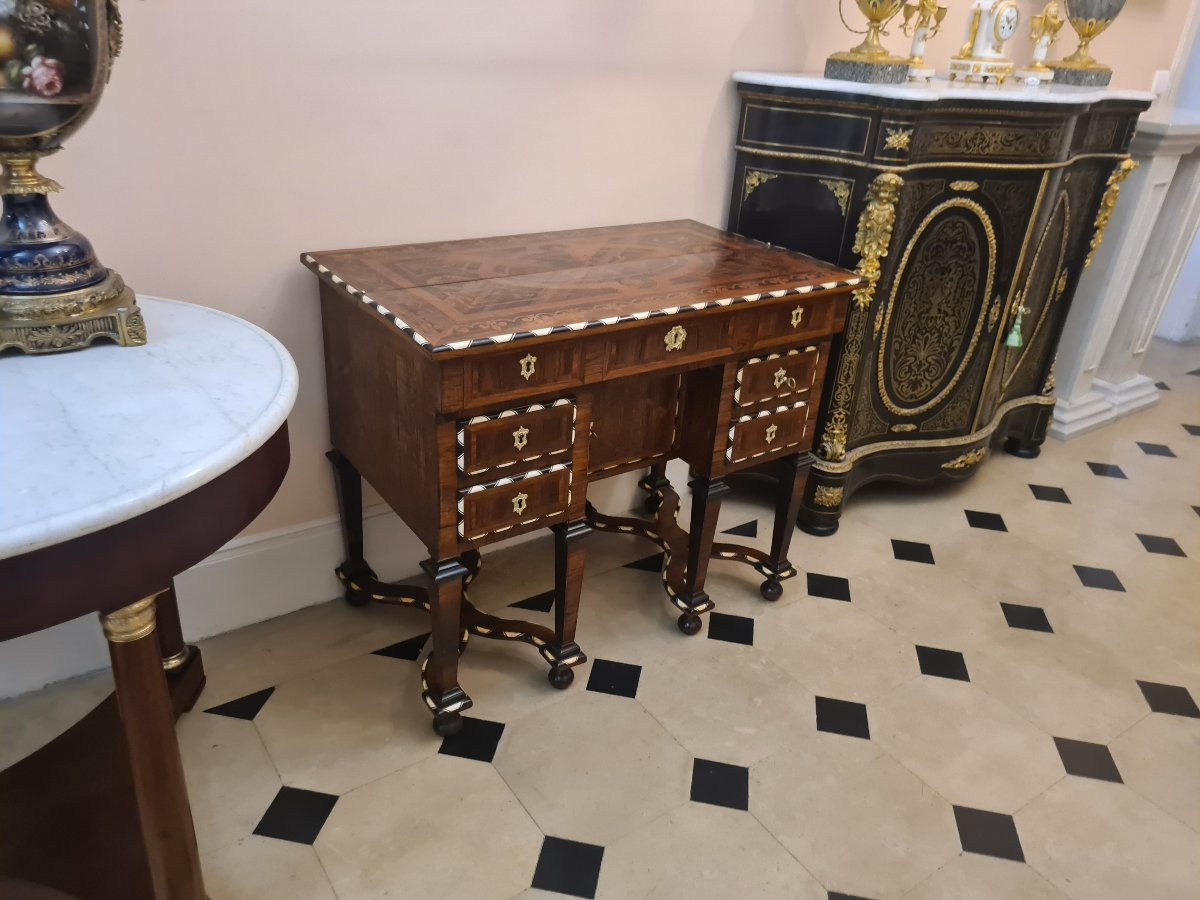
A Mazarin desk veneered in rosewood and boxwood, combined with marquetry of various wood species and inlays of bone and ebonized wood. It rests on eight ball feet connected by two X-shaped stretchers, extending from the tapered uprights. The front features a recessed central door flanked by four drawers. The drop-front, inlaid with fleur-de-lis friezes and reserves, is centered with a quatrefoil motif and reveals three drawers. Made in the 17th-century style, Louis XIV, late 19th century, circa 1890-1900. Restored in our workshop, therefore in perfect condition. H. 81 cm – W. 96 cm – D. 56 cm.
In conclusion: a superb (and certainly period-appropriate) piece of furniture in excellent condition, which has not undergone extensive restoration due to the ravages of time.
3 things you probably didn't know about the Mazarin desk...:
→ In the 17th century, it was customary to sit at an angle: one knee under the writing surface and the other outside. This position wasn't a whim of the Grand Siècle (the 17th century) but a necessity: members of the nobility who carried a sword always held it on their left. To avoid discomfort while they were at their desks, it was customary to sit at an angle, so that the weapon held on the left wouldn't strike the furniture's uprights. This is also why, even today, riders mount their horses using their left stirrup.
→ The "Mazarin" desk is one of the jewels of 17th-century furniture. It only acquired the name "Mazarin" in the 19th century, coined by antique dealers to give it more prestige. In reality, it only appeared around 1670, well after the cardinal's death in 1661. The oldest example we can precisely date to 1669 was made by Pierre Gole (1620-1684), a Dutch craftsman who became cabinetmaker to the king. This piece of furniture generally consists of two side cabinets with three drawers each, supported by X- or H-shaped stretchers. A central frieze drawer sits above a flap that opens with a drop-front. The top can be "broken," meaning it opens to reveal a writing surface containing further interior drawers.
→Like cabinets of curiosities, the Mazarin desk was more often a showpiece than a true desk. It was reserved for an elite and highly prized by the nobility, who could, through the virtuosity of the cabinetmakers, convey the wealth and power of a patron eager to display precious materials.
Pay attention to the legs and condition of Mazarin desks:
→ The Mazarin desk (late 17th – early 18th century) rests on eight legs connected by an X or H-shaped stretcher, with a highly sculpted apron and often simulated drawers. It combines many delicate elements, few large load-bearing sections of wood, and a structure that shifts considerably over time. Therefore, pay close attention to the legs of these desks, as they are structurally bold but mechanically vulnerable.
→ These pieces are often over 300 years old, crafted from magnificent wood species but highly sensitive to humidity variations. Over time, it is not uncommon to observe differential shrinkage, twisting, and gradual sagging under the weight of the upper cabinet.
→ This 17th-century piece of furniture was not designed with our modern requirements for long-term stability in mind. It is, in a way, the quintessential Baroque piece: superb, but temperamental. In our case, these problems are nonexistent because the piece of furniture is much newer, assembled using more modern techniques (strong glue applied to younger wood, less rigid cross braces, and no clumsy grafts). Far be it from me to disparage 17th-century furniture, but it's important to know that it is fragile and has often been restored with varying degrees of success depending on the cabinetmaker's skill.
Note: price includes delivery within mainland France.
In conclusion: a superb (and certainly period-appropriate) piece of furniture in excellent condition, which has not undergone extensive restoration due to the ravages of time.
3 things you probably didn't know about the Mazarin desk...:
→ In the 17th century, it was customary to sit at an angle: one knee under the writing surface and the other outside. This position wasn't a whim of the Grand Siècle (the 17th century) but a necessity: members of the nobility who carried a sword always held it on their left. To avoid discomfort while they were at their desks, it was customary to sit at an angle, so that the weapon held on the left wouldn't strike the furniture's uprights. This is also why, even today, riders mount their horses using their left stirrup.
→ The "Mazarin" desk is one of the jewels of 17th-century furniture. It only acquired the name "Mazarin" in the 19th century, coined by antique dealers to give it more prestige. In reality, it only appeared around 1670, well after the cardinal's death in 1661. The oldest example we can precisely date to 1669 was made by Pierre Gole (1620-1684), a Dutch craftsman who became cabinetmaker to the king. This piece of furniture generally consists of two side cabinets with three drawers each, supported by X- or H-shaped stretchers. A central frieze drawer sits above a flap that opens with a drop-front. The top can be "broken," meaning it opens to reveal a writing surface containing further interior drawers.
→Like cabinets of curiosities, the Mazarin desk was more often a showpiece than a true desk. It was reserved for an elite and highly prized by the nobility, who could, through the virtuosity of the cabinetmakers, convey the wealth and power of a patron eager to display precious materials.
Pay attention to the legs and condition of Mazarin desks:
→ The Mazarin desk (late 17th – early 18th century) rests on eight legs connected by an X or H-shaped stretcher, with a highly sculpted apron and often simulated drawers. It combines many delicate elements, few large load-bearing sections of wood, and a structure that shifts considerably over time. Therefore, pay close attention to the legs of these desks, as they are structurally bold but mechanically vulnerable.
→ These pieces are often over 300 years old, crafted from magnificent wood species but highly sensitive to humidity variations. Over time, it is not uncommon to observe differential shrinkage, twisting, and gradual sagging under the weight of the upper cabinet.
→ This 17th-century piece of furniture was not designed with our modern requirements for long-term stability in mind. It is, in a way, the quintessential Baroque piece: superb, but temperamental. In our case, these problems are nonexistent because the piece of furniture is much newer, assembled using more modern techniques (strong glue applied to younger wood, less rigid cross braces, and no clumsy grafts). Far be it from me to disparage 17th-century furniture, but it's important to know that it is fragile and has often been restored with varying degrees of success depending on the cabinetmaker's skill.
Note: price includes delivery within mainland France.
4 800 €
Period: 19th century
Style: Louis 14th, Regency
Condition: Fully restored in our whorkshop
Material: Wood marquetry
Width: 96
Height: 81
Depth: 56
Reference (ID): 1696824
Availability: In stock
Print