Imari-style Earthenware Box Surmounted By A Cat, 20th Century
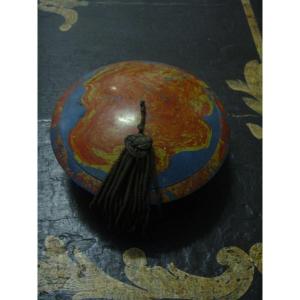
Round earthenware box in the Imari style, decorated with floral and foliate motifs in iron red, blue, and gold highlights, surmounted by a reclining cat forming the lid handle. Mark on the underside. Very good overall condition.
20th century, China.
Dimensions: H 16 x Diam. 12.5 cm.
The Imari Style: The Imari style originated in 17th-century Japan, when the first Japanese porcelain was exported to Europe from the port of Imari on the island of Kyushu. These pieces are characterized by a rich palette dominated by iron red, underglaze blue, and gold highlights, combined with stylized floral, vegetal, and sometimes geometric designs. Highly prized in the West, the Imari style was widely imitated from the 18th century onward, in both China and Europe. In the 20th century, it became a decorative motif in its own right, reinterpreted for ornamental objects, while retaining its contrasting colors and opulent appearance.
The symbolism of the cat in Asia: In Far Eastern culture, the cat is an animal imbued with positive meanings. It is traditionally associated with the protection of the home, good fortune, and prosperity. In Japan as in China, its presence evokes domestic harmony, vigilance, and abundance. Represented here in a serene, reclining, and attentive pose, the cat reinforces the benevolent and decorative dimension of the object.
****
I handle delivery for you within France and internationally. Shipping methods depend on the delivery address; please feel free to contact me to determine the cost and arrange it. I take particular care in the protection and packaging of each work of art.
20th century, China.
Dimensions: H 16 x Diam. 12.5 cm.
The Imari Style: The Imari style originated in 17th-century Japan, when the first Japanese porcelain was exported to Europe from the port of Imari on the island of Kyushu. These pieces are characterized by a rich palette dominated by iron red, underglaze blue, and gold highlights, combined with stylized floral, vegetal, and sometimes geometric designs. Highly prized in the West, the Imari style was widely imitated from the 18th century onward, in both China and Europe. In the 20th century, it became a decorative motif in its own right, reinterpreted for ornamental objects, while retaining its contrasting colors and opulent appearance.
The symbolism of the cat in Asia: In Far Eastern culture, the cat is an animal imbued with positive meanings. It is traditionally associated with the protection of the home, good fortune, and prosperity. In Japan as in China, its presence evokes domestic harmony, vigilance, and abundance. Represented here in a serene, reclining, and attentive pose, the cat reinforces the benevolent and decorative dimension of the object.
****
I handle delivery for you within France and internationally. Shipping methods depend on the delivery address; please feel free to contact me to determine the cost and arrange it. I take particular care in the protection and packaging of each work of art.
280 €
Period: 20th century
Style: Asian art
Condition: Excellent condition
Material: Earthenware
Diameter: 12,5
Height: 16
Reference (ID): 1688420
Availability: In stock
Print