Japanese Print 'festival At Atsuta Shrine' Hiroshige Early 20th Century
Artist: Utagawa Hiroshige (1797-1858)
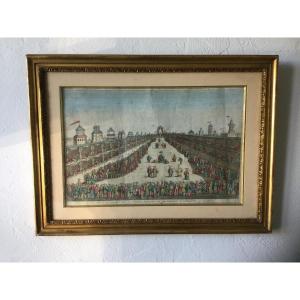
Japanese print in Ôban yoko-e format representing the "Festival at Atsuta Shrine", this print is part of the series "The fifty-three relays of Tôkaido", 41st relay.
Signature "Ichiryûsai Hiroshige Ga" lower left, posthumous edition by Utagawa Hiroshige (1797-1858) with the publisher's stamp below.
Early 20th century period.
Dimensions with frame: H 35 x L 48 cm, at sight: H 23.55 x L 36.5 cm
The Atsuta shrine
The Atsuta Shinto shrine housed an imperial treasure: the sacred sword, which legend attributes to a hero's act of bravery. Many pilgrims came to pray in this temple, increasing the prosperity of the Miya relay each year. Hiroshige evokes in this print a traditional festival bringing together in June the protagonists, men and horses, of a chariot race ready to cross the temple enclosure.
The technique
Japanese prints were made using the technique of wood engraving, xylography. The engraver used a wooden plate and dug around the image. He then cut out all the parts he wanted to leave blank on the paper. Thus, only the patterns to be printed appeared in relief. Finally, he printed on paper using a baren which he applied to the back of the print by pressing on the wooden plate.
Signature "Ichiryûsai Hiroshige Ga" lower left, posthumous edition by Utagawa Hiroshige (1797-1858) with the publisher's stamp below.
Early 20th century period.
Dimensions with frame: H 35 x L 48 cm, at sight: H 23.55 x L 36.5 cm
The Atsuta shrine
The Atsuta Shinto shrine housed an imperial treasure: the sacred sword, which legend attributes to a hero's act of bravery. Many pilgrims came to pray in this temple, increasing the prosperity of the Miya relay each year. Hiroshige evokes in this print a traditional festival bringing together in June the protagonists, men and horses, of a chariot race ready to cross the temple enclosure.
The technique
Japanese prints were made using the technique of wood engraving, xylography. The engraver used a wooden plate and dug around the image. He then cut out all the parts he wanted to leave blank on the paper. Thus, only the patterns to be printed appeared in relief. Finally, he printed on paper using a baren which he applied to the back of the print by pressing on the wooden plate.
190 €
Period: 20th century
Style: Asian art
Condition: Good condition
Material: Paper
Length: 48
Height: 35
Reference (ID): 1352248
Availability: In stock
Print