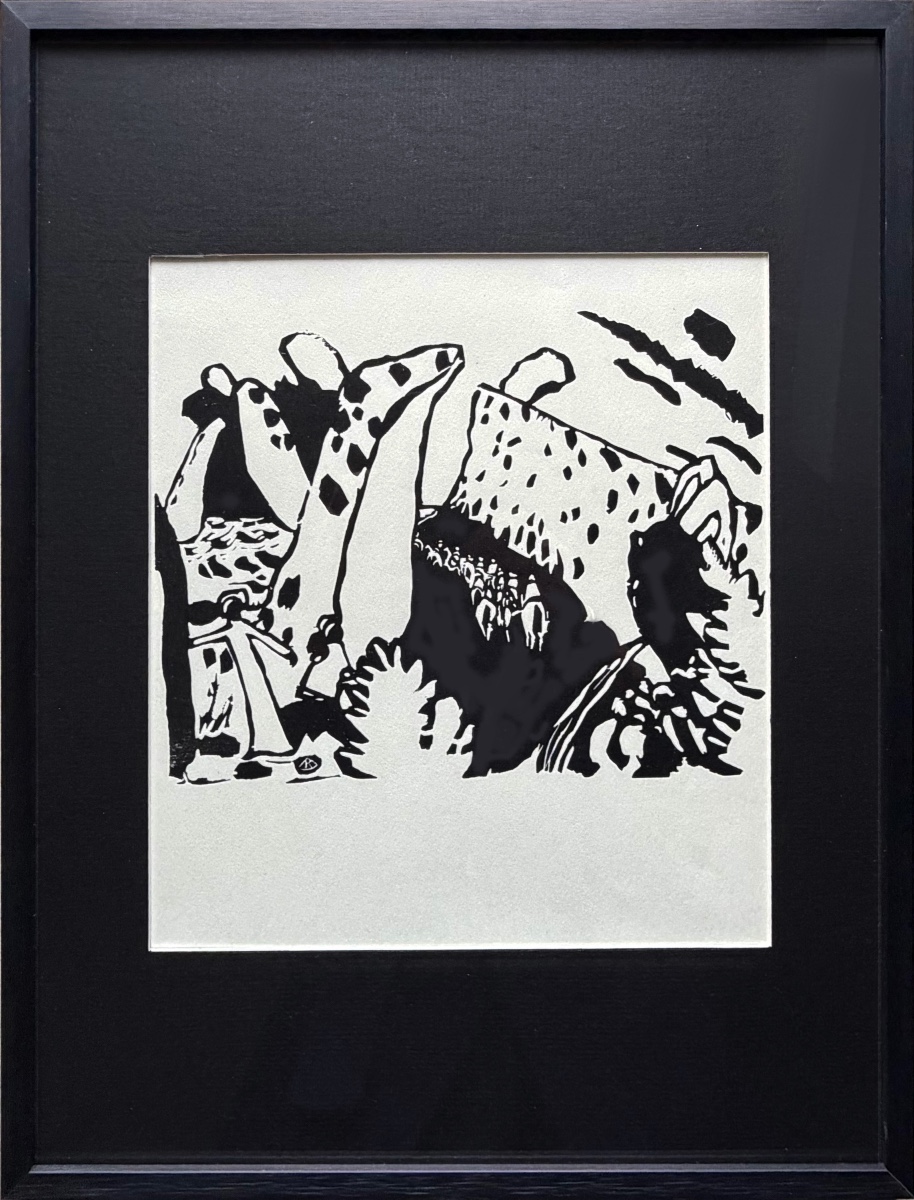
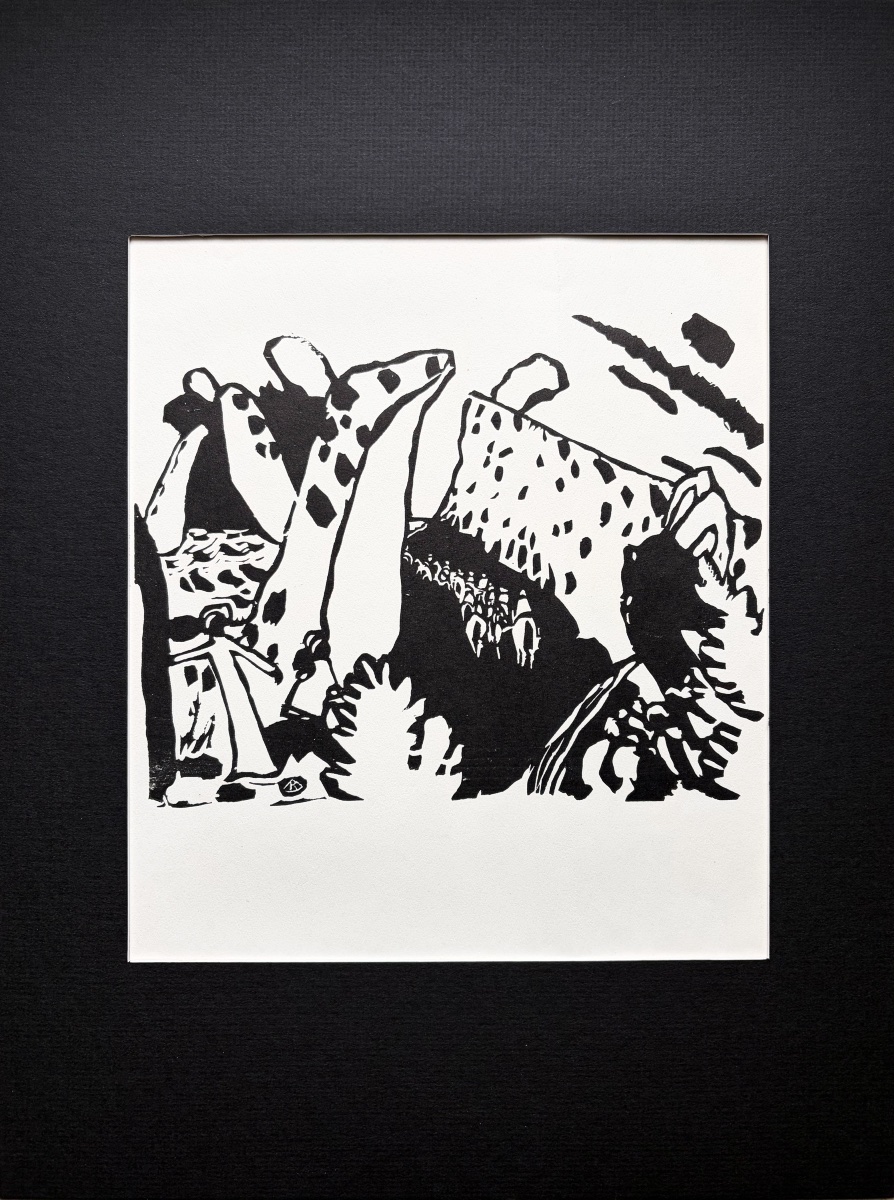


Wassily Kandinsky, Reiterweg, The Riders' Path, Woodcut 1938 Signed With The Monogram
Artist: Wassily Kandinsky (1866 - 1944)
An important black and white woodcut is featured in the collections of MoMA, the National Gallery, and the Centre Pompidou, which even possesses the printing plate bequeathed by Nina Kandinsky.
This is the 1938 proof, and therefore the final version of Kandinsky's original woodcut, which he created for the album Klänge, completed in 1911, a masterpiece of art and poetry published in 1913. It was later published in this second edition by Gualtieri di San Lazzaro, Chroniques du Jour, Paris, for the journal XXe Siècle, in its final form under Kandinsky's supervision in 1938 as part of his essay "My Woodcuts."
The edition is generally given as 1200 copies, sometimes indicated as 2000 (the standard print run for this art journal), but many copies of this edition were lost during the war. The series of wood engravings contained in Klänge was not merely illustrative but resonated with a poetic project, a synesthesia of sounds and images contributing to the development of Kandinsky's abstract art.
Most of the wood engravings were simply titled "Improvisation," with a barely discernible subject, but this one, more programmatic, was given a precise title: "Reiterweg" (riding path). The particularly interesting theme of this original woodcut, here in its final state, probably the most captivating of the series, which constituted folio 24 of Klänge, entitled "Reiterweg" (Riding Path), seems to depict riders in the distance making their way through a rocky defile, a landscape more allegorical than figurative, surrounded by speckled cliffs that appear almost alive, with a man or lookout in the foreground, perched atop the cliffs, of disproportionate size, watching the advance of this cavalry as it moves away from him. This highly mysterious woodcut, with its fertile imagination and mystical tension, is described as "depicting," with all the liberating freedom of abstraction, Moses and the Hebrews crossing the Red Sea.
The rocky defile would then be formed not of terrestrial cliffs, but of the more mystical and shifting landscape of a sea opening before Moses and the chosen people, creating an ephemeral passage framed by marine cliffs. While the depiction of the Hebrew people on horseback may seem surprising, it is also known that the figure of the rider is a key element of Kandinsky's innovative artistic grammar since the Der Blaue Reiter movement, which he co-founded.
For Kandinsky, the rider serves as a metaphor for the artist, guiding the horse of creation, a symbol of his conquest and gallop towards the heights of art.
This is a superb inking of this original black and white woodcut in its final 1938 print, signed in the plate with Kandinsky's monogram.
Overall sheet dimensions: 31.8 cm x 24.5 cm - Visible area inside the black mat: 24 cm x 21 cm.
Framed dimensions in an elegant black steel frame: 41 cm x 31 cm.
A slight vertical crease is present, but overall it is in very good condition.
Discover this artwork on our WE ART TOGETHER gallery website by clicking here.
This is the 1938 proof, and therefore the final version of Kandinsky's original woodcut, which he created for the album Klänge, completed in 1911, a masterpiece of art and poetry published in 1913. It was later published in this second edition by Gualtieri di San Lazzaro, Chroniques du Jour, Paris, for the journal XXe Siècle, in its final form under Kandinsky's supervision in 1938 as part of his essay "My Woodcuts."
The edition is generally given as 1200 copies, sometimes indicated as 2000 (the standard print run for this art journal), but many copies of this edition were lost during the war. The series of wood engravings contained in Klänge was not merely illustrative but resonated with a poetic project, a synesthesia of sounds and images contributing to the development of Kandinsky's abstract art.
Most of the wood engravings were simply titled "Improvisation," with a barely discernible subject, but this one, more programmatic, was given a precise title: "Reiterweg" (riding path). The particularly interesting theme of this original woodcut, here in its final state, probably the most captivating of the series, which constituted folio 24 of Klänge, entitled "Reiterweg" (Riding Path), seems to depict riders in the distance making their way through a rocky defile, a landscape more allegorical than figurative, surrounded by speckled cliffs that appear almost alive, with a man or lookout in the foreground, perched atop the cliffs, of disproportionate size, watching the advance of this cavalry as it moves away from him. This highly mysterious woodcut, with its fertile imagination and mystical tension, is described as "depicting," with all the liberating freedom of abstraction, Moses and the Hebrews crossing the Red Sea.
The rocky defile would then be formed not of terrestrial cliffs, but of the more mystical and shifting landscape of a sea opening before Moses and the chosen people, creating an ephemeral passage framed by marine cliffs. While the depiction of the Hebrew people on horseback may seem surprising, it is also known that the figure of the rider is a key element of Kandinsky's innovative artistic grammar since the Der Blaue Reiter movement, which he co-founded.
For Kandinsky, the rider serves as a metaphor for the artist, guiding the horse of creation, a symbol of his conquest and gallop towards the heights of art.
This is a superb inking of this original black and white woodcut in its final 1938 print, signed in the plate with Kandinsky's monogram.
Overall sheet dimensions: 31.8 cm x 24.5 cm - Visible area inside the black mat: 24 cm x 21 cm.
Framed dimensions in an elegant black steel frame: 41 cm x 31 cm.
A slight vertical crease is present, but overall it is in very good condition.
Discover this artwork on our WE ART TOGETHER gallery website by clicking here.
650 €
Period: 20th century
Style: Modern Art
Condition: Excellent condition
Material: Paper
Length: 41 cm avec le cadre
Width: 31 cm avec le cadre
Reference (ID): 1686786
Availability: In stock
Print