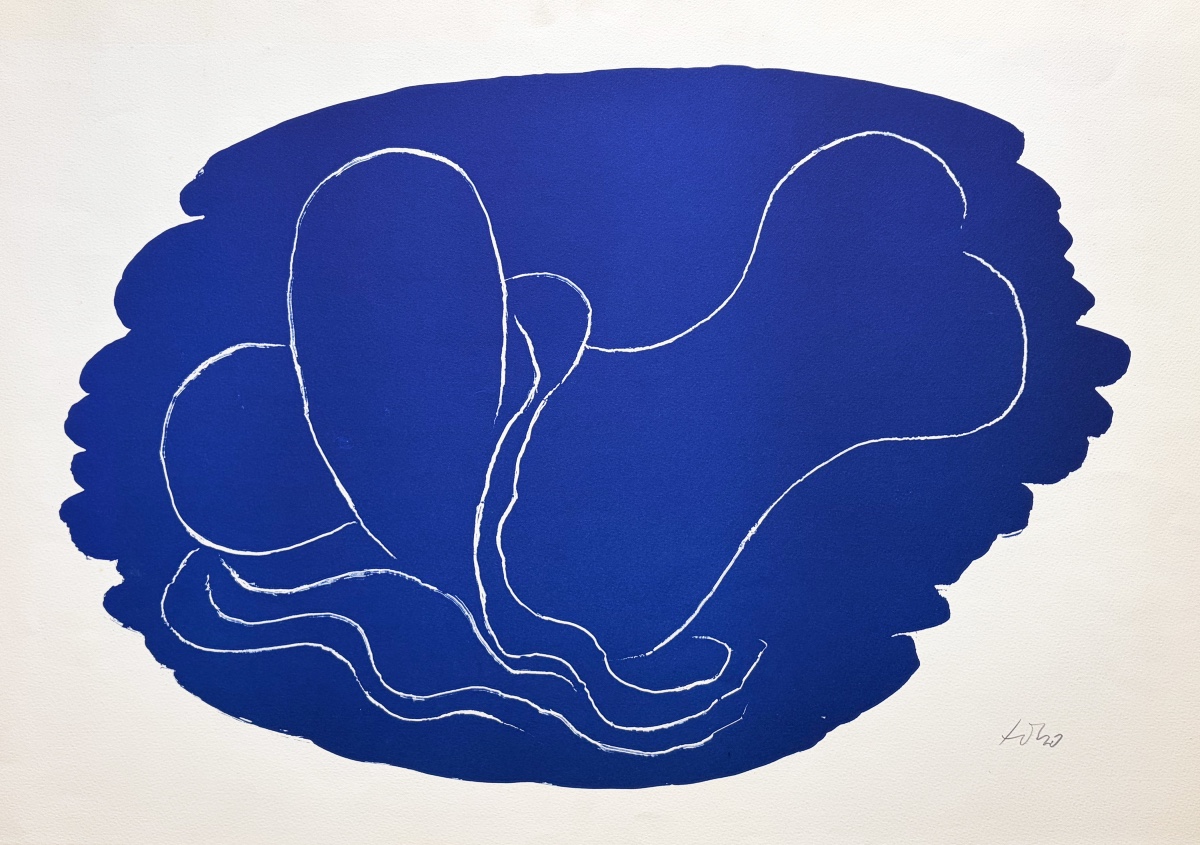



Baltasar Lobo, Abstract Nude Study, Original Lithograph Numbered And Signed
Artist: Baltasar Lobo (1910-1993)
Étude de nu féminin abstrait cubiste, ST
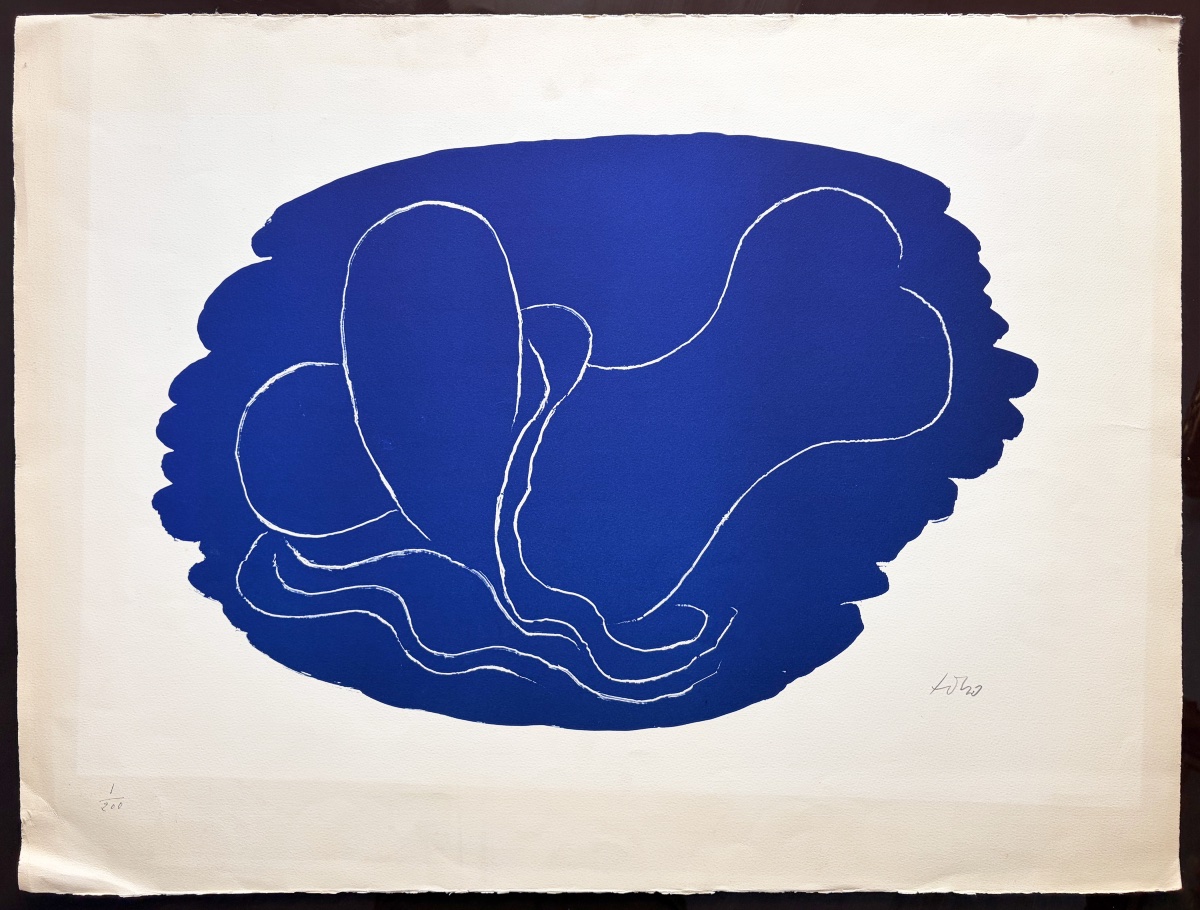
Original lithograph signed lower right in pencil and numbered 1/200 in the artist's hand lower left.
Condition report: oxidation and traces of framing (traces of framing that will no longer be visible once the work is reframed with a marie-louise), crease lower left (see photos).
Very interesting original lithograph by sculptor Baltasar Lobo Casuero, often abbreviated to Baltasar Lobo and signing "Lobo". Spanish artist belonging to the École de Paris, who found refuge in France during the Spanish Civil War.
Picasso was one of the first to welcome him and introduced him to Henri Laurens.
A nude study that breaks away from the three-dimensional work of sculpture to treat nudity differently, almost always feminine in this artist's work, seeming to float in an azure sea, playing here with the simplification of forms, while interweaving them, inspired by cubism ; and, even more astonishingly, imbuing the subject with a chromatic accent of pure indigo, reminiscent of Matisse's cut-out gouaches, the series Matisse produced in 1947 for the art book "Jazz" published by Tériade.
In 1946, Baltasar Lobo's sculptures were exhibited at the Galerie Vendôme alongside works by Matisse and Picasso.
Very soon, Baltasar Lobo, an artist who dedicated his work to the feminine principle, achieved international recognition, exhibiting in Japan and Switzerland, and constantly moving towards greater formal purity, following the example of Brancusi or Henri Moore.
This lithograph by Baltasar Lobo seems to us to date from or refer to the period of the late '40s, possibly between '45 and '50, when the dual influence of Picasso and Matisse in his work appears strongest.
Prints by this artist remain rare on the art market, and this work, with its Matissian blue accent, stands out, both chromatically distinct, and representative of Lobo's ongoing research into the female nude, his synthesis of cubist abstraction to translate the different postures of a woman's body but also its embodiments.
Here, the languor owes more to the contemplation of a soul than to the concupiscent gaze, the anaphoric fruit of male artists, for the modern version of the desirable figure of the odalisque.
Color affirms the predominance of the transcendence of the Feminine over the patriarchal reification of woman. Immanence and eternity rather than passive, univocal sensuality.
An avant-garde, feminist and magnetic work.
Dimensions: 56.2 cm x 76 cm
The large-format work is sold unframed and shipped in a shipping tube
Full description on the website of the WE ART TOGETHER gallery
Original lithograph signed lower right in pencil and numbered 1/200 in the artist's hand lower left.
Condition report: oxidation and traces of framing (traces of framing that will no longer be visible once the work is reframed with a marie-louise), crease lower left (see photos).
Very interesting original lithograph by sculptor Baltasar Lobo Casuero, often abbreviated to Baltasar Lobo and signing "Lobo". Spanish artist belonging to the École de Paris, who found refuge in France during the Spanish Civil War.
Picasso was one of the first to welcome him and introduced him to Henri Laurens.
A nude study that breaks away from the three-dimensional work of sculpture to treat nudity differently, almost always feminine in this artist's work, seeming to float in an azure sea, playing here with the simplification of forms, while interweaving them, inspired by cubism ; and, even more astonishingly, imbuing the subject with a chromatic accent of pure indigo, reminiscent of Matisse's cut-out gouaches, the series Matisse produced in 1947 for the art book "Jazz" published by Tériade.
In 1946, Baltasar Lobo's sculptures were exhibited at the Galerie Vendôme alongside works by Matisse and Picasso.
Very soon, Baltasar Lobo, an artist who dedicated his work to the feminine principle, achieved international recognition, exhibiting in Japan and Switzerland, and constantly moving towards greater formal purity, following the example of Brancusi or Henri Moore.
This lithograph by Baltasar Lobo seems to us to date from or refer to the period of the late '40s, possibly between '45 and '50, when the dual influence of Picasso and Matisse in his work appears strongest.
Prints by this artist remain rare on the art market, and this work, with its Matissian blue accent, stands out, both chromatically distinct, and representative of Lobo's ongoing research into the female nude, his synthesis of cubist abstraction to translate the different postures of a woman's body but also its embodiments.
Here, the languor owes more to the contemplation of a soul than to the concupiscent gaze, the anaphoric fruit of male artists, for the modern version of the desirable figure of the odalisque.
Color affirms the predominance of the transcendence of the Feminine over the patriarchal reification of woman. Immanence and eternity rather than passive, univocal sensuality.
An avant-garde, feminist and magnetic work.
Dimensions: 56.2 cm x 76 cm
The large-format work is sold unframed and shipped in a shipping tube
Full description on the website of the WE ART TOGETHER gallery
280 €
Period: 20th century
Style: Modern Art
Condition: En l'etat
Material: Paper
Length: 76 cm
Width: 56,2 cm
Reference (ID): 1740153
Availability: In stock
Print