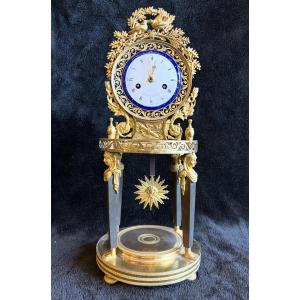
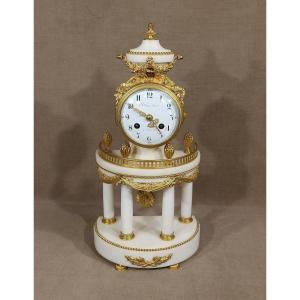
Directoire Skeleton Clock, 1795-1799, With Date Display, Attributed To Folin The Elder, Signed Dubuisson
Artist: Folin L'aîné Et Dubuisson (etienne Gobin)
An exceptional and rare skeleton clock in the shape of an arch, dating from the Directoire period, with a white enameled annular dial revealing in its center a portion of the finely cut gears of the mechanism. The clock indicates the hours in Roman numerals, the minutes in fifteen-minute increments, and the date of the Republican month, graduated from 1 to 30 in Arabic numerals, by three superb hands: two pierced and magnificently crafted in gilt copper, and one in blued steel. The entire mechanism is driven by a magnificent mercury-gilt pendulum bearing the central motif of the enamel plaque. This clock is attributed to Nicolas-Alexandre Folin, known as Folin the Elder (1750-1815), considered one of the greatest clockmakers of the late 18th and early 19th centuries. He became a Master in 1789 and established his own workshop on Rue Salle-au-Comte, where he quickly gained considerable renown, specializing in skeleton clocks and calendar movements. Very active after the fall of Louis XVI and during the First Empire, he collaborated with the best craftsmen of his time for the making of the dials and cases of his clocks, such as the enamellers Dubuisson and Merlet, the engravers Martincourt and Vion, and the cabinetmaker Schwerdfeger. Only a few privileged individuals could afford such remarkable clocks. The dial, signed Dubuisson, is remarkably decorated with scrolling motifs; The dates are encircled by a magnificent blue border and separated by flowers dotted with emerald. The arch and the central enameled plaque, a deep blue, are remarkably crafted with threads of mother-of-pearl and floral scrolls. On the arch, at its center, is a Medusa head framed by fine emerald dots. On the central plaque is inscribed in gold letters "A Paris". The griotte red marble base rests on four adjustable ball feet and displays in its center a frieze of griffins and flowers. A frieze with remarkably guilloché geometric designs adorns the two lateral faces of the base. The clock is richly decorated with finely chased, knurled, and mercury-gilded bronze. At the top of the clock sits an eagle with outstretched wings supporting a sheaf of flowers and fruit. The four arches, in the form of inverted brackets, rest on tall, truncated conical shafts with molded bases. Every hour and quarter hour, the clock strikes a magnificent bronze bell with a crystalline sound. The clock's wire-driven movement has been fully serviced by a professional watchmaker and is sold in perfect working order. Skeleton clocks are representative of this transitional period, in which various noble materials were combined (enamel work, bronze, and marble). They were produced for only a very short time; The rarest of these, like this one, display the 30-day Republican calendar. Height 47 cm. Key, pendulum, and timpani included. Dubuisson (1731-1815), whose real name was Etienne Gobin, was one of the most celebrated enamellers in Paris at the end of the 18th and beginning of the 19th centuries, a colleague and main rival of Joseph Coteau. Around the mid-1750s, he worked at the Sèvres porcelain factory, later establishing his own workshop. Specializing in enameled watch cases and dials, he was renowned for his exceptional skill and attention to detail.
8 000 €
Period: 18th century
Style: Louis 16th, Directory
Condition: Excellent condition
Height: 47 cm
Reference (ID): 1686299
Availability: In stock
Print