

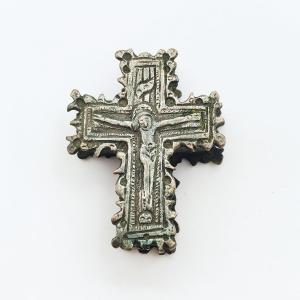
"Portable Byzantine Reliquary Cross In Enameled Silver"
Epirus or Macedonia, ca. 1250–1320With post-Byzantine case in repelled silver (16th century)
DIMENSIONS
Cross: 43 × 26 × 9 mm
Case: proportional dimensions, not measured
Born in the silence of a monastery of Epirus or Ohrid around 1250–1320, this cross-reliquary was shaped like a small sanctuary: twisted filigree, domed rock crystal, light boxwood then freshly cut. At the time of its closure, thin fibers of textile relics slipped between the wood and the metal, where they still rest, prisoners of the medieval gesture.
Carried on the chest of several successive higoumenes, she saw the glow of candles, breathed incense, accompanied processions and received the prayers of generations of monks. Over the centuries, the boxwood has darkened, the crystal has been veiled, and the cross has preserved in it the deep memory of those who served and protected it.
Placed in the 16th century in a silver case, it left its mark as a silent seal of time. Thus come down to us, it presents itself not as a simple object, but as a living witness of the Byzantine faith and seven centuries of devotion.
Description
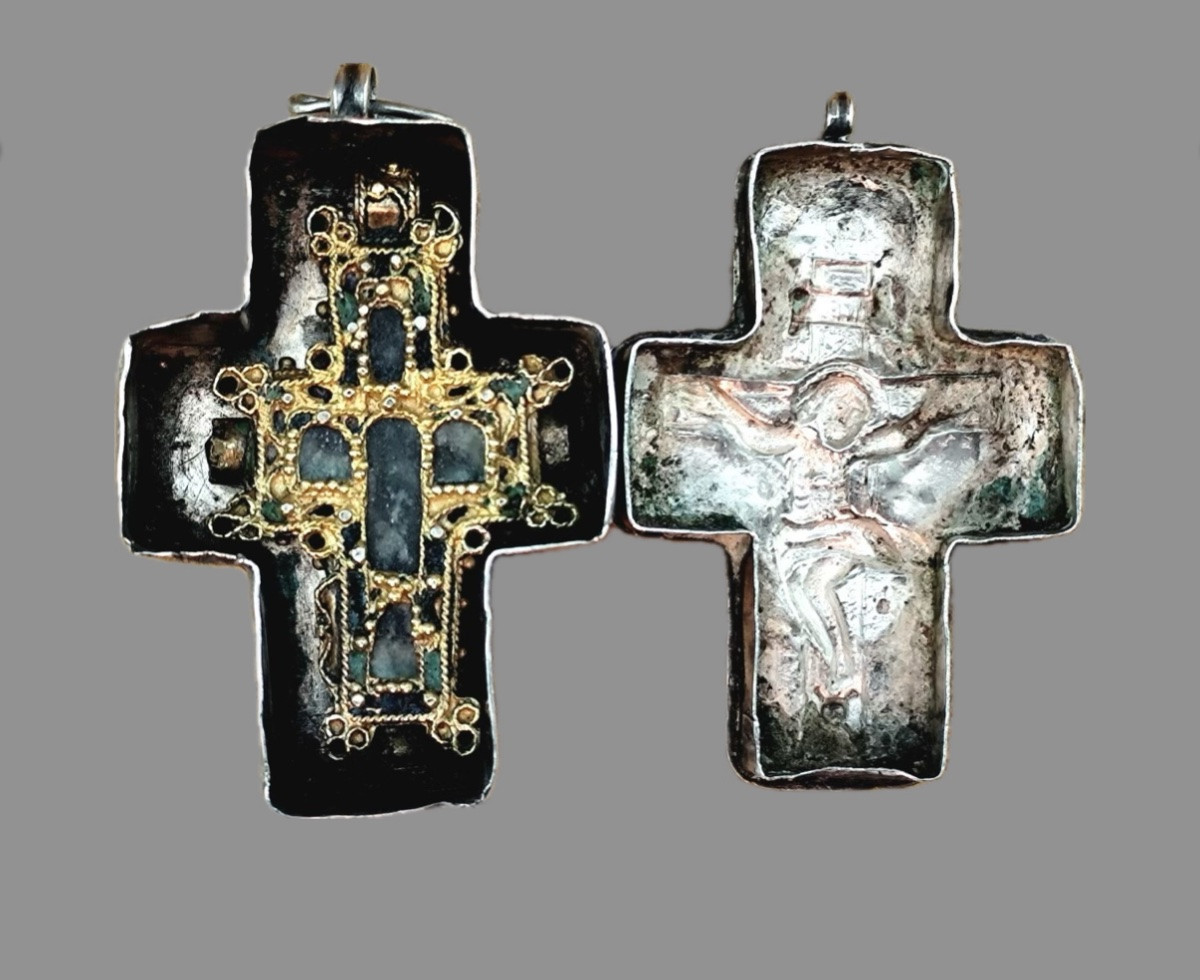
Small monastic cross-reliquary in filigree and enameled vermeil, typical of active workshops between Epirus and Ohrid at the turn of the 13th and 14th centuries. The object keeps its visible relics in five frontal alcoves, protected by domed rock crystal lenses, now milky. Behind these lenses are ancient relics, while some filigree rolls contain tiny fragments of fabric, a reminder of their function as secondary receptacles.
The reverse is closed by an original dark wood plate, identified as ancient boxwood (Buxus sempervirens), a dense, non-porous and extremely stable wood, traditionally used in high-end Byzantine reliquaries. Its very dark color, fine grain and absence of visible pores confirm a perfectly preserved old plaque, typical of liturgical productions of the 13th century.
The cross has an archaic filigree, twisted columns, thick granulation, as well as green and turquoise partitioned enamels. Three ancient garnets in primitive setting complete the composition.
The cross retains its archaic suspension ring in gilded silver, characteristic of Byzantine pectoral reliquaries and attesting to its worn liturgical use.
The three garnets, deliberately arranged, refer to the omnipresent Trinitarian symbolism in Byzantine sacred art, giving the cross an additional theological dimension.
ALCOVES AND RELIQUARY COMPARTMENTS
The cross has five main alcoves visible on the facade, protected by domed rock crystal lenses:
– Upper alcove
– Two side alcoves
– Large central alcove (probable fragment of the Lignum Crucis)
– Lower alcove
At the corners and along the columns are twelve filigree scrolls, serving as reliquary micro-receptacles, each of which can contain blessed fibers or fragments of sacred textile.
The number of twelve scrolls is probably not fortuitous: it refers to the symbolic cycle of the Twelve Apostles, frequently mentioned in Byzantine monastic goldsmithing, and gives the cross an additional liturgical dimension specific to dignitaries such as the Higoumen.
The whole forms an architecture with seventeen potential reliquary spaces, characteristic of the high-level portable monastic crosses between the 13th and 14th centuries, intended for the higoumens of the great monasteries.
The element located at the top is not a reliquary roller but the original belière, intended for the pectoral wear of the cross.
Technique
Welded twisted watermark, volumetric granulation, micro-bossing, rock crystal, partitioned enamels, open settings.
The deep color, stability and homogeneity of the granules suggest the use of a high-content vermeil.
POST-BYZANTINE CASE (16TH CENTURY)
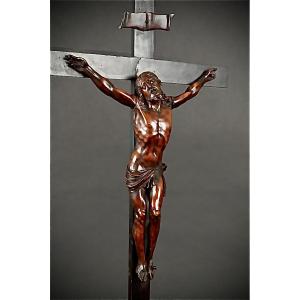
The solid silver case shows a Christ with a repulse, typical of post-Byzantine Orthodox production. Made to protect an ancient cross.
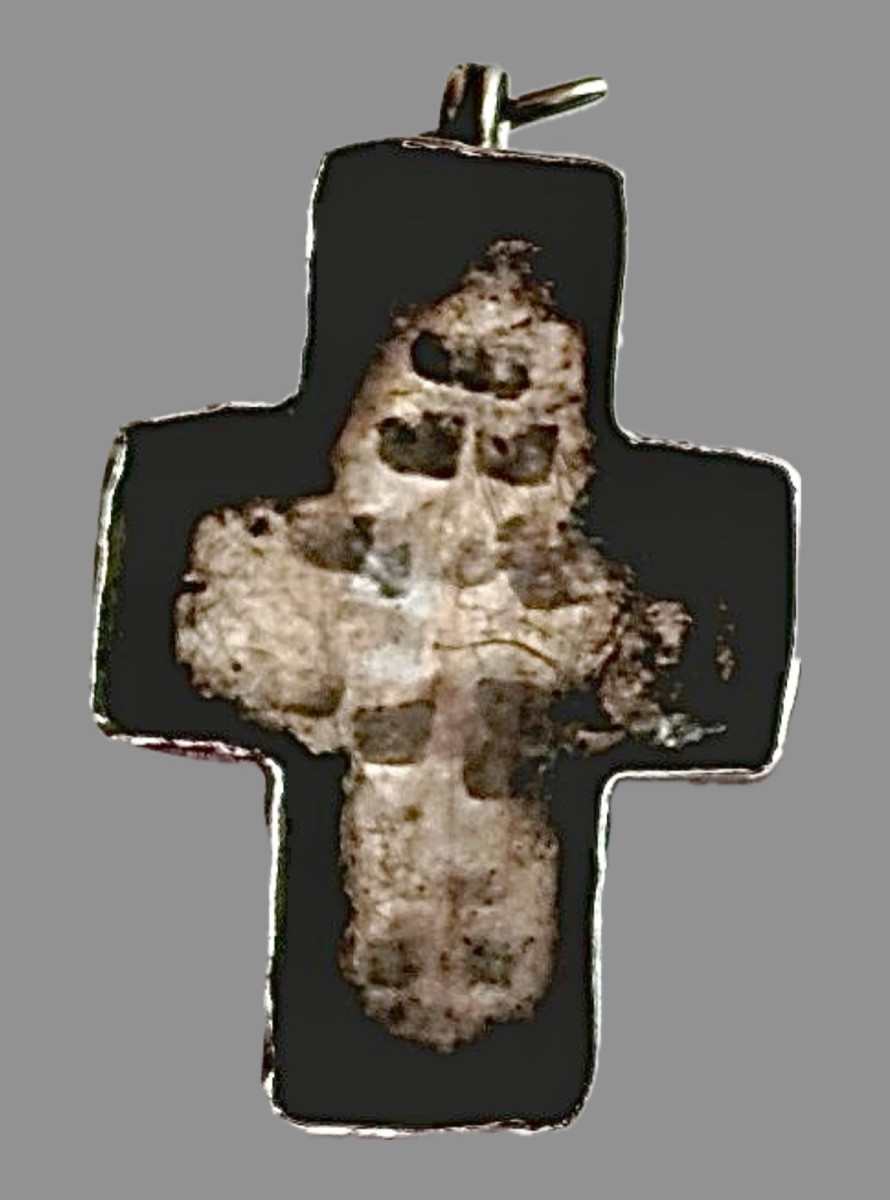
INTERNAL IMPRINT
The fossil silhouette of the cross in the case testifies to continuous contact for several centuries, confirming the historical integrity of the whole.
STONE ANALYSIS
The garnets have an irregular archaic size, characteristic of medieval manual stonemaking between the 13th and 14th centuries.
COLUMN ANALYSIS
Structural, symbolic and reliquary: some still contain blessed textiles.
Fine old textile fibers are visible on the reverse side of the cross, stuck in the junction between the wood and the filigree during medieval setting. Their position and compression prove that they are original textile relics, imprisoned in the cross at the very time of its manufacture.
NATURE OF THE WOOD (BACK OF THE CROSS)
The back wood is made of ancient boxwood (Buxus sempervirens), a preferred species in Byzantine goldsmithing for portable reliquaries. Dense, very fine, non-porous and almost rotproof, it offered perfect stability for sealing the relics. Its natural, regular and deep blackening is consistent with an aging of 700 to 800 years. This material confirms the high monastic quality and the ancient dating of the cross (13th century).
MUSEUM COMPARISONS
— Benaki Museum (Athens), late 13th century cross
— Museum of Christian Art of Ioannina, colonnaded cross (13th century)
— Ohrid Museum, compartmentalized crosses (13th–early 14th century)
— St. Mark's Treasury (Venice), pre-paleological granulation and use of solid rock crystal
SCIENTIFIC ANALYSIS – DATING CRITERIA
1. General morphology
Study cross, short arms: typical of the 13th century.
2. Rock crystal
Bulging, thick, very opaque lenses: archaic typology of the 13th century.
3. Torsed watermark
Wide, irregular twist: 13th century signature.
4. Granulation
Massive granules, visible fusion: typical of the 13th century.
5. Palette of enamels
Green and turquoise, thick partitions: late 13th - early 14th.
6. Garnets
Irregular facetting: typical 13th century.
7. Wooden lapel (boxwood)
Characteristic of pre-paleological reliquaries.
8. Organization of relics
17 cavities: tradition 11th–13th century.
9. Regional Comparisons
Very close models dated 1260–1320 (Ioannina, Ohrid).
10. Material consistency
Concordant natural aging.
CONCLUSION – REFINED DATING
Cross: late 13th - early 14th century, ca. 1250–1320
Case: 16th century (post-Byzantine)













 Le Magazine de PROANTIC
 TRÉSORS Magazine
 Rivista Artiquariato