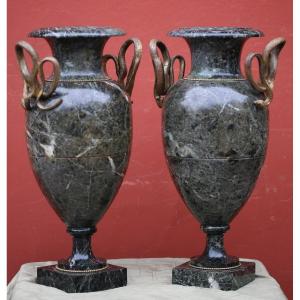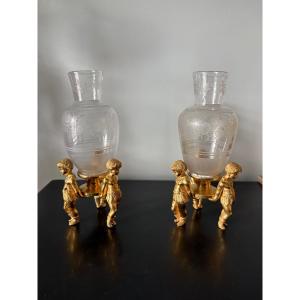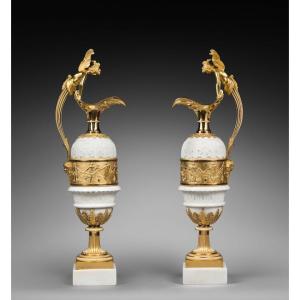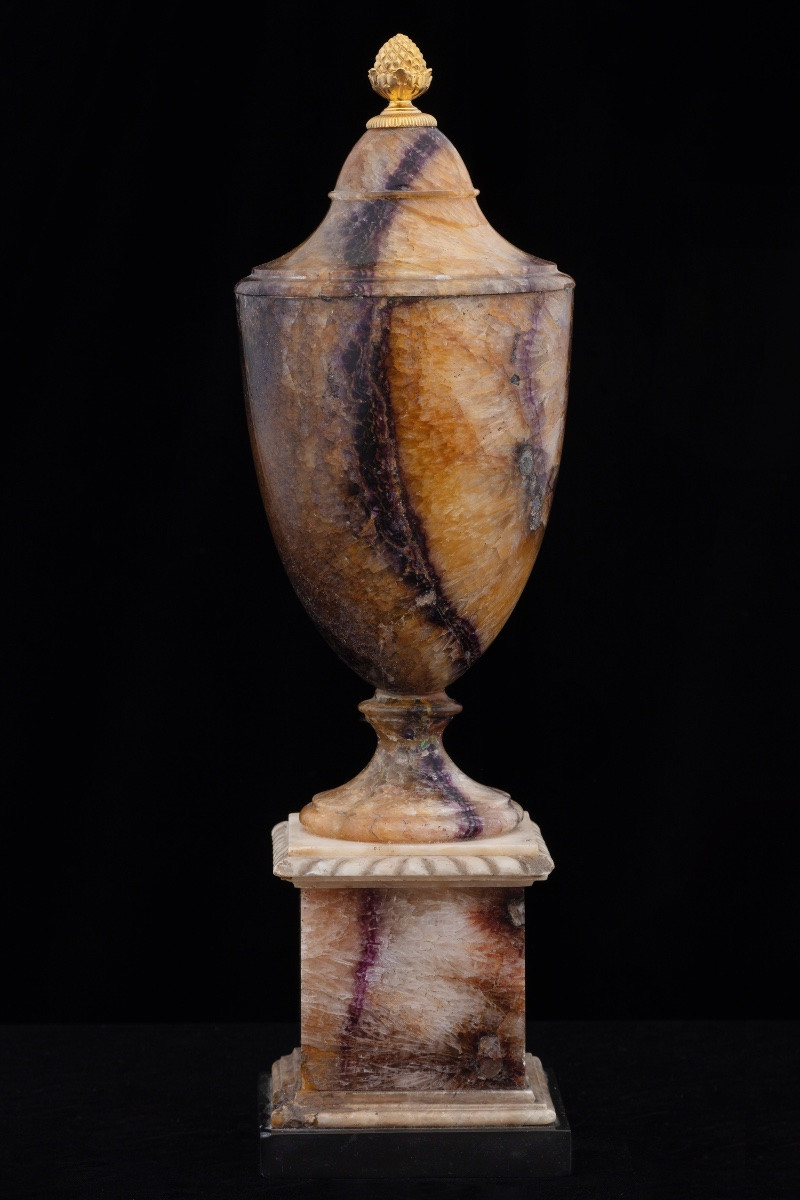




Collection Of Four Blue John Vases, Early 19th Century.
"Collection of four Blue John vases", early 19th century.
Blue John, gilt and chiseled bronze.
Vase with cameo: 34 x 15 x 15 cm.
Vase with rams' heads: 34 x 14 x 14 cm.
Vase with festoons: 27 x 10 x 10 cm.
Amber vase: 40 x 12 x 12 cm.
Blue John is a prized form of the fragile and precious mineral fluorite, composed of calcium fluoride. The characteristic that has made it a luxurious and inimitable material is the presence of extraordinary chromatic veining and contrasting bands of color. The name "Blue John" likely derives from the French bleu et jaune, adapted to the Cornish miners' dialect. It is considered the rarest mineral in Britain, as it can be mined in only a few unique places: the hills of Derbyshire and the Treak Cliff Cavern and Blue John Cavern. Its popularity exploded in the 18th century, when it was chosen to create important artistic artifacts, such as vases. These are luxury objects in the Neoclassical style, often mounted with mercury-gilt or engraved bronze applications. Extremely elegant objects, these vases were chosen by the nobility to decorate their wealthy homes; some examples were even placed in Buckingham Palace.
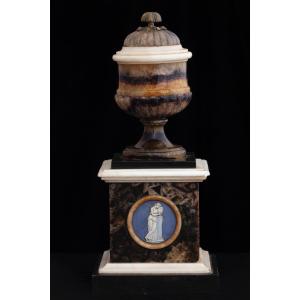
Cameo vase: It is mounted on an elegant pedestal. The circular medallion set in the pedestal is a Jasperware cameo, a decoration developed and made famous by Wedgwood in the 18th century to create antique-style cameos. It is a complex and luxurious type of workmanship, using a very hard and fine stoneware.
Ram's head vase: The design is monumental. The body and cylindrical support section are made of Blue John, while the square base is made of black marble, supported by gilded bronze corbels. The decoration, in ormolu-chiseled bronze, is in full neoclassical style: the vase's handles become two extraordinary ram heads, an animal typically found in the decorations of Greek and Roman sacred altars.
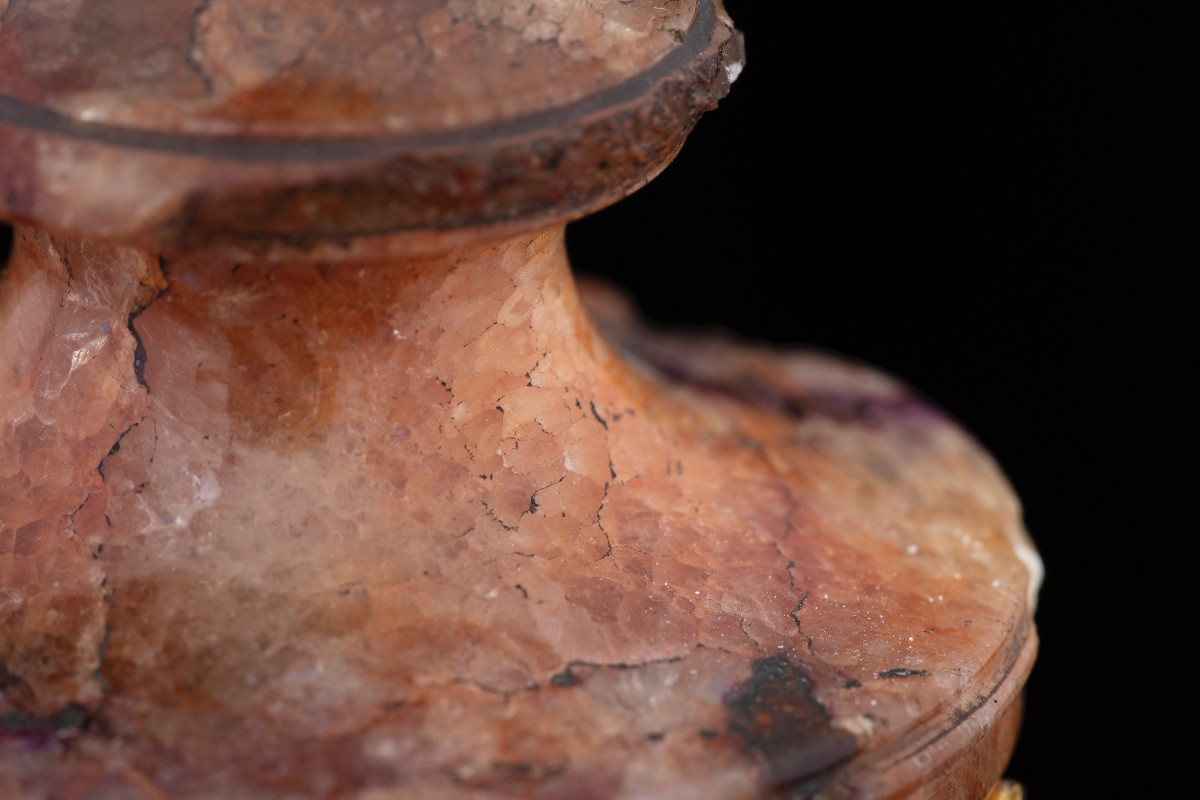
Vase with festoons: This vase features a rare reddish color, due to the high concentration of iron oxides. The lid is topped with a knob featuring a golden pine cone. The golden festoons that decorate the vase, intertwining flowers of all kinds, enhance the vase's elegance and the contrasting colors.
Amber vase: This is a celebration of the pure beauty of the material, characterized by amber and yellow ochre hues. The fittings remain minimal, such as a small pine cone-shaped knob.
Period: 19th century
Style: Consulat, Empire
Condition: Excellent condition
Material: Semi precious stone
Height: varie
Reference (ID): 1673136
Availability: In stock