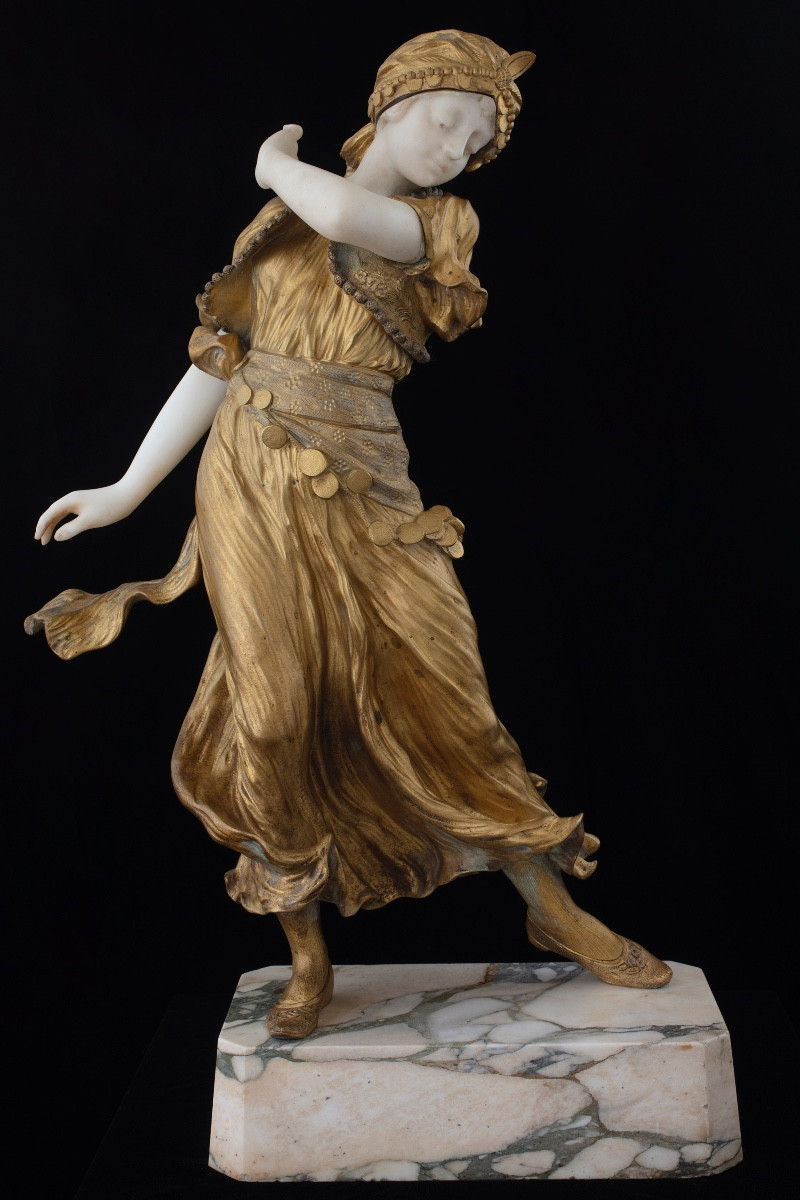


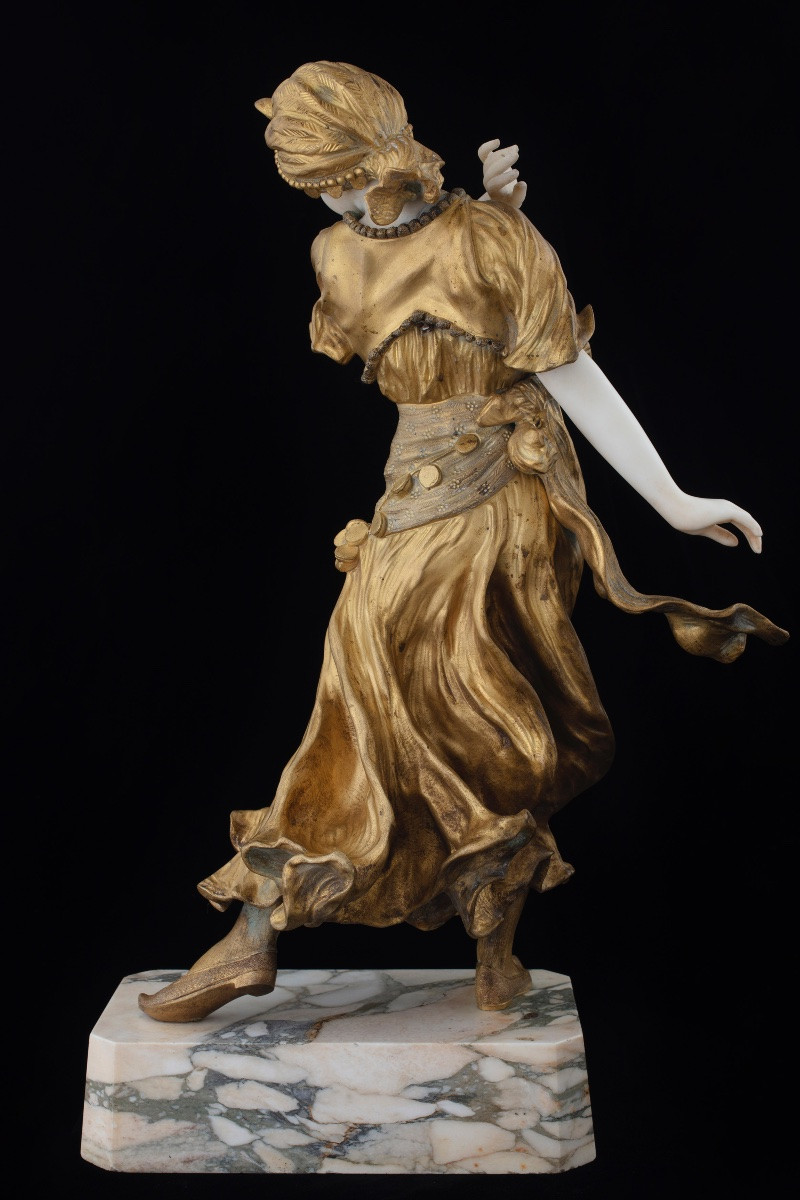


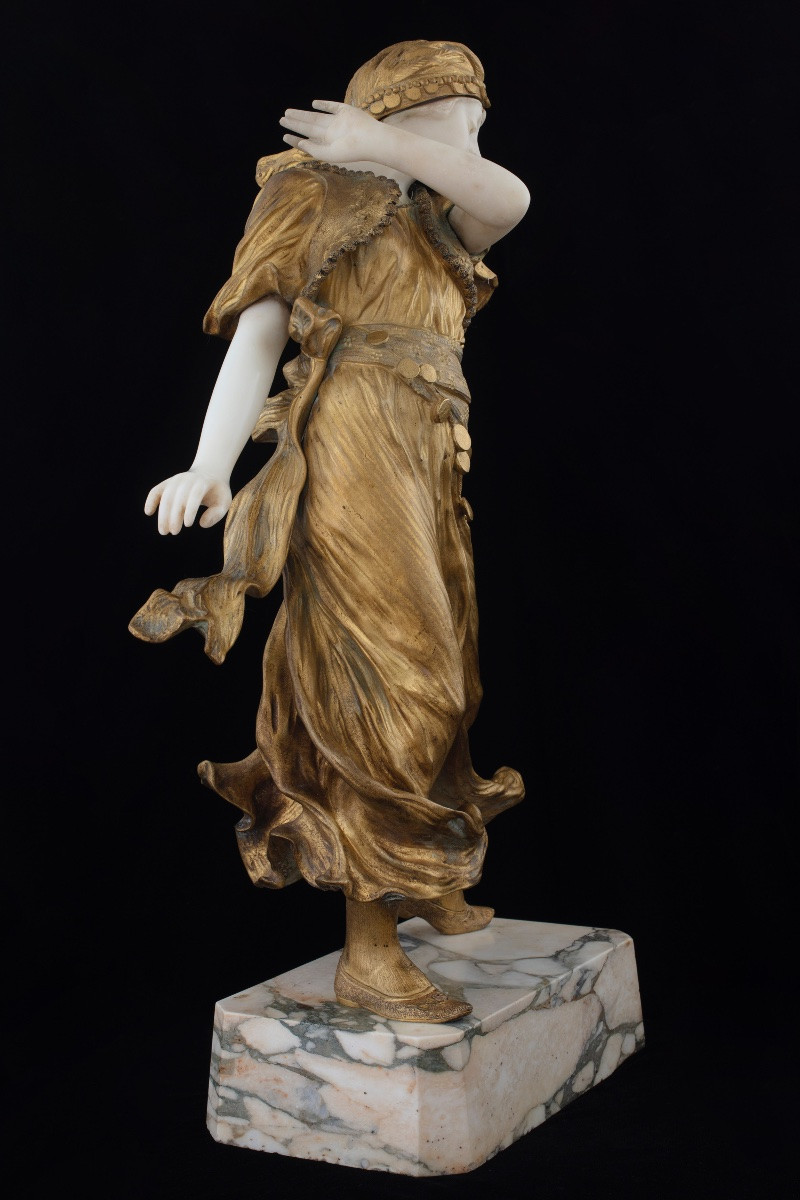


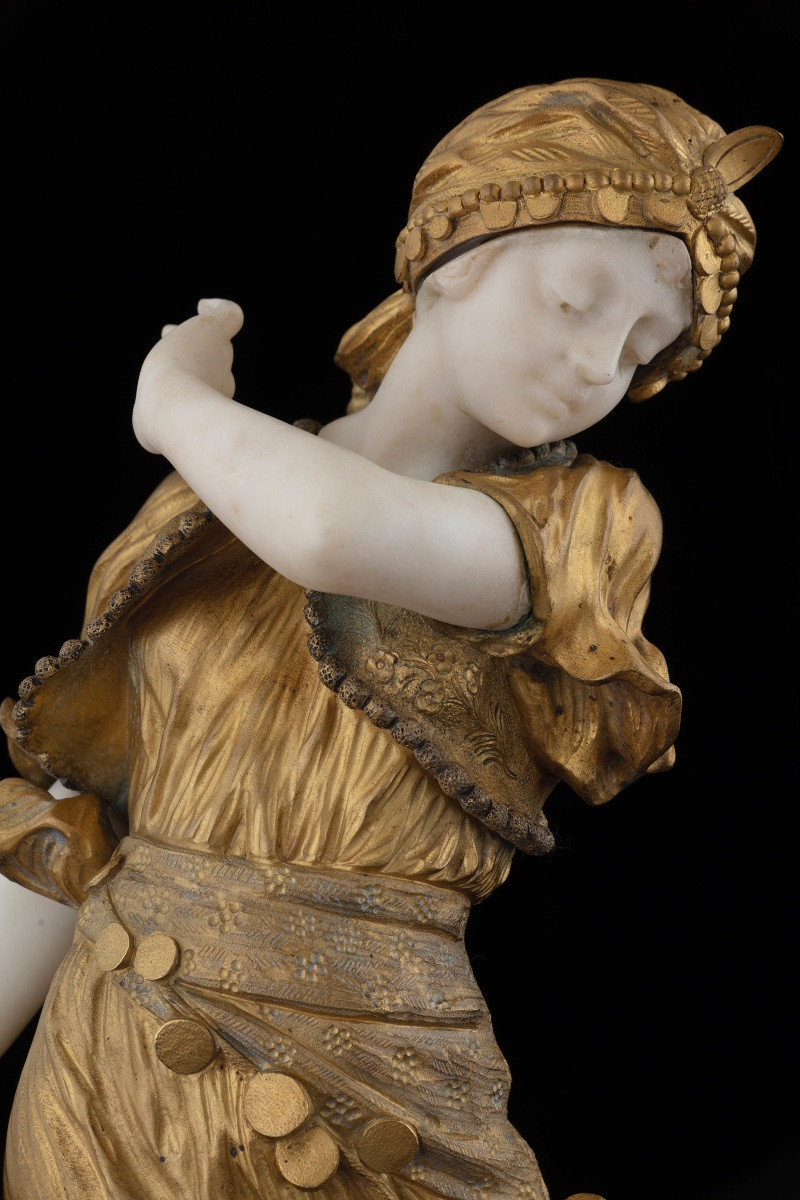


Fortunato Gory (Florence 1869 ca. - Paris 1925), “Oriental Dancer”
Marble and bronze, height 58 cm.
Period: early 20th century.
The sculpture depicts a dancer in oriental dress, sculpted in a dance movement.
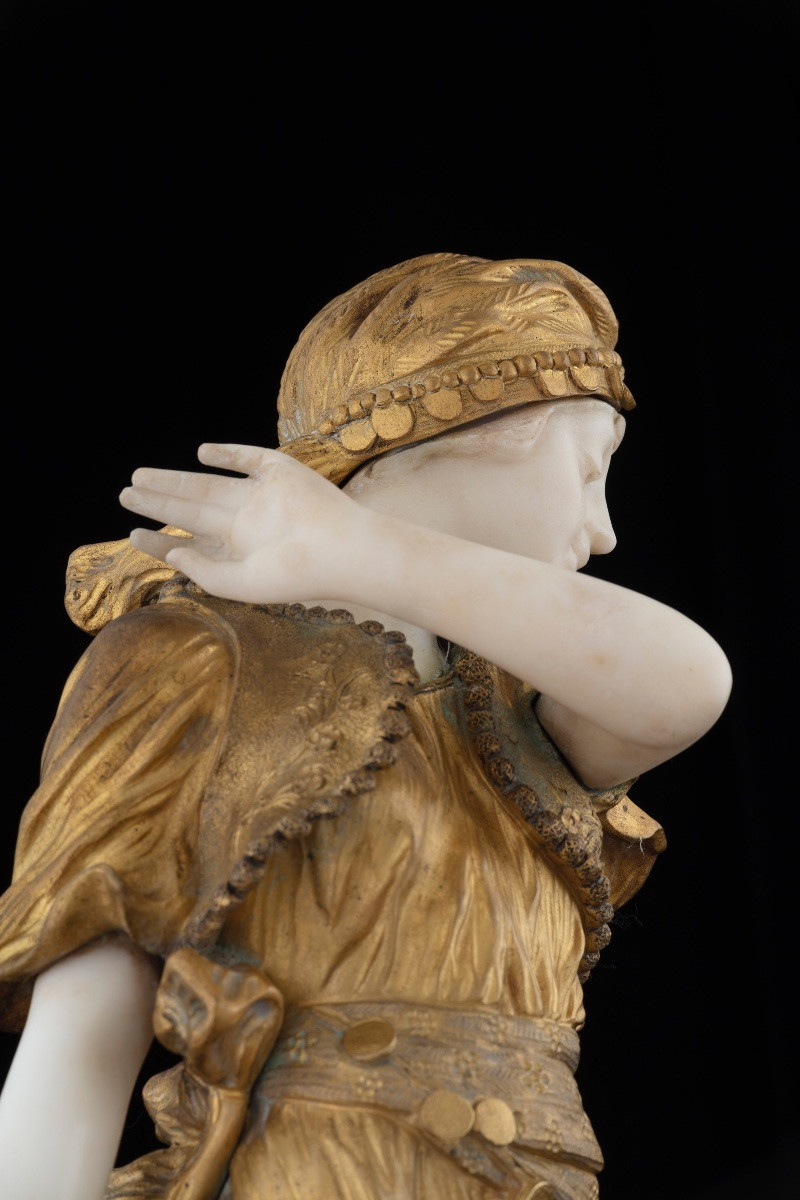
The elegant female figure is covered in an elaborate golden robe, made of a dress that the artist succeeded in making very light on the body. It is cinched at the waist with a sash with dotted decorations and a belt with coin-shaped pendants, typical of oriental dances. The chest is also covered with a shawl with floral ornaments.
The costume is completed by low shoes with curled toes and a striking headdress featuring decorative engravings and the coin motif found on the belt.
The sculpture rests on a base of fine brecciated marble.
This type of sculpture is part of the great variety of small Art Nouveau sculptures that depicted dancers in their sumptuous costumes engaged in a dance step.
Gory, in particular, manages to imbue his dancers with great elegance.
BIOGRAPHY
Fortunato Gori, also known as Affortunato Gory, was born in Florence around April 14, 1869.
He received his artistic training at the Academy of Fine Arts in his hometown under the guidance of maestro Augusto Rivalta. He first worked in Florence as a sculptor, then moved to Paris, where he studied under the sculptor Victorien Bastet. He began exhibiting his works at the Salon des Beaux-Arts in 1902, continuing in subsequent years.
His sculptures began with a more Italianate neoclassical style, particularly in his small-scale nudes, and in Paris evolved into a more French style in line with early 20th-century artistic movements such as Art Nouveau and Art Deco, of which he became a leading artist.
His works were characterized by an elegant combination of materials that made the sculptures sparkle. Gory combined marble, alabaster, and ivory for the body with bronze, ceramic, or zinc for the clothing and decorations. He was widely appreciated by collectors both in his own time and in contemporary times for the quality and elegance of his works.
His activity, however, ended with his death in Paris in 1925.
Today, Gory's work is represented in both public and private collections, including the Musée du Chateau Dufresne in Canada and the Musée Louis Senlecq in France.












 Le Magazine de PROANTIC
 TRÉSORS Magazine
 Rivista Artiquariato