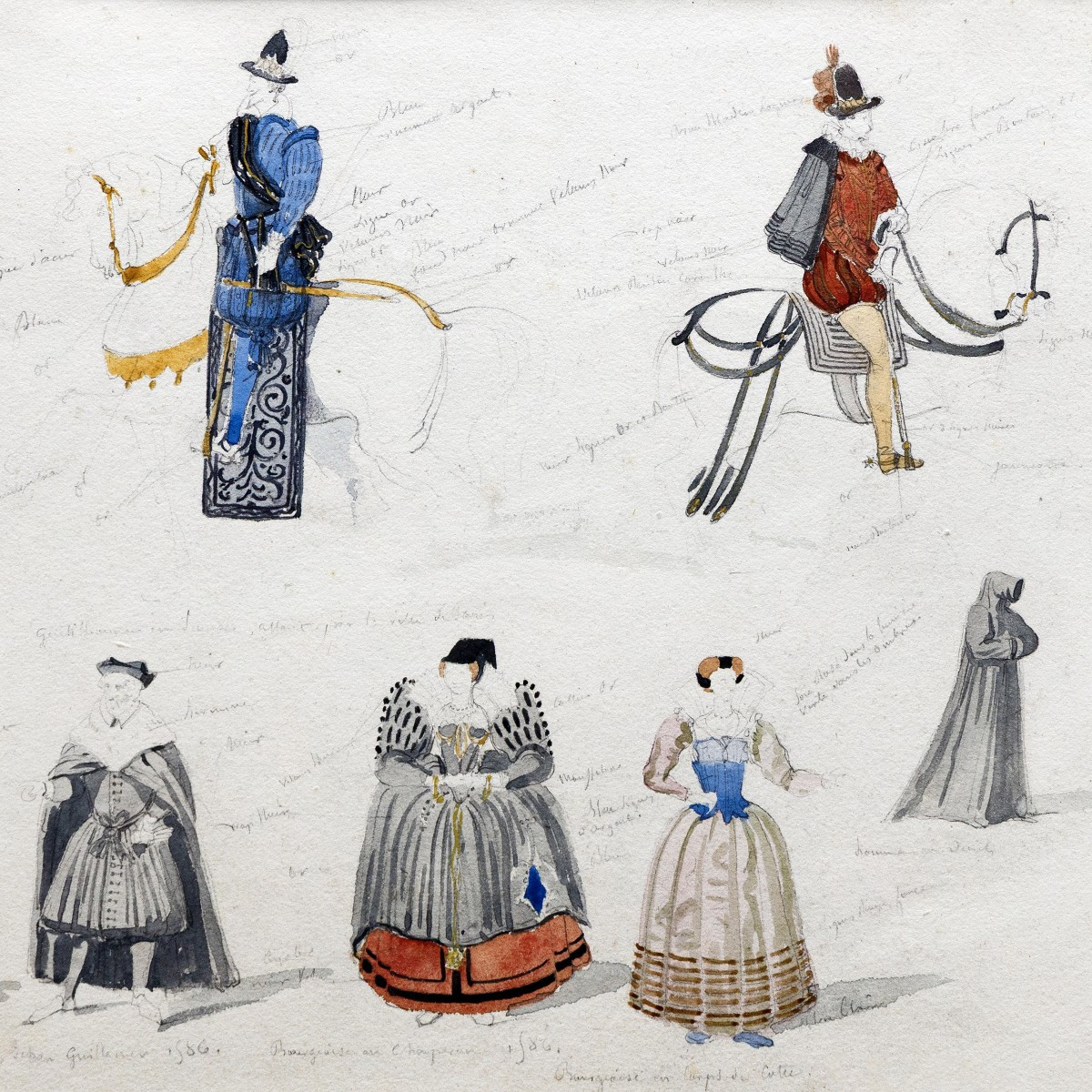






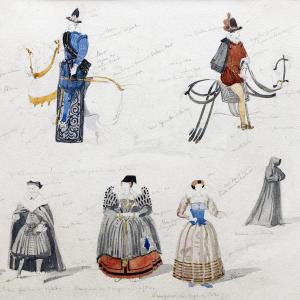


"Paul Delaroche - Studies For The Costumes Of A Historical Drama – Watercolor – Circa 1830"
Paul Delaroche (1797-1856)Costume Design for Historical Theater, Probably for Alexandre Dumas's Henri III et sa cour (Henry III and His Court)
Watercolor, Ink, and Pencil on Paper
Monogrammed "HD" (Hippolyte Delaroche) in the Lower Right Corner
Circa 1829-1830
This exceptional costume plate is from Delaroche's personal sketchbook and is a valuable testament to his lesser-known work as a costume designer for historical theater during the July Monarchy.
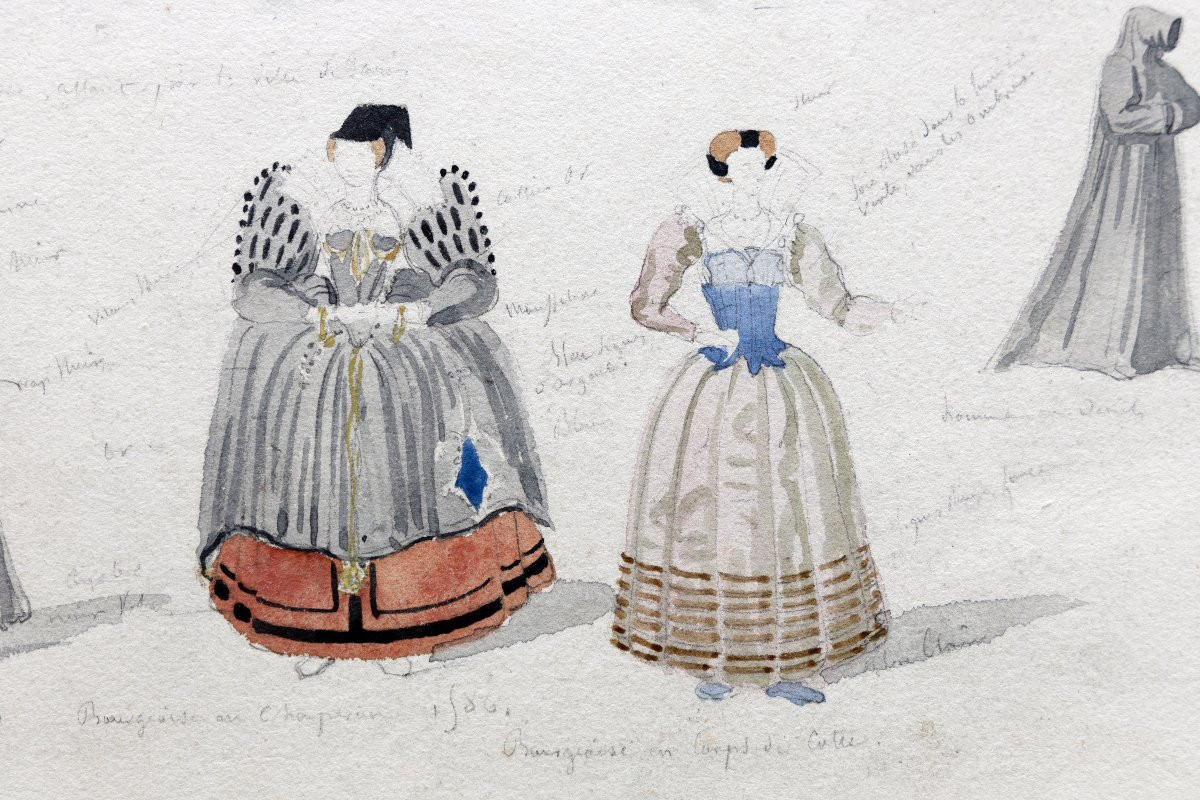
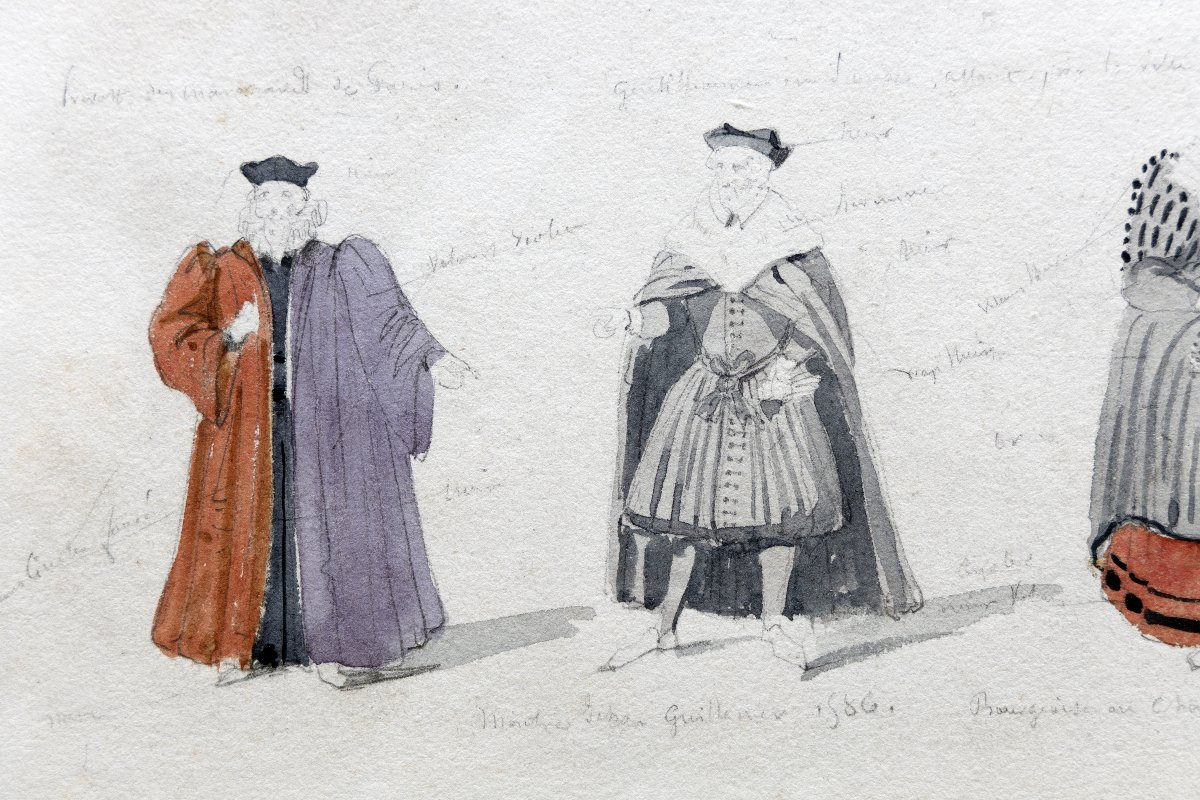
This sheet features eight figures in French Renaissance costumes, meticulously rendered and enhanced with watercolor. The characters are from the 16th-century court and include gentlemen in doublets and hose, ladies of quality in ornate dresses with large ruffs and vertugadins, and a veiled female figure. The male costumes include a character in armor (top left) and a horseman dressed elegantly in red and gray.
Each costume is accompanied by handwritten annotations in pencil specifying the desired colors and materials (velvet, satin, and taffeta). These technical instructions reveal the documentary rigor and attention to detail that characterize Delaroche's approach.
These sketches were probably created for the production of Alexandre Dumas's historical drama, Henri III et sa cour, which premiered at the Comédie-Française in 1829. This play is emblematic of Romantic theater and revolutionized the French stage; therefore, the historical accuracy of the costumes was paramount. Some of the costumes featured in this sketch can be seen in a set of models from the Paris Opera library, which is now preserved at the National Library of France (https://gallica.bnf.fr/ark:/12148/btv1b84545361/f3.item).
Provenance: Paul Delaroche's personal notebook, family sale.
The plate is in very good condition overall, with some foxing consistent with the age of the document. It is presented in an early 20th-century frame made of stuccoed and gilded wood with a bronze patina. The frame is in very good condition.
The artist
Paul Delaroche (born Hippolyte de la Roche on July 17, 1797, in Paris) established himself as one of the most famous French painters of the 19th century. Born into a wealthy family, Delaroche first trained with Watelet before joining Antoine-Jean Gros's studio in 1818. There, he developed his signature style, which combined academic rigor with romantic sensibility.
Delaroche specialized in history painting, a major genre of his time, but he took a new approach to the subject. Rather than idealized neoclassical compositions, he favored psychological realism and dramatic emotion. His most famous works, including Les Enfants d'Édouard (1831), L'Exécution de Lady Jane Grey (1833), and Napoléon à Fontainebleau (1845), captivated audiences with their theatrical intensity and meticulous attention to historical detail.
Delaroche's success was meteoric. Elected a member of the Institut de France in 1832, he taught at the École des Beaux-Arts, training a generation of artists, including Jean-Léon Gérôme. His paintings enjoyed exceptional international renown, particularly in England and America, thanks to engravings that reproduced his works.
Beyond easel painting, in 1837, Delaroche undertook the monumental decoration of the École des Beaux-Arts's hemicycle, a vast fresco representing seventy-five famous artists from antiquity to his own time. This major work was completed in 1841.
Less well known today but essential to his career was his involvement in creating costumes for historical theater, a booming genre in the first half of the nineteenth century. Sought after for his erudition and keen sense of reconstruction, Delaroche participated in designing costumes for several theatrical and operatic productions. He approached this work with the same documentary rigor as his paintings, seeking to faithfully reproduce the fabrics, ornaments, and silhouettes specific to each period.
Paul Delaroche died prematurely on November 4, 1856, in Paris. He left behind a significant body of work that perfectly exemplifies the era's taste for dramatized history.
His works are held in numerous French museums, including the Louvre, the Musée d'Histoire de France in Versailles, the Musée des Beaux-Arts in Nantes, Dijon, and Rouen, and the Musée Condé in Chantilly. His works are also held in museums abroad, such as the Wallace Collection and the National Gallery in London, the Hermitage Museum in Saint Petersburg, the Kunsthalle in Hamburg, and the Museum of Fine Arts in Boston.
Work is on display at the gallery (07240).
For shipping costs in France and abroad, please contact us.










 Le Magazine de PROANTIC
 TRÉSORS Magazine
 Rivista Artiquariato