

Gallo-roman Cauldron - Copper Alloy - Bessonneau Collection (1842-1916)
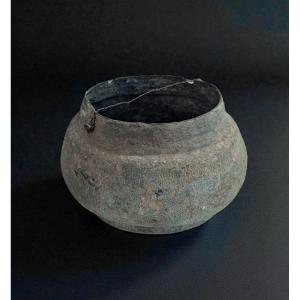
Gallo-Roman copper alloy cauldron – Bessonneau Collection, Eggers Type 9-10 – 1st-2nd century AD. The cauldron was discovered in Vic-sur-Seille (Moselle) – Vicus Bodatius. Exceptional Gallo-Roman copper alloy cauldron, exhibiting a characteristic low, flared shape, typical of the production of the High Roman Empire. Flattened globular body with a low profile, known as a "pumpkin" shape. Short, slightly flared, and concave neck. Gentle carination marking the transition between the neck and the body. Base with a wide, flat ring foot, clearly visible. Diameter at the neck: 18 cm. Maximum diameter (at the body): 25 cm. Diameter of the base: 19.5 cm. Total height: 16 cm. Excellent condition for a piece approximately 2000 years old. Beautiful patina from burial with typical verdigris oxidation. Vic-sur-Seille was an important Gallo-Roman vicus (fortified settlement) within the territory of the Mediomatrici tribe, renowned for its salt industry from the Iron Age to the Middle Ages. The site has yielded numerous remains of dwellings, workshops, and domestic equipment, attesting to a dense and prosperous settlement during the High Empire. This type of cauldron was used daily for cooking food, heating liquids, and other culinary preparations. Its movable handles allowed it to be suspended over the hearth or easily transported. In the context of Vic-sur-Seille, these vessels could also have been used for activities related to salt production. It is related to the Eggers type 9-10, a classification established by Hans Jürgen Eggers in 1951 for Roman imports. These low-profile cauldrons are distinct from the taller forms (Eggers 7-8) and attest to widespread production in the western provinces of the Empire during the 1st and 2nd centuries AD. Julien Bessonneau (1842-1916), from a wealthy industrial family, significantly expanded his linen and hemp weaving factories, becoming the leading industrialist in Angers by the 1870s. On the eve of the First World War, his businesses employed approximately one in sixteen Angers residents. Like many business leaders of his time, he established social programs, including a sports club that would later become SCO Angers, and contributed to the growth of the aeronautics industry with the famous Bessonneau hangars, which were widely used during the war. He owned several prestigious residences: the Château des Brosses near Saint-Clément-de-la-Place, the Château de Mûrs south of Angers, and a large private mansion in the center of Angers, as well as a Parisian residence on the rue de Constantine. A great collector, he amassed a vast art collection: paintings, decorative arts, sculptures, African and Oceanic objects, and numerous archaeological pieces. His post-mortem inventory in 1916 revealed hundreds of antique objects (Cypriot, Greek, Phoenician, Gallo-Roman vases, etc.). His purchases are documented by numerous invoices from specialist dealers. After his death, neither his heirs nor his company continued to expand this collection. A major sale in 1956 dispersed a portion of the works. REFERENCE BIBLIOGRAPHY EGGERS HJ, Der römische Import im freien Germanien, Atlas der Urgeschichte, vol. 1, Hamburg, 1951 TASSINARI S., Roman and provincial bronze dishes at the Musée des Antiquités Nationales, Paris, 1993 PETROVSZKY R., Studien zu römischen Bronzegefäßen mit Meisterstempeln, Kölner Studien zur Archäologie der römischen Provinzen, vol. 1, Buch am Erlbach, 1993
1 200 €
Period: Before 16th century
Style: Rome and Antic Greece
Condition: Condition of use
Material: Bronze
Diameter: 25
Height: 16
Reference (ID): 1660735
Availability: In stock
Print