

Hirado Porcelain Karashishi (lion Dog), Blue And White, Edo–meiji Period, Japan C. 1840–1880
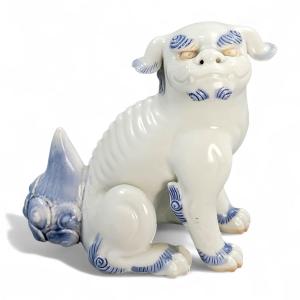
A fine Hirado porcelain karashishi (guardian lion dog) produced in the Mikawachi kilns of the Hirado domain, Hizen Province, during the late Edo to early Meiji period, c. 1840–1880. The figure is sculpted in a compact seated pose with the head turned slightly to one side, giving a lively and attentive character. The surface is decorated in underglaze cobalt blue, most notably in the spiral tufts of the mane, brows, and tail, a signature motif of Hirado workshop style.
The porcelain is made from Amakusa kaolin, a fine white clay prized for its purity and cool, luminous tone. A clear glaze of even, soft sheen covers the body, while the underside is left unglazed, exactly as expected for Hirado figural production of the nineteenth century. The modelling is disciplined and refined, with crisp detailing to the ribcage, face, and paws, reflecting the careful craftsmanship for which the Hirado kilns were known.
Historical Background
The Hirado kilns in Mikawachi became renowned in the eighteenth and nineteenth centuries for their porcelain of exceptional quality. Their output included small figures, scholar’s objects, and presentation wares commissioned by the ruling Matsura family. These works are characterised by precise modelling, a restrained palette, and a quiet sense of elegance.
The karashishi (lion dog) is a traditional symbol of protection and auspicious power in both Buddhist and Shinto contexts. Figures of this type were displayed in interior settings to guard against misfortune and to convey cultured taste. Comparable examples are held in the British Museum and the Kyushu Ceramic Museum.
Measurements
Height: 10 cm / 3.9″
Width: 7.5 cm / 3.0″ (approx.)
Depth: 7 cm / 2.75″
Weight: 200 g
Condition
Excellent antique condition.
UV-checked with no restoration, repainting, or repair.
The glaze remains even and gently glossy. Minor natural kiln speckling and faint traces of age only. No chips, no cracks, no structural issues. A clean and well-preserved example of Hirado porcelain sculpture.
Shipping & Packaging
• Fully tracked and insured delivery
• Professional packing with secure protective materials
• Customs documentation supplied where necessary
Period: 19th century
Style: Asian art
Condition: Perfect condition
Material: Porcelain
Width: 7,5 cm
Height: 10 cm
Depth: 7 cm
Reference (ID): 1648601
Availability: In stock