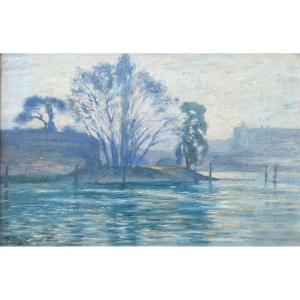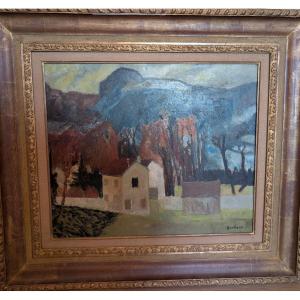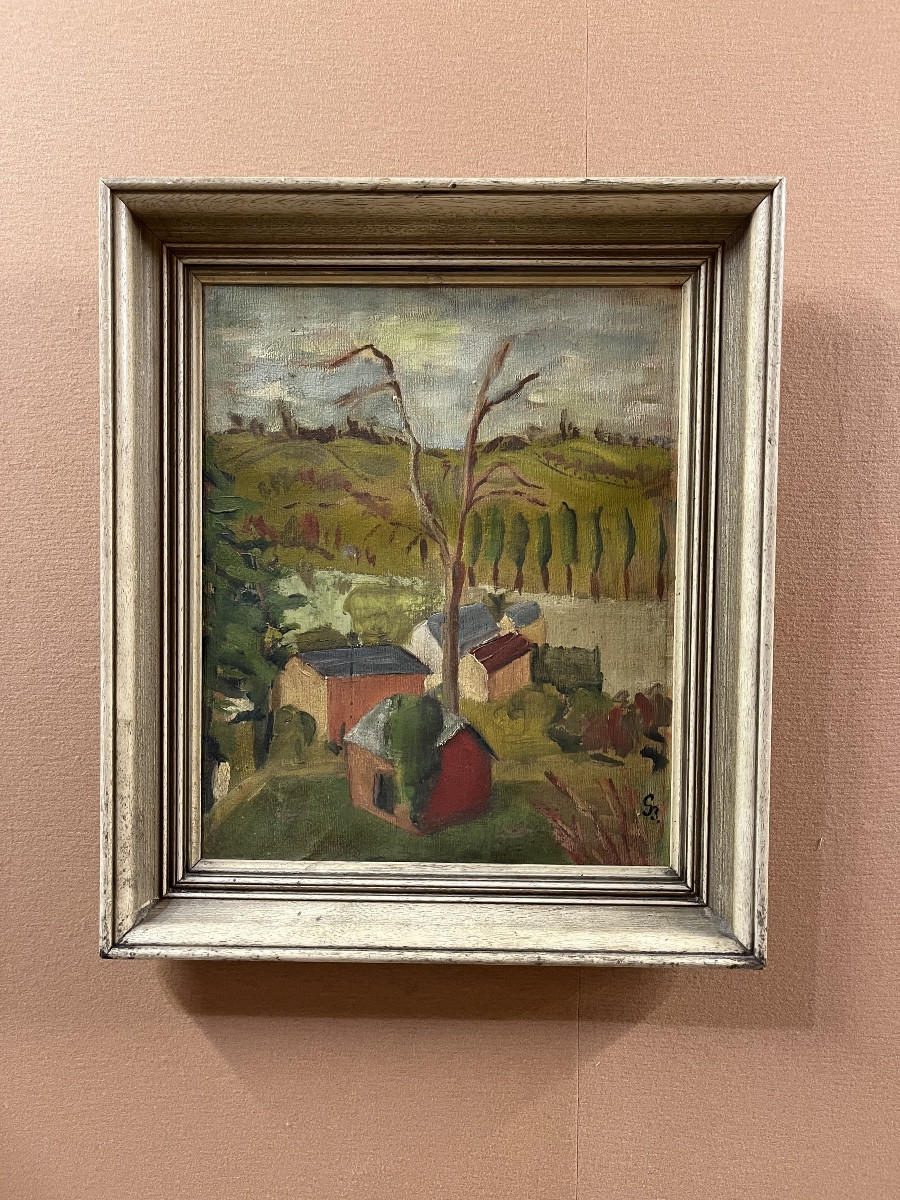
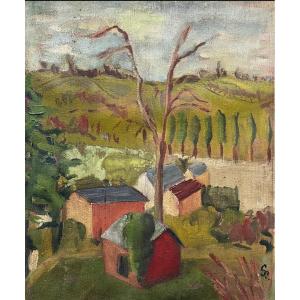


Synthétism, Fauvist-précubist Normandy Landscape By Georges Braque (1882-1963).
Artist: Georges Braque
French school :
Movement: fauvism-cubism, synthétism.
Medium : oil on board.
Technique : brush.
Date of creation: before 1908.
Location: Banks of the Seine, Normandy.
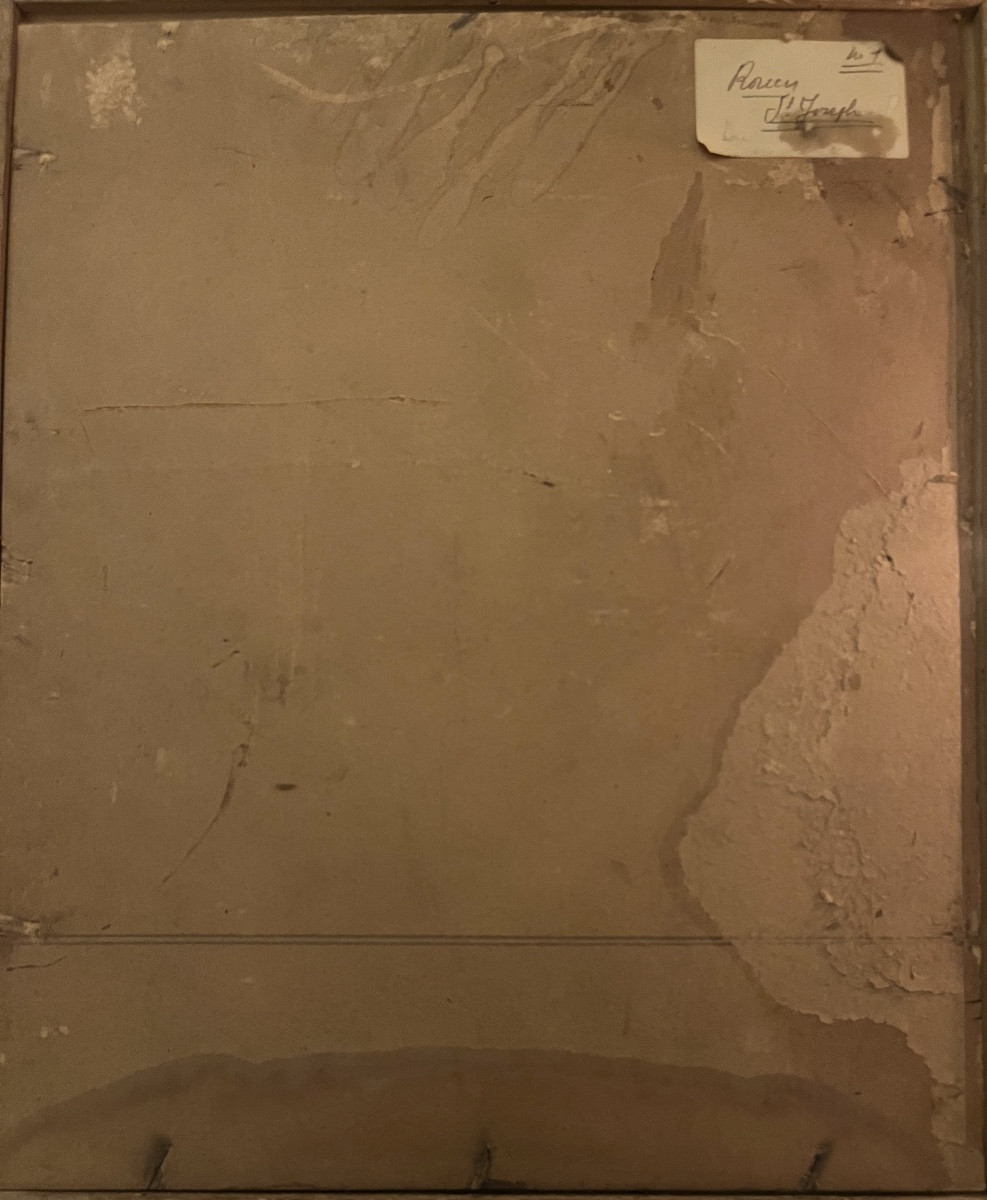
Rouen, Saint-Joseph, Numéro 1 annotated in brown ink and appearing on the back of the work on a label, see photo.
The Saint-Joseph district in Rouen is intimately linked to the artistic history of the city, being part of the heart of the Jouvenet district, often nicknamed the "village in the city.
The district has hosted other major artists, in particular the painter Paul Gauguin who lived there in 1884 and painted about forty canvases, including one representing the Jouvenet Street.
It is quite likely that the student was inspired and called to come and paint in the footsteps of one of the great masters of the late nineteenth century.
To date, we cannot say that the landscape on the banks of the Seine represented is located in Rouen itself but rather in its surroundings and certainly in Normandy.
The label seems to confirm an exhibition place rather than a location since no view offers the possibility of seeing the Seine from the Saint-Joseph district in Rouen.
Georges braque will have painted only in three regions of France; exclusively :
-In the Ile-de-France;
-In Provence;
-In Normandy.
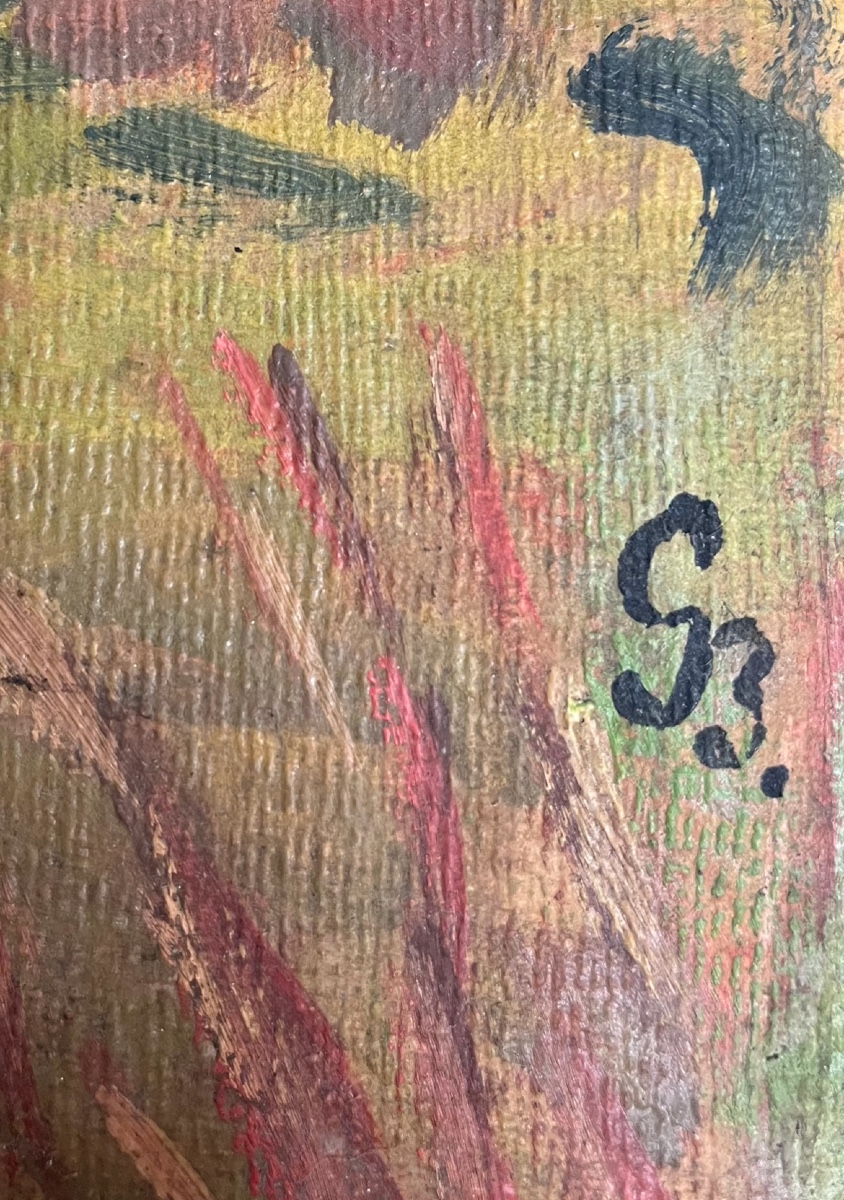
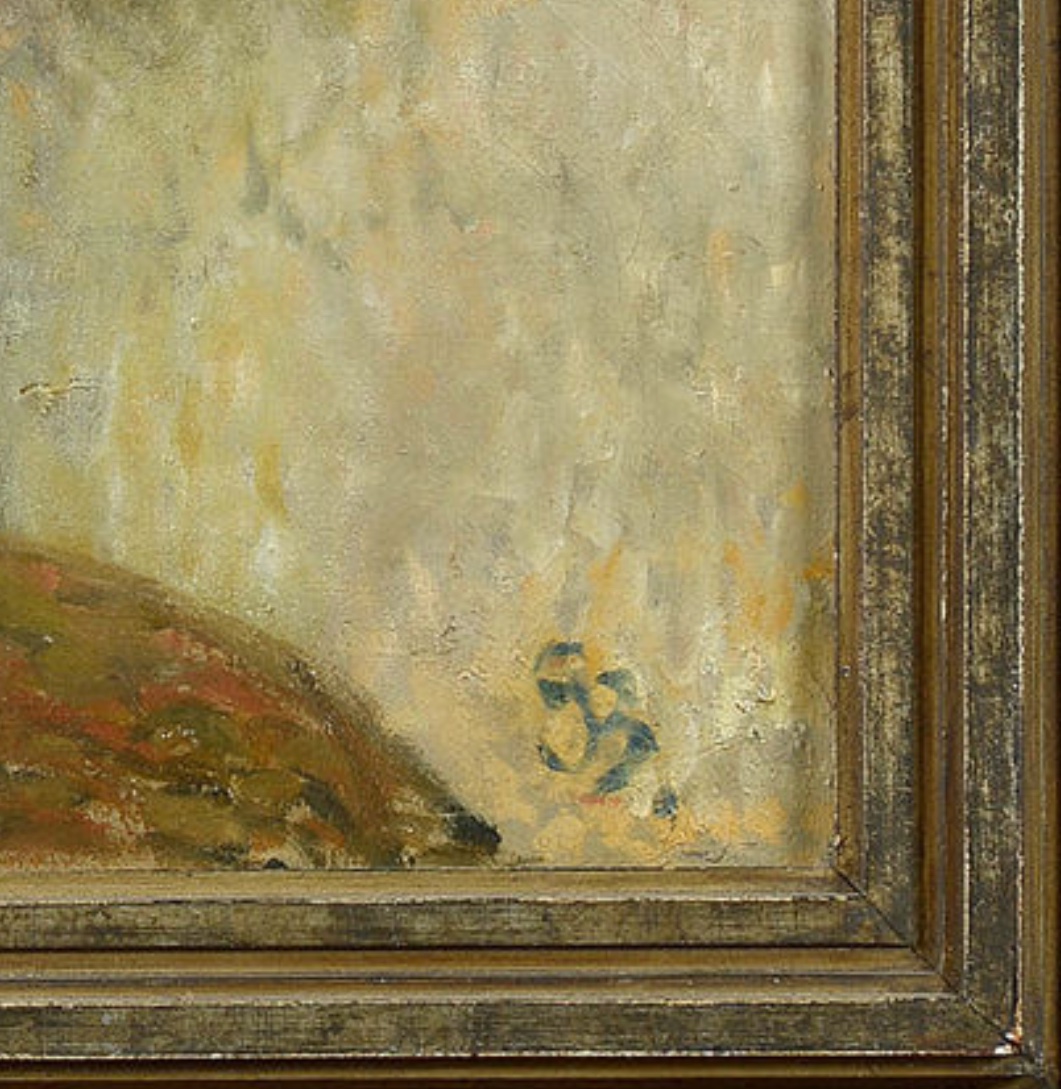
Signature: Monogram G. B, inscribed at the bottom right.
Vertical perspective, orthogonal composition, of Gauguinian ( synthétisme ) and Cezanian inspiration.
This painting marks a turning point between the end of Fauvism and the first beginnings of Cubism.
Its interest is historical.
The vertical Perspective, generated by the superposition of the simplified planes, creates a curious two-dimensional decorative rhythm of which Braque's painting offers quite numerous examples, even in the years after the works of this period.
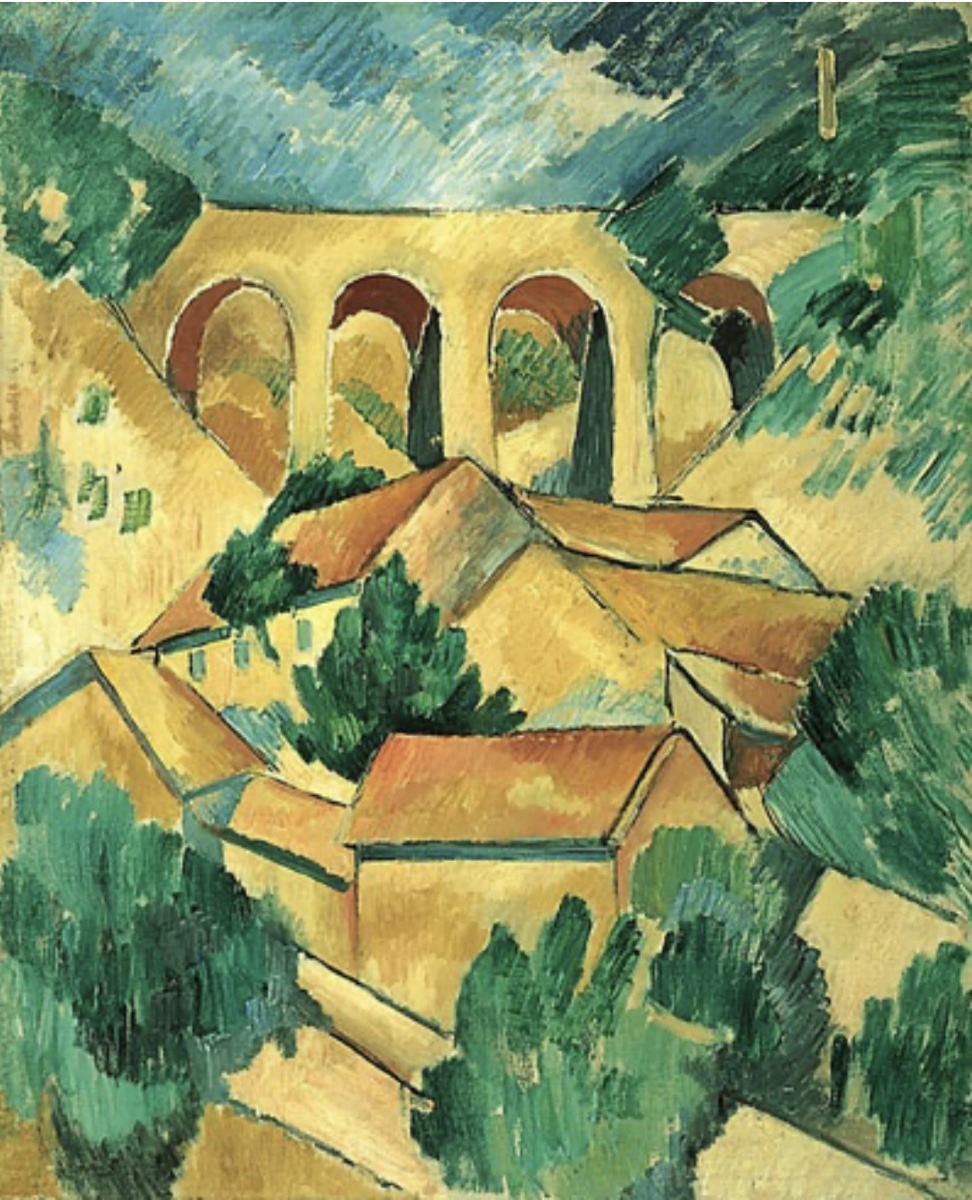
The photo of the painting Viaduct at the estaque painted in 1908 is an example of comparison see photo (11) :
Concentration of elements (overlapping houses) grouped in the center of the canvas in a purely orthogonal composition.
The trees depicted as bushes in front of the houses create a repulsive effect (like the tree in the center) and strengthen the perspective, just like in our painting.
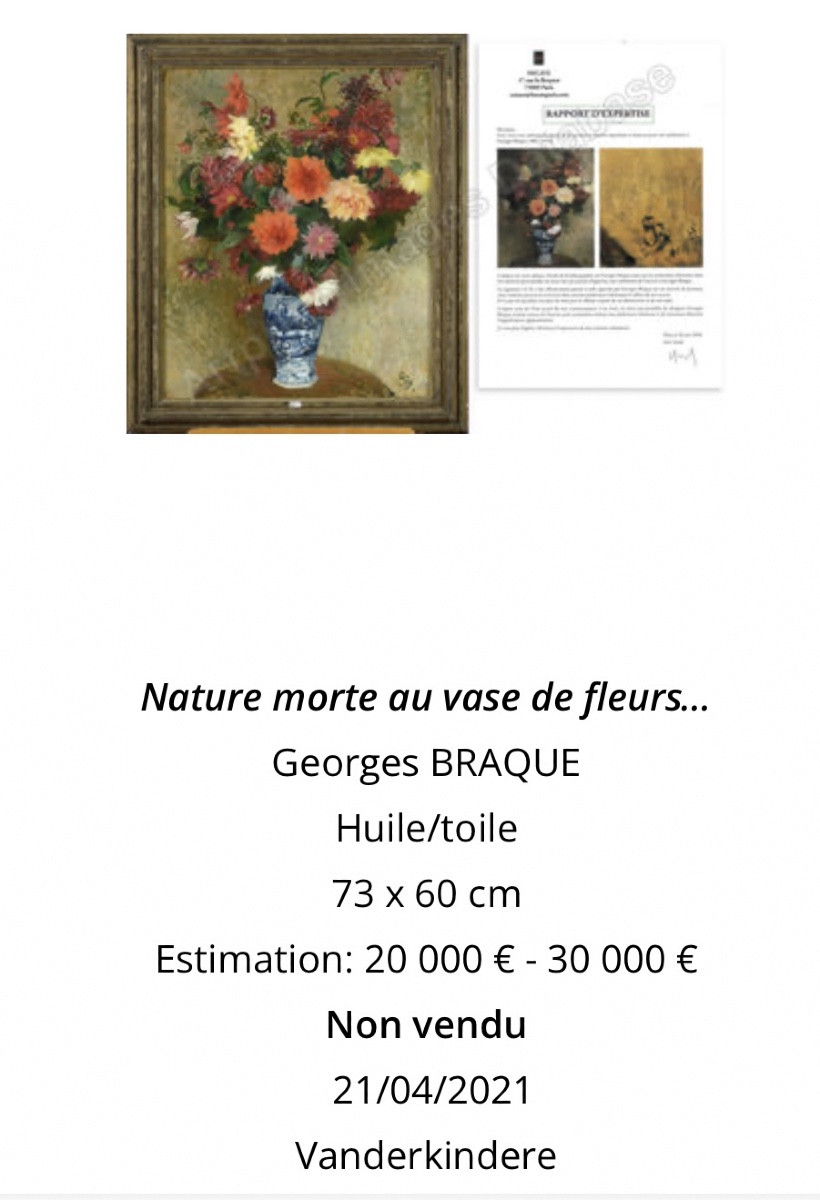
Note, another canvas from his very brief post-Impressionist period presenting a monogram identical to that worn on the proposed work, see photo (6).
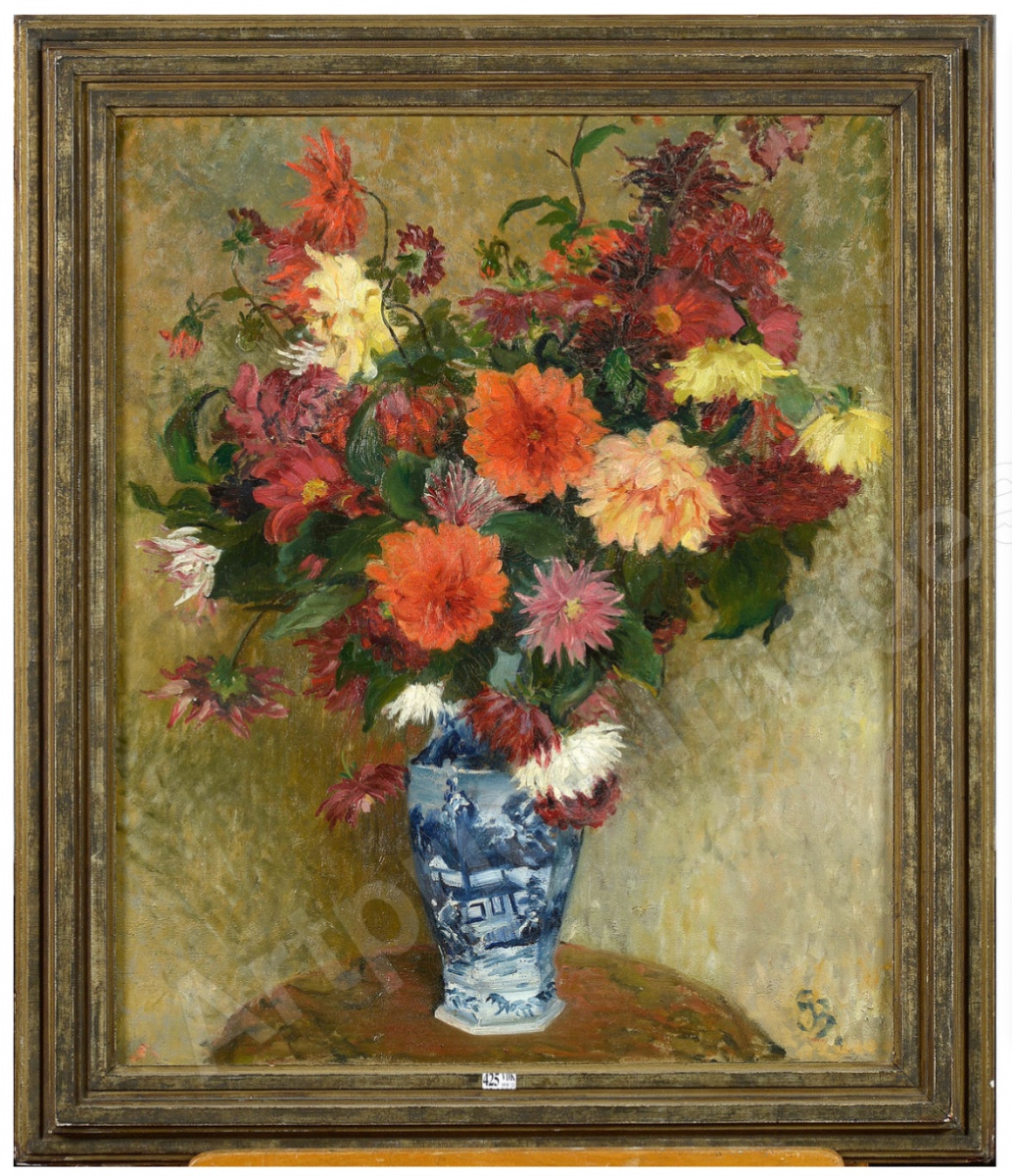
This still life with a bouquet of flowers, see photo (5) is also reminiscent of the post-impressionist bouquets of flowers by Paul Gauguin, to quote him once again.
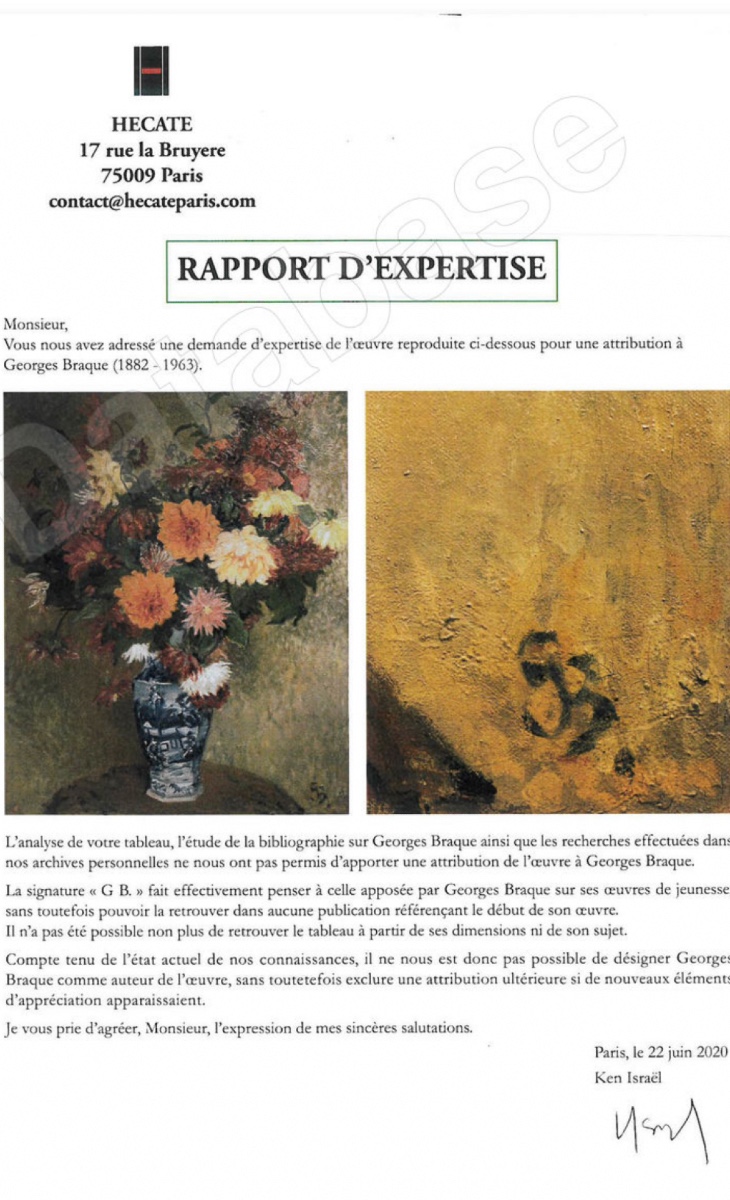
No expert since the death of Armand Israel, to this day, represents the work of Georges Braque.
His son, Ken Israel, intervened with an expert report issued for a work, see photo (5), with the same monogram as the one on our painting, see photo (6).
The letter G of the monogram is reminiscent, once again, of that of Paul Gauguin's Monogram. Nothing excludes that the young Georges Braque could have been influenced by the great master both in his way of painting and in the choice of a place up to his way of stylizing his monogram at a short given moment of his career as a painter with a great future.
Officially, to date, and to our knowledge, no expert represents the work of Georges Braque.
The main reason why the Mont des Arts Gallery cannot provide a certificate of authenticity to accompany this authentic work.
The last catalogue raisonné, known to date, documented by Massimo Carrà and edited by Rizzoli in 1971, only mentions works made between 1908 and 1929.
No catalogue raisonné, to date, takes up and reproduces the works of Georges braque made before 1908.
Many of them were destroyed by the artist himself.
It is to be assumed that this work was presented at an exhibition realized by his father, Charles Braque, himself an amateur painter, who organized exhibitions with and for his son and his friends Raoul Dufy and Émile Othon-friesz, in the region of Le Havre.
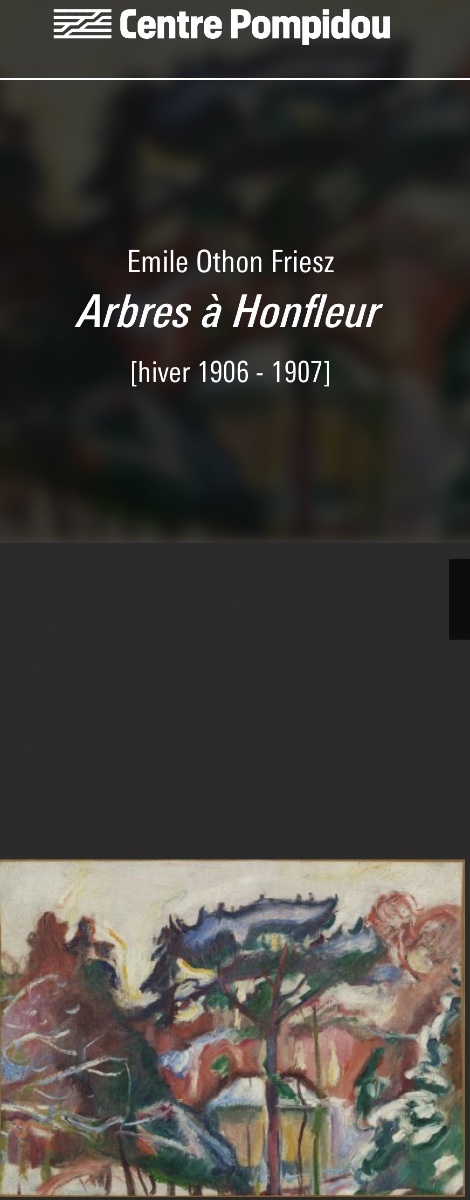
A fauve work, today at the Pompidou Center, and painted by his friend and four-year-old elder, Émile Othon-Friesz, entitled trees in winter in Honfleur (winter 1906-1907), is similar in composition to our painting by Georges Braque , see photo (10).
It is likely that in his capacity as an elder, he could have had an influence on his younger friend who will embark on the path of Cubism unlike Émile Othon-friesz who will never borrow it in favor of a neoclassical technique, see photo (10).
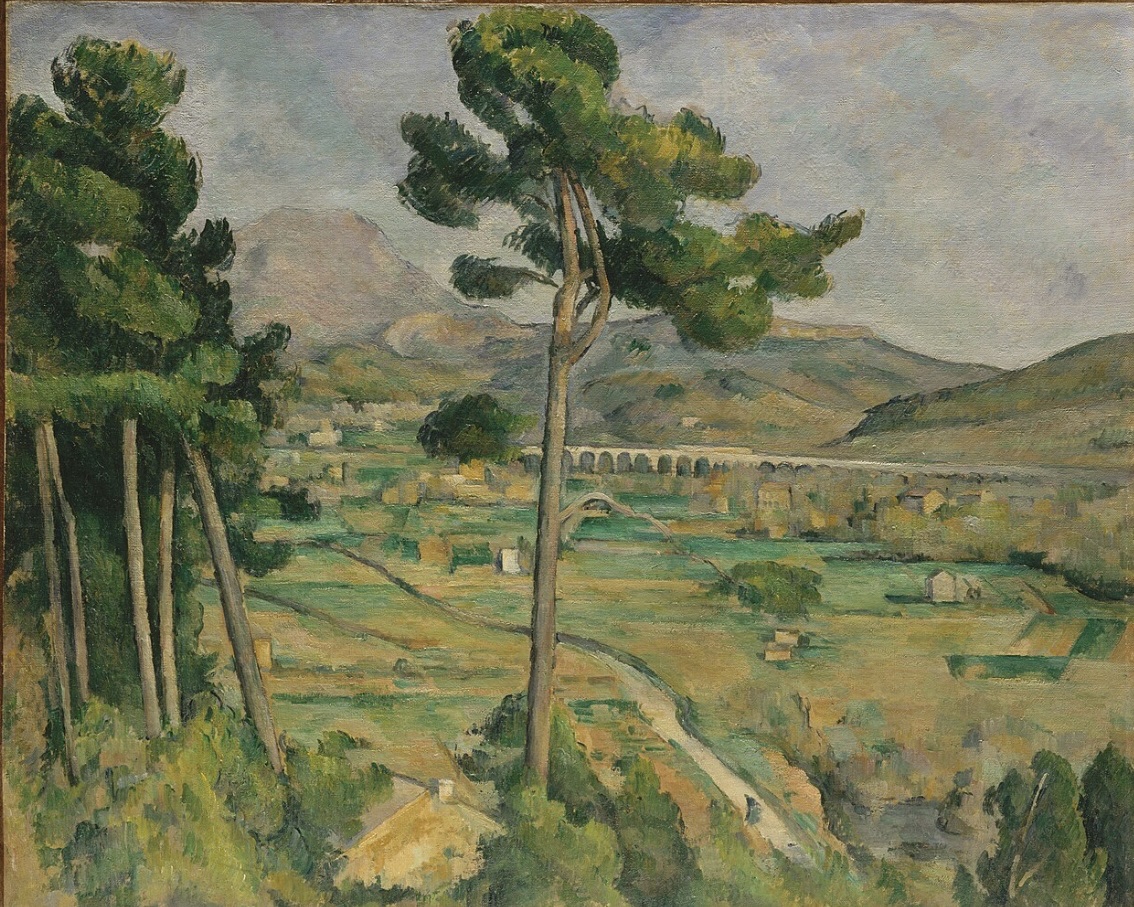
A work by Cézanne, The Sainte Victoire Mountain seen from Montbriand, confirms the prominence of the Cézanian influence in its composition, see photo (9).
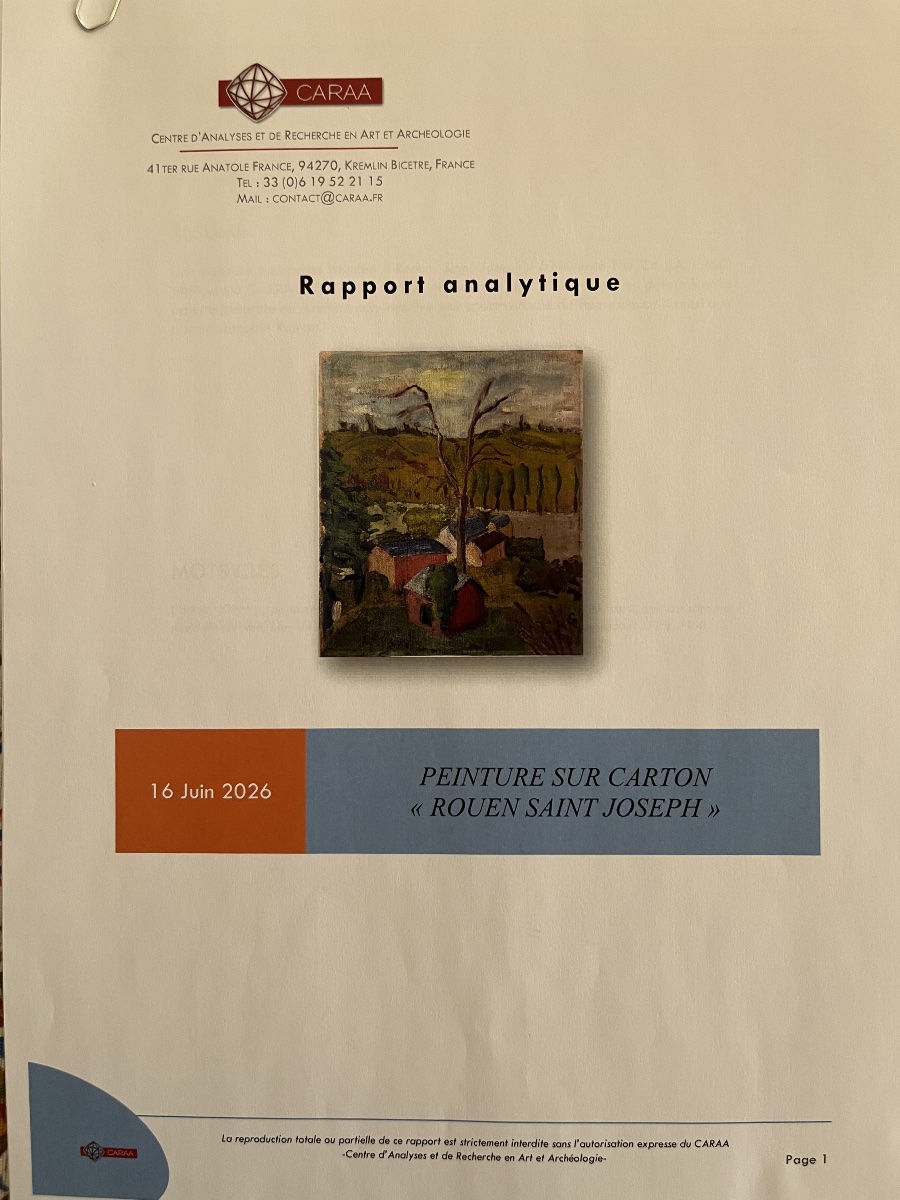
The CARAA research center, center for analysis and research in Art and Archeology was previously contacted and gave us an analytical report dated June 16, 2026 confirming that the work was indeed made during the first decade of the twentieth century and more precisely from 1907, which corroborates with our hypothesis that the work would be located on the border of Fauvism and pre-Cubism, in this case in 1907.
The analytical report remains confidential and cannot be sent either by email or by post.
It will be available for reading in the presence of the painting, in France, by appointment.
And to conclude, a first contact was established with an expert in graphology in order, for informational and complementary purposes, to be able to establish a link between the handwritten label and its author, namely Georges Braque.
To do this, texts and documents written between 1905-1910 will be necessary for a thorough graphological comparison.
Since the task seemed particularly difficult in view of the little text inscribed on the label, we first resorted to artificial intelligence - for only one and last time - and it was clear that it confirms a great similarity between the writing present on the back of our painting and the writings of Georges Braque identified and offered for comparison.
First appearance of this painting on the art market since its purchase, in all likelihood.
Unpublished.
Work visible by appointment, only.
Provenance:
- Galerie Le Mont des Arts, Dommartemont, France. Nota bene :
All the elements announced come from sources collected in various reference books mainly distributed by the réunion des musées nationaux (RMN).
Movement: fauvism-cubism, synthétism.
Medium : oil on board.
Technique : brush.
Date of creation: before 1908.
Location: Banks of the Seine, Normandy.
Rouen, Saint-Joseph, Numéro 1 annotated in brown ink and appearing on the back of the work on a label, see photo.
The Saint-Joseph district in Rouen is intimately linked to the artistic history of the city, being part of the heart of the Jouvenet district, often nicknamed the "village in the city.
The district has hosted other major artists, in particular the painter Paul Gauguin who lived there in 1884 and painted about forty canvases, including one representing the Jouvenet Street.
It is quite likely that the student was inspired and called to come and paint in the footsteps of one of the great masters of the late nineteenth century.
To date, we cannot say that the landscape on the banks of the Seine represented is located in Rouen itself but rather in its surroundings and certainly in Normandy.
The label seems to confirm an exhibition place rather than a location since no view offers the possibility of seeing the Seine from the Saint-Joseph district in Rouen.
Georges braque will have painted only in three regions of France; exclusively :
-In the Ile-de-France;
-In Provence;
-In Normandy.
Signature: Monogram G. B, inscribed at the bottom right.
Vertical perspective, orthogonal composition, of Gauguinian ( synthétisme ) and Cezanian inspiration.
This painting marks a turning point between the end of Fauvism and the first beginnings of Cubism.
Its interest is historical.
The vertical Perspective, generated by the superposition of the simplified planes, creates a curious two-dimensional decorative rhythm of which Braque's painting offers quite numerous examples, even in the years after the works of this period.
The photo of the painting Viaduct at the estaque painted in 1908 is an example of comparison see photo (11) :
Concentration of elements (overlapping houses) grouped in the center of the canvas in a purely orthogonal composition.
The trees depicted as bushes in front of the houses create a repulsive effect (like the tree in the center) and strengthen the perspective, just like in our painting.
Note, another canvas from his very brief post-Impressionist period presenting a monogram identical to that worn on the proposed work, see photo (6).
This still life with a bouquet of flowers, see photo (5) is also reminiscent of the post-impressionist bouquets of flowers by Paul Gauguin, to quote him once again.
No expert since the death of Armand Israel, to this day, represents the work of Georges Braque.
His son, Ken Israel, intervened with an expert report issued for a work, see photo (5), with the same monogram as the one on our painting, see photo (6).
The letter G of the monogram is reminiscent, once again, of that of Paul Gauguin's Monogram. Nothing excludes that the young Georges Braque could have been influenced by the great master both in his way of painting and in the choice of a place up to his way of stylizing his monogram at a short given moment of his career as a painter with a great future.
Officially, to date, and to our knowledge, no expert represents the work of Georges Braque.
The main reason why the Mont des Arts Gallery cannot provide a certificate of authenticity to accompany this authentic work.
The last catalogue raisonné, known to date, documented by Massimo Carrà and edited by Rizzoli in 1971, only mentions works made between 1908 and 1929.
No catalogue raisonné, to date, takes up and reproduces the works of Georges braque made before 1908.
Many of them were destroyed by the artist himself.
It is to be assumed that this work was presented at an exhibition realized by his father, Charles Braque, himself an amateur painter, who organized exhibitions with and for his son and his friends Raoul Dufy and Émile Othon-friesz, in the region of Le Havre.
A fauve work, today at the Pompidou Center, and painted by his friend and four-year-old elder, Émile Othon-Friesz, entitled trees in winter in Honfleur (winter 1906-1907), is similar in composition to our painting by Georges Braque , see photo (10).
It is likely that in his capacity as an elder, he could have had an influence on his younger friend who will embark on the path of Cubism unlike Émile Othon-friesz who will never borrow it in favor of a neoclassical technique, see photo (10).
A work by Cézanne, The Sainte Victoire Mountain seen from Montbriand, confirms the prominence of the Cézanian influence in its composition, see photo (9).
The CARAA research center, center for analysis and research in Art and Archeology was previously contacted and gave us an analytical report dated June 16, 2026 confirming that the work was indeed made during the first decade of the twentieth century and more precisely from 1907, which corroborates with our hypothesis that the work would be located on the border of Fauvism and pre-Cubism, in this case in 1907.
The analytical report remains confidential and cannot be sent either by email or by post.
It will be available for reading in the presence of the painting, in France, by appointment.
And to conclude, a first contact was established with an expert in graphology in order, for informational and complementary purposes, to be able to establish a link between the handwritten label and its author, namely Georges Braque.
To do this, texts and documents written between 1905-1910 will be necessary for a thorough graphological comparison.
Since the task seemed particularly difficult in view of the little text inscribed on the label, we first resorted to artificial intelligence - for only one and last time - and it was clear that it confirms a great similarity between the writing present on the back of our painting and the writings of Georges Braque identified and offered for comparison.
First appearance of this painting on the art market since its purchase, in all likelihood.
Unpublished.
Work visible by appointment, only.
Provenance:
- Galerie Le Mont des Arts, Dommartemont, France. Nota bene :
All the elements announced come from sources collected in various reference books mainly distributed by the réunion des musées nationaux (RMN).
3 500 000 €
Period: 20th century
Style: Modern Art
Condition: Excellent condition
Material: Oil painting on cardboard
Length: 46 cm
Width: 38 cm
Reference (ID): 1638935
Availability: In stock
Print