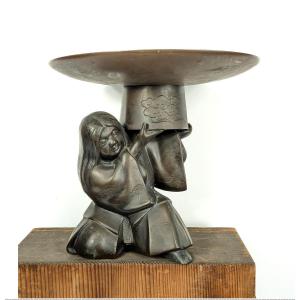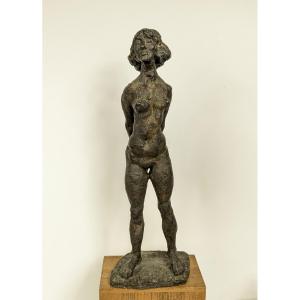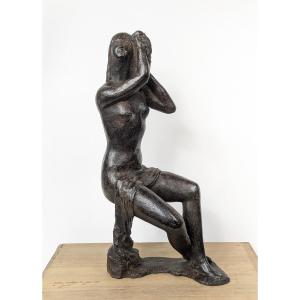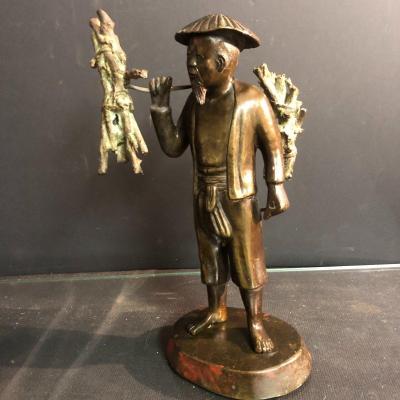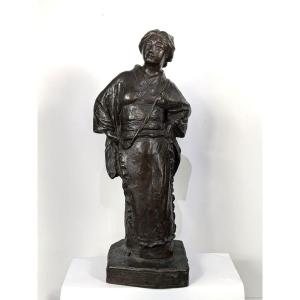


An Okâ-san - Bronze 60cm - Seibo Kitamura 1884-1987 # 764
Artist: Seibo Kitamura Japon 1884-1987
This is an "okâ-san" (director of an "okya"; boarding house for "maikos", geisha students). When an oka-san retired, a senior geisha who had proven herself within the house, took her place. Proud, hands on hips, carrying a satchel and apron, the new Oka-san savors her promotion. The okamisan had to maintain the values and traditions that defined the okiya. This also meant guiding young geishas in their careers. The okāsan covers all the expenses of young maikos and geishas (kimonos, accessories, personal effects, etc.) and takes care of their training. It is also through the okiya that reservations for geisha services are made. The future geisha repays her debt to the okiya thereafter, as soon as she receives her first income. The sculptor: In 1903, he entered the Kyoto University of Arts to study sculpture. He graduated in 1907. He then joined the Tokyo University of Fine Arts, graduating in 1912. After his military service, in 1915, he devoted himself to sculpture. In 1920, he was appointed professor at the Tokyo School of Fine Arts. In 1925, he became a member of the Japanese Academy of Arts. In 1931, he decorated the Diet: a statue of the Constitution. His production is made up of realistic scenes of daily life inspired by familiar members of his family or entourage. These are calm, peaceful works. After the Second World War, his style changed: the prayer for peace was his leitmotif. It was no longer a question of realistic representations, but of a tormented, skeletal physical beauty. Until his last days, he produced many nude zodiac subjects in this new style. In 1951, the 10-meter-high statue of Peace was inaugurated in Nagasaki, located near the hypocenter of the 1945 explosion. The emperor came to pay homage to him at the workshop regularly.--------------------------Bronze with brown patina - some micro-wear and oxidation spots. Weight 11 kg - An illustrated biography and a certificate will be given to the purchaser.
1 400 €
Period: 20th century
Style: Asian art
Condition: Good condition
Material: Bronze
Width: 25,5
Height: 60
Depth: 18
Reference (ID): 1575992
Availability: In stock
Print