THIS OBJECT WAS SOLD
Indonesia, Island Of Java, 9th - 10th Century, Representation Of Kubera, Bronze With Dark Patina


Bronze representation of Kubera
Indonesia, Island of Java
9th - 10th century
°°° Price can be reasonably negotiated °°°
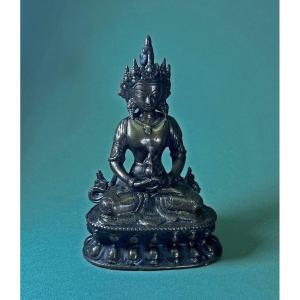
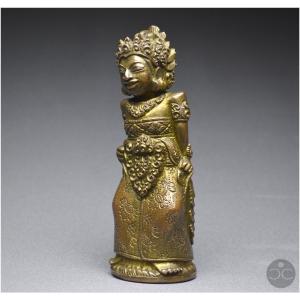
The deity Kubera/Jambhala is represented seated in the ardhaparyanka position (attitude of relaxation), the right leg bent, the foot resting on a jar (purnagatha) pouring out jewels, left leg folded. Sitting on a high lotiform circular base with a double row of alternating lotus petals, the latter resting on a quadrangular base decorated at the top with six treasure jars.
Dressed in a simple dothi, the chest and torso adorned with heavy necklaces with floral motif pendants, the deity grasps a gem or a fruit (jambhara) with the right hand, the left hand for its part enclosing the mongoose named Nehulay springing forth her mouth pearls and jewels.The deity wears numerous bracelets on his arms, elbows, ankles and wrists, his shoulders decorated with ornaments. The face slightly inclined, the forehead displaying the urna, the head crowned with a high tiara with five richly decorated florets.
Kubera/Jambhala, respectively in Hinduism and Buddhism is the god of wealth and good health, and, by analogy, protector of all sentient beings. Kubera, in ancient Indian tradition, is the master of the Yakshas and the guardian of the North. Son of a sage called Visravas (hence his other surname Visravana or Vaisravana), he is said to have performed austerities for a thousand years as a reward for which Brahma gave him immortality and then made him god of wealth.
Jambhala, for Tantric Buddhism, is considered an emanation of the bodhisattva Avalokitesvara.
The Island of Java was from the 5th to the 16th century the cradle of a civilization characterized by several cultural traits originating in India (use of Sanskrit, practice of Hindu and Buddhist religions, artistic traditions in statuary and temple construction). The strategic geographic location of Java Island along the maritime route linking China to the Middle East favored political and cultural exchanges with South and Southeast Asia. Thus, at the beginning of the 8th century, the Kingdom of Medang in central Java practiced a cult centered on the figure of the Hindu God Shiva, but shortly after, the Sailendra dynasty developed in the Kedu plain and then became an important center of Mahayana Buddhism, the two religions coexisting between the 9th and 10th centuries.
The Hindu and Buddhist bronze statuettes from this period constitute one of the major vestiges of Javanese civilization, but also one of the privileged witnesses of these relations on both sides of the Bay of Bengal.
Bronze with dark patina
13.3 x 6 cm
Usual wear, restoration at the base of the neck
European private collection
Contact us: culturesetcivilisations@orange.fr
Explore similar pieces and discover your ideal find:
Asian Bronze Sculptures