

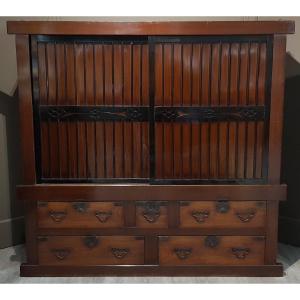


Japan - Futon-dansu à Deux Corps - Meiji 19th.
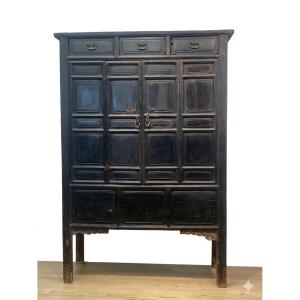
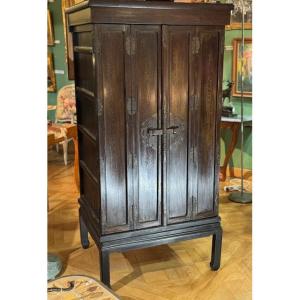
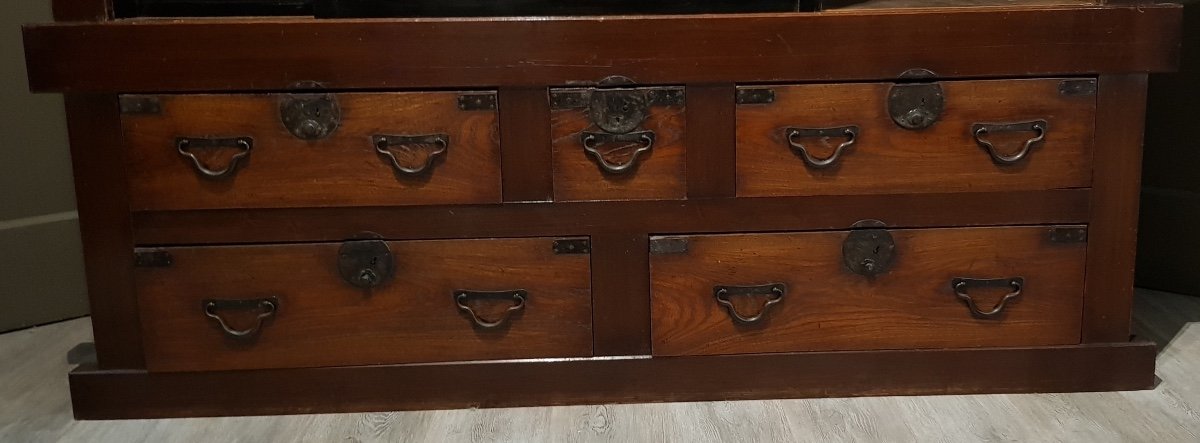
A Japanese futon-dansu-style storage unit, crafted from Japanese cedar (sugi) and elm (keyaki), features an architectural structure with a compartmentalized front and a functional layout typical of late 19th-century Japanese utilitarian furniture. The upper section comprises large compartments for storing linens and futons, closed by sliding doors with vertical slats (koshi-do), reinforced by decorative wrought-iron crossbars with stylized motifs. The design also incorporates open shelving, characteristic of Japanese household furniture intended for everyday storage. The lower section features a series of drawers of varying sizes, fitted with movable handles and circular iron keyholes, demonstrating traditional blacksmithing. The hardware, both functional and decorative, is a characteristic element of Meiji-era Japanese furniture.
The construction reveals traditional Japanese joinery with no visible structural nails, featuring back panels mounted with horizontal planks and a robust structure designed for intensive domestic use. The asymmetrical and rational organization of the front reflects the functional principles of Japanese furniture, where the hierarchy of volumes responds to storage needs. The warm, even, and slightly satiny brown patina, along with the visible wear on the surfaces, attests to the natural aging of the wood and an age consistent with the period in question. The piece constitutes an authentic example of Japanese domestic furniture from the Meiji period, an era marked by the modernization of Japan while preserving traditional craft techniques. The futon-dansu, intended for storing bedding and textiles, occupied an essential place in Japanese interior design and is distinguished by its robustness, functionality, and understated aesthetic.
Origin: Japan
Period: Meiji (1868–1912) – 19th century
Dimensions: Height: 172 cm Length: 181.5 cm; Width: 67 cm.
Condition: The piece is in very good condition, with wear and marks consistent with age and use, original patina preserved, and original hardware retained. No major restoration is visible.
The construction reveals traditional Japanese joinery with no visible structural nails, featuring back panels mounted with horizontal planks and a robust structure designed for intensive domestic use. The asymmetrical and rational organization of the front reflects the functional principles of Japanese furniture, where the hierarchy of volumes responds to storage needs. The warm, even, and slightly satiny brown patina, along with the visible wear on the surfaces, attests to the natural aging of the wood and an age consistent with the period in question. The piece constitutes an authentic example of Japanese domestic furniture from the Meiji period, an era marked by the modernization of Japan while preserving traditional craft techniques. The futon-dansu, intended for storing bedding and textiles, occupied an essential place in Japanese interior design and is distinguished by its robustness, functionality, and understated aesthetic.
Origin: Japan
Period: Meiji (1868–1912) – 19th century
Dimensions: Height: 172 cm Length: 181.5 cm; Width: 67 cm.
Condition: The piece is in very good condition, with wear and marks consistent with age and use, original patina preserved, and original hardware retained. No major restoration is visible.
5 000 €
Period: 19th century
Style: Asian art
Condition: Excellent condition
Material: Solid wood
Length: 181,5 cm
Width: 67 cm
Height: 172 cm
Reference (ID): 845677
Availability: In stock
Print