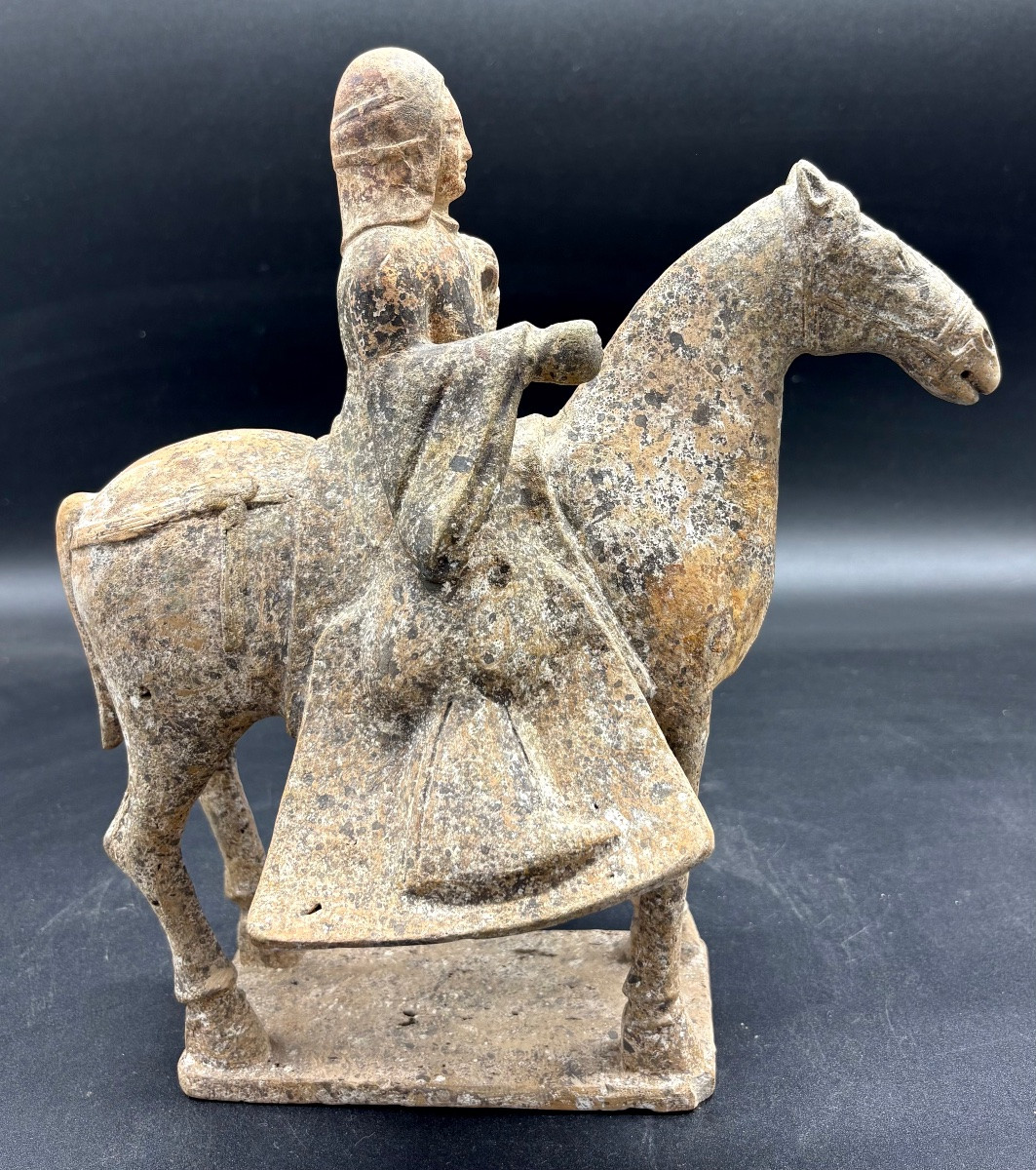


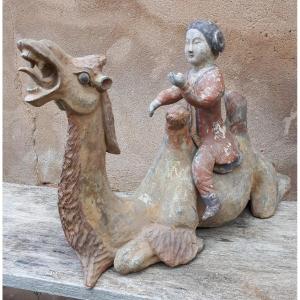
"China - Terracotta Horseman - Northern Wei Dynasty (386–534) - Tl"
A terracotta sculpture depicting a horseman, a remarkable example of funerary art from the Northern Wei dynasty, a pivotal period in northern China, under the rule of the Xianbei people, which developed a unique sculptural style: austere, expressive, and imbued with a severe elegance. The horseman has an elongated face with almost geometric features, reminiscent of the Xianbei ethnic influence. The incised eyes, straight nose, and discreet mouth lend the figure a calm and hieratic interiority typical of sculptures from this era, which already foreshadow the forms of the great Buddhist art of the Yungang and Longmen caves. The horse, massive yet simply modeled, illustrates the type of mount favored by the Northern Wei: robust animals used for both transport and warfare. The stylized mane, the lines engraved on the head, and the musculature suggested by simple volumes testify to an art deliberately devoid of embellishment, favoring the strength of the silhouettes. The terracotta surface bears an ancient mineral patina: calcareous incrustations, variations of brown-ochre and stone gray, attesting to a long period of burial. The whole clearly evokes the workshops of Northern China (Hebei, Shanxi, Henan), major centers of funerary production under the Northern Wei dynasty. Visual examination, combined with thermoluminescence testing, confirms that it is entirely ancient. No major modern intervention is observed: the work shows only natural wear on the edges, a few superficial abrasions, and very small losses expected for an object over 1,400 years old. Through its balance, its statuary presence, and the strength of its modeling, this horseman constitutes a fine example of Northern Wei funerary sculpture, a period much less common on the market than the Tang, and consequently more sought after. Origin: China Period: Northern Wei Dynasty (386–534) - TL Dimensions: Height 28 cm; length 25 cm; width 16 cm Provenance: French private collection. 












 Le Magazine de PROANTIC
 TRÉSORS Magazine
 Rivista Artiquariato