

Eugène Deshayes – Algerian Landscape In The Evening Light – Oil On Panel – Signed
Artist: Deshayes Eugène François (1862 – 1939, Algérie)
Eugène François DESHAYES (Algiers, 1862 – Algiers, 1939)
Landscape of Algeria
Circa 1900–1910
Oil on panel
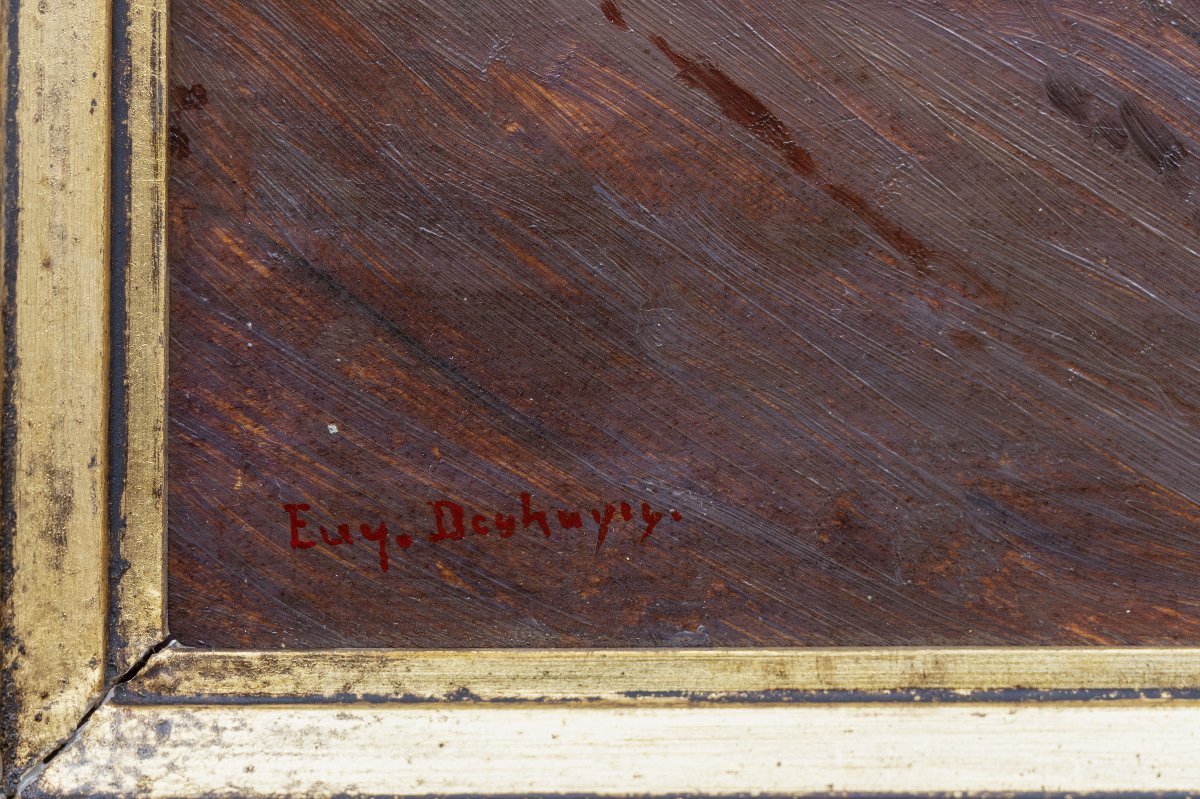
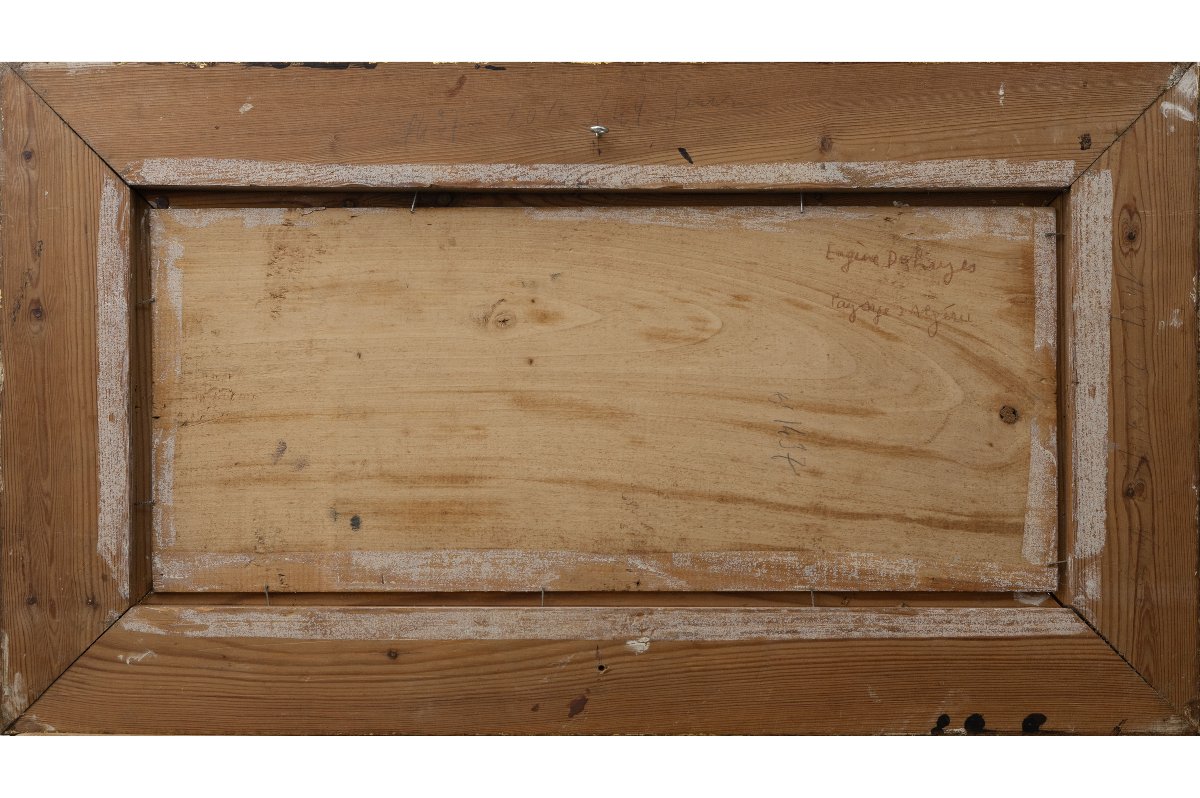
Signed lower left, in red. On the back, the title and the artist’s name.
Dimensions: 50 x 22 cm; 66 x 38 cm with frame
Very good condition
Frame: carved gilded wood with incised black moldings, early 20th century. Good condition, some missing gilding.
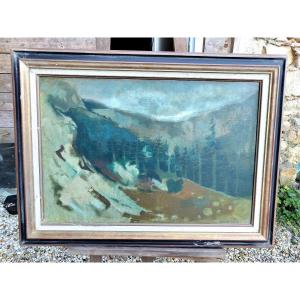
Who said an Algerian landscape had to be yellow and white? Here, Deshayes paints almost everything in purple.
The mountain occupies the center of the painting. Its right flank is in shadow, a deep purple, almost indigo. The left flank is still bathed in light: a light blue-gray, with streaks of pinkish white for the bare rock. At its base, a band of salmon pink shows where the sun still touches the plain.
In the foreground, the slope descends diagonally across the entire width of the panel. Its soil is reddish-brown, somewhere between red ochre and burnt sienna, painted with broad brushstrokes. The wood of the panel shows through in places, further warming the color. A row of very dark trees follows the slope. Their silhouettes are almost black, with a few touches of bright green where the light catches them.
On the right, a wooded hill offers a completely different palette. It features acid greens, olive greens, and almost golden greens, applied in small, tightly packed strokes.
The sky is cream-colored, with a slight orange tint toward the horizon. In the upper left, a few clouds of pure ultramarine blue have been applied with a heavily loaded brush, without any retouching.
This panel embodies everything that makes Deshayes’ work so compelling. He draws with great confidence, using few strokes, but his colors are bold: they construct the landscape as much as they depict it. The very elongated format accentuates the panoramic effect, as if one had just stopped at a bend in the road. This is a work painted from life or based on a study made on site, with all the spontaneity that entails.
In its period gilded frame, with its black moldings and sharp corners, this painting will easily find its place in both traditional and contemporary interiors.
The Artist
Eugène François Deshayes was born in Algiers in 1862 (some sources indicate 1868). A child of frail health who was often bedridden, he drew from morning to night. He lost his parents at an early age and was raised by his older brother, a young doctor at the Douéra Hospital.
He enrolled at the École des Beaux-Arts in Algiers, directed by the landscape painter Émile-Charles Labbé, who was associated with the Barbizon School. In 1882, a scholarship enabled him to attend the École des Beaux-Arts in Paris, in Jean-Léon Gérôme’s studio. He copied works at the Louvre and painted the surroundings of Versailles and Parc Monceau. The art dealer Durand-Ruel purchased a view of Clamart under the snow from him.
Around 1890, he returned to settle in Algiers. There, he exhibited regularly and submitted his paintings to the Salon des Artistes Français in Paris. An avid traveler, he explored southern Algeria and the Sahara (Biskra, Ouargla, Batna, Timgad), as well as Morocco and Tunisia. He also painted the Mediterranean coast from a studio boat. For the 1900 World’s Fair, he created one of the decorative panels for the Algerian pavilion.
He was named a Knight of the Legion of Honor in 1935 and received a gold medal at the 1937 International Exposition. He died in Algiers in 1939. He was one of the leading figures of the Algiers School. He is known for his landscapes, seascapes, and architectural views.
Work on view at the gallery (07240)
Shipping: Please contact us for shipping rates within France and internationally.
600 €
Period: 20th century
Style: Modern Art
Condition: Excellent condition
Material: Oil painting on wood
Width: 22 cm, 38 cm encadrée
Height: 50 cm, 66 cm encadrée
Reference (ID): 1864737
Availability: In stock
Print