

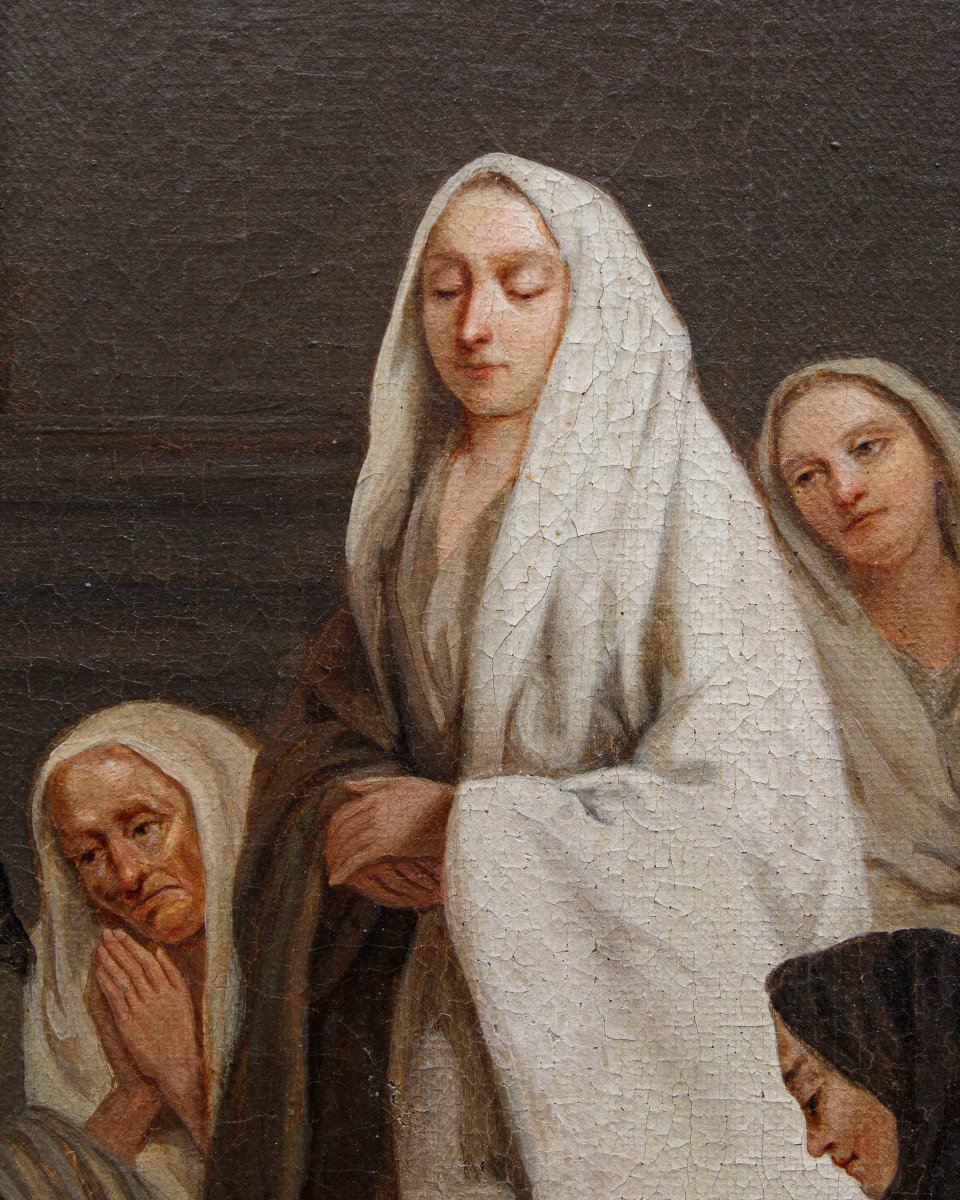

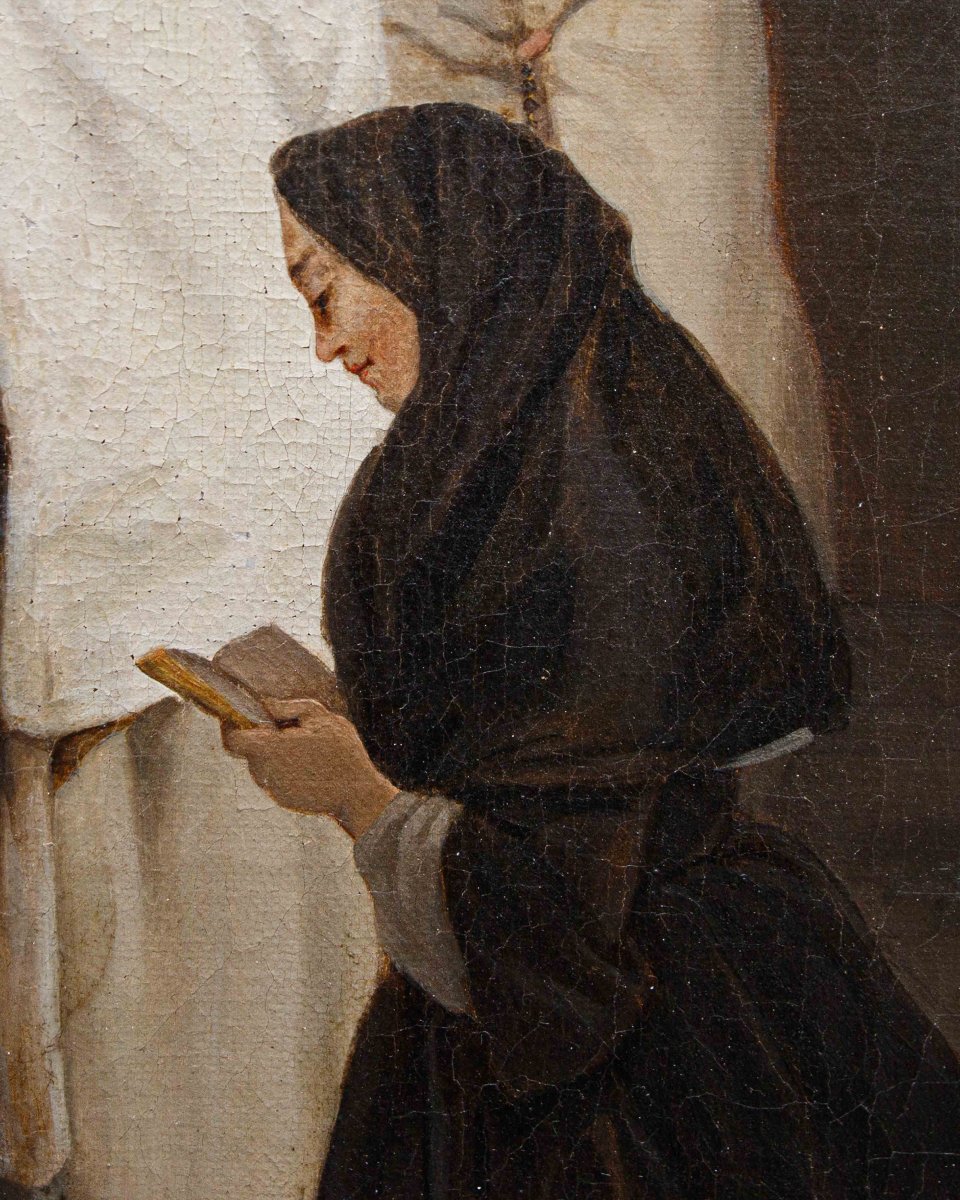


Pietro Longhi (venice, 1701–1785), *the Confession*
Pietro Longhi (Venice, 1701–1785)
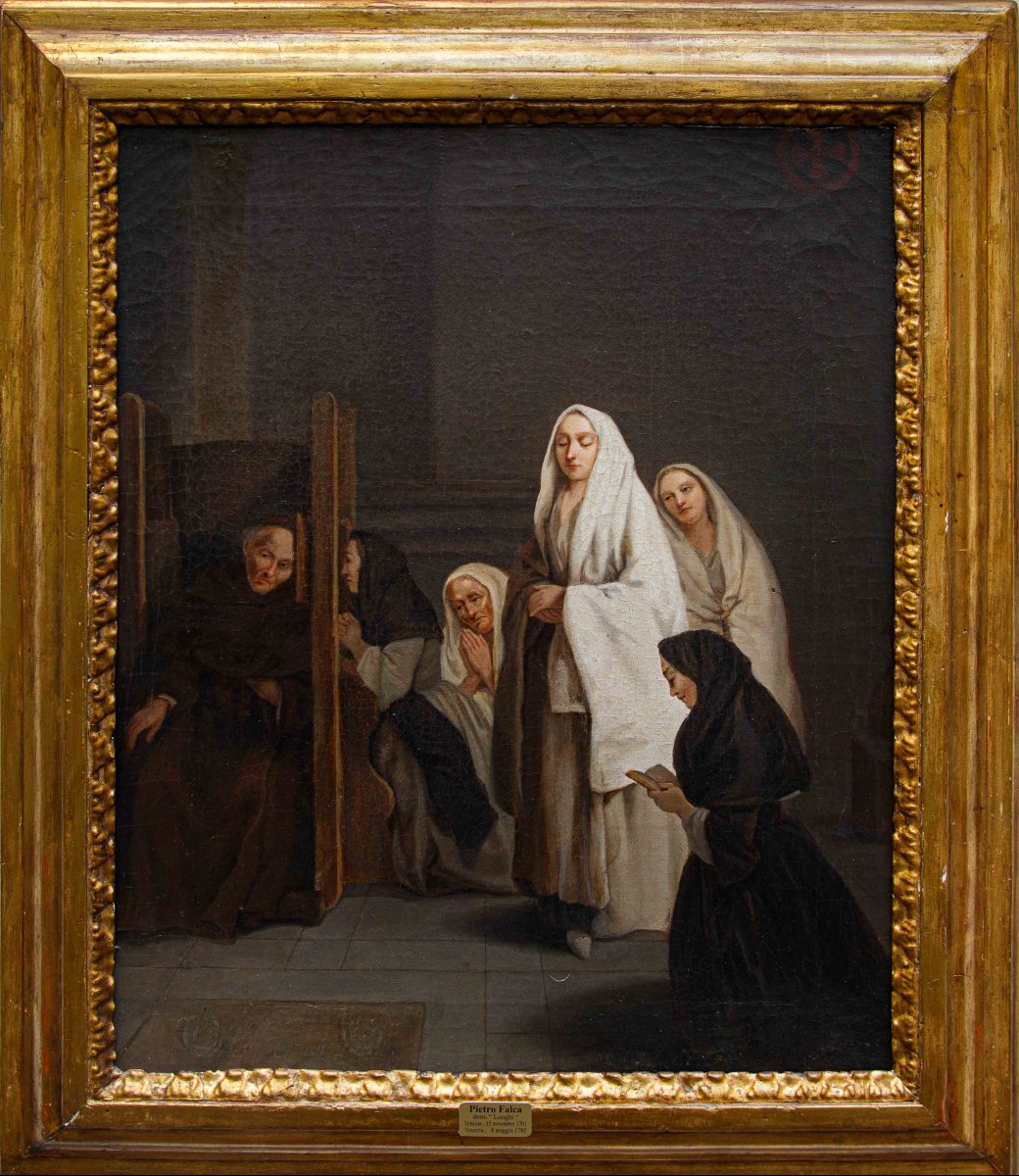
The Confession
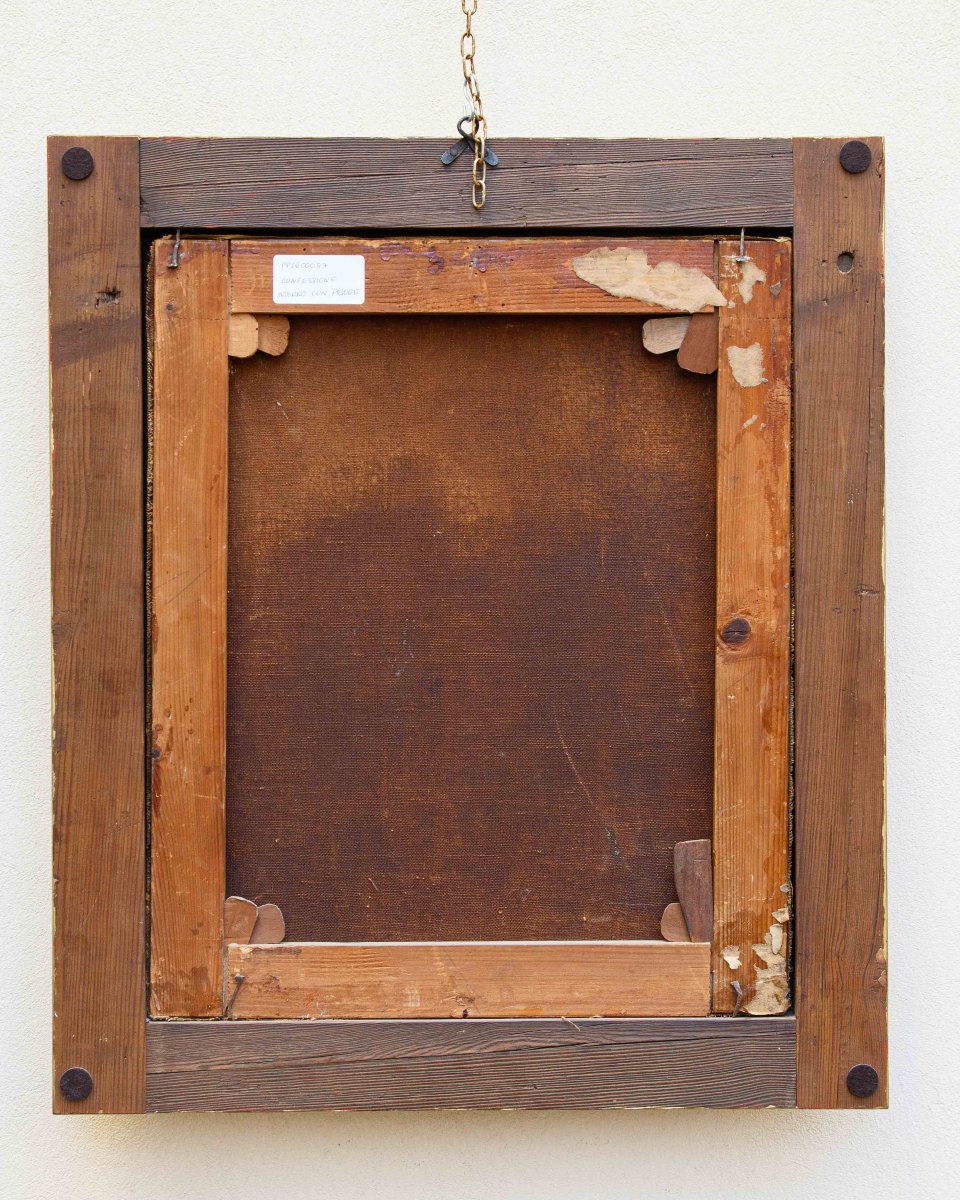
Oil on canvas, 54.5 x 44.5 cm
with frame: 67 x 59 cm
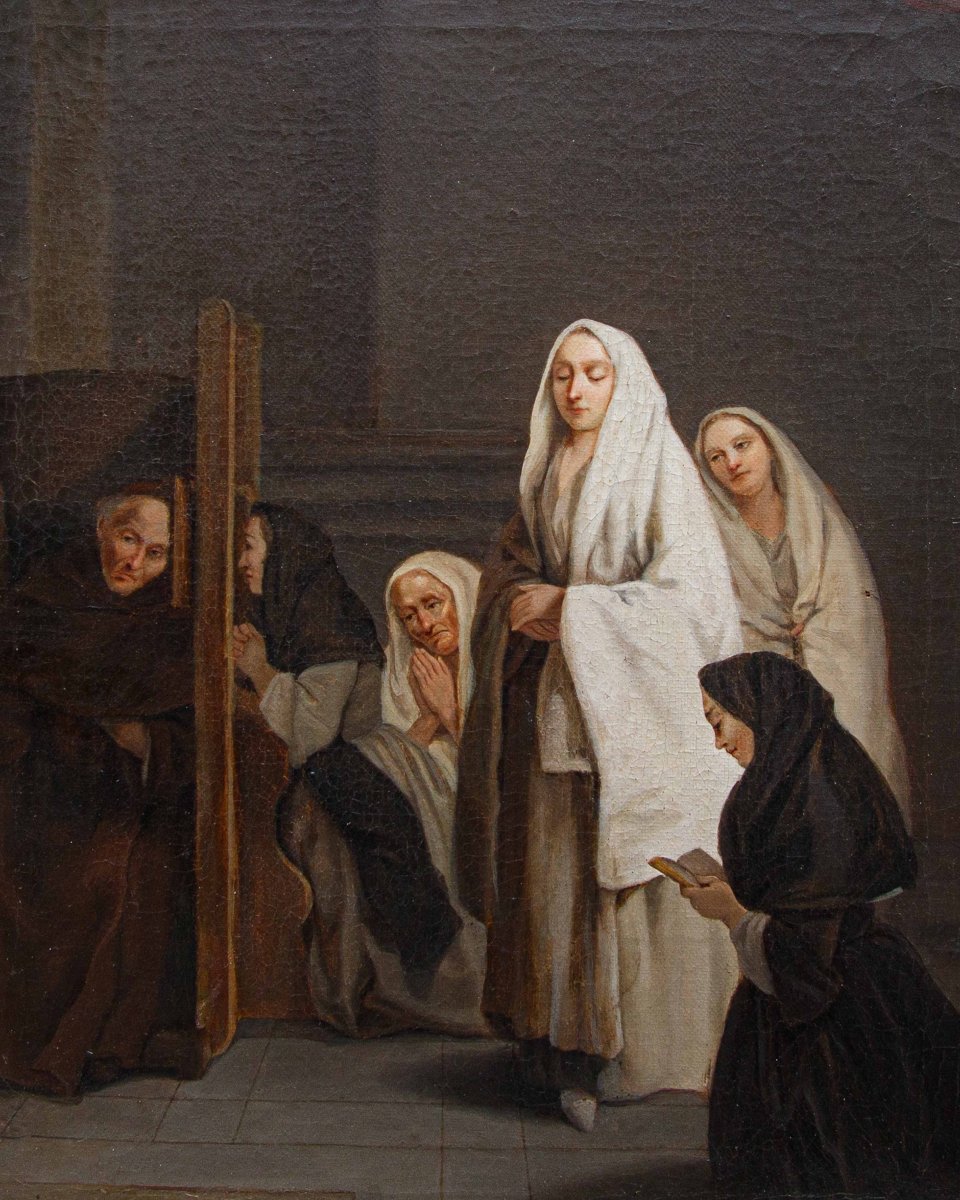
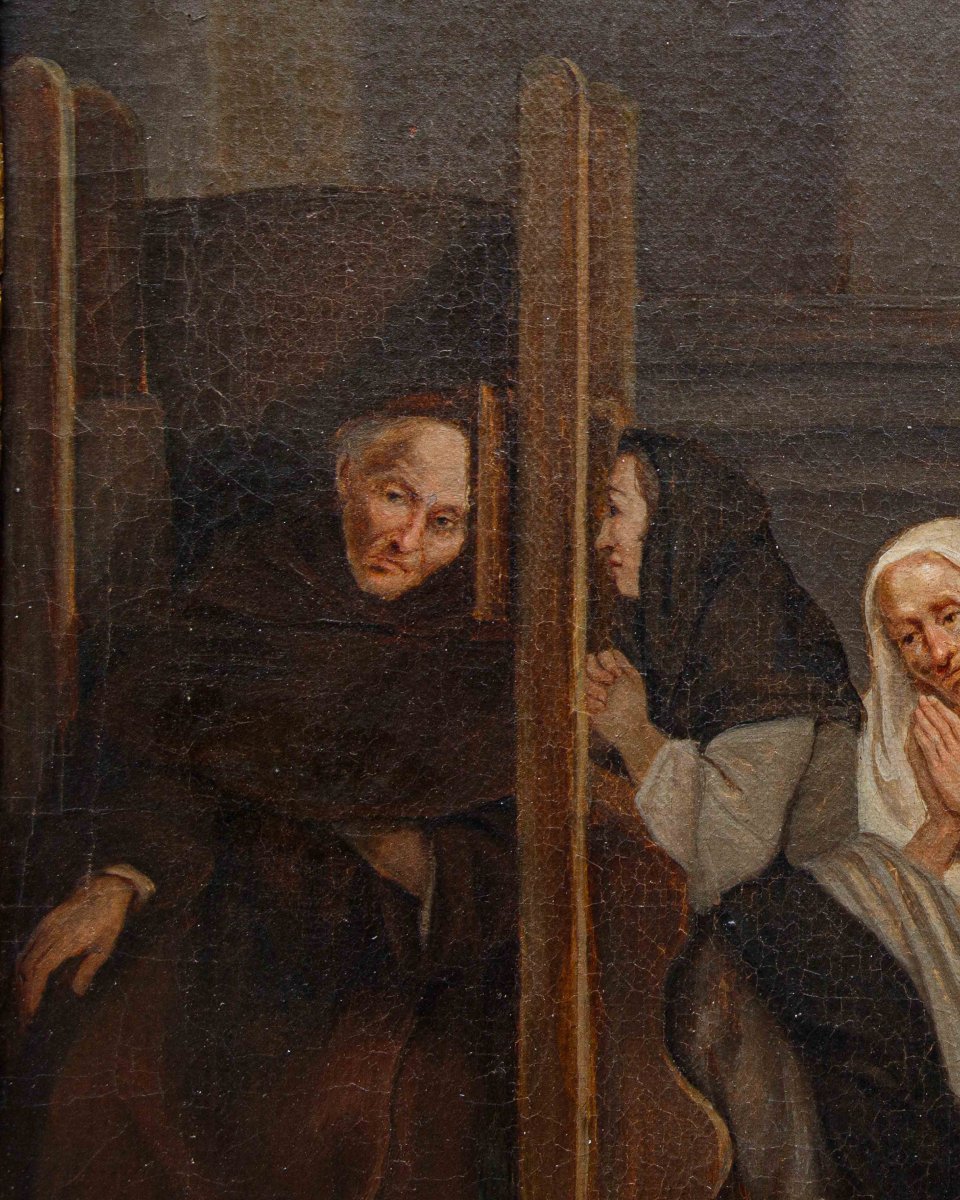
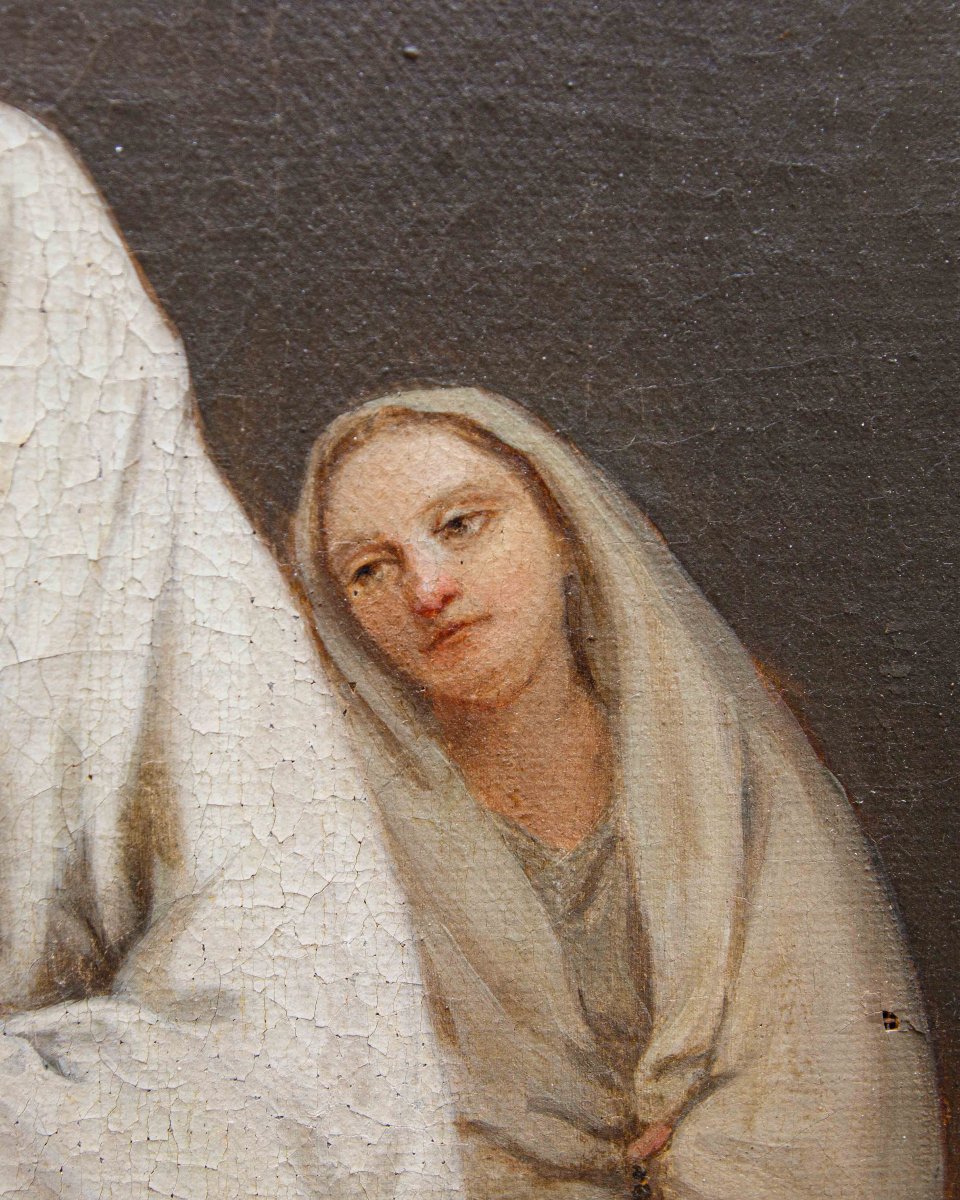
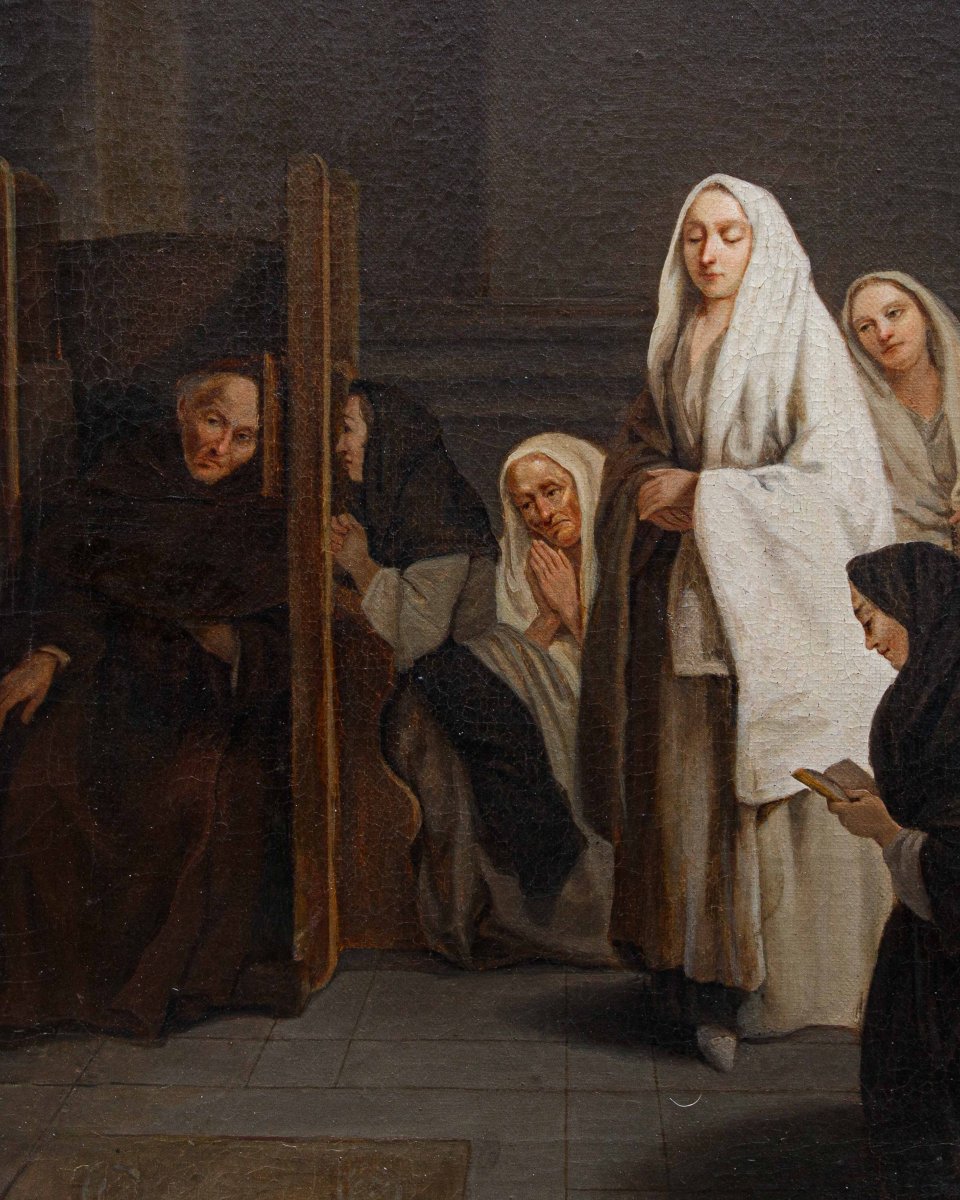
This painting depicts a subject, *The Confession*, which Pietro Longhi rendered in several variations. This particular version refers to a work by Longhi housed at the Galleria Querini Stampalia in Venice, from which Marco Alvise created an engraving, now preserved at the Luigi Bailo Museum in Treviso. Upon close inspection, however, one can note that the engraving exhibits slight differences from the work at the Stampalia; differences that become similarities when compared to the work analyzed here. In this regard, note not only the presence of the dog but also the closed eyes—rather than open ones—of the female figure in the center and the symbol in the upper right corner, instead of the clock.
With regard to the canvas under examination, Longhi frequently addressed the subject of the Sacraments and Confession itself. Another similar work is on display at the Uffizi in Florence.
The Venetian painter Pietro Longhi, whose real name was Pietro Antonio Falca, was born in Venice in 1701. He received his early training in his father’s workshop, where his father was a silversmith. In fact, from a young age, Pietro showed a great aptitude for art, and it was his father who encouraged him to develop his drawing skills. He met the famous painter Antonio Balestra, with whom he worked while learning the art of painting. From around 1734, Longhi’s work shifted away from religious subjects for a time, as he devoted himself to genre painting. Longhi also moved to Bologna, where he became acquainted with the work of Gambarini, a refined painter of genre scenes. Upon his return to Venice, he devoted himself to painting scenes of daily life among the Venetian bourgeoisie, following the style of Nicolas Lancret, albeit in a more ironic manner. His paintings provide a detailed record of Venetian life, reflecting the artist’s interest in the social life of the era. In the first half of the 1750s, he devoted himself to depicting “carriere”—that is, scenes of real, everyday activities among the common people and the bourgeoisie. Around the 1760s, his color palette took on brownish tones with loosely rendered perspective lines, closely resembling Rembrandt’s style.
In 1763, Pietro Longhi was director of the Pisani Academy of Drawing and Engraving and devoted himself to portraiture, with the assistance of his son Alessandro.
The great Venetian playwright Carlo Goldoni (1707–1793) praised Longhi’s dedication to depicting the quirks of contemporary society. In fact, Longhi’s work, full of humor and irony, is somewhat reminiscent of Goldoni’s comedies. The artist is also mentioned in Carlo Goldoni’s work *Le commedie*. Their careers ran parallel on two distinct artistic fronts: theater and the visual arts.
Period: 18th century
Style: Other Style
Condition: Good condition
Material: Oil painting
Width: 44,5
Height: 54,5
Reference (ID): 1862941
Availability: In stock