





Antonio Rasio, Composition With Bread And Salami, Meat And Fruit
Antonio Rasio (Brescia, post 1677 – before 1699)
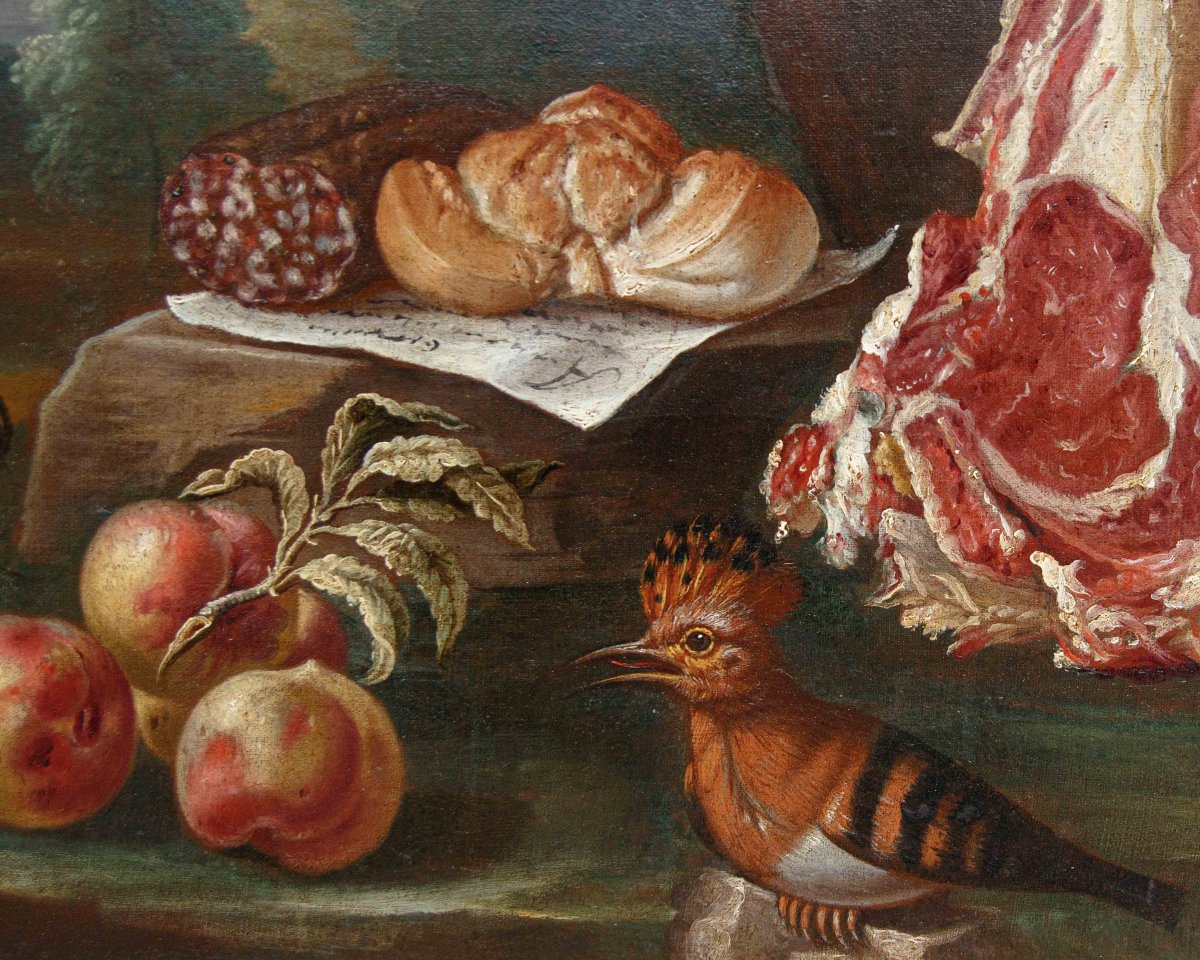
Composition with bread and salami, meat, fruit and a hoopoe in a landscape
oil on canvas 61x76.5 cm
Frame, 73 cm, 5 x 89
Criticism Sheet Prof. Alberto Crispo
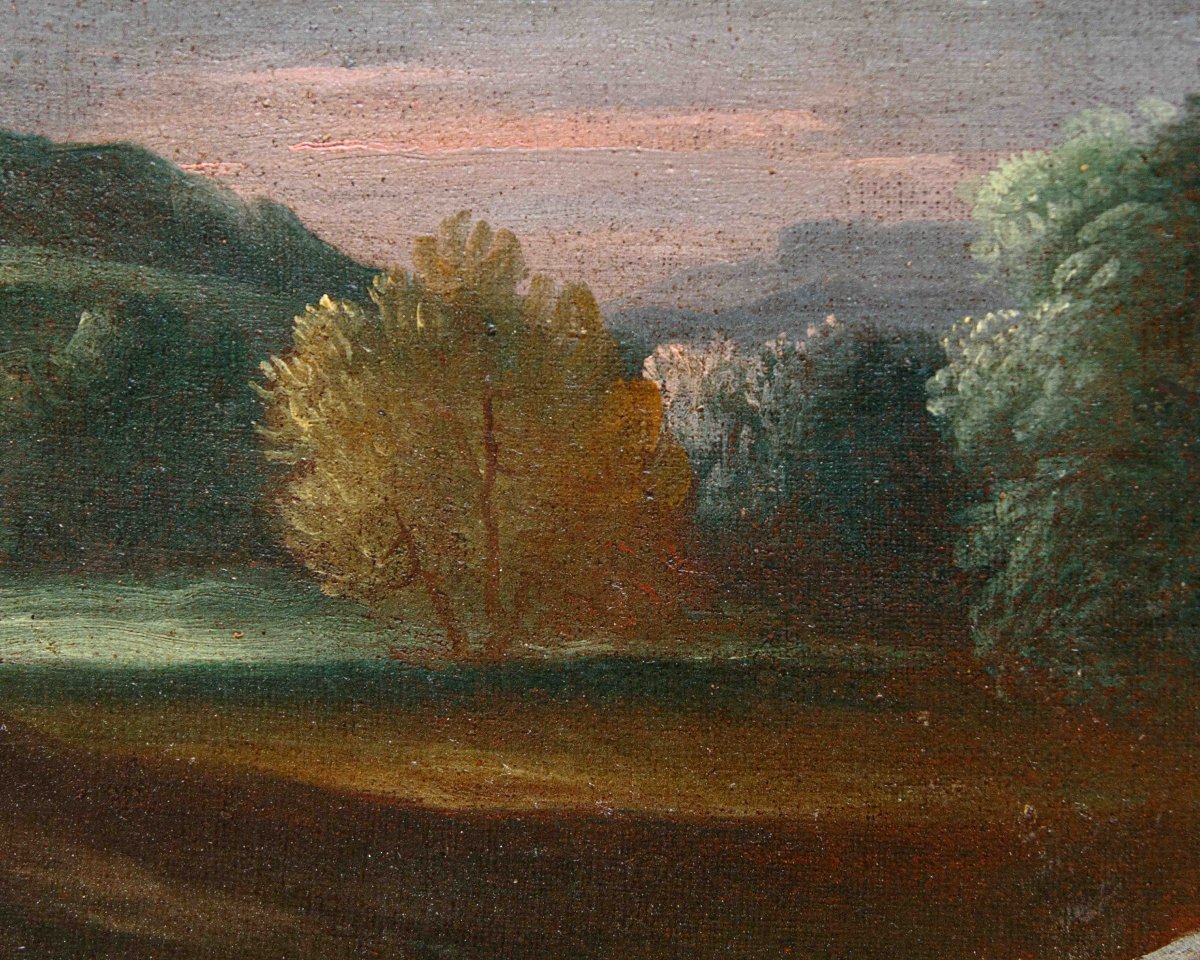
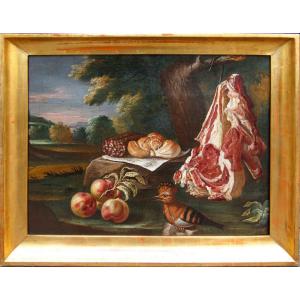
This evocative canvas is attributed to the Brescian master Antonio Rasio (active after 1677 – around 1700), and presents itself as a valuable example of the Lombard still life of the late Baroque. The painting departs from Rasio's best-known Arcimboldeschi cycles, such as the famous Four Seasons preserved at the Pinacoteca Tosio Martinengo, to fit into the genre of still life from the pantry, a genre popular in the Po Valley, which celebrates the abundance of land products and hunting. The work orchestrates a rich variety of objects on a natural stage. The focal point, located on the right, is the large quarter of flesh hanging from a tree trunk, treated with a strong material realism in the shades of dark red and white of the fat. On the left, on a rocky shelf, bread and a sliced salami are carefully arranged, elements that introduce a contrast of textures and colors. In the foreground are three red fruits (apples or peaches) still attached to the branch, a symbol of vitality and freshness. At the bottom right is a hoopoe, depicted with meticulous detail in its feathers and crest.
There is no certain documentary information about the Brescian painter Antonio Rasio. His only works so far confidently included in the catalogue are preserved at the Pinacoteca Tosio Martinengo in Brescia. The only painting he signed is Still Life with Musical Instrument, Relief and Flowers, created in 1677. In this elaborate composition, Rasius depicts a marble shelf with historiated sides (decorated with relief scenes), in particular with the Sacrifice of Iphigenia at Aulis. A carpet and a pillow are draped over the shelf; on these rests a spinet with an open music booklet and a small parlor dog. On the right you can see a vase of flowers, a globe with a celestial sphere in front of an astronomy book, and a plate full of peaches and grapes. Rasio's most famous cycle of works is the series of The Four Seasons, created around 1685-1695 and also preserved at the Pinacoteca Tosio Martinengo in Brescia. This series highlights a close relationship with the inventions of Giuseppe Arcimboldo, the very famous painter active in the second half of the 16th century at the Austrian and Bohemian courts. Arcimboldo achieved success by creating a particular type of portrait composed entirely of the juxtaposition of plants or objects. Rasio's depictions of the seasons are inspired by Ovid's Metamorphoses, whose themes were later reported and codified, for example, in Cesare Ripa's Iconologia of 1593. Unlike the subjects portrayed by Arcimboldo, which are all half-length, the personifications of Spring, Summer, Autumn and Winter are depicted by Rasio in full figure and placed in a lakeside landscape. However, it cannot be overlooked that much of the painter's repertoire seems to be influenced by artists active in Rome, such as Antonio Tibaldi and Carlo Manieri. Furthermore, the four seasons already mentioned also appear to be inspired by the compositions created by the Stanchi, Roman still life painters. It is therefore likely that the painter became acquainted with the Roman world of still life, perhaps during a study trip, later reworking it in his homeland.
The unpublished painting is an important acquisition to expand the painter's catalogue, as it shows its multifaceted nature beyond the elaboration of still lifes with carpets and experiments inspired by Arcimboldo.
Composition with bread and salami, meat, fruit and a hoopoe in a landscape
oil on canvas 61x76.5 cm
Frame, 73 cm, 5 x 89
Criticism Sheet Prof. Alberto Crispo
This evocative canvas is attributed to the Brescian master Antonio Rasio (active after 1677 – around 1700), and presents itself as a valuable example of the Lombard still life of the late Baroque. The painting departs from Rasio's best-known Arcimboldeschi cycles, such as the famous Four Seasons preserved at the Pinacoteca Tosio Martinengo, to fit into the genre of still life from the pantry, a genre popular in the Po Valley, which celebrates the abundance of land products and hunting. The work orchestrates a rich variety of objects on a natural stage. The focal point, located on the right, is the large quarter of flesh hanging from a tree trunk, treated with a strong material realism in the shades of dark red and white of the fat. On the left, on a rocky shelf, bread and a sliced salami are carefully arranged, elements that introduce a contrast of textures and colors. In the foreground are three red fruits (apples or peaches) still attached to the branch, a symbol of vitality and freshness. At the bottom right is a hoopoe, depicted with meticulous detail in its feathers and crest.
There is no certain documentary information about the Brescian painter Antonio Rasio. His only works so far confidently included in the catalogue are preserved at the Pinacoteca Tosio Martinengo in Brescia. The only painting he signed is Still Life with Musical Instrument, Relief and Flowers, created in 1677. In this elaborate composition, Rasius depicts a marble shelf with historiated sides (decorated with relief scenes), in particular with the Sacrifice of Iphigenia at Aulis. A carpet and a pillow are draped over the shelf; on these rests a spinet with an open music booklet and a small parlor dog. On the right you can see a vase of flowers, a globe with a celestial sphere in front of an astronomy book, and a plate full of peaches and grapes. Rasio's most famous cycle of works is the series of The Four Seasons, created around 1685-1695 and also preserved at the Pinacoteca Tosio Martinengo in Brescia. This series highlights a close relationship with the inventions of Giuseppe Arcimboldo, the very famous painter active in the second half of the 16th century at the Austrian and Bohemian courts. Arcimboldo achieved success by creating a particular type of portrait composed entirely of the juxtaposition of plants or objects. Rasio's depictions of the seasons are inspired by Ovid's Metamorphoses, whose themes were later reported and codified, for example, in Cesare Ripa's Iconologia of 1593. Unlike the subjects portrayed by Arcimboldo, which are all half-length, the personifications of Spring, Summer, Autumn and Winter are depicted by Rasio in full figure and placed in a lakeside landscape. However, it cannot be overlooked that much of the painter's repertoire seems to be influenced by artists active in Rome, such as Antonio Tibaldi and Carlo Manieri. Furthermore, the four seasons already mentioned also appear to be inspired by the compositions created by the Stanchi, Roman still life painters. It is therefore likely that the painter became acquainted with the Roman world of still life, perhaps during a study trip, later reworking it in his homeland.
The unpublished painting is an important acquisition to expand the painter's catalogue, as it shows its multifaceted nature beyond the elaboration of still lifes with carpets and experiments inspired by Arcimboldo.
6 000 €
Period: 17th century
Style: Other Style
Condition: Good condition
Material: Oil painting
Width: 76,5
Height: 61
Reference (ID): 1669363
Availability: In stock
Print