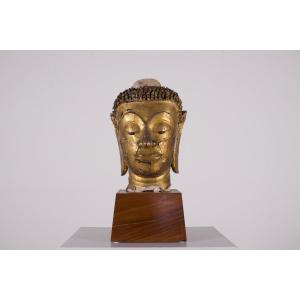
Buddha Head: Greco-buddhist Art From Gandhara, 3rd–4th Century, Central Asia
Buddha Head
Stucco, with traces of polychromy
Dimensions: 13 × 6 cm
This sculpture belongs to the Gandhara tradition, an ancient region located in the northwest of present-day Pakistan and extending into eastern Afghanistan, where Buddhism gave rise, during the first centuries of our era, to a particularly original sculptural tradition. The choice of stucco is characteristic of Gandharan art from Late Antiquity: beginning in the 3rd century and especially during the 4th and 5th centuries, this material played an important role in the region’s major monastic complexes, particularly around Taxila and in the centers of western Gandhara. Stucco allowed forrelatively rapid modeling and could be painted in multiple colors, traces of which remain here.
Gandhara art constitutes one of the great traditions of ancient Buddhist art. Its artistic language combines Buddhist iconography with a conception of the human figure deeply influenced by the classical traditions that spread throughout Central Asia following Alexander’s conquests and by the exchanges linking the Mediterranean, Bactria, India, and China. However, this art shouldnot be reduced to a mere Greek influence: local traditions and cultural exchanges played an essential role in shaping the image of the Buddha. The period from the 3rd to the mid-5th century corresponds precisely to a significant expansion of Buddhist settlements in Gandhara, notably at Taxila, Takht-i-Bahi, Sahri-Bahlol, Jamal Garhi, and in the Peshawar region.
The most relevant parallels concern the stucco works from Taxila, several of whose Buddha heads display a fluid modeling and an introspective expression; the workshops at Sahri-Bahlol and Jamal Garhi, major monastic centers in Gandhara; as well as the sculptures of Hadda, in Afghanistan, where the Gandharan tradition of stucco and polychromy continued into the 5th–6th centuries. These parallels are exclusively stylistic and geographical and do not constitute an attribution to a specific workshop.
The work exhibits significant losses and wear consistent with its fragmentary nature; traces of red pigments are still visible on the surface. The material and the state of preservation of the polychromy are particularly interesting for a work of this nature, as they serve as a reminder that Gandharan stucco sculptures were frequently painted. The presentation on a metal base allows for immediate appreciation of the sculpture. Given its presumed age, its significance for the history of Buddhism, and its place within one of the great artistic traditions of ancient Asia, this head is an interesting addition to a collection devoted to the arts of India, Pakistan, Afghanistan, or the Silk Road.
Geographic context: Gandhara – Taxila – Peshawar – Khyber-Pakhtunkhwa – Takht-i-Bahi – Sahri-Bahlol – Jamal Garhi – Hadda – Afghanistan – Pakistan – Northern India – Silk Road. Gandhara-Schule, griechisch-buddhistische Kunst Die
Skulptur gehört zur buddhistischen Kunsttradition von Gandhara, einer
historischen Region im heutigen Nordwesten Pakistans und im Osten
Afghanistans. Stuck wurde dort ab dem 3. Jahrhundert zu einem wichtigen
Werkstoff und insbesondere in den großen buddhistischen Klosterzentren
um Taxila und Peschawar verwendet. Das Material ermöglichte eine relativ
schnelle Modellierung und konnte farbig gefasst werden; Reste dieser
ursprünglichen Polychromie sind hier noch sichtbar. Die
Gandhara-Kunst gehört zu den bedeutenden Traditionen der buddhistischen
Kunst der Antike. Sie verbindet buddhistische Ikonographie mit einer
naturalistischen Auffassung der menschlichen Figur, die durch die
Kontakte zwischen Südasien, Zentralasien und der klassischen
Mittelmeerwelt geprägt wurde. Zwischen dem 3. und der Mitte des 5.
Jahrhunderts erlebte die buddhistische Skulptur in Gandhara eine
bedeutende Entwicklung, insbesondere in Taxila, Takht-i-Bahi,
Sahri-Bahlol und Jamal Garhi. Stilistische und
geografische Vergleiche finden sich insbesondere bei den Stuckarbeiten
von Taxila, Sahri-Bahlol, Jamal Garhi und Hadda. Diese Vergleiche sind
ausschließlich kunsthistorischer und geografischer Natur und stellen
keine Zuschreibung an eine bestimmte Werkstatt dar. Das
Fragment weist Verluste und Oberflächenabnutzungen auf; Reste roter
Pigmente sind noch sichtbar. Material, mutmaßliches Alter und
kunsthistorische Bedeutung machen die Skulptur zu einem interessanten
Stück für eine Sammlung buddhistischer, gandharischer oder entlang der
Seidenstraße entstandener Kunst. Geografische Bezüge:
Gandhara – Taxila – Peschawar – Takht-i-Bahi – Sahri-Bahlol – Jamal
Garhi – Hadda – Afghanistan – Pakistan – Nordindien – Seidenstraße. Scuola del Gandhara, arte greco-buddhista La
scultura appartiene alla tradizione buddhista del Gandhara, antica
regione situata nell'attuale Pakistan nord-occidentale e
nell'Afghanistan orientale. Lo stucco divenne un materiale importante
nella produzione scultorea del Gandhara a partire dal III secolo,
soprattutto nei grandi centri monastici della regione di Taxila e
Peshawar. Il materiale consentiva una modellazione relativamente rapida e
poteva essere dipinto; alcune tracce della policromia originaria sono
ancora visibili. L'arte del Gandhara costituisce una
delle grandi tradizioni dell'arte buddhista antica. Essa unisce
l'iconografia buddhista a una concezione naturalistica della figura
umana, sviluppatasi attraverso i contatti tra Asia meridionale, Asia
centrale e mondo mediterraneo. Tra il III e la metà del V secolo la
regione conobbe un importante sviluppo della scultura buddhista, in
particolare a Taxila, Takht-i-Bahi, Sahri-Bahlol e Jamal Garhi. I
confronti più pertinenti riguardano le produzioni in stucco di Taxila,
Sahri-Bahlol, Jamal Garhi e Hadda. Si tratta esclusivamente di confronti
stilistici e geografici e non costituiscono un'attribuzione a uno
specifico atelier. Il frammento presenta perdite e usure
superficiali; sono ancora visibili tracce di pigmento rosso. Il
materiale, l'antichità presunta e l'importanza nella storia dell'arte
buddhista ne fanno un interessante elemento per una collezione dedicata
all'arte del Gandhara, al buddhismo o alla Via della Seta. Riferimenti
geografici: Gandhara – Taxila – Peshawar – Takht-i-Bahi – Sahri-Bahlol –
Jamal Garhi – Hadda – Afghanistan – Pakistan – India settentrionale –
Via della Seta. Escuela de Gandhara, arte greco-budista La
escultura pertenece a la tradición budista de Gandhara, antigua región
situada en el actual noroeste de Pakistán y extendida hasta el este de
Afganistán. El estuco se convirtió en un material importante de la
escultura gandhariana a partir del siglo III, especialmente en los
grandes centros monásticos de la región de Taxila y Peshawar. Permitía
un modelado relativamente rápido y podía recibir policromía, de la que
todavía se conservan algunos restos. El arte de Gandhara
constituye una de las grandes tradiciones del arte budista antiguo.
Combina la iconografía budista con una concepción naturalista de la
figura humana, influida por los contactos entre Asia meridional, Asia
Central y el mundo mediterráneo. Entre los siglos III y mediados del V
se produjo un importante desarrollo de la escultura budista en Gandhara,
especialmente en Taxila, Takht-i-Bahi, Sahri-Bahlol y Jamal Garhi. Los
paralelos más pertinentes corresponden a las producciones de estuco de
Taxila, Sahri-Bahlol, Jamal Garhi y Hadda. Se trata exclusivamente de
comparaciones estilísticas y geográficas y no implican una atribución a
un taller determinado. El fragmento presenta pérdidas y
desgaste superficial; todavía son visibles restos de pigmento rojo. Su
material, su antigüedad presunta y su importancia dentro de la historia
del arte budista hacen de esta cabeza una pieza interesante para una
colección dedicada al arte de Gandhara, al budismo o a la Ruta de la
Seda. Referencias geográficas: Gandhara – Taxila –
Peshawar – Takht-i-Bahi – Sahri-Bahlol – Jamal Garhi – Hadda –
Afganistán – Pakistán – norte de la India – Ruta de la Seda.
***
Deutsch
Buddha-Kopf
Stuck mit Resten von Polychromie
Maße: 13 × 6 cm
Testa di Buddha
Stucco con tracce di policromia
Dimensioni: 13 × 6 cm
Cabeza de Buda
Estuco con restos de policromía
Dimensiones: 13 × 6 cm
Period: Before 16th century
Style: Asian art
Condition: Condition of use
Reference (ID): 1858336
Availability: In stock