F.-d. Froment-meurice, Orientalist Solid Silver Coffee Pot, Paris 1838–1855
Artist: François-désiré Froment-meurice
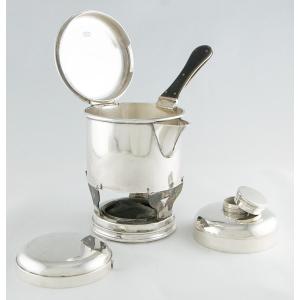
Orientalist coffee pot in 950-grade solid silver by the master silversmith François-Désiré Froment-Meurice, Paris, 1838–1855.
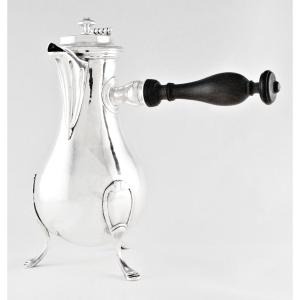
The rounded body is formed with broad lobes that taper towards the slender neck. Fine ribs ending in foliate motifs accentuate the contours. A calyx of stylised leaves links the body to the moulded, polylobed pedestal foot. The hinged cover echoes the lobed outline of the foot and is surmounted by a pinecone finial.
The long, sinuous spout curves upwards and flares at the mouth. Its junction with the body is decorated with foliage and scrollwork. Opposite it, the sweeping scroll handle incorporates two insulating rings.
Dimensions
• Height — 26 cm (10.24 in.)
• Length — 20 cm (7.87 in.)
• Diameter — 16 cm (6.30 in.)
Gross weight — 672 g (23.70 oz)
Hallmarks and signatures
• French Minerva first-standard hallmark for 950-grade silver.
• Maker’s mark « F. Froment » with a sheaf of wheat, for François-Désiré • « Froment-Meurice » stamped in full beneath the foot and on the underside of the cover.
Condition report
Very good overall condition.
FRANÇOIS-DÉSIRÉ FROMENT-MEURICE (1801–1855)
The son of the silversmith François FROMENT, François-Désiré trains under the chaser LENGLET before joining the family workshop, then run by his stepfather, Pierre-Jacques MEURICE. He takes over the manufacturing business in 1828, registers his maker’s mark in 1833 and moves to 2 rue Lobau in 1838. As silversmith and jeweller to the City of Paris, he makes the presentation vases for the engineer EMERY and the Baron de FEUCHÈRE, both now in the Musée du Louvre.
At the French Exhibition of Industrial Products in 1839, he wins two silver medals and exhibits a silver-gilt tea service that Louis-Philippe subsequently presents to the Shah of Persia. He receives a gold medal in 1844. Queen MARIE-AMÉLIE presents the Pope with a Late Gothic-style monstrance made by Froment-Meurice after a design by LIÉNARD. The Emperor of Russia acquires a shield depicting the history of the horse. In 1846, the Duc de LUYNES commissions a monumental table garniture in repoussé silver, now in the Musée du Louvre. For the Duchess of PARMA, FROMENT-MEURICE oversees the making of an elaborate dressing-table set designed by Félix DUBAN, now in the Musée d’Orsay.
At the Great Exhibition in London in 1851, he receives a Council Medal. That same year, Baron James de ROTSCHILD presents Melchior POISAT with a cup made by FROMENT-MEURICE and Jules WIÈSE, now in the Rijksmuseum. Following the silversmith’s death in February 1855, his widow exhibits the completed LUYNES table garniture and a breakfast service intended for Empress EUGÉNIE at the Paris Exposition Universelle. She continues to run the firm, which their son Émile later takes over.
Related works
The low, rounded body with broad lobes, the slender neck and the sinuous spout recall the coffee pot FROMENT-MEURICE exhibited in 1839, known from an engraving published by LE BOUTEILLER. The treatment of the body is particularly close to that of the lobed model in the engraving. The Musée du Louvre holds a coffee pot from a related service, dated circa 1839 and bearing the same maker’s mark (inv. OA 11093). Another coffee pot by the silversmith, with a lobed body and dated circa 1840, is in the Musée de la Vie romantique (inv. 2002.15.2).
The silver-gilt ewer in the Metropolitan Museum of Art, circa 1850 (inv. 1999.217.1), offers a further parallel for the profile of the body and neck. Bernhard Heitmann traces the ewer’s silhouette to Ottoman water jugs. In the present coffee pot, the Orientalist influence is most evident in the proportions of the body and neck, accentuated by the sweep of the spout.
Selected works in public collections
• Musée du Louvre, Paris — Coffee service, the Emery and Feuchères vases, the Coupe des Vendanges, a hunting tankard, a silver seal bearing the name Pauline, a Gothic Revival casket and the Duc de Luynes table garniture.
• Musée d’Orsay, Paris — The Duchess of Parma’s dressing-table set and its presentation book, and Patria, dated 1854.
• Musée de la Vie romantique, Paris — An engine-turned silver breakfast service and General Cavaignac’s epaulette case.
• Musée des Arts décoratifs, Paris — Bracelet with two female figures and a vinaigrette, dated 1841, with James Pradier and Jules Wièse.
• Rijksmuseum, Amsterdam — The Melchior Poisat cup, with Jules Wièse (inv. BK-1989-13), and a pair of candelabra dated 1853.
• Metropolitan Museum of Art, New York — Silver-gilt ewer and basin, circa 1850 (inv. 1999.217.1–2).
• Victoria and Albert Museum, London — Glass and silver flask acquired from the firm at the Great Exhibition of 1851.
Bibliography
• Dion-Tenenbaum, Anne, Orfèvrerie française du XIXe siècle. La collection du musée du Louvre, Louvre éditions / Somogy, 2011, pp. 136–138, cat. 69 and fig. 2, for the coffee service and the engraving of the model exhibited in 1839, and p. 279 for the silversmith’s biography and maker’s mark.
• Heitmann, Bernhard, Migration and Metamorphosis: The Transformation of Shapes, Ornaments, and Materials, Metropolitan Museum Journal, vol. 37, 2002, pp. 107–108, fig. 1, for the Metropolitan Museum’s ewer and basin.
3 200 €
Period: 19th century
Style: Louis Philippe, Charles 10th
Condition: Excellent condition
Material: Sterling silver
Length: 20 cm
Diameter: 16 cm
Height: 26 cm
Reference (ID): 1856969
Availability: In stock
Print