Gilded Bronze Medicine Buddha, China, 16th–17th Century
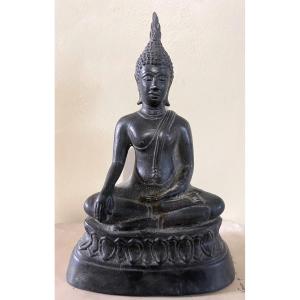
Gilded bronze sculpture of the Medicine Buddha (Bhaisajyaguru). China, Ming Dynasty, 16th–17th century.
A rare and expressive cast bronze sculpture depicting the Medicine Buddha (Bhaisajyaguru) seated, retaining significant traces of its original mercury gilding.
The Buddha is depicted seated in the lotus position (vajraparyankasana), his face radiating serenity and contemplation, his eyes half-closed, his earlobes elongated, and his hair styled in small, tight curls topped by the ushnisha. His right hand rests on his knee in the gesture of giving and the fulfillment of vows (varada mudra), holding between his thumb and index finger the medicinal myrobalan fruit, a symbol of healing in Buddhist iconography. His left hand rests in his lap, palm facing upward, in the gesture of meditation (dhyana mudra).
He is dressed in a loose-fitting monastic robe finely embroidered with floral scrolls along the edges and tied with a sash beneath his chest. His bare torso is adorned with a relief of the auspicious Buddhist symbol wan(svastika), embodying eternity, perfection, and compassion. The base is open, revealing the hollow interior of the cast bronze, a characteristic of Chinese statuary from the Ming dynasty.
Good antique condition. Natural wear due to age and areas where the gilding has worn away on the protruding parts, revealing a beautiful dark brown patina on the bronze that attests to the work’s age and authenticity.
Provenance:
- Private collection, United States.
- Acquired in 2015 from the renowned Brussels gallery of art dealer and specialist Karim Grusenmeyer (Brussels, Belgium).
- Private collection, Vienna (Austria), from 2015 to the present.
20 000 €
Period: 17th century
Style: Asian art
Condition: Good condition
Material: Gilt bronze
Height: 36
Reference (ID): 1856717
Availability: In stock
Print