

Large Neoclassical Mask In Relief – Dionysian Satyr, 18th Century
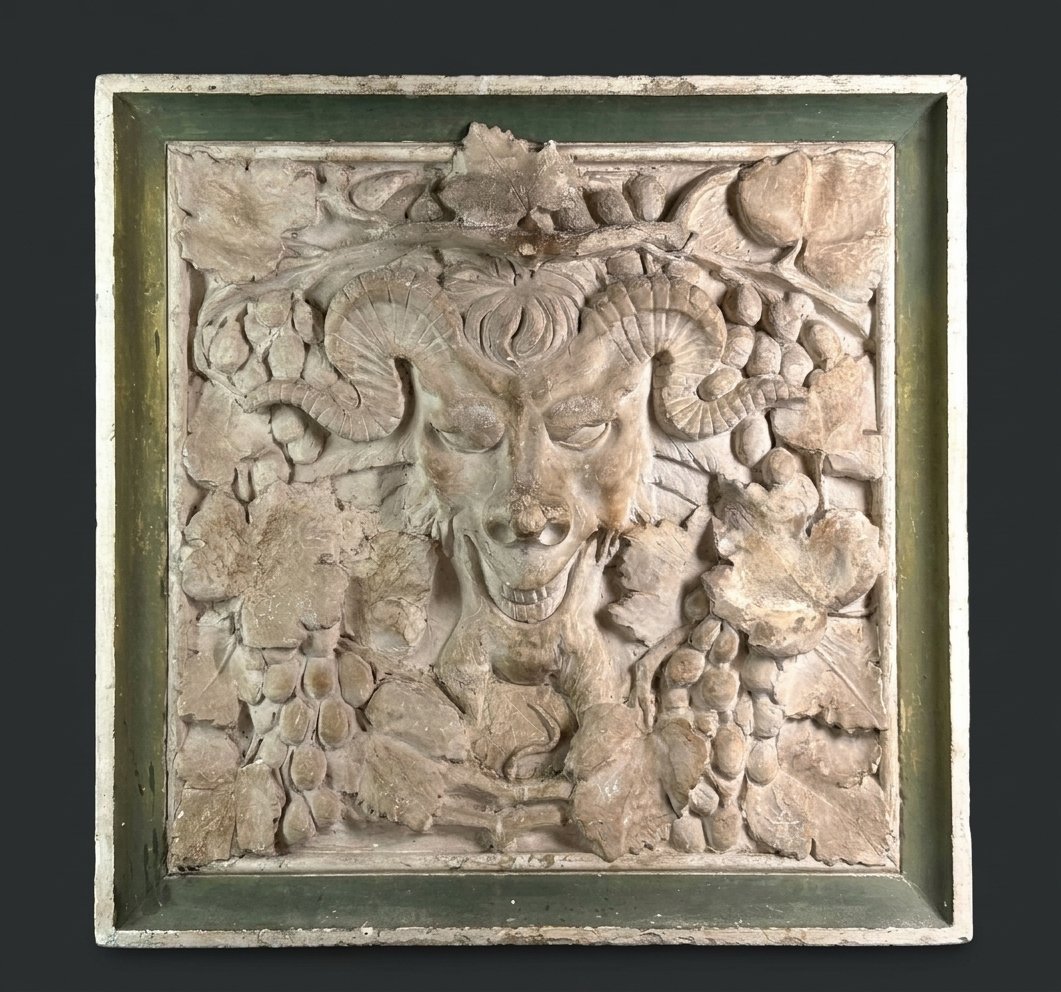
A splendid neoclassical decorative panel in high relief from the second half of the 18th century, crafted in stucco. The work, set within a simple and austere frame, depicts an expressive and captivating Dionysian mask.
The work comes from the private salons of an ancient noble residence located in Lucca, a city that remained an independent and protected republic for centuries, whose patrician families cultivated a taste for art and interior design of extraordinary scale and refinement. At the turn of the 18th and 19th centuries, under the influence of the court of Elisa Bonaparte Baciocchi, Lucca experienced a veritable Neoclassical renaissance. It was in this climate of cultural renewal that this mask was commissioned to decorate an intimate room in the residence—a winter garden—where the lords of the palace would retreat to escape the rigors of public life. The choice of a Dionysian subject was no accident: the satyr and the grapes celebrated not only the pleasures of life and the abundance of the vineyards on the hills of Lucca, but also the Enlightenment ideal of a harmonious return to wild and unspoiled nature. The frame, painted in that distinctive sage green so beloved by the color palettes of the era, was designed to complement the room’s wood paneling and the greenery of the city’s inner courtyards.
For nearly two centuries, the Faun’s mocking face has silently watched the passing of generations, the dance parties, the whispers of history, and the slow transformation of the world beyond Lucca’s walls. Jealously guarded within the palace, the relief remained intact, protected from dust and the passage of time. It was only when the last heirs decided to sell the historic family estate that the work came to light, leaving for the first time the home that had housed it for generations.
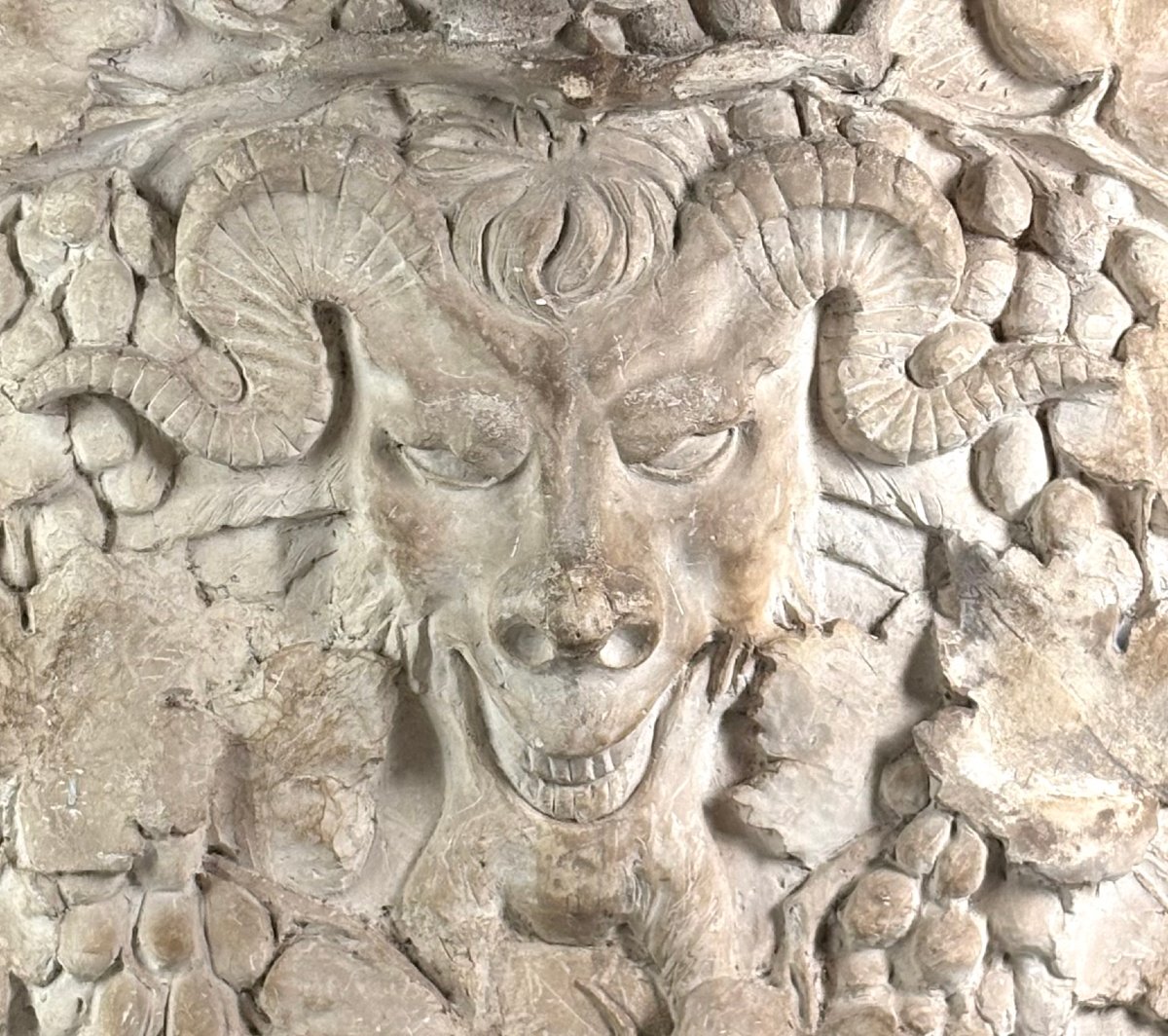
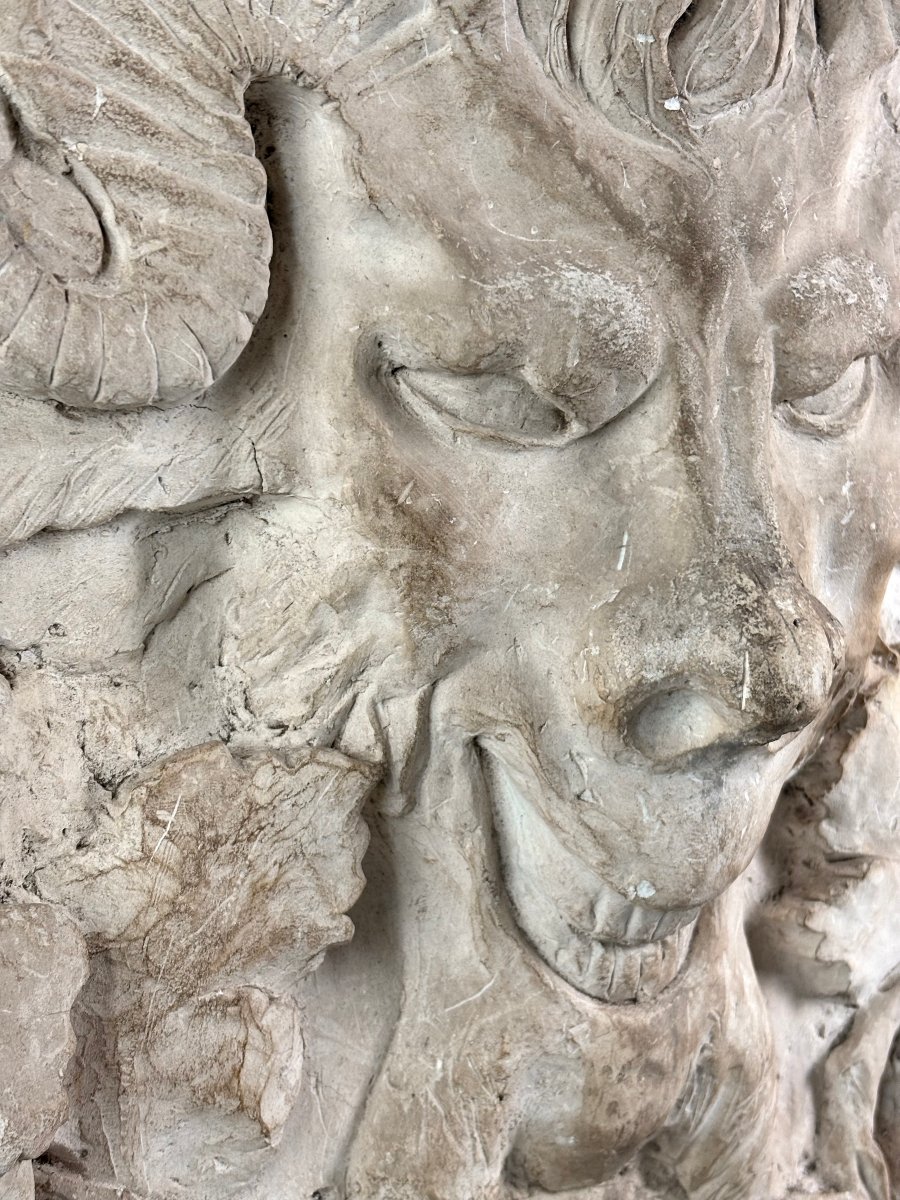
The face of the mythological creature—identifiable as a satyr, a faun, or a young Pan—is characterized by the typical twisted goat-like horns and a mocking, archaic smile of great expressive power. The facial features interact magnificently with the rich natural elements surrounding it: a dense composition of vine shoots, crumpled leaves, and lush bunches of grapes—symbols par excellence of the cult of Dionysus (Bacchus), the fertility of the earth, and the regeneration of nature.
The symbolism of this mask has its roots in classical Greco-Roman myths, closely tied to untamed nature, rites of passage, and the deities of the earth.
Grapes symbolize the life force, the fertility of the earth, and the power of wine to transform one’s state of consciousness, breaking down inhibitions and connecting humans to their most instinctive side. The faun mask was the instrument of choice during the Dionysian mysteries and the very origin of theater. Wearing it meant temporarily losing one’s identity to be possessed by the deity or to embody the forces of nature. These creatures represent the antithesis of orderly civilization and human laws. They embody the pure life force, unbridled sexuality, animal fertility, and the absolute freedom found in unspoiled places.
During the Neoclassical period (late 18th century–early 19th century), the use of decorative panels to adorn door lintels, fireplaces, or room friezes was widespread in Italy. Many of these depict the heads of Bacchus or fauns integrated into perfect symmetrical arrangements of vine branches and plant motifs. Those intended for interiors were made of stucco.
The panel has a beautiful patina that enhances its volume and the depth of its carved details. The frame retains its original, understated sage-green polychrome finish. Minor signs of aging
Dimensions
W 65 cm
H 65 cm
D 12 cm
++++++++++++++++++++++++++++++++++++++++++++++++++++++++++++++++++++++++++++++++++++++++++++++ SHIPPING VIA DHL or TRUSTED COURIER
Payment methods: Bank transfer - Online credit card (including AMEX) via Nexi-pay link - PayPal (+3.7%) - Checks are NOT accepted https://internationalantiques.eu/fr/livraison-et-assurance/ ++++++++++++++++++++++++++++++++++++++++++++++++++++++++++++++++++++++++++++++++++++++++++++++
1 800 €
Period: 18th century
Style: Louis 16th, Directory
Condition: Excellent condition
Material: Stucco
Width: 65
Height: 65
Depth: 12
Reference (ID): 1855432
Availability: In stock
Print