





Antique Zonofone Parlor Gramophone. United States, Circa 1902
View in 360°: https://ardhamin.sirv.com/2026/09/GR-E-630/GR-E-630.spin
Watch the video on YouTube: https://youtu.be/_w26xUjBJ-s
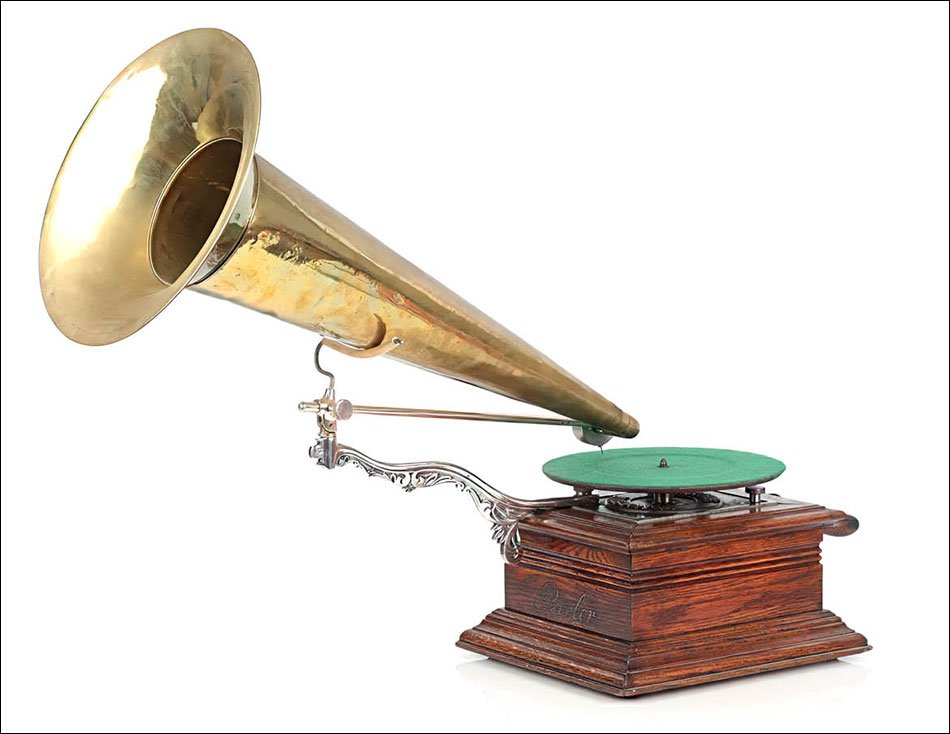
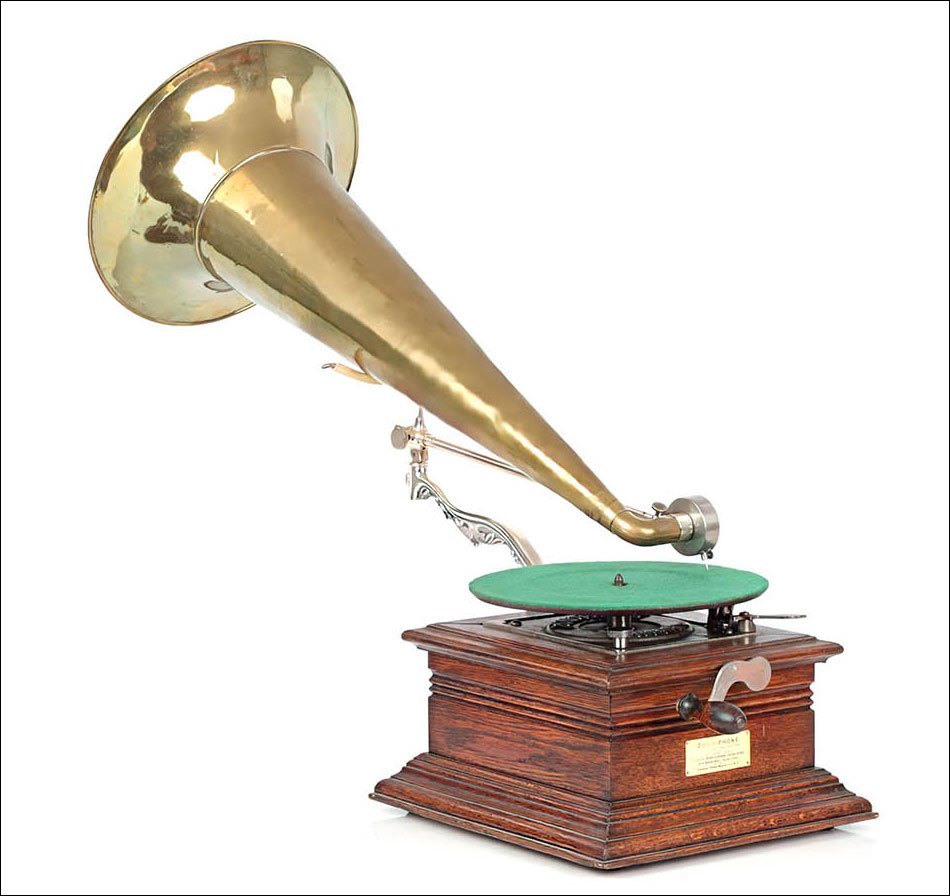
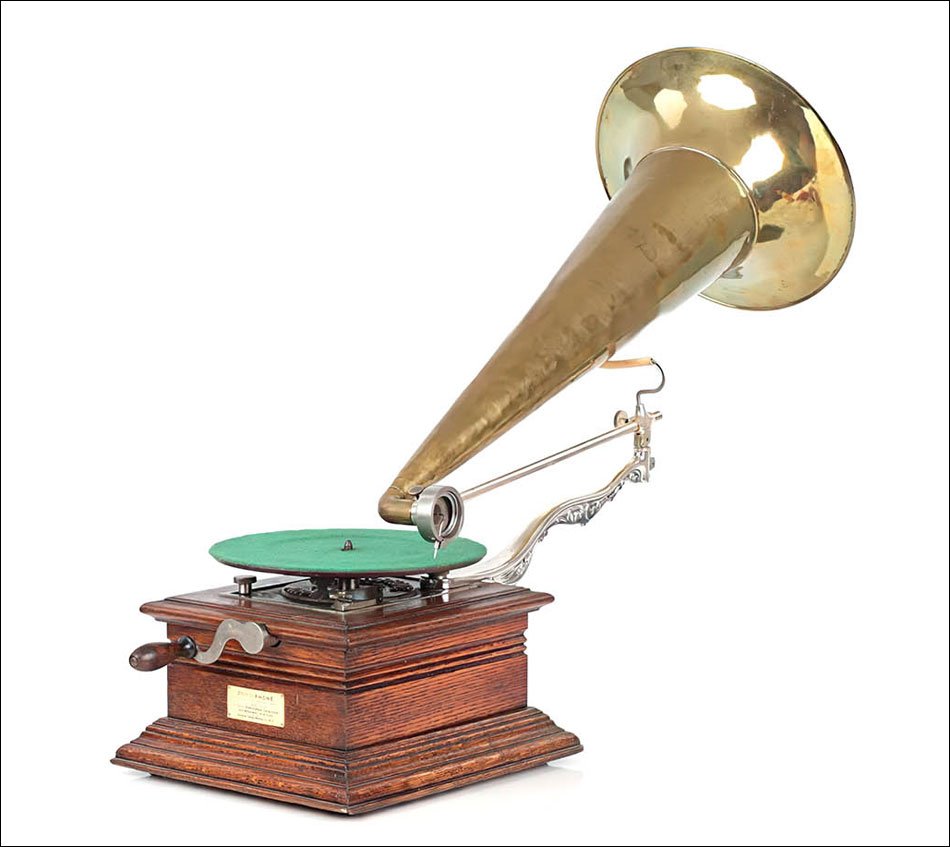
Antique American Zonofone gramophone, Parlor model, manufactured around 1902, during the early years of the recorded sound industry. The brand was originally spelled Zon-o-phone, as shown by the inscriptions on the machine, although it is also commonly referred to as Zonofone. Manufactured by the Universal Talking Machine Company, it belongs to one of the earliest generations of commercial disc gramophones. It retains its main original components, including the early acoustic soundbox, metal horn, ornamental support, and spring-driven motor, with the only known exception being the turntable felt, which has been replaced. A machine of particular interest to collectors, still delivering remarkably good sound quality more than 120 years after its manufacture.
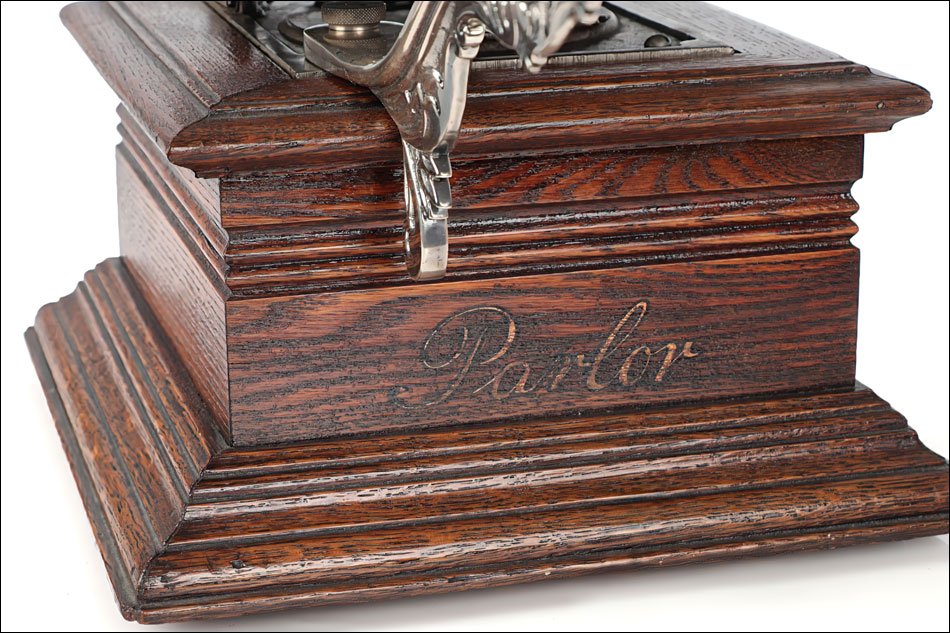
The gramophone features an attractive rectangular wooden cabinet, with stepped moldings and a broad-profile base that gives it a solid and elegant appearance. One side bears the original "Parlor" inscription in a calligraphic style, identifying the model. The cabinet also retains its original manufacturer's plate, with minor signs of use and wear consistent with its age.
One of its most striking features is the long metal horn, with a conical shape and a circular flared opening. It is supported by an elaborate silver-colored metal bracket decorated with raised floral motifs and elegant curved lines. This mechanical arrangement, very different from the acoustic tonearms that became common in later years, reflects the technical solutions employed during the earliest period of gramophone development. The decoration and construction of the support give this model a distinctive character, and its original components are very well preserved.
Of particular interest is its original acoustic soundbox, an early design featuring a circular metal body and an inscription referring to patents associated with the Universal Talking Machine Company. Its design belongs to the earliest period of Zon-o-phone gramophones, predating the more familiar soundboxes used on later generations of machines. Vibrations from the needle are transmitted directly to a diaphragm, from which the sound passes into the horn for acoustic amplification. Despite its considerable age, the soundbox produces surprisingly clear and powerful sound, something that can be heard directly in the accompanying video.
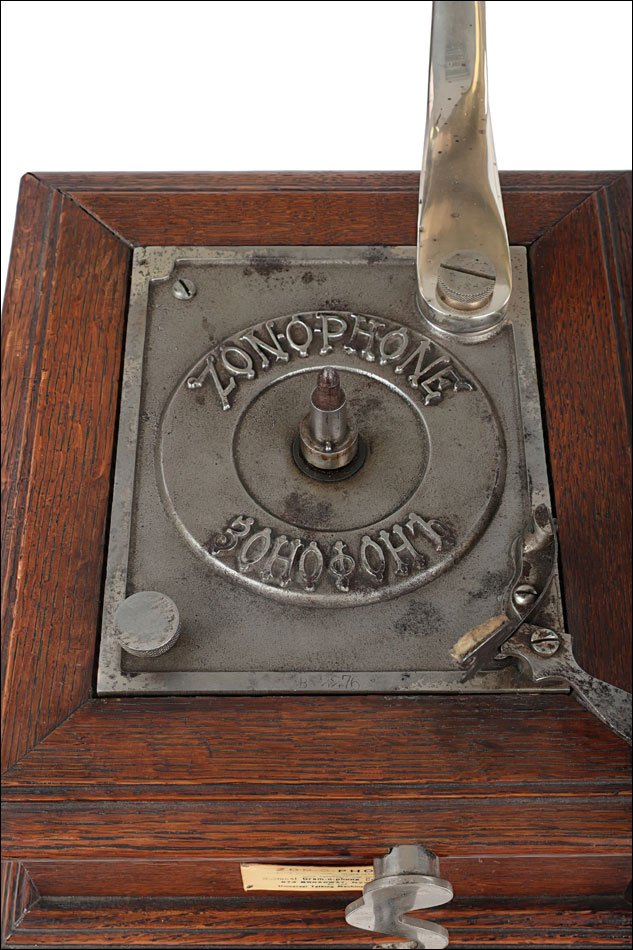
The gramophone operates with a mechanical spring-driven motor, wound by a crank with a wooden handle. It incorporates a mainspring, gears, and a centrifugal governor that maintains a steady turntable speed. Particularly interesting is the metal plate covering the mechanism, featuring the original "ZON-O-PHONE" inscription in large raised letters, visible when the turntable is removed. The motor is exceptionally well preserved and runs perfectly, maintaining smooth, steady operation.
On the back of the cabinet, a small original plate bears the inscription "ZON-O-PHONE" and states that the machine was expressly manufactured for the National Gram-o-phone Corporation, located at 874 Broadway, New York, by the Universal Talking Machine Company. This identification directly connects the gramophone with the earliest commercial companies associated with the brand and represents one of its most interesting historical details.
The overall condition of the gramophone is very good. The wooden cabinet retains its moldings, inscriptions, and finish, with normal signs of age. The horn shows minor surface marks and variations in its metal finish. The ornamental support, soundbox, and mechanical components are all very well preserved. The machine retains its main original components, except for the green turntable felt, which has been replaced. Its excellent working condition makes it possible to fully enjoy a machine manufactured more than a century ago.
The accompanying video shows the gramophone in operation, playing a beautiful French song performed by Yves Montand. The recording allows viewers to see how the machine works and appreciate the surprisingly good sound quality it still delivers after more than 120 years. Listening to music on this Zonofone is particularly enjoyable, offering the opportunity to experience a technology dating back to the very beginnings of the disc gramophone.
For collectors of early gramophones, this Zonofone Parlor combines highly desirable qualities: early manufacture, original period components, a mechanical design full of character, and excellent working condition. Its greatest appeal is that it is far more than a display piece. More than 120 years after it was made, this remarkable machine can still be enjoyed exactly as it was intended: by playing records and bringing music to life. An extraordinary example from the earliest years of the disc gramophone, to be enjoyed, admired, and preserved in a fine collection.
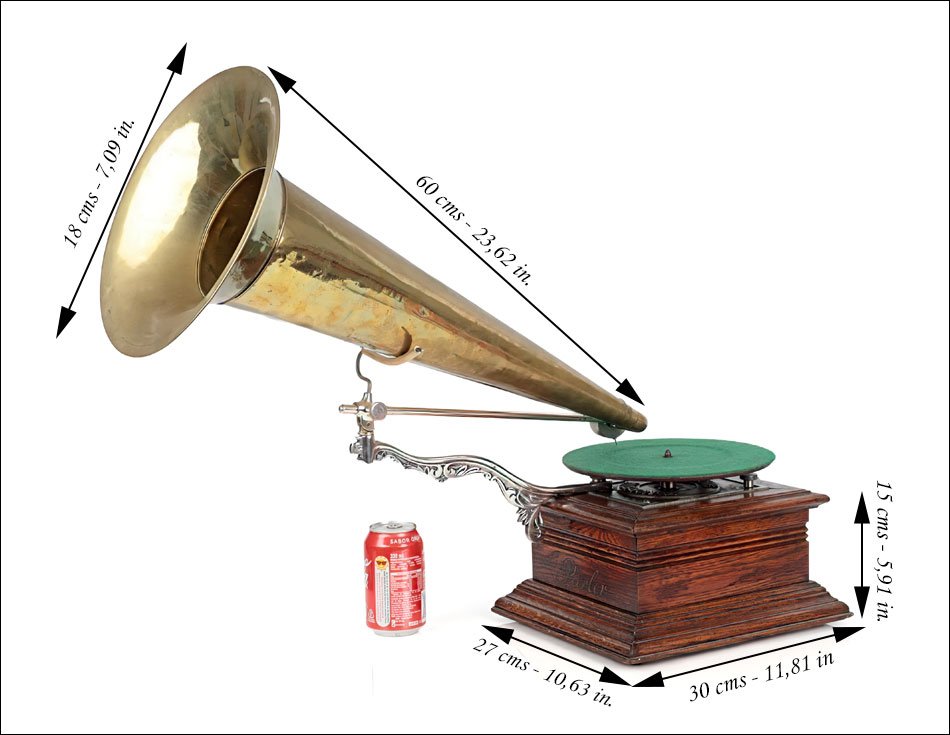
Dimensions: Cabinet: 30 x 27 x 15 cm. Horn length: 60 cm. Horn opening diameter: 18 cm.
History of Zon-o-phone, the Universal Talking Machine Company, and the Parlor Model:
The history of Zon-o-phone began in the late 19th century and is closely connected with the birth of the commercial gramophone. Its founder, American businessman Frank Seaman, had worked with Emile Berliner in distributing his disc gramophones, but their business relationship eventually deteriorated. Seaman decided to establish his own competing company, and the Universal Talking Machine Company was formed in 1898. Around 1899, gramophones and records began to be marketed under the Zon-o-phone name. Those early years were marked by intense competition and numerous patent disputes that played an important role in the development of the American recording industry.
The earliest Zon-o-phone gramophones shared certain similarities with Berliner machines, although they gradually incorporated mechanical developments of their own. The first models were identified by letters, including A, B, C, and D, followed by others bearing commercial names such as Home, Parlor, Grand, and Concert Grand. The Parlor model, documented around 1902, was designed for domestic use and combined a compact wooden cabinet, a single-spring motor, and acoustic reproduction through an external horn. Its distinctive ornamental support is associated with the developments of inventor Louis P. Valiquet, who was granted a patent in July 1902. The floral decoration also reflects the attention given to the appearance of these early machines.
The plate preserved on this example provides an interesting record of that period. It bears the names National Gram-o-phone Corporation and Universal Talking Machine Company, two businesses involved in the manufacture and marketing of Zon-o-phone machines in New York. The National Gramophone Corporation ceased operations around 1901, during a reorganization of Frank Seaman's companies. The presence of its name on a Parlor dated approximately 1902 reflects this period of business transition, although the plate alone does not establish the exact year of manufacture. The survival of these original identifications adds considerable historical interest to the gramophone.
Beginning in 1903, the brand underwent significant changes. Financial difficulties and patent litigation weakened Frank Seaman's companies, and the American Zon-o-phone interests came under the influence of Eldridge R. Johnson and the Victor Talking Machine Company. Meanwhile, the brand had expanded into Europe through the activities of Frederick Marion Prescott, establishing a notable presence in Germany and other countries. Its European operations eventually became associated with The Gramophone Company and Deutsche Grammophon. Early American Zon-o-phone machines such as the Parlor therefore represent an important period in the evolution of the gramophone, when disc records were still competing with cylinders and recorded music was beginning to become popular in the home.
The Recording Heard in Our Video: "Mais qu'est-ce que j'ai?" performed by Yves Montand. Recorded in 1947.
In the accompanying video, we hear the beautiful French song "Mais qu'est-ce que j'ai?", performed by Yves Montand with orchestral accompaniment conducted by Jean Marion. The original recording was made in Paris on November 3, 1947. The music was composed by Henri Betti, with lyrics written by Édith Piaf. The record played in our video is an English pressing on the Parlophone label, recognizable by its distinctive dark blue and gold label.
The history of this song is closely connected with the romantic lives of two of the greatest figures in 20th-century French music. Édith Piaf and Yves Montand had been romantically involved, and following their separation, Piaf wrote the lyrics to "Mais qu'est-ce que j'ai?", drawing inspiration from their relationship. Henri Betti composed the music. Montand introduced the song to Parisian audiences in October 1947 at the Théâtre de l'Étoile and recorded it in the studio the following month. The composition became one of the notable songs from the early years of his success.
Yves Montand was born in Italy in 1921 under the name Ivo Livi and moved to France during his childhood. He eventually became one of the most recognized figures in French popular music, admired for his expressive voice, elegant stage presence, and distinctive interpretation of romantic and popular songs. He also developed a successful career as a film actor, achieving considerable international fame. This 1947 recording belongs to the early years of his rise to prominence and preserves the charm of French popular song of that period, with a performance full of sensitivity and emotion.
We are professional antique dealers. To see more photos of this item, Please click on this link:
https://www.antiguedades.es/en/antique-gramophones/5577-antique-zonofone-parlor-model-gramophone-united-states-circa-1902.html
2 400 €
Period: 20th century
Style: Other Style
Condition: Good condition
Reference (ID): 1853946
Availability: In stock
Print