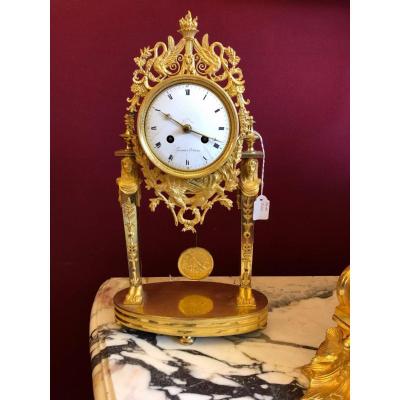
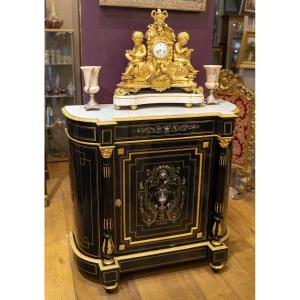
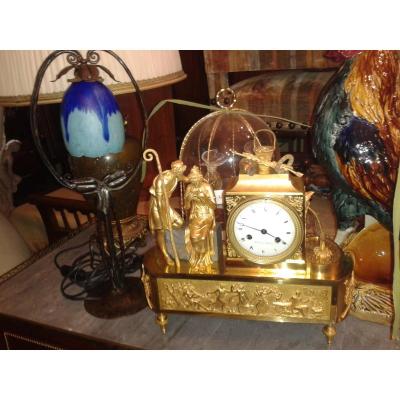
Silent Love. Louis XVI-style Parlor Clock In White Marble And Gilded Bronze.
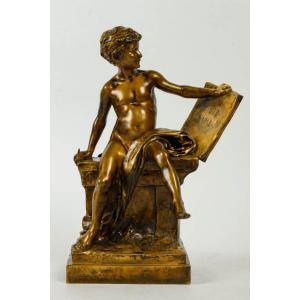
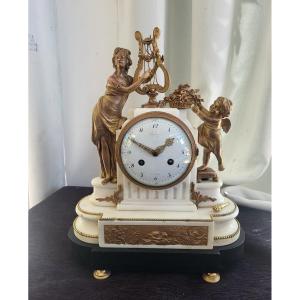
CharmingLouis XVI-style parlor or dressing room clock in white marble and bronze,gilded and finely engraved with the dreamlike motif of “Silent Love,” depictingstanding and leaning slightly on a fluted half-column encircled by astring of pearls and a ribbon-wrapped rod, a childlikeCupid holding an arrow in his right hand, the other raised near hislittle face, a finger touching his mouth.
The charming composition sits atop a soberoval base molded with a dovetail profile, enhanced by a beaded border and featuring, at its center,by a continuous rectangular panel featuring an openwork frieze of interlaced patterns depicting exquisite floral garlands of roses, oneof Venus’s emblematic attributes.
Base with flattened ballsembellished with generous acanthus fleurons. The circular, white-enameleddial, topped with a ribbon bow, features Arabic numerals for the hours andminutes.
High-quality Parisian craftsmanship from the second half of the 19th century. Circa1880VARIATION ON SILENT LOVE*Resting ona base adorned with generousacanthus fleurons, an oval marmoreal base with aa molding enhanced by a string of pearls, with an embellished rim,within a rectangular panel, featuring an openwork frieze of delicatelychiseled interlacing patterns depicting exquisite floral garlands of roses,serving as a pedestal for an attractive sculptural composition.
Adornedin elegant Louis XVI style, this piece combines formal simplicity, balanced ornamentation,and the captivating charm of its timeless subject, inspired by the sentimentof love.
Beside afluted half-column—housing the movement of theclock, with neoclassical profiles encircled by a ribboned bandand a string of pearls—stands gracefully aarm resting lightly on it, a ravishing little Cupid.Sculpted with tact, this sweet, childlike figurewith plump, lightly draped forms and a gentle face beneath his curly hair—dreamy and tender—holds, nestled in his left hand,an arrow drawn from his quiver, which is held in place by a thinband against his side; the other, raised on one of his fingers and held near hismouth, seems to imply—not without ambiguity, according to a symbolism established in the18th century—either to keep the passions ofLove discreet and secret as Time passes, or to signify Eros’s propensity to kindle, at the whim of theHours, the feeling of love through the flight of one of his arrows.
Topped with acharming pleated ribbon bow, the white enameled dial of the clockset on a bezel of fine beaded patterns alternating with ridges indicatesthe hours and minutes in Arabic numerals via two hands featuring afloreted dart motif.
Allformal balance and refined charm, this alluring clock with itssmiling, even intimate, subject of *L’Amour silencieux* belongs in the tradition of neoclassical clockmakingknown as “Aux Amours,” crafted in the 1770s and 1780s by renowned Parisian master bronze casterssuch as, among others, Jean-Louis Prieur (1732–1795) and Robert Osmond (1711–1789) fortheir high-society clientele, who were particularly fond of the gracesthat are at once dreamlike and innocent, linked to ancientmythological fables. As such, given its elegantNeo-Louis XVI style and its appealing theme, it is representative ofof the 18th and 19th centuries, which successfully blend tradition andinventiveness.
*“Silent Love”: oneof the favorite iconographic motifs of the French school of sculpture in thesecond half of the 18th century, between 1750 and 1780—a decade duringwhich the subject appears to have fallen out of fashion. Examples include: *The Threatening Cupid* (1755)by Etienne-Maurice Falconnet, and *The Silent Cupid* (1779)by Jean-Baptiste Pigalle—whose authorship, according to current art historical research,is attributed to his circle or to one of the sculptors and modelersassociated with the Sèvres Manufactory, namely Louis-Simon Boizot, a prolificin this type of Cupid, and *The Silent Cupid*, also known as “CupidAdvising Discretion in Love” (terracotta, 1785) by Pierre Julien. Thesesculptures were reworked in the second half of the 19th century with somevariations by manufacturers and bronze casters of decorative art, in this casefor timepieces. To these we may add the anonymous marble statuette titled*The Silent Cupid*, created in the 19th century and housed in Paris,at the Cognac-Jay Museum (Inv. J 244), whose composition closely resembles themodel adopted for our clock.
Materials: white marble; gilded bronze; enamel; glass.
Dimensions: H.: 32 cm; W.: 20 cm; D.: 10 cm.
Parisian work in the Louis XVI style from the last thirdof the 19th century. 1880–1890.Very good condition. Original gilding
1 100 €
Period: 19th century
Style: Louis 16th, Directory
Condition: Excellent condition
Material: Bronze
Width: 20 cm
Height: 32 cm
Depth: 10 cm
Reference (ID): 1853499
Availability: In stock
Print