

Ath 1784 Louis XVI-style Chocolate Pot In Solid Silver, With A Silversmith’s Hallmark Featuring A Crowned Animal Head
Voici la traduction intégrale en anglais, dans un style adapté à un catalogue d’orfèvrerie ancienne, en conservant une présentation uniforme, sans couleurs ni caractères gras.
EXCEPTIONAL LOUIS XVI SOLID SILVER CHOCOLATE POT – ATH, 18TH CENTURY – UNIDENTIFIED SILVERSMITH, CLOSELY ASSOCIATED WITH JEAN-LOUIS PHILIPPRONT
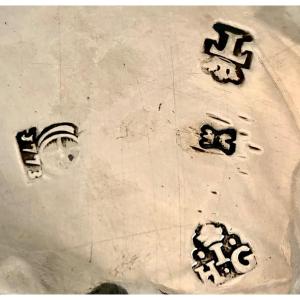
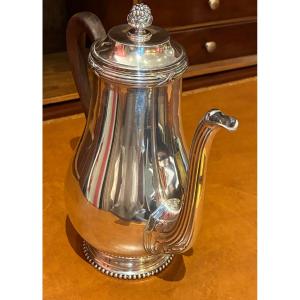
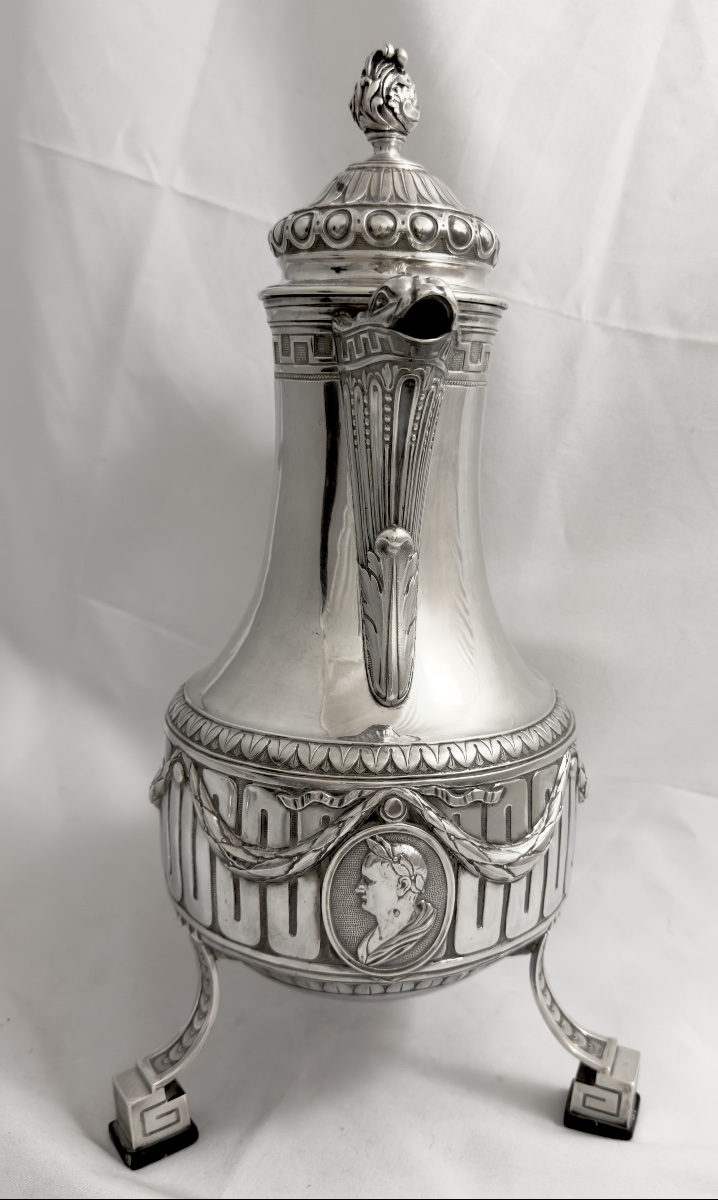
An important and magnificent Louis XVI period solid silver chocolate pot, standing on three feet and bearing the hallmarks of the city of Ath, together with an unidentified maker’s mark depicting a crowned animal’s head.
Height: 36 cm.
Weight: 1,220 grams.
This remarkable chocolate pot is distinguished by its elegant proportions, richly detailed Neoclassical decoration and exceptional quality of craftsmanship.
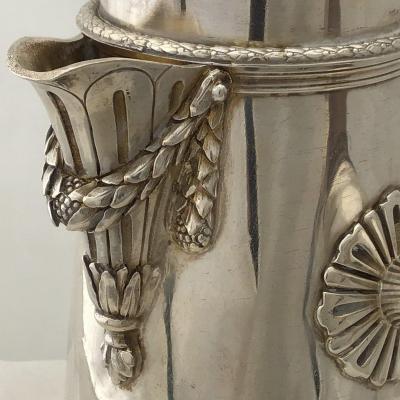
Its pear-shaped body, resting on three curved feet, has a largely plain and polished upper section, contrasting with the sumptuous chased and repoussé decoration of the lower part. The latter is adorned with fluting, laurel garlands and oval medallions containing classical profile portraits inspired by the iconography of Roman emperors.
These medallions, executed with a delicacy comparable to that of engraved medals, recall Renaissance portrait medals, which were an important source of inspiration for artists and silversmiths during the Neoclassical period.
The richly moulded and chased spout displays a particularly remarkable feature: its upper section takes the form of a dolphin appearing to emerge from the water. This lively and imaginative sculptural detail demonstrates the creativity and technical virtuosity of its maker.
The domed hinged lid is surmounted by a removable finial, which can be unscrewed to reveal an opening through which a wooden stirring rod or chocolate whisk could be inserted. This device was used to stir and froth hot chocolate before serving and clearly identifies the vessel as a chocolate pot rather than a coffee pot, despite the close similarity between their shapes.
AN ORIGINAL HANDLE OF EXCEPTIONAL QUALITY
Another remarkable and relatively rare feature for an 18th-century chocolate pot is the survival of its original handle, finely carved from blackened walnut or pearwood.
Far from being merely a functional element, this handle is a genuine work of sculpture. Its decoration reproduces with astonishing fidelity the Neoclassical ornaments of the chocolate pot, both in design and proportions, as well as in the refinement of its execution.
The motifs carved into the wood correspond perfectly with those chased and embossed in the silver, creating a remarkable harmony between the two materials. This unity of decoration demonstrates that the handle was specially designed for this particular chocolate pot and forms an essential part of its original composition.
The preservation of such an elaborate original handle, perfectly matched to the silver body, considerably enhances the importance and rarity of this piece.
AN UNIDENTIFIED SILVERSMITH FROM ATH, VERY CLOSE TO JEAN-LOUIS PHILIPPRONT
The identity of the silversmith who made this chocolate pot remains unknown. His maker’s mark, depicting a crowned animal’s head, differs from that of Jean-Louis Philippront and has not yet been attributed to a specific master silversmith.
Nevertheless, the extraordinary resemblance between this chocolate pot and the known works of Jean-Louis Philippront (1725–1789), undoubtedly one of the most important silversmiths working in Ath during the second half of the 18th century, is particularly striking.
Almost the entire decorative vocabulary employed by Philippront during the same period can be found here, reproduced in virtually identical fashion: the overall proportions, fluting, laurel garlands, classical medallions, mouldings and even the extraordinary delicacy of the chasing.
To this remarkable stylistic similarity must be added an equally significant chronological coincidence. Indeed, the scholarly study devoted to the silversmiths of Ath records the period of activity of the master using this crowned animal’s head mark as extending from 1752 to 1784, precisely the same years as the documented period of activity of Jean-Louis Philippront.
This exact correspondence of dates, combined with the exceptional similarities in form, proportions and craftsmanship, strongly suggests a particularly close relationship between the two silversmiths. It is even possible to envisage regular collaboration or activity within the same workshop, although no documentary evidence has yet been found to confirm this hypothesis.
This chocolate pot therefore constitutes not only an outstanding example of the silversmiths’ art in Ath during the second half of the 18th century, but also an object of considerable historical interest, potentially contributing to a better understanding of the professional relationships between the master silversmiths working in this town.
JEAN-LOUIS PHILIPPRONT AND THE SILVERSMITHS OF ATH
Jean-Louis Philippront (1725–1789) began his career in 1752 and continued working until the mid-1780s.
Unlike most of his fellow silversmiths, who struggled to make a living by producing small articles, known as “minuties”, such as shoe buckles, small boxes and snuffboxes, Philippront created magnificent pieces of silverware of exceptional quality.
His works in the Louis XV style were already highly accomplished, but it was when he began producing objects in the Louis XVI style that he demonstrated true virtuosity, sometimes even revealing a touch of humour.
I once discovered a coffee pot by his hand whose spout was shaped like an enormous tubular brick chimney, resembling those that would later multiply throughout the Hainaut region with the development of industry.
This freedom of invention, combined with complete technical mastery, characterises Philippront’s finest creations.
The present chocolate pot clearly reflects the same aesthetic ambition and technical virtuosity. The extraordinary similarity between its decoration and that of Philippront’s known works, reinforced by the exact correspondence between the periods of activity of the two masters, strongly suggests that its maker belonged to Philippront’s immediate artistic and professional circle.
The nobility of solid silver, the splendour of its Neoclassical forms, the exceptional quality of its chasing and the preservation of its original carved wooden handle make this chocolate pot a remarkable example of 18th-century silverware from Ath.
BIBLIOGRAPHY
Jean Dugnoille, “Note pour servir à l’étude de l’œuvre du maître orfèvre athois Jean-Louis Philippront (1725–1789)”, Art & Fact, no. 15, 1996, pp. 156–159.
Jean Dugnoille and J.-M. Lequeux, Orfèvreries au poinçon d’Ath, Ath, 1980.
Jean Dugnoille and E. Overlau, Orfèvrerie civile athoise, Ath, 2006.
Period: 18th century
Style: Louis 16th, Directory
Condition: Excellent condition
Material: Sterling silver
Height: 36 cm
Reference (ID): 1853474
Availability: In stock