

Royal Navarre & Ties - Montigny - 1772
Artist: Claude-antoine Littret De Montigny (1735-1775)
Claude-Antoine Littret de Montigny (1735–1775) drew and engraved these engravings, which were colored and highlighted with gouache at the time, from the book *Military Uniforms*, which features intaglio engravings of the uniforms of the Maison du Roy, all the regiments of France, the flags, standards, and pennants, along with the dates of their creation and various drill formations for both the cavalry and the infantry, Paris, 8vo, 1772.
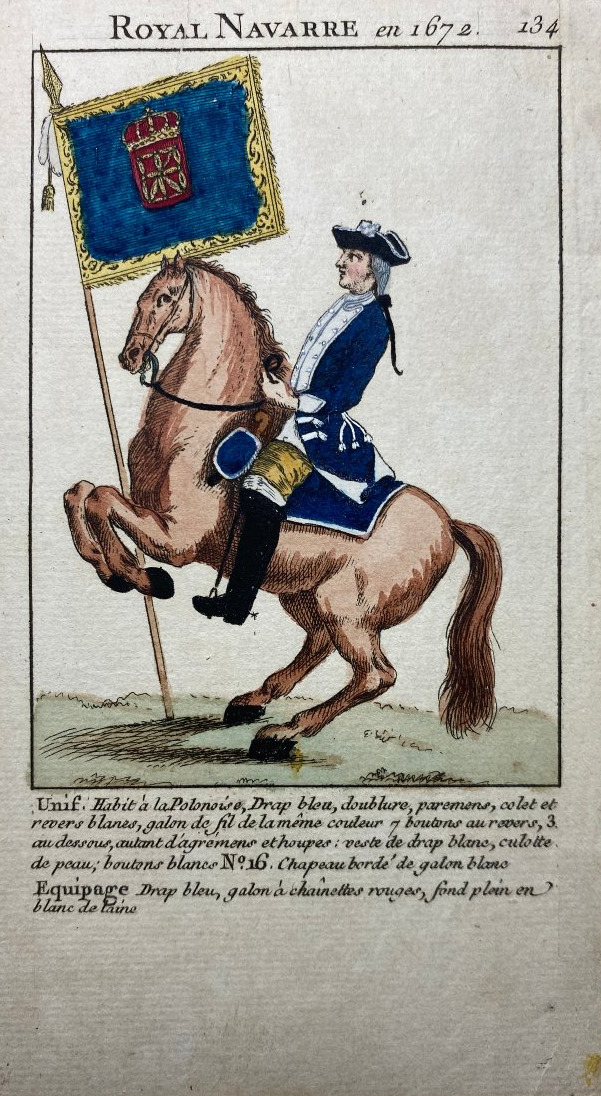
- Royal Navarre in 1672 (Plate No. 134)
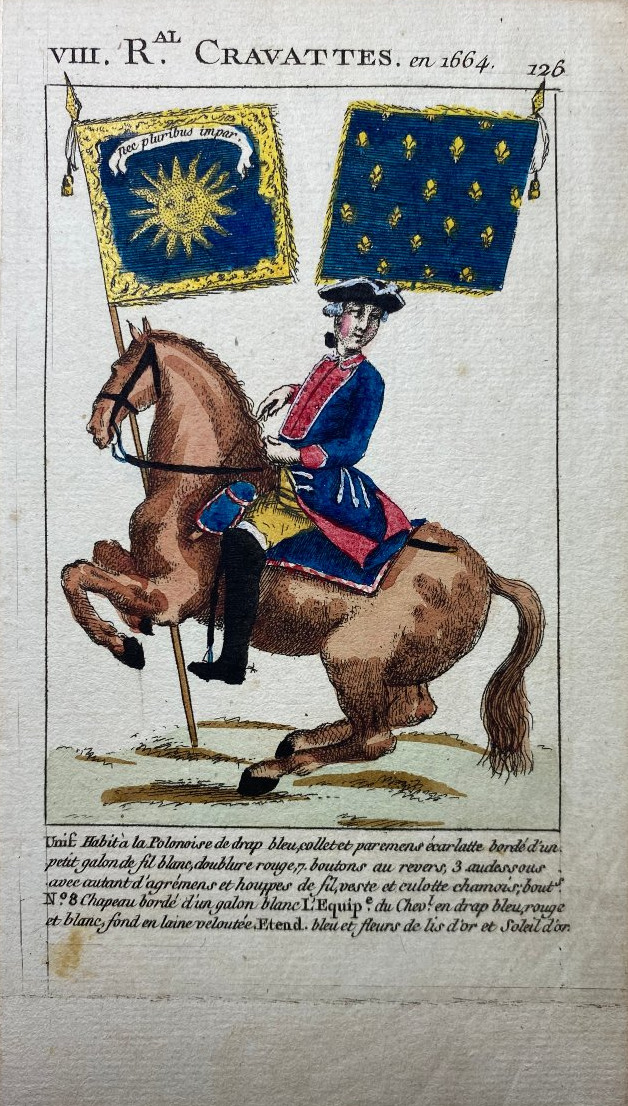
- Royal Cravattes in 1664 (Plate No. 126)
In 1672, the term "Royal-Navarre" primarily referred to the creation of the Royal-Navarre Cavalry Regiment, a military unit of the Kingdom of France’s army. At that same time, the title “King of France and Navarre” was held by Louis XIV, as Lower Navarre had been permanently annexed to the Crown of France in 1620 under Louis XIII.
Here are the key facts related to this unit in 1672: The Royal-Navarre Cavalry Regiment
The year 1664 marked a major symbolic turning point in the recognition and integration of Croatian mercenaries intothe French army, initiating the process that would give rise to the universally known fashion accessory: the cravat. During this period, the history of the “Royal Cravates” revolved around two fundamental aspects: 1. Official recognition by the royal army. Since the reign of Louis XIII and the Thirty Years’ War, France had been employing Croatian light cavalry, renowned for their bravery and fighting spirit. In 1664, these soldiers received official recognition from King Louis XIV for their military exploits. This recognition laid the groundwork for their administrative reorganization:
Dimensions: 15.5 cm x 8.5 cm
- Royal Navarre in 1672 (Plate No. 134)
- Royal Cravattes in 1664 (Plate No. 126)
In 1672, the term "Royal-Navarre" primarily referred to the creation of the Royal-Navarre Cavalry Regiment, a military unit of the Kingdom of France’s army. At that same time, the title “King of France and Navarre” was held by Louis XIV, as Lower Navarre had been permanently annexed to the Crown of France in 1620 under Louis XIII.
Here are the key facts related to this unit in 1672: The Royal-Navarre Cavalry Regiment
- Establishment: The regiment was raised in 1672 during the reign of Louis XIV.
- Type of unit: It was a heavy cavalry regiment.
- Historical evolution: Integrated into the royal armies, it changed its name several times over the centuries and through reorganizations to become, under the French Republic, the 21st Cavalry Regiment
The year 1664 marked a major symbolic turning point in the recognition and integration of Croatian mercenaries intothe French army, initiating the process that would give rise to the universally known fashion accessory: the cravat. During this period, the history of the “Royal Cravates” revolved around two fundamental aspects: 1. Official recognition by the royal army. Since the reign of Louis XIII and the Thirty Years’ War, France had been employing Croatian light cavalry, renowned for their bravery and fighting spirit. In 1664, these soldiers received official recognition from King Louis XIV for their military exploits. This recognition laid the groundwork for their administrative reorganization:
- A few years later (in 1666–1667), what remained of these contingents officially merged to form a permanent unit of the line army: the Royal Cravates Cavalry Regiment.
- The word “Cravate” is a French phonetic corruption of the word “Croate” (Hrvat).
Dimensions: 15.5 cm x 8.5 cm
120 €
Period: 18th century
Style: Louis 15th - Transition
Condition: Good condition
Material: Paper
Length: 15,5 cm
Width: 8,5 cm
Reference (ID): 1853077
Availability: In stock
Print