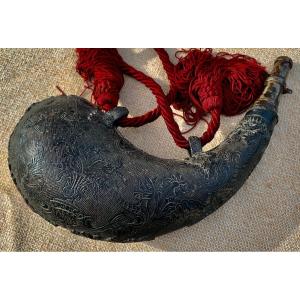
A 17th-century Iron Cannonball Converted To A Counterweight
This beautiful original piece dates from the 17th century. The counterweight mechanism dates from the same period.
Historically, cannonballs were used as counterweights for three main purposes: to operate siege engines,to serve as a gravitational mechanism for the “automatic” closing of gates, or to function as mechanical weights inindustrial or architectural systems.
The manufacturing process of iron cannonballs involved using two-part spherical molds—made from wooden,metal, or, more recently, composite or 3D-printed models—that corresponded to the exact dimensions of the cannonball. Once cooled, theraw ball was removed from its sand mold. The cast iron residues, called “sprues” or “sprues” (the excess solidified metal in the pouring channel),were then removed using chisels or grinders. In this case,the casting seam remains visible on the cannonball.
Beautiful patina!
Dimensions:
Weight: approximately 3 kilograms
375 €
Period: 17th century
Style: Renaissance, Louis 13th
Condition: Excellent condition
Material: Wrought iron
Width: 10 .m.
Height: 16 c.m.
Reference (ID): 1852647
Availability: In stock
Print