


Angers, 1768; Coat Of Arms Of Titon De Villotran; Solid Silver Bowl By Jean Joubert
Louis XV Solid Silver Écuelle with the Titon Marriage Arms — Angers, 1768 — Jean Joubert
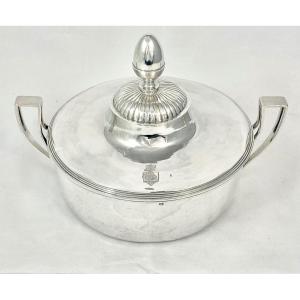
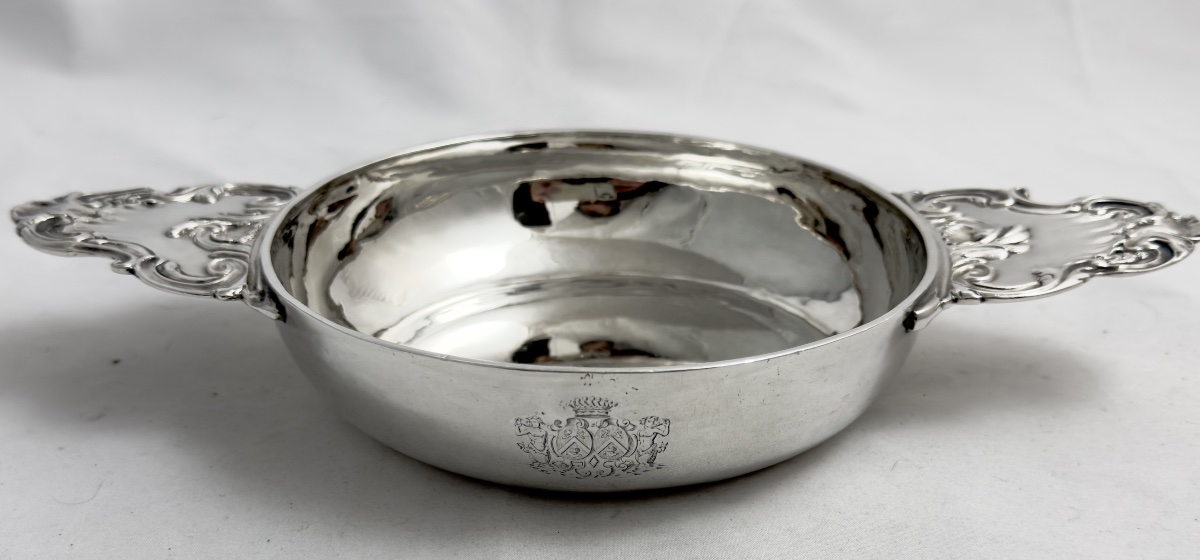
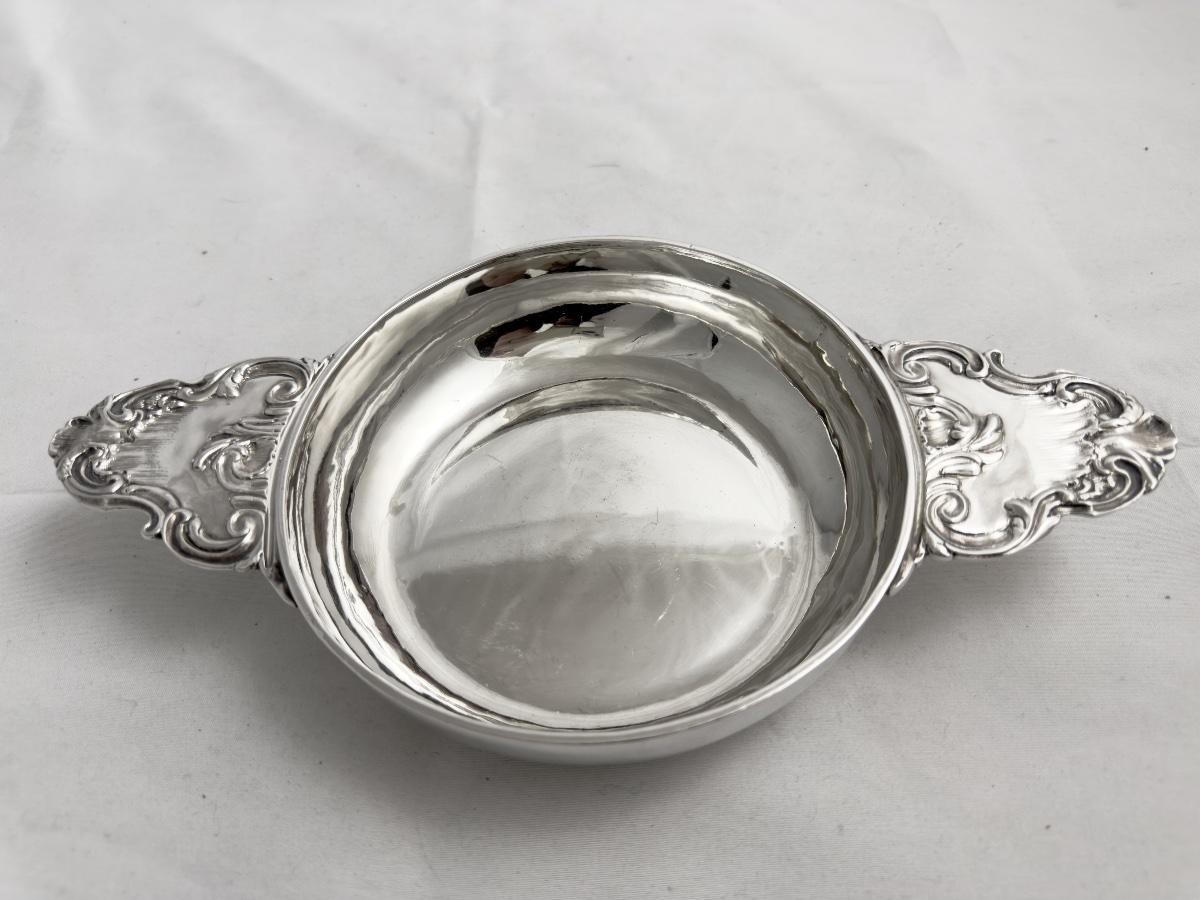
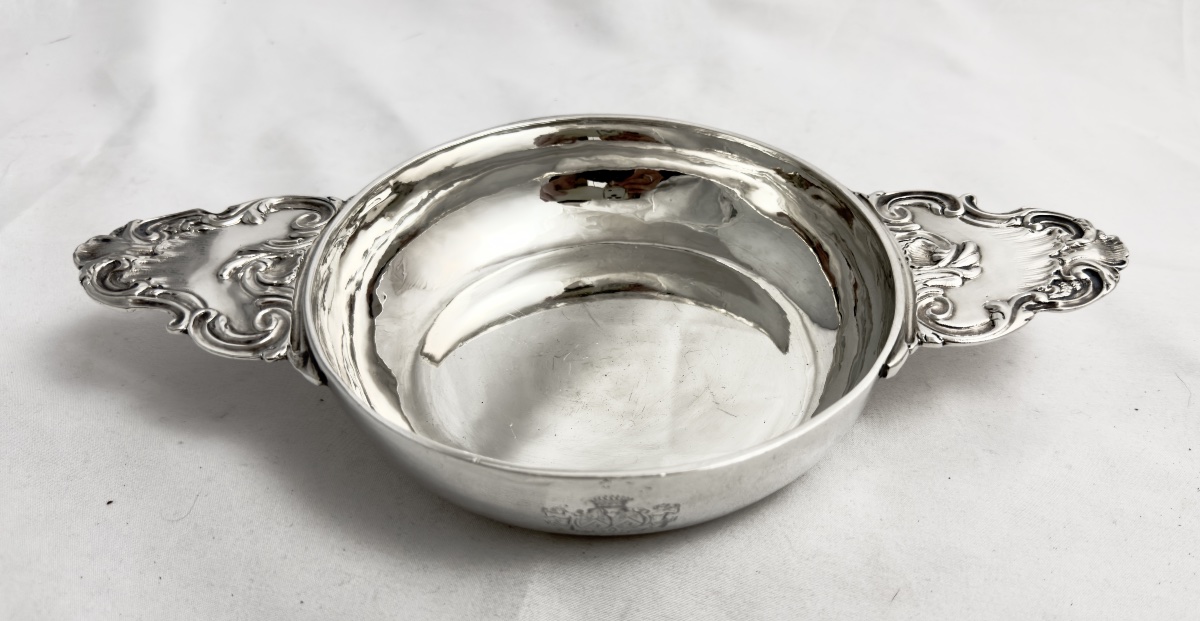
A Louis XV period solid silver écuelle, or two-handled bowl, made in Angers in 1768 by Jean Joubert, admitted as a master silversmith around 1758 and deceased in 1785.
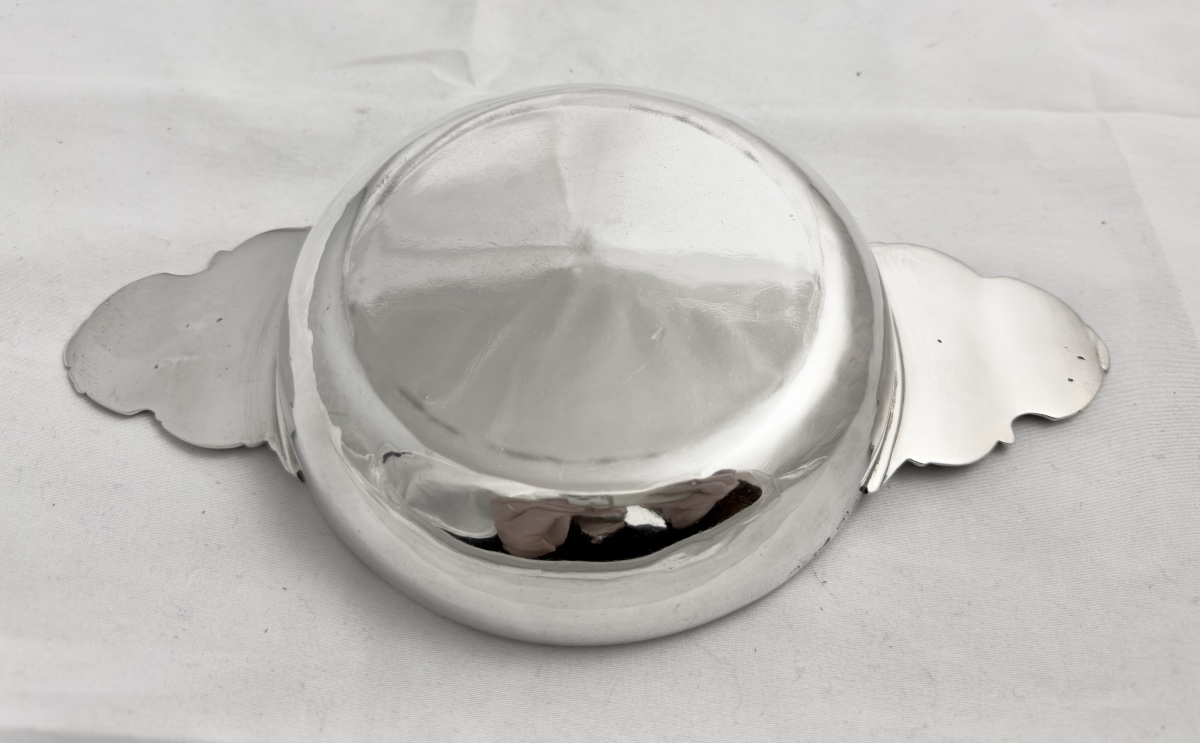
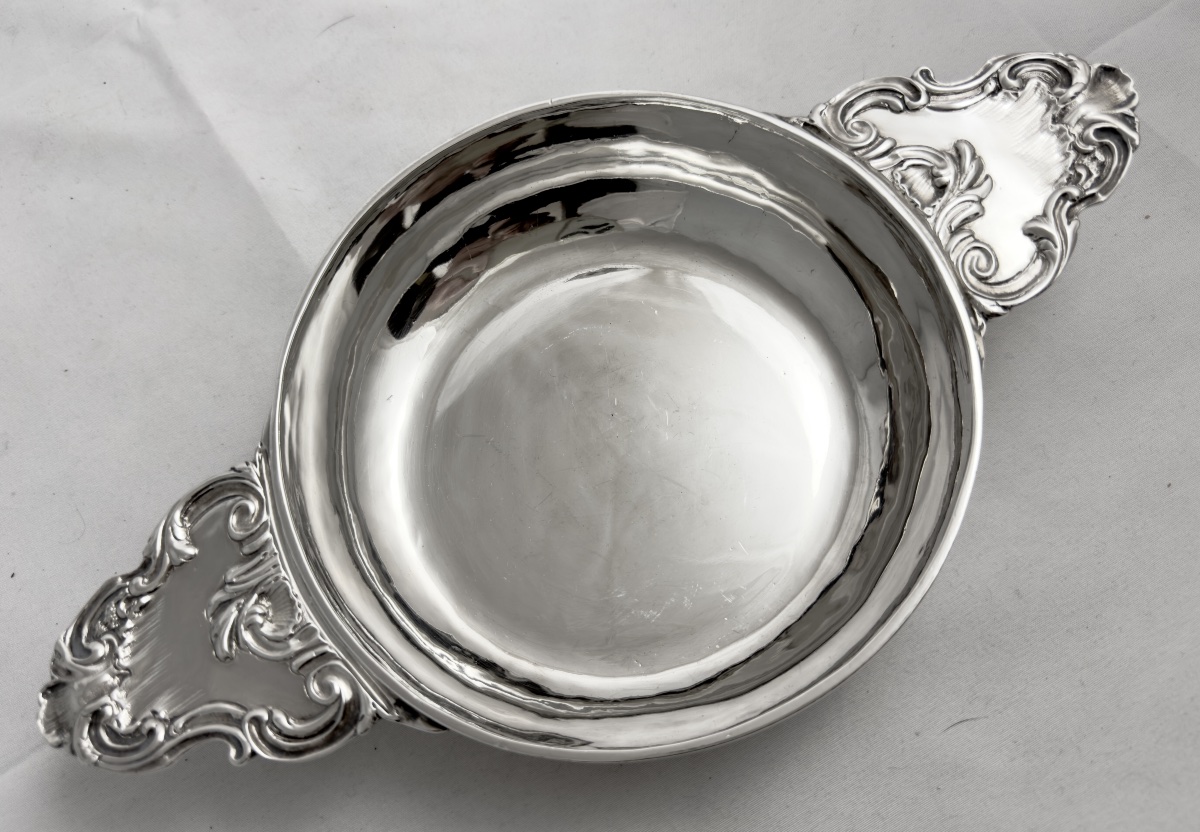
The circular bowl has a flat base and rounded, slightly flaring sides, finished with a moulded rim. Its plain, polished surfaces highlight the richly decorated horizontal handles, whose shaped outlines form an elegant interplay of curves and counter-curves.
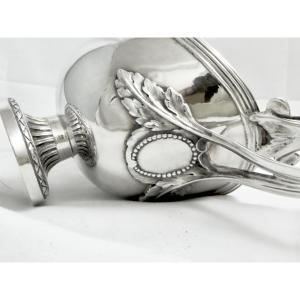
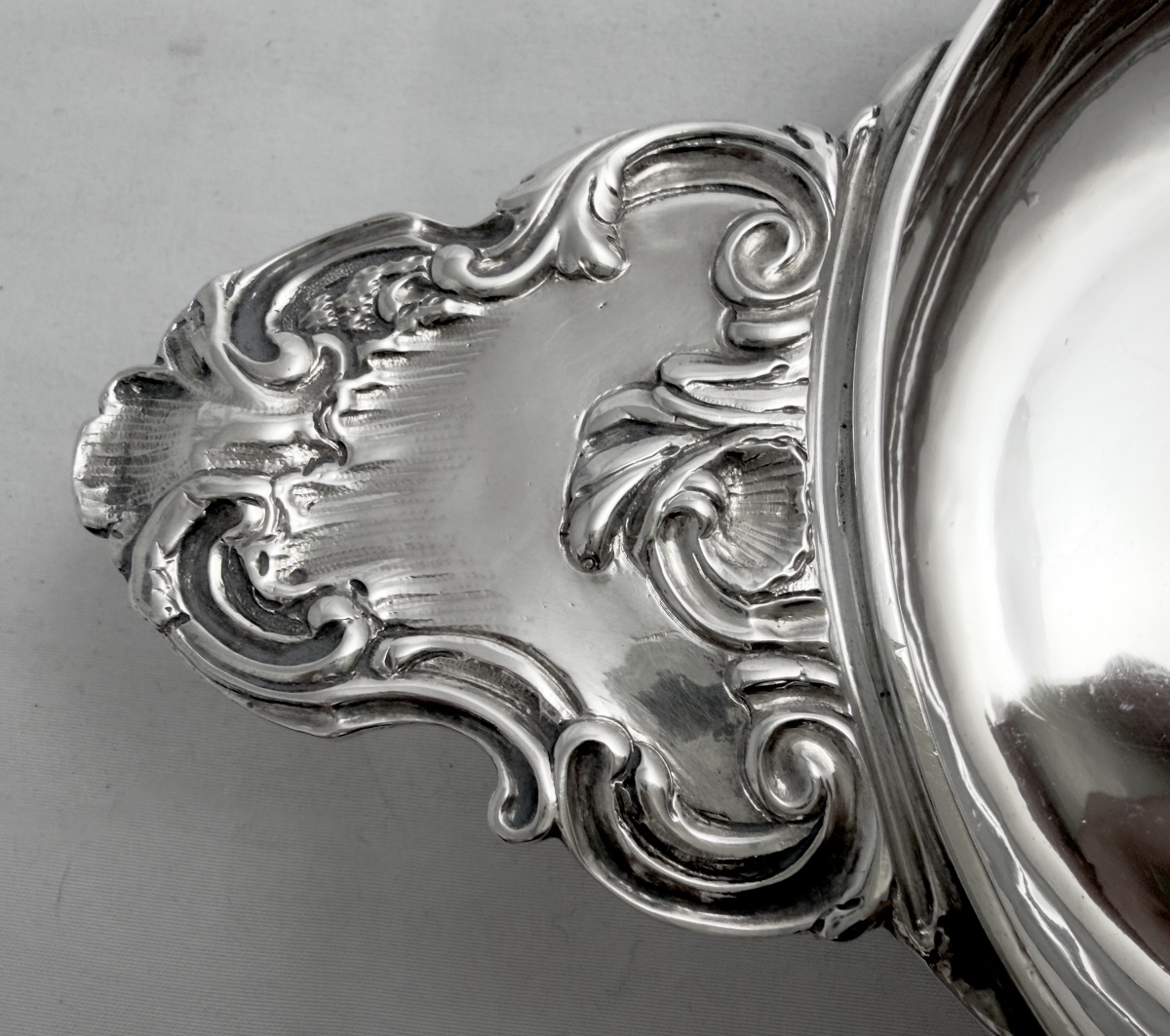
The handles display rococo decoration in relief, combining bold scrolls, foliage and ribbed shells. The chasing alternates smooth raised surfaces with stippled grounds and finely striated areas, giving depth and movement to the design. A fan-shaped shell terminates each handle, while a foliate motif adorns its junction with the bowl. The contrast between the restrained body and the exuberant handles gives this écuelle its distinctive character.
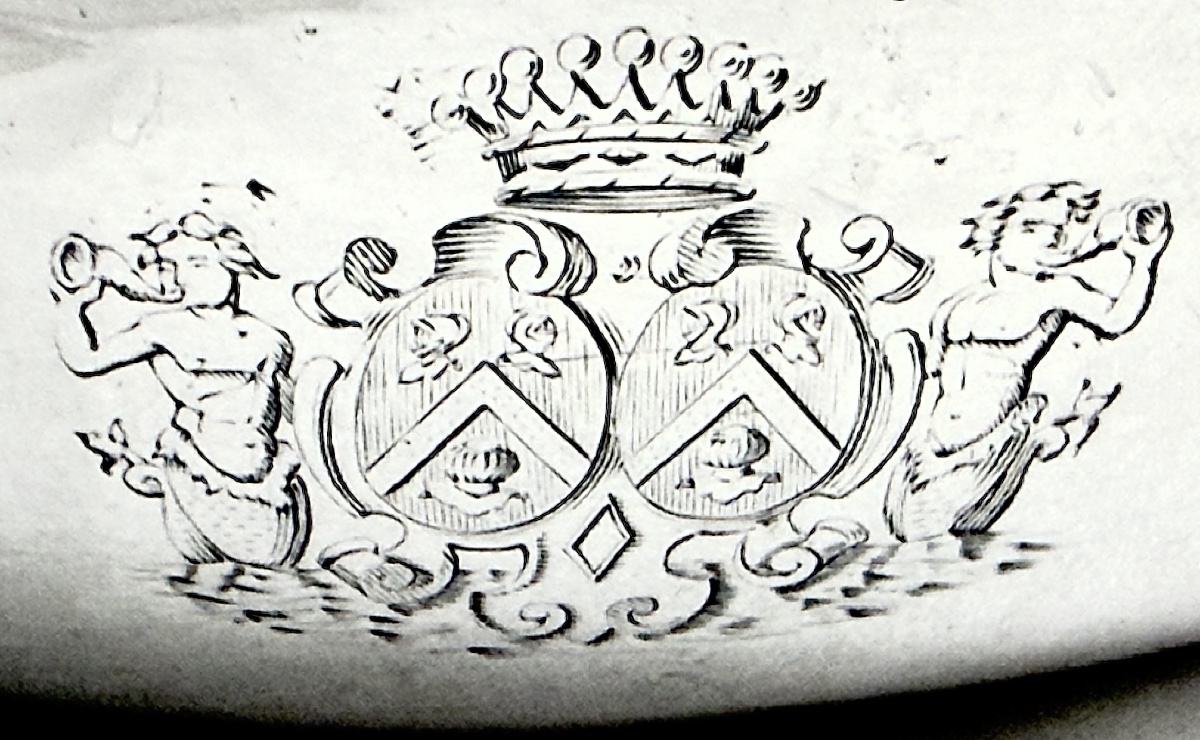
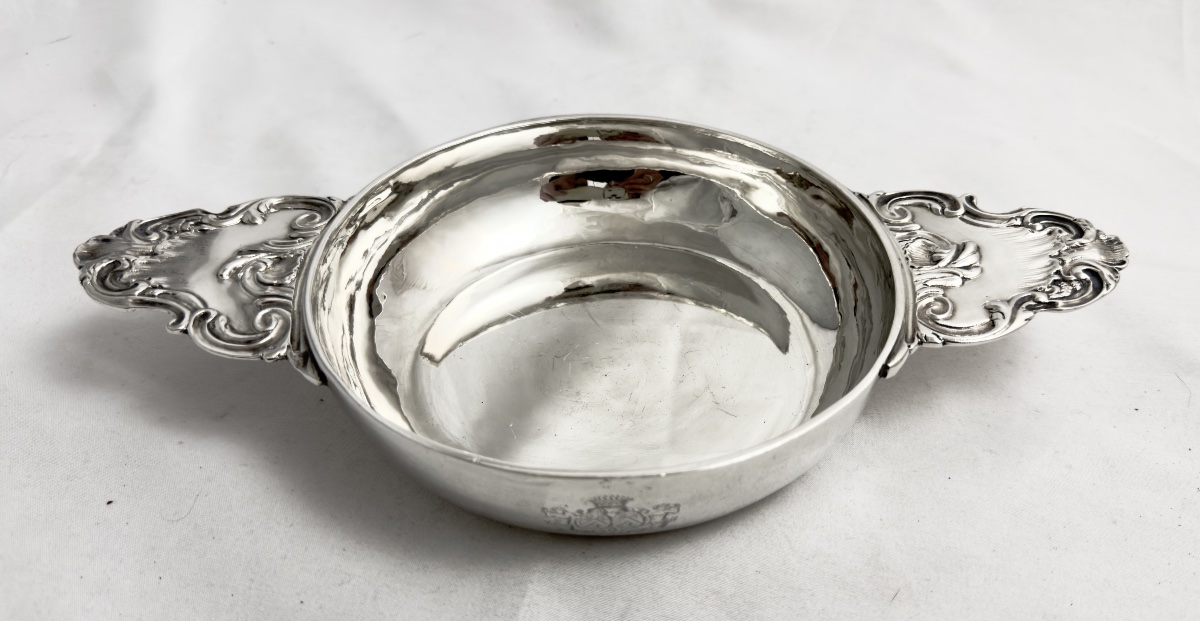
The side is finely engraved with marriage arms comprising two adjoining shields within a scrolling surround, surmounted by a count’s coronet. Two tritons blowing conch shells flank the composition. Both shields bear the arms of the Titon family: these marriage arms therefore commemorate a union between two members of the same family, probably close or distant cousins. The delicate engraving clearly renders the details of the figures, the ornamental cartouches and the heraldic hatching within the shields.
This écuelle is a fine example of domestic silver made in Angers during the reign of Louis XV, combining a balanced form, sculptural handles and particularly elaborate heraldic engraving.
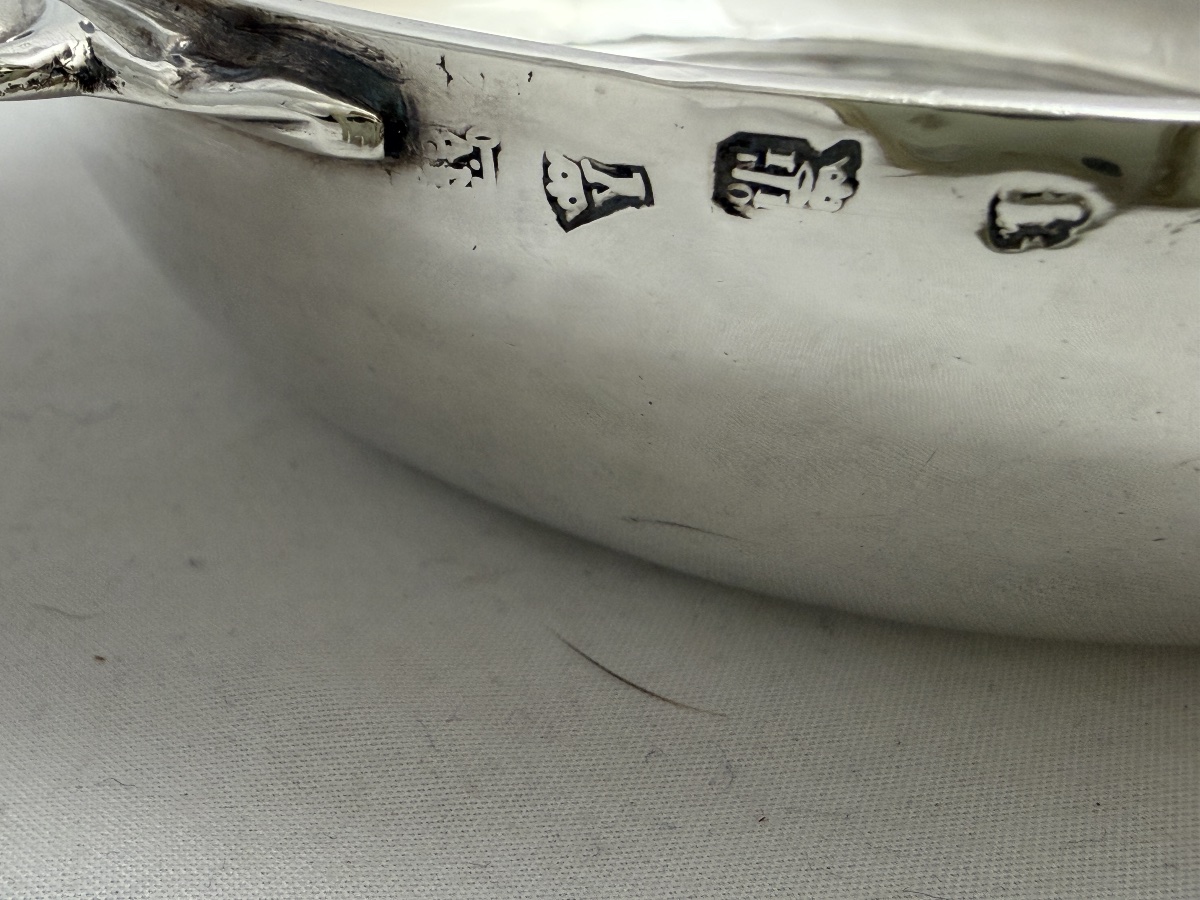
The hallmarks allow its manufacture to be dated precisely:
- Maker’s mark: Jean Joubert.
- Angers charge mark: 1762–1775.
- Angers discharge mark: 1762–1768.
- Angers guild date letter: Y, corresponding to 1768.
Weight: 377 g.
Overall length, including the handles: 28.5 cm.
The paired Titon coats of arms engraved on this écuelle evoke a family whose rise illustrates the prominence attained under the later Bourbon kings by dynasties serving the monarchy. Divided into several branches, notably those of Villotran, du Plessis, Villegenon and du Tillet, the Titons combined the offices of the noblesse de robe, or judicial nobility, with military service and a pronounced interest in the arts.
The family fortune was established by Maximilien Titon (1632–1711), Secretary to the King and Director General of the Royal Arms Depots under Louis XIV. A major figure in supplying the royal armies, he helped organise French production of small arms. His responsibilities and success enabled him to accumulate considerable wealth, securing his descendants’ position among the elites of the Ancien Régime.
During the eighteenth century, members of the Titon family held important offices in the judiciary and royal administration. Jean-Jacques Titon du Plessis was an Ordinary Master of the Paris Chamber of Accounts and Grand Master of Waters and Forests in the Blaisois and Berry. Several generations held office in the Parlement of Paris. The Villotran branch was represented notably by Jean-Baptiste-Maximilien-Pierre Titon de Villotran, a councillor in the Grand’Chambre and one of the commissioners appointed to report on the celebrated Affair of the Diamond Necklace during the closing years of Louis XVI’s reign.
Alongside this judicial tradition stood a record of military service. Évrard Titon du Tillet (1677–1762) was a captain of dragoons, then master of the household to the Duchess of Burgundy, mother of Louis XV, and subsequently a provincial commissary of war. Pierre-Joseph Titon de Cogny (1686–1758) served as an officer in the Grey Musketeers, part of the King’s Military Household. His portrait and that of his wife were painted by Nicolas de Largillière, with whom the family maintained longstanding connections.
The estates accumulated over successive generations reflect the family’s social standing. In what is now the département of Oise, the family was associated with the lands and residences of Ognon, Le Plessis, Chamant, Aumont, Villotran and La Neuville-Garnier. In Berry, it owned Villegenon, Cogny and La Forêt-Thaumiers, while La Selle-sur-le-Bied, in Gâtinais, formed another part of its holdings. In Provence, Maximilien Titon acquired the Barony of Berre in 1707, together with the lordships of Istres, Lançon, Châteauneuf, Entressen and Saint-Mitre. These properties, held at different times by members of the family, demonstrate the geographical extent of its landed wealth.
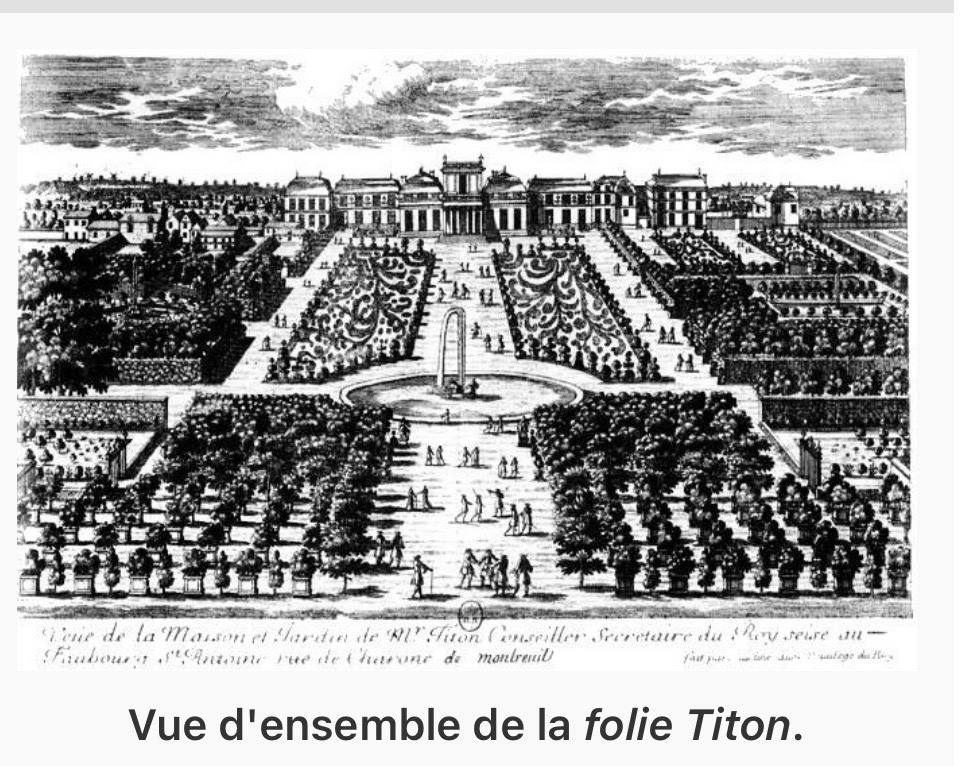
In Paris, this success found its most spectacular expression in the Folie Titon, also known as Titonville, a sumptuous pleasure residence built from 1673 onwards on Rue de Montreuil in the Faubourg Saint-Antoine. Its gardens, decoration and collections made it one of the remarkable residences of Louis XIV’s Paris. The family’s artistic interests continued through Évrard Titon du Tillet, author of Le Parnasse français, an ambitious undertaking dedicated to preserving the memory of the poets and musicians of the Grand Siècle.
The Folie Titon also entered the history of aviation. Acquired in 1765 by the manufacturer Jean-Baptiste Réveillon, its gardens hosted some of the earliest human ascents in tethered hot-air balloons. On 19 October 1783, Pilâtre de Rozier and Giroud de Villette rose there in a balloon secured to the ground by ropes: a decisive step preceding the first free human flight on 21 November that year. The estate thus preserved the Titon name within one of the founding episodes of aeronautical history.
Another reminder of the family’s Parisian presence survives at 58 Rue du Faubourg-Poissonnière: the Hôtel Titon, a private mansion built from 1776 onwards by the architect and ornamental designer Jean-Charles Delafosse, and acquired by the family around 1783. This elegant neoclassical residence retains its façades, staircases and several interior decorative schemes. Parts of the building are now listed as a French historic monument, preserving within Paris’s architectural heritage the memory of a family associated with royal service, artistic life and eighteenth-century history.
Period: 18th century
Style: Louis 15th - Transition
Condition: Excellent condition
Material: Sterling silver
Width: 28,5 cm
Reference (ID): 1848872
Availability: In stock