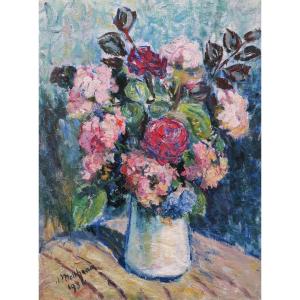
René Seyssaud (1867–1952) - Still Life With Watermelon, Ca. 1922
Artist: René Seyssaud (1867 - 1952)
René Seyssaud (1867–1952)
Still Life with Watermelon, ca. 1922
Oil on canvas, signed lower right.
46 x 55 cm
History :
Painting given by the artist to Alphonse Fondère in 1923.
Literature :
A table en Provence, 1850–1940, Toulon Museum of Art, November 15, 2014–March 1, 2015, exhibition catalog, texts by CJ Sury Bonnici, pp. 41–50, Toulon, 2014.
René Seyssaud 1867–1952, Claude-Jeanne Sury-Bonnici, Somogy, 2015, reproduced as no. 330 on p. 238.
Exhibition :
René Seyssaud, Instinctive Colorist,Gallo-Roman Museum, Sisteron, September 9–November 11, 2017, reproduced in the exhibition catalog.
Seyssaud, the Landscape Painter of Living Forces
It was under the guidance of the Avignon-based master Pierre Grivolas—rather than at the École des Beaux-Arts in Marseille, where he had studied under Dominique Magaud from the age of thirteen—that the young man’s artistic personality took shape. Although he drew inspiration from his Provençal roots, he moved away fairly early on from the depiction of local customs and traditions favored by his master to anchor his work in the land itself. He would become a landscape painter.
As early as 1885, he participated in the Salon des Indépendants, and it was Le Barc de Boutteville who was the first to dedicate a solo exhibition to him at his Parisian gallery in 1897. Two years later, Seyssaud won the favor of Ambroise Vollard, and his special exhibition was a success with art lovers. An exhibition at the Bernheim-Jeune Gallery in 1901 capped off this Parisian trilogy. Seyssaud also began a sustained collaboration with the cabinetmaker and interior designer Eugène Printz. However, these forays into the capital’s galleries would not continue, as Seyssaud remained loyal to François Honnorat, a Marseille art dealer with whom he partnered to improve his financial situation in the long term.
With fragile lung health, the urban environment made the painter uncomfortable, and it was as much out of necessity as by choice that he settled in the countryside, on an isolated farm. There, he married a peasant woman from the Vaucluse. Living with her and her family in Villes-sur-Auzon (Vaucluse) and Saint-Chamas (Bouches-du-Rhône), he deepened his understanding of peasant life—from the farming calendar to the hardships of fieldwork. Seyssaud’s work is rooted in nature in all its vastness and abundance: the earth, the sky, and everything they sustain and encompass—including humankind, since humans are also a product of nature. In his peasant-themed compositions, the intensity of color echoes the forces at play—those of nature and the seasons; people are one with the earth, from which they derive the necessities of life through their labor.
In February 2015, the artist’s first monograph, written by Claude-Jeanne Bonnici, was published, meeting the expectations of a growing number of art lovers captivated by the power of his painting and eager for a study of this scope to finally be dedicated to him.
Discover more works by this artist on the gallery’s website: https://www.galeriepentcheff.co.uk/en/peintre-rene-seyssaud
9 000 €
Period: 20th century
Style: Modern Art
Condition: Good condition
Material: Oil painting
Length: 46 cm
Width: 55 cm
Reference (ID): 1847892
Availability: In stock
Print