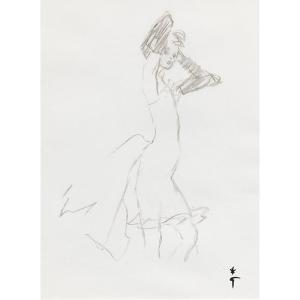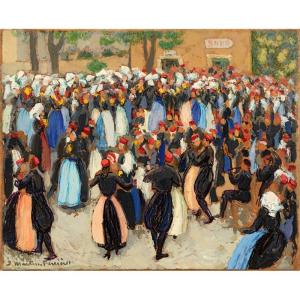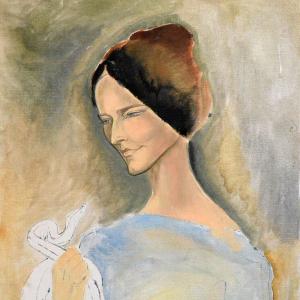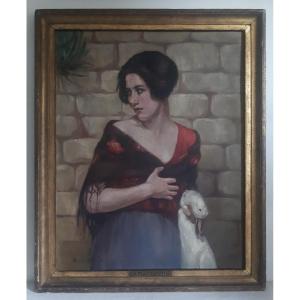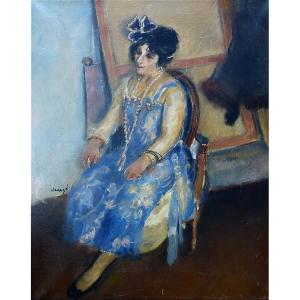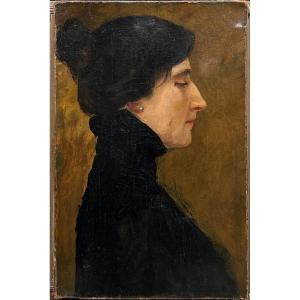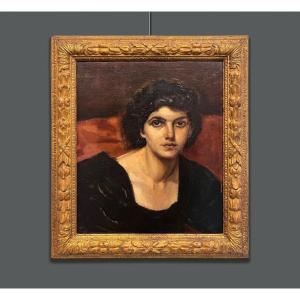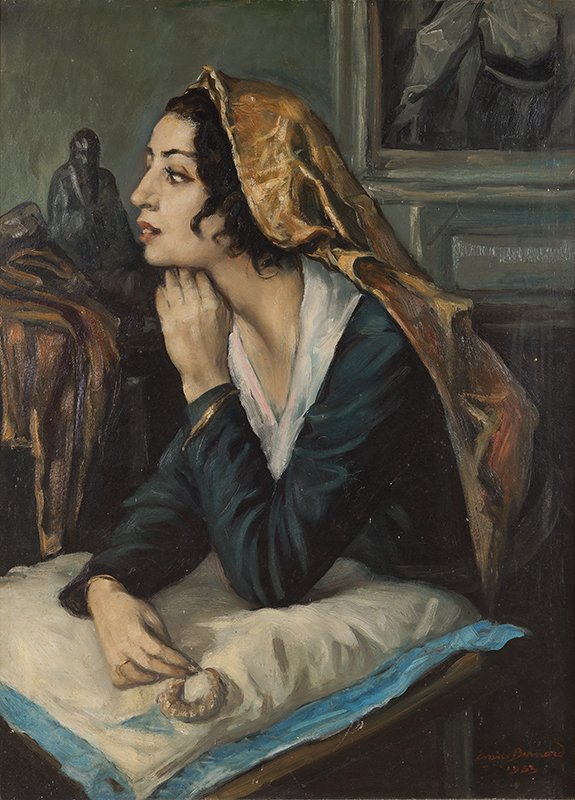
émile Bernard (1868–1941) - Pensive Woman
Pensive Woman
Oil on panel, signed and dated 1933 lower right
101 x 73 cm
Émile Bernard – A visionary painter straddling modernity and tradition
Émile Bernard’s family left Lille, where he was born in 1868, to settle in Paris. The young man first took drawing classes at the École des Arts Décoratifs before joining Fernand Cormon’s studio in 1884. There he met Louis Anquetin and Henri de Toulouse-Lautrec, but was expelled for disciplinary reasons.
Bernard rejected the studio’s academic approach, seeking a formal freedom fueled by direct observation of nature and the study of the old masters.
He then embarked on a six-month journey on foot through Normandy and Brittany, a formative journey that revealed to him the intensity of the landscape and the need to break free from it in order to better capture it.
Émile Bernard is particularly known for having pioneered, alongside Louis Anquetin, a revolutionary visual vocabulary, which he continued to develop in the years that followed.
In the fall of 1888, his encounter with Paul Gauguin in Pont-Aven marked a major turning point. Together, they laid the foundations for a new art form, based on formal simplification, the synthesis of impressions, and the rejection of naturalism.
Cloisonnism—flat shapes outlined in black and punctuated by color—became the vehicle for an “inner” style of painting, constructed no longer in response to the subject but based on memory and emotion.
Synthetism, a broader movement, combined spiritual vision with plastic composition.
These artistic innovations already foreshadowed the boldness of Symbolism and influenced the avant-garde movements of the 20th century.
“One had to paint, no longer in front of the object, but by recapturing it in the imagination that had absorbed it…”
— Émile Bernard, Unpublished Memoirs on Paul Gauguin, 1941.
In 1891, following his definitive break with Gauguin—whom he accused of appropriating their shared artistic approach—Émile Bernard left to live in Egypt. He remained there for about ten years, married the daughter of a wealthy Egyptian family in 1894, and became deeply immersed in the Orient, absorbing its symbols, rhythms, and light.
This period of seclusion gave rise to a more mystical style of painting, attuned to spiritual and philosophical questions, marked by a gradual return to the great masters and the European pictorial tradition.
Upon his return to France, Émile Bernard settled in the North, then in Paris. He took the young André Maire under his wing; Maire would later become his stepson. He founded the journal La Rénovation Esthétique and published in it—sometimes under a pseudonym—passionate essays advocating a return to beauty and classical rigor.
He positioned himself in opposition to the modern avant-garde, defending a humanist vision of art grounded in heritage and transcendence. His painting became more austere, at times uncompromising. Yet his numerous writings reveal a profound artist—often misunderstood—who remained entirely true to his convictions.
In 2015, an exhibition at the Orangerie, organized by the Musée d’Orsay, brought Émile Bernard’s work back into the spotlight, highlighting both its visual and theoretical dimensions. It reveals a well-rounded artist—a thinker on images and forms—who long remained in the shadow of his contemporaries.
Discover more works by this artist on the gallery’s website: https://www.galeriepentcheff.fr/fr/peintre-emile-bernard
Period: 20th century
Style: Modern Art
Condition: Good condition
Material: Oil painting on wood
Reference (ID): 1824537
Availability: In stock