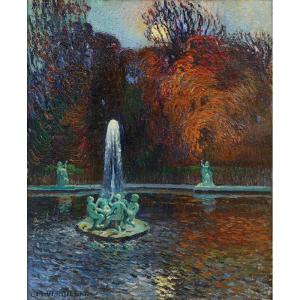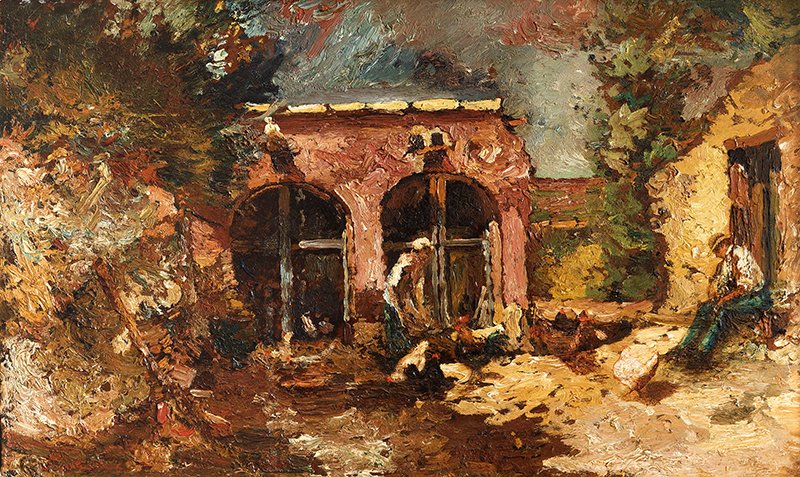
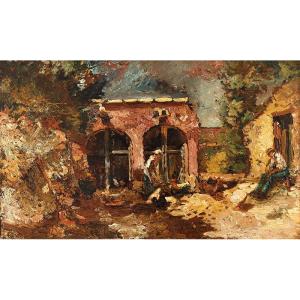
Adolphe Monticelli (1824–1886) - Farmyard
Farmyard
Oil on panel, signed lower left.
40 x 67 cm
Provenance:
Florence Jay Gould Collection
Maret-Gould Collection, Cap d’Antibes
René Cassin Collection
Alexis Pentcheff Gallery
Private collection, Salon-de-Provence
Bibliography:
STAMMEGNA Sauveur, Catalog of Monticelli’s Works, 1824–1886, Volume II, 1986, reproduced on page 191, no. 954.
Exhibitions:
Charpentier Gallery, Beauties of Provence, 1947
Cailleux Gallery, Monticelli Exhibition, 1956, no. 24
Boymans Museum Exhibition, Rotterdam, Monticelli, March 21–May 3, 1959, no. 71
Origins and Education
Adolphe Joseph Thomas Monticelli was born in Marseille on October 14, 1824, into a modest family of Italian origin. He trained at the École des Beaux-Arts in Marseille under Émile Loubon, a painter of Provençal landscapes who introduced him to a free style of painting, attentive to light and color.
Around 1846, he left for Paris. At the Louvre, he copied the masters who inspired him: Watteau, Rembrandt, Rubens, and the Venetian masters. He also admired Delacroix and Narcisse Diaz, whose influence is evident in his “fêtes galantes.” He also frequented the Forest of Fontainebleau and the circle of Barbizon painters.
A Career Divided Between Paris and MarseilleMonticelli divided his time between Marseille and Paris. He exhibited at the Salon on several occasions, but never achieved lasting recognition. In the 1860s, he worked in Paris for a clientele of collectors and painted scenes of courtly festivities, processions, and receptions, featuring 18th-century costumes, in a style reminiscent of the Second Empire.
The war of 1870 turned his life upside down. He left Paris and returned to Marseille, where he settled permanently. There he led a fairly secluded life, selling his paintings to local art lovers and a few dealers, often at low prices. His reputation as an eccentric man, a friend of the bohemian set and a lover of fine wine, fueled a legend that was at times exaggerated. He fell ill toward the end of his life and died in Marseille on June 29, 1886.
A Unique StyleMonticelli’s paintings are recognizable by their thick, impasto-like texture—often applied with a palette knife—and their vivid, almost incandescent colors: reds, yellows, deep blues, and golds. He often painted on small wooden panels, which he covered with layered brushstrokes, glazes, and shimmering light. The subject mattered less than the effect of color: the figures dissolved into shimmering backgrounds.
A Remarkable LegacyHis name remains linked to that of Vincent van Gogh, who admired his use of color and texture. Van Gogh saw his works in Paris, then referred to them in his correspondence—particularly in his letters to his brother Theo—and cited him as an influence on his approach to flower arrangements. Cézanne, also a resident of Marseille by choice, knew and respected him. Monticelli is now considered an important precursor of Expressionism and modern painting. His works are held at the Musée des Beaux-Arts in Marseille, the Van Gogh Museum in Amsterdam, the National Gallery in London, and in numerous Scottish collections.
Period: 19th century
Style: Modern Art
Condition: Excellent condition
Material: Oil painting on wood
Length: 40
Width: 67
Reference (ID): 1841962
Availability: In stock